

Thermal paper works in cold storage, but cold changes three things a buyer must specify around: the imaging moment, the adhesive and the moisture cycle. Direct thermal coating develops an image at the print head regardless of ambient temperature, but stock printed while cold can give a light first pass and should be conditioned to ambient before use. General-purpose adhesives stiffen on frozen surfaces, so freezer-duty programmes need a low-temperature adhesive declared on the specification. And every movement between cold and ambient zones films the coated face with condensation, which is why sealed packaging, a protective overcoat and disciplined storage-before-use matter more in the cold chain than anywhere else.
Cold storage is where ordinary paper specifications fail quietly. A roll that behaves flawlessly in an ambient back room can scan intermittently in a chill corridor, lift off a frozen carton, or arrive fogged with condensation after discharge. None of this traces to a defective roll — it traces to a specification written as if the paper would only ever live at room temperature.
The buyers who feel this first sit in food distribution, grocery retail, pharmaceutical logistics and laboratory programmes — everyone who labels or documents goods spending their life between roughly −20 °C and +8 °C. For them cold is the operating environment, and paper is one of the few components never designed for it.
Construction is the first lever, and a visible one: a sealed protective layer changes how a label surface handles frost, condensation and abrasion in a cold store. Our top-coated thermal label stock is documented per grade, so a cold-chain programme can be written around a named construction rather than a generic description.
This guide walks the cold chain in the order the failures happen: the coating against a cold surface, the adhesive, condensation on discharge, storage and conditioning before use, and the specification that survives a supplier change.
- Direct thermal coating develops an image at the print head even when cold, but stock printed straight from a cold store can give a light first pass — condition rolls to ambient before printing.
- The adhesive, not the coating, is usually the first thing to fail on frozen surfaces; freezer-duty programmes must declare a low-temperature adhesive.
- Every cold-to-ambient transition puts a moisture film on the coated face; sealed packaging and a protective overcoat are the defences, and open cartons in a cold store are the classic mistake.
- Stock should be stored sealed, off the floor and away from doorlines, then conditioned in its wrapper before use — the wrapper is the moisture barrier, not the carton.
- A cold-storage specification should name construction, adhesive class, sensitivity grade and packing per environment, so any replacement supplier is qualified against the same document.
Why cold is a separate specification, not a downgrade
Cold storage attacks a paper programme on three fronts at once. The imaging moment moves: many workflows print or apply labels in chilled corridors or dock areas, where paper, print head and surface are all below the temperature the specification assumed. The adhesive moves: tack is a viscoelastic property, and an adhesive formulated for ambient cartons stiffens as it cools, showing up as corner lift within hours. And the moisture cycle intensifies: every warm-to-cold or cold-to-warm move pushes relative humidity across the dew point and deposits a film of water where it does most damage — the coated face.
A cold programme cannot be ordered as ordinary stock with a note attached. The fronts interact: a label imaged perfectly but applied over frost fails on adhesion; a label that adheres but spent a week in an open carton fails on image quality; a programme that handles both but stores rolls beside the doorline fails on shelf life. The specification has to hold all three at once.
Weight belongs in the conversation too, because stock on frozen cartons is chosen for stiffness and surface as much as economy. Our 48 gsm lightweight thermal paper suits high-volume ambient ticketing, but cold-chain buyers typically step up to constructions whose coating and overcoat are specified for moisture exposure — and the grade, like the adhesive, should be named in the document.
How the coating behaves when the label meets the cold
The chemistry of direct thermal imaging does not stop in the cold: the coating develops wherever the print head delivers enough energy. A roll that has spent days at −18 °C prints through a cold, occasionally frosted face; the first passes can read light, and operators respond by turning energy up — which shortens head life and greys the background on the rest of the roll. The cheaper fix happens hours earlier, in storage, not at the device.
The practical rule is conditioning. Stock to be printed at ambient should reach ambient in its sealed wrapper — commonly overnight for full pallets — before the wrapper comes off. Stock that must genuinely print inside a chilled zone should be a named, tested construction for that duty, because sensitivity classes differ in how their coatings respond at low substrate temperature — a laboratory measurement, not a visual one.
Application temperature is the twin of print temperature. A label can image beautifully and still fail if pressed onto a frozen or wet surface with an adhesive below its working range. The specification should carry the two temperatures as separate lines — print/conditioning temperature and minimum application surface temperature — because a programme can do one cold and the other ambient, but rarely both at the extremes.
Adhesives: the first component to fail on a frozen carton
Ask a cold-chain operator where labels fail and the answer is almost never the image — it is the corner. General-purpose acrylic adhesives lose tack and shear as temperature drops, and on a frost-filmed carton the label holds through the chill zone and lifts by the picking face. The fix is an adhesive class chosen for the duty: constructions intended for refrigerated and frozen surfaces are formulated to wet out at low temperature and hold through the freeze–thaw cycles a carton actually experiences.
The buyer's job is to make the adhesive a declared line, not an assumption. The same facestock with a different adhesive is a different product, and two samples identical on an ambient desk can behave completely differently at −20 °C. Trial protocol matters equally: approved samples should be applied at the coldest, wettest condition the programme will really see, then read again after a full distribution cycle.
Surface condition is the adhesive's partner in failure. Frozen cartons carry frost, condensate and release coatings from their wrapping; wiping the application zone does not save a wrong adhesive, and dry surfaces with a merely chilled duty let ordinary adhesives succeed. Chilled at +4 °C is a different product from deep-frozen at −20 °C — quoting the wrong one is the most common cold-chain pricing error.
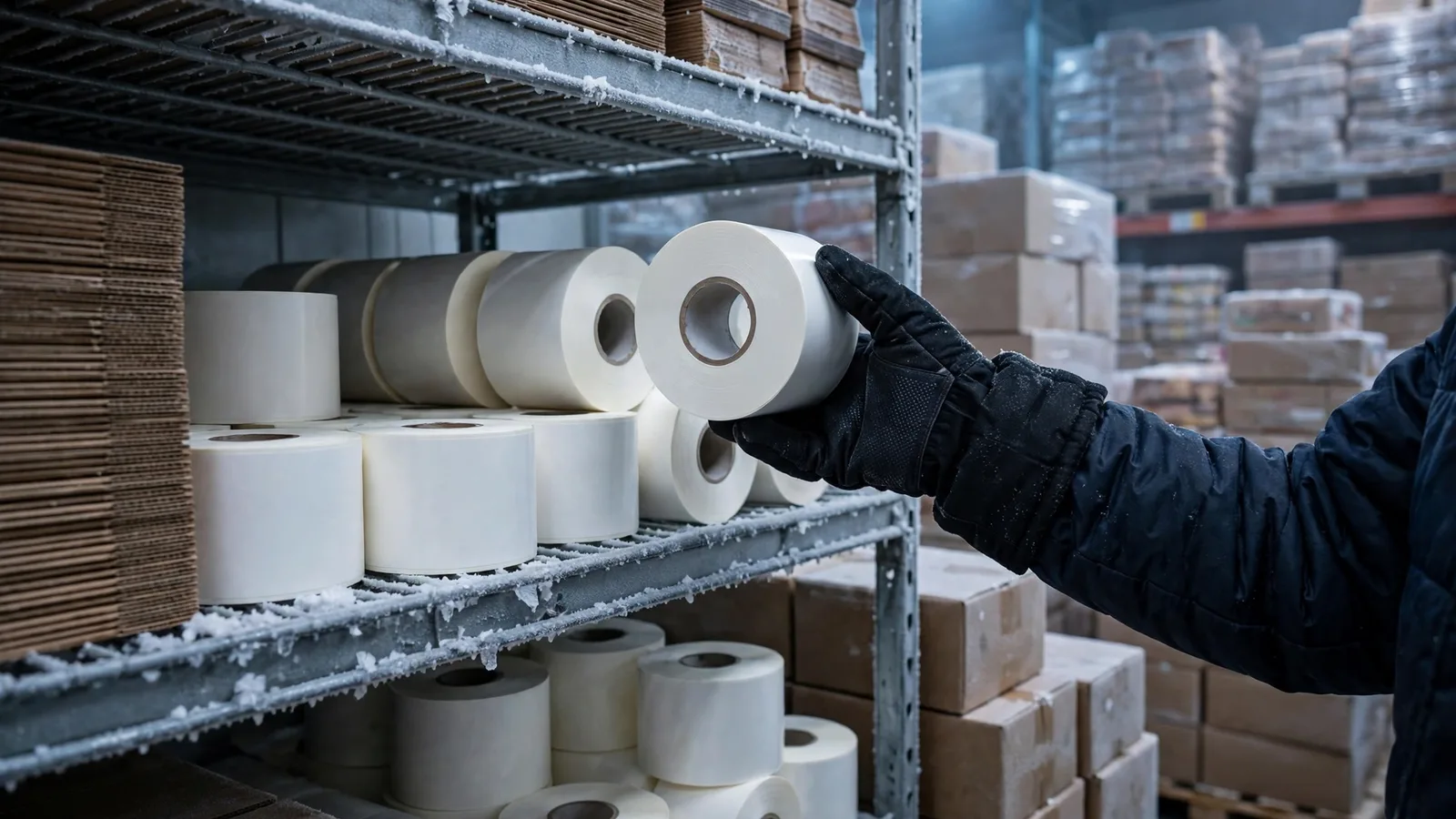
Condensation on discharge: the moisture cycle nobody budgets for
The most underestimated cold-chain event happens after the cold ends. When a pallet leaves a −18 °C store into a 25 °C dock, every surface films over with condensate — cartons, cores, wrappers and the coated faces of unsealed stock. For thermal paper that film is not cosmetic: water on the coated face degrades image life, blocks rolled surfaces together and leaves edge fade that surfaces as complaints months later.
The defences are structural and cheap. Sealed moisture-barrier wrap per roll or case keeps the paper in its own climate until the moment of use; a protective overcoat gives the coated face a sacrificial, wipeable layer for chilled handling; and packing discipline — cartons closed, pallets wrapped, stock never open beside a doorline — keeps the moisture cycle out of the warehouse entirely.
Export buyers run this cycle in its hardest form: an ocean container crossing climates, then an ambient chain ending in a customer's cold store. Where container planning and barrier packing are the next step, our export shipping guide covers pallet standards, moisture-barrier packing and the document set for ocean freight — the moisture logic that protects a cold-store pallet protects a container load.
Specifying the programme so it survives a supplier change
A cold-storage programme is only as durable as its paperwork. The specification should name, per line: construction (facestock, coating system, overcoat), adhesive class with its minimum application temperature, sensitivity grade, core and roll diameter, and the packing — barrier wrap, case quantity, pallet pattern — that matches the storage reality. Each line maps to a failure mode: light first passes point at conditioning and sensitivity, corner lift at adhesive, edge fade at packing and coating.
Documentation turns the specification into an auditable programme. Batch certificates and safety documents travel with the goods so goods-in compares arrival to what was written, and a retained reference sample from the approved batch gives every future delivery a physical standard. Food and healthcare buyers already run document chains; the paper line deserves the same discipline as the product it labels.
Where a programme needs several formats from one supplier — receipt rolls for the dock office, label stock for the cartons — our custom thermal paper programme covers width, core, roll diameter, adhesive class and developer system in a single specification sheet, so the cold-chain duty is written once and quoted identically by every replacement supplier after it.
Specification shorthand: name the construction, declare the adhesive and its minimum application temperature, state the conditioning rule, and put the barrier packing in the document — then the paper stops being the weakest link in the cold chain.
Frequently asked questions
Does thermal paper develop an image properly in a cold room?
Yes — the coating develops wherever the print head applies enough energy, whatever the ambient. The risk is the state of the stock: rolls printed straight from deep cold can give a light, uneven first pass. Condition stock to the printing environment in its sealed wrapper, and reserve in-coldroom printing for constructions tested for that duty.
Can I use ordinary label stock on frozen cartons?
Chilled duties just above freezing are sometimes within reach of a good general-purpose construction, but deep-frozen surfaces need an adhesive formulated to wet out at low temperature. The failure mode is adhesion, not imaging: the label prints fine and lifts at the corners hours later. Declare the adhesive class and minimum application temperature, and trial at the coldest real condition.
Why do my labels look fine in store and fail after discharge?
Condensation. A pallet moved from cold air into warm air films over with moisture, and unsealed thermal stock wears that film on its coated face. Keep rolls sealed until the moment of use, prefer constructions with a protective overcoat, and never store open cartons near cold-store doorlines.
How long should rolls condition before printing?
Long enough for the paper at the core to reach the printing environment — a few hours for cases, commonly overnight for full pallets, always inside the sealed wrapper. Conditioning unwrapped stock defeats the purpose: the wrapper is what separates the paper from ambient moisture during the transition.
What should a cold-chain buyer demand from the supplier's documents?
The lines that matter in the cold: named construction and overcoat, adhesive class with minimum application temperature, sensitivity grade, and barrier packing per case or roll. Batch documentation — certificate of analysis and safety data sheet — should travel with every shipment so goods-in verifies against the specification, not memory.