

Thermal receipt paper comes in a handful of standard sizes defined by width, diameter and core. The most common widths are 57 mm (2-1/4 inch) and 80 mm (3-1/8 inch); typical diameters run from 40 mm to 83 mm, almost always on a 12.7 mm (1/2 inch) core for receipt rolls. The size printed on the box — 80 x 80, 57 x 40, 3-1/8 x 230 — is width x diameter in millimetres or width x length in feet. Width must match the terminal's paper compartment; a roll that is too wide jams and one that is too narrow slips. Diameter decides how much paper you get, and because length scales with the square of the diameter minus the core, a 10 mm larger diameter can add 15–20 percent more prints per roll.
Receipt paper sizes look simple from the outside — a roll is a roll — yet the dimension codes on cartons confuse even experienced procurement teams. Is 80 x 80 the same as 3-1/8 x 230? Why does a 57 x 40 roll hold less paper than the same width in 57 x 50? And why does a roll that fits one terminal jam in another that accepts the same width?
The answers come from three numbers: width, diameter and core. Width is fixed by the machine and must be matched exactly. Diameter is a commercial choice — bigger rolls mean fewer changeovers but must still clear the compartment's height limit. Core is the tube in the middle, and it quietly changes how much paper fits in the same outer diameter.
This guide charts the standard thermal receipt paper sizes used worldwide, decodes the labelling conventions, and walks through the length maths so a buyer can compare quotations that look different but describe the same — or very different — amounts of paper. Distributors can hand the tables directly to end customers; converters can use them to sanity-check slitting plans.
Buyers comparing these specifications can review our custom thermal paper programme, where basis weight, coating construction and packing are documented per grade before an order is placed.
- Receipt roll labels read width x diameter (mm) or width x length (feet): 80 x 80 = 80 mm wide, 80 mm diameter; 3-1/8 x 230 = 79.4 mm wide, 230 feet long.
- Width must match the terminal exactly — 57 mm-class machines take 57–58 mm paper, 80 mm-class machines take 79.5–80 mm paper.
- Diameter drives prints per roll: paper length grows with the square of the diameter, so small diameter increases yield a lot of extra metres.
- Core size changes usable length: a 12.7 mm core leaves more paper than a larger core at the same outer diameter.
- Check compartment clearance and winding direction alongside size — the two specification errors that cause most 'wrong paper' complaints.
How receipt roll sizes are labelled
Two labelling conventions dominate the market. In metric markets, a roll is written width x diameter in millimetres: 80 x 80 means 80 mm wide and 80 mm in outer diameter. In inch-based markets, rolls are written width x length, where length is in feet: 3-1/8 x 230 means a 3-1/8 inch (79.4 mm) wide roll holding 230 feet (about 70 m) of paper. Both describe the same physical product family — an 80 mm-class receipt roll — but a diameter code and a length code are not interchangeable, and comparing a quote in one convention with a sample specified in the other is a classic sourcing mistake.
Width is the dimension that must match the device. Receipt terminals cluster around two families: 57 mm-class (paper specified 57, 57.5 or 58 mm wide, often sold as 2-1/4 inch) and 80 mm-class (79.5–80 mm, sold as 3-1/8 inch). A 58 mm roll generally fits machines cut for 57 mm because the tolerance runs to slightly over-width; an 80 mm roll rarely fits a 57 mm machine at all. There are also 2-1/4 inch-class machines that take narrower 44–50 mm rolls, and some older or specialised terminals in 76 mm.
Diameter is the dimension that decides economy. Two rolls of the same width can hold very different paper lengths depending on diameter and core, which is why the same '80 mm roll' can mean anything from about 25 m to over 80 m of paper. Before comparing prices per roll, always convert to price per metre — the section below gives the formula.
- Metric convention: width x diameter, e.g. 80 x 80, 57 x 40.
- Imperial convention: width x length in feet, e.g. 3-1/8 x 230, 2-1/4 x 50.
- Width tolerance: usually +0/-0.5 mm; slight over-width is usually fine, under-width causes slip and misfeeds.
- Winding direction (paper out vs paper in) must match the terminal — a correctly sized roll wound the wrong way is still the wrong roll.
| Label | Width | Diameter | Approx. length | Typical use |
|---|---|---|---|---|
| 57 x 40 | 57 mm (2-1/4") | 40 mm | ≈ 12–13 m | Compact card terminals, mobile POS |
| 57 x 50 | 57 mm | 50 mm | ≈ 19–20 m | Handheld POS, small receipt devices |
| 58 x 50 | 58 mm | 50 mm | ≈ 18–19 m | Same family as 57 x 50, slight over-width |
| 80 x 60 | 80 mm (3-1/8") | 60 mm | ≈ 31–33 m | Retail counters, compact desktop terminals |
| 80 x 70 | 80 mm | 70 mm | ≈ 45–48 m | Supermarket tills, busy counters |
| 80 x 80 | 80 mm | 80 mm | ≈ 60–64 m | High-volume retail, hospitality POS |
| 3-1/8 x 230 | 79.4 mm | ≈ 66 mm equiv. | ≈ 70 m | Imperial-market receipt rolls |
| 2-1/4 x 50 | 57.2 mm | ≈ 40 mm equiv. | ≈ 15 m | Imperial-market card terminals |
| 2-1/4 x 85 | 57.2 mm | ≈ 50 mm equiv. | ≈ 26 m | Imperial-market handheld devices |
Lengths assume a 12.7 mm (1/2") core and typical 55–65 gsm receipt grade; heavier paper or larger cores shorten the length at the same diameter.
The diameter-to-length maths buyers should know
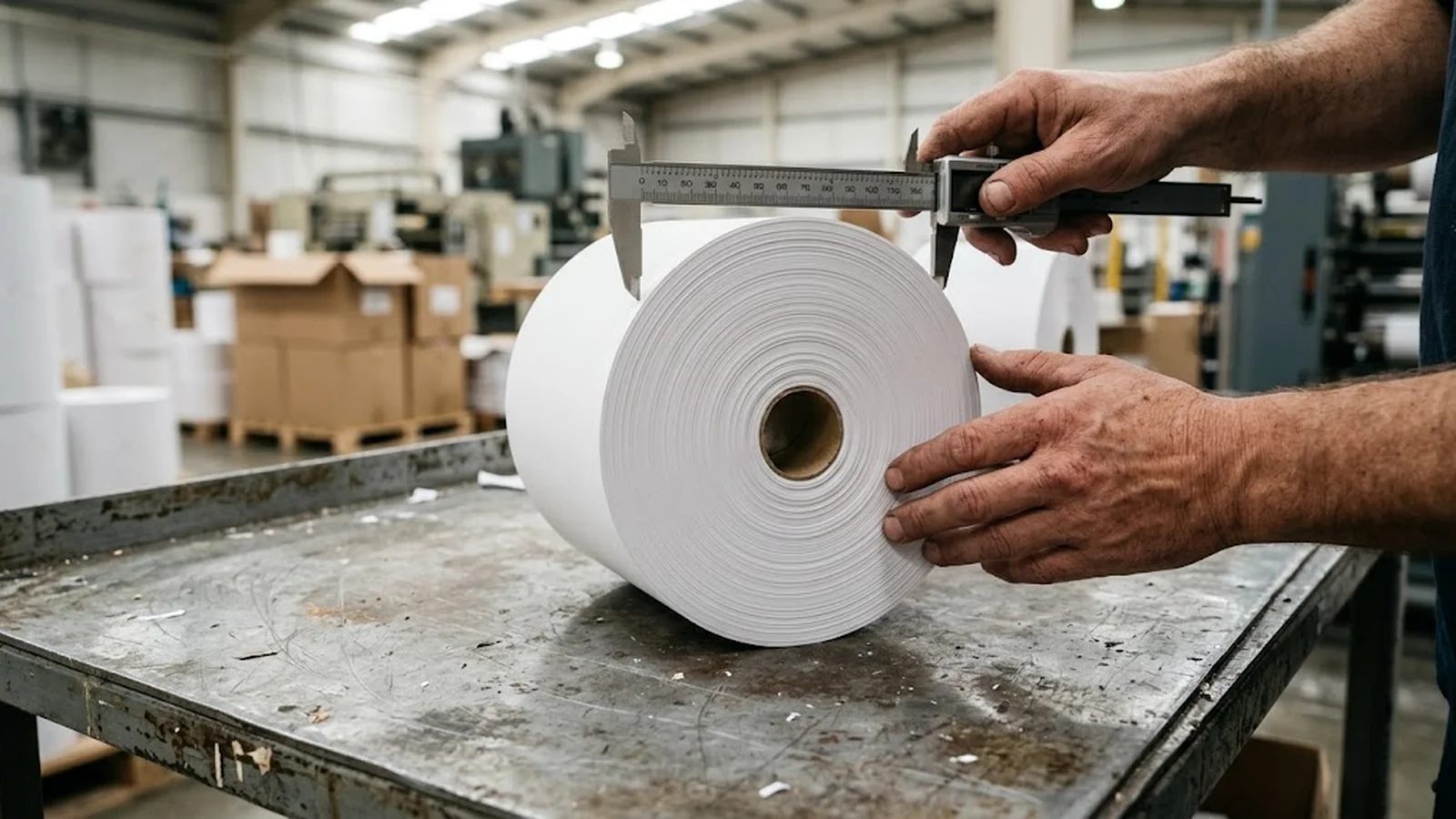
Paper length on a roll follows from simple geometry. Every wrap adds one paper thickness to the radius, so the total length is the sum of the circumferences of every layer — which works out to: length = π x (OD² − core²) / (4 x caliper), where OD is the outer diameter, core the core diameter, and caliper the paper thickness. For a typical 60 gsm receipt grade, caliper is roughly 0.075–0.085 mm including the coating.
The practical consequence of the square term is that diameter buys length disproportionately. Going from a 70 mm to an 80 mm diameter on the same 12.7 mm core adds about 40 percent more paper, not the 14 percent a linear guess would suggest. That is why high-volume operators insist on the largest diameter their terminals accept: fewer changeovers, less downtime, fewer partial rolls opened at once.
Core size matters just as quietly. At an 80 mm outer diameter, switching from a 25.4 mm core to a 12.7 mm core adds roughly 6 percent more paper. Some markets and machine families standardise on 12.7 mm cores for receipt rolls; jumbo parent rolls, by contrast, sit on 76.2 mm (3 inch) cores. When a quotation looks cheaper per roll, check the core before celebrating — a larger core is a smaller amount of paper hiding behind the same label.
Where a programme needs several formats from one supplier, our POS and receipt paper rolls covers width, core, roll diameter and developer class in a single specification sheet.
- Length formula: L = π x (OD² − core²) / (4 x caliper).
- Compare offers in metres, not rolls: price per metre = price per roll ÷ calculated length.
- A 10 mm larger diameter typically adds 15–20 percent more paper at receipt-roll sizes.
- Always confirm caliper (thickness) of the grade — heavier paper shortens length at identical OD.
Core sizes, winding and packaging standards
Receipt rolls almost universally use a 12.7 mm (1/2 inch) plastic or paper core, with 25.4 mm (1 inch) common in some regions and machine families. The core is not packaging — it is part of the specification, because it changes usable length and because some terminals grip the core to drive the paper. Machines that drive from the core require a core at all; many modern receipt devices instead drive from the paper itself and accept coreless rolls, which squeeze even more paper into the same compartment.
Winding direction is the specification line most often forgotten. Rolls are wound either paper-out or paper-in depending on how the terminal threads the paper; both exist in the market, and the same size in the wrong winding will not print. Converters label this on the carton; buyers should state it explicitly when ordering for a known device fleet rather than assuming the market default.
Packaging is standardised enough to plan against: receipt rolls typically ship 10, 20, 25 or 50 rolls per inner carton and 4–6 inners per master carton, individually wrapped in moisture-barrier film to protect the coating in transit and storage. For export buyers, the useful planning numbers are rolls per carton and cartons per pallet, which vary with diameter — 80 x 80 rolls palletise fewer per layer than 57 x 40, so the same paper tonnage occupies different pallet counts depending on the size mix ordered.
Choosing the right size for your fleet: a quick workflow
Start from the machine, not the market. Open the paper compartment and read the marking inside the lid — most terminals print the accepted roll size there — or check the device manual for a width and maximum diameter. Match width first, then choose the largest diameter that clears the compartment with a few millimetres of slack. If the fleet mixes models, standardise on the size that satisfies the strictest machine to keep one SKU in the storeroom.
Then convert the commercial decision to metres. Take the label, compute or ask for the paper length, and compare quotations per metre rather than per roll — that single step removes most of the confusion between diameter-coded and length-coded labels. Finally, confirm three details that size charts never show but cause most field problems: winding direction, core size, and whether the terminal is a core-drive machine. A supplier with its own slitting line can produce any width, diameter and core combination to order, which is why fleets with unusual devices usually source from converters rather than distributors holding standard SKUs.
Where container planning is the next step, our export shipping guide covers pallet standards, moisture-barrier packing and the document set for ocean freight.
Golden rule: width is fixed by the machine, diameter is your economic choice, core and winding are the details that decide whether the roll actually works.
Frequently asked questions
Is 80 x 80 receipt paper the same as 3-1/8 x 230?
They are the same width family (80 mm / 3-1/8 inch) but the second number means different things: 80 x 80 is width x diameter in millimetres (about 60–64 m of paper on a 12.7 mm core), while 3-1/8 x 230 is width x length, i.e. 230 feet ≈ 70 m. Convert both to metres before comparing prices.
Will 58 mm paper fit a 57 mm machine?
Usually yes. The 57 mm-class machines accept 57–58 mm paper because tolerance runs slightly over-width. The reverse is not true for wider paper: an 80 mm roll will not fit a 57 mm machine. When in doubt, match the width printed inside the terminal's paper compartment lid.
How many receipts does one 80 x 80 roll print?
An 80 x 80 roll holds roughly 60–64 m of paper. A typical retail receipt uses 200–300 mm, so one roll yields around 200–300 receipts depending on receipt design and print density. A 57 x 40 roll holds about 12–13 m, roughly 40–60 mobile receipts.
Does a bigger core mean less paper?
Yes. At the same outer diameter, the core occupies paper space. Moving from a 25.4 mm core to a 12.7 mm core at 80 mm OD adds about 6 percent more paper; coreless rolls add more still. Always check core size when comparing rolls sold at the same diameter.
What size is standard receipt paper?
Globally, the two dominant standards are 57 mm (2-1/4 inch) wide for card and mobile terminals and 80 mm (3-1/8 inch) wide for counter receipt devices, with 80 x 80 and 57 x 40 the single most ordered versions in metric markets and 3-1/8 x 230 in imperial markets.