
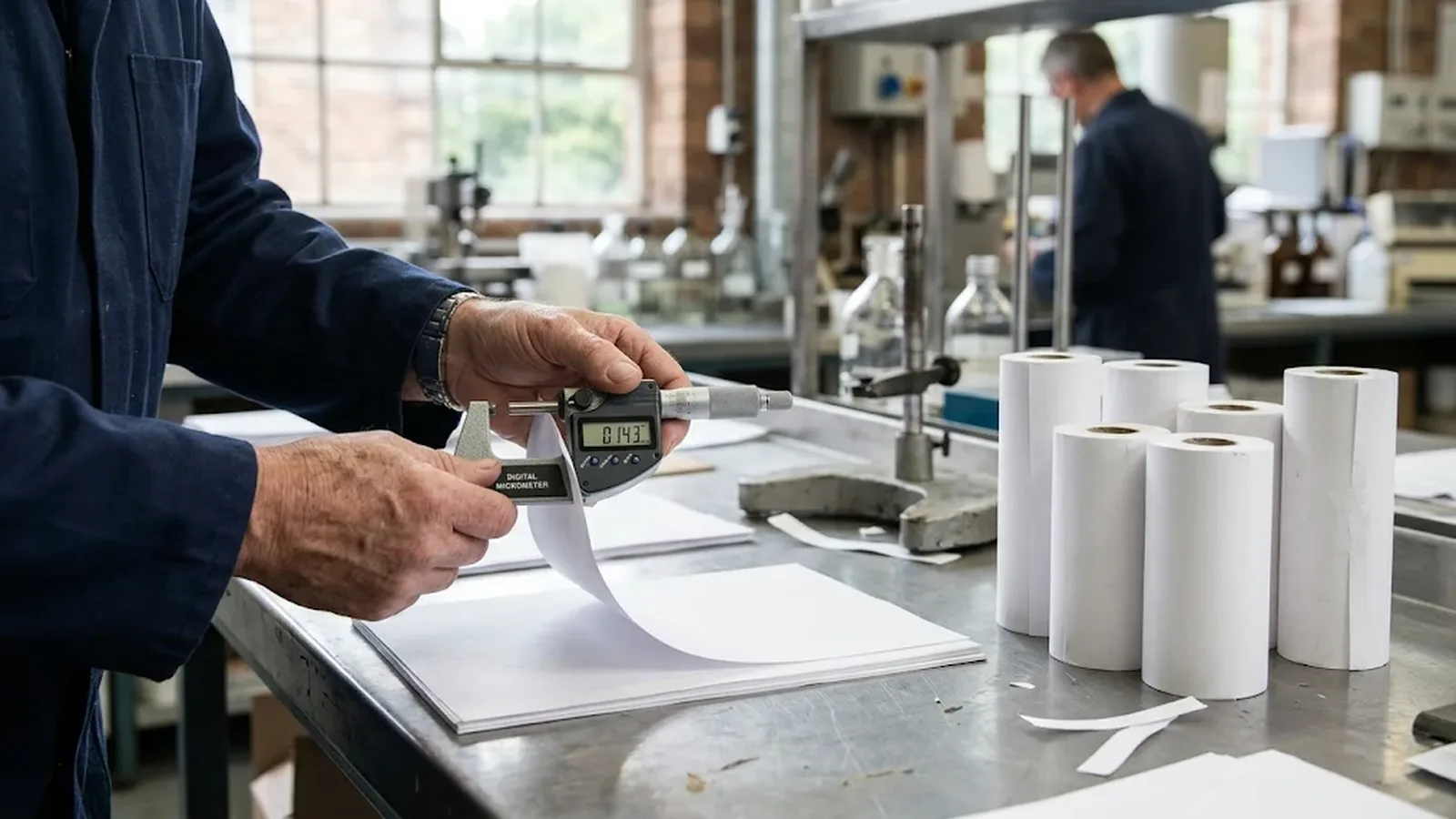
62 gsm thermal paper is a mid-weight direct thermal grade that sits deliberately between the two volume classes of the market: 55 gsm commodity receipt stock and the 65-75 gsm premium tier. It delivers most of the stiffness, opacity and perceived quality of the heavier grades while retaining a meaningful part of the length yield and freight advantage of the lighter ones. The class is specified on the same parameters as any direct thermal grade — basis weight with tolerance, caliper, sensitivity class, developer system, image life — but its commercial case rests on one trade-off: a buyer paying roughly five to ten percent more per square metre than 55 gsm buys noticeably better hand feel, less show-through and smoother feeding in retail and hospitality terminals. It suits programmes where the receipt is part of the brand experience but full heavyweight pricing is hard to justify.
Between the two grades that dominate quotations — 55 gsm commodity receipt stock and the 65 to 75 gsm premium tier — sits a class that buyers encounter constantly in finished rolls but rarely see named in supplier catalogues: 62 gsm. It is the compromise grade, engineered for programmes where the receipt or voucher is part of the customer experience but the heavyweight price per square metre is hard to defend.
The class exists for a simple reason. Paper weight is a continuous dial, and the market's anchor points leave a gap: 55 gsm prints and ships economically but feels thin, shows through, and occasionally misfeeds in tight paper paths; 70 gsm feels substantial but costs more per roll and yields fewer metres per tonne. A 62 gsm grade recovers most of the stiffness and opacity of the heavy tier while keeping a real share of the lightweight economics.
This guide works through the class in buyer's order: what 62 gsm actually specifies and how it compares on the numbers, how the extra basis weight changes machine and customer behaviour, where the grade earns its place, what it does to roll yield and logistics, and how to specify and source it without paying premium prices for a mid-weight claim. For production volumes, the same construction logic applies to our 48 gsm lightweight thermal paper, quoted per jumbo roll, slit reel or finished format.
- 62 gsm is the deliberate midpoint between 55 gsm commodity receipt stock and the 65-75 gsm premium tier — most of the stiffness and opacity of the heavy class, part of the economics of the light one.
- The measurable differences at 62 gsm are caliper, stiffness and opacity: better feed reliability in tight paper paths, less show-through, a heavier hand feel at the point of sale.
- The cost is yield: metres per tonne drop about ten percent versus 55 gsm, so roll counts per shipment fall and per-roll prices rise.
- The grade is specified like any direct thermal paper — basis weight tolerance, caliper, sensitivity class, developer system, image life — plus the band around 62 itself.
- Demand lot-level test data around the declared weight: a '62 gsm' claim without tolerance and measurement records is a marketing number.
What 62 gsm specifies — and how it compares on the numbers
Basis weight in grammes per square metre is the mass of one square metre of the finished sheet, measured under standard climate conditions. It is the headline number of every thermal paper grade because it drives almost everything downstream: caliper, stiffness, opacity, cost per square metre, and the metres of paper that a tonne of furnish produces. A 62 gsm grade therefore sits in a defined band around that value — serious mills declare a tolerance, typically ±2 gsm, and hold it with in-line basis-weight measurement.
Against its neighbours: a 55 gsm sheet is roughly 55-60 microns caliper, a 62 gsm sheet adds five to eight, a 70 gsm sheet roughly ten more. Those few microns are what the customer feels: the sheet resists buckling in curved paper paths, feeds flat through tight transport rollers, and seats cleanly in the mechanism. Opacity rises too, so dense receipt content shows through less on the reverse.
The comparison the class is usually bought against is the premium tier below heavyweight. A 62 gsm sheet carries roughly eighty percent of the stiffness advantage of a 65 gsm premium stock at a lower price per square metre, while giving up very little in print quality — sensitivity and image density are coating properties, not weight properties, and the same sensitive formulation can be applied to either. Where image life is the deciding factor, our top-coated vs non top-coated guide compares the two constructions on retention, cost and machine behaviour.
| Grade | Typical caliper | Hand feel / feed | Metres per tonne (approx.) | Typical role |
|---|---|---|---|---|
| 48 gsm | 50-55 µm | Thin, very high yield, light-duty paths | ~42,000 m | Ultra-compact mobile and budget rolls |
| 55 gsm | 57-62 µm | Standard commodity receipt feel | ~36,000 m | Volume POS receipt stock |
| 62 gsm | 63-68 µm | Mid-weight: stiffer feed, fuller feel, low show-through | ~32,500 m | Quality receipts, hospitality, branded vouchers |
| 70 gsm | 72-78 µm | Substantial, premium hand feel | ~28,500 m | Premium retail and banking receipts |
| 75 gsm+ | 78-85 µm | Heavyweight, maximum durability | ~26,500 m | Hard-copy retention and heavy-duty applications |
How the extra weight changes machine and customer behaviour
The mechanical argument for the mid-weight class is feed behaviour. Compact terminals, payment devices and hospitality equipment run tight, curved paper paths where a flimsy sheet can buckle, jam or skew. The extra caliper and bending stiffness of a 62 gsm sheet keeps the web flat through those paths, and in field experience the mid-weight grades show fewer misfeeds than 55 gsm stock in the same mechanisms.
The perceptual argument is the one buyers respond to fastest: the receipt is a physical artefact of the brand. A heavier sheet reads as quality at the moment it changes hands — restaurants, boutique retail, hotels and medical-adjacent service businesses all use the hand-feel argument. Opacity matters here too: dense line items, taxes and promotional text show through less on a 62 gsm sheet, which keeps the receipt legible on both faces.
The costs are equally concrete. Metres per tonne fall roughly ten percent versus 55 gsm, so the same roll diameter yields fewer rolls per shipment, more freight per metre, and a higher price per roll even at a similar price per tonne. None of these is disqualifying — they are the price of the class, and the buying decision is whether feed reliability and perceived quality justify them for the application.
Where the 62 gsm class earns its place
The class fits best where three conditions meet: the paper path is mechanically demanding, the receipt is customer-facing, and volumes are large enough that heavyweight pricing would hurt. Hospitality is the classic case — restaurant order pads, kitchen dockets and guest receipts all live in humid, greasy environments and tight feed paths, and the heavier sheet survives both better. Boutique and specialty retail use the hand-feel argument for branded receipts and vouchers. Pharmacy and clinic front desks favour the class for the same reason.
Conversely, the class is wasted money in pure commodity volume: a high-throughput grocery checkout running 55 gsm stock gains little from 62 gsm, and a logistics operation printing parcel documents cares about scan life, not hand feel. Mobile and compact devices with maximum roll diameters push buyers the other way, toward 48-55 gsm grades.
Buyers comparing these specifications can review our 75 gsm heavyweight thermal paper, where basis weight, coating construction and packing are documented per grade before an order is placed.
Yield, logistics and pricing consequences
Yield arithmetic drives most procurement surprises in this class, so it deserves numbers. At 62 gsm, one tonne of finished paper delivers roughly 32,000-33,000 square metres; at 55 gsm the same tonne delivers about 36,000. A converter slitting standard 80 x 80 mm rolls therefore ships roughly ten percent fewer rolls per tonne, and the same effect shows directly in metres per parent roll. Quotations should be normalised to price per square metre or price per thousand metres before comparison — a per-roll price comparison across different basis weights is meaningless.
Freight and storage follow the yield. Fewer metres per tonne means more volume per delivered metre: slightly higher ocean-freight cost per metre and faster-filling shelf space at the distribution centre. For buyers running mixed grades, the practical mitigation is to standardise the mid-weight class only on the formats where its advantages matter, and keep 55 gsm for the commodity volume.
Where a programme needs several formats from one supplier, our custom thermal paper programme covers width, core, roll diameter and developer class in a single specification sheet.
Specifying and sourcing the grade without surprises
The specification discipline for 62 gsm is the same as for any direct thermal grade, with one addition. Declare basis weight as a value plus tolerance — '62 ±2 gsm' — and ask how it is measured and how often. Declare caliper, because stiffness follows it. Declare sensitivity class against a reference print condition, the developer system (BPA-free or phenol-free chemistry, with documentation), and the image-retention class the application needs. Ask for lot-level test data covering density, background ageing and accelerated retention — the readout of the whole process.
The addition is the tolerance itself. The mid-weight class lives or dies on whether the mill genuinely holds 62 gsm or drifts between a thin 58 and a heavy 66 depending on the run — a drift that changes feel, feed behaviour and yield from lot to lot. In-line basis-weight measurement, declared tolerance and audit-able records are the strongest supplier signal; a catalogue number alone is the weakest.

Rule of thumb: judge the grade on price per square metre with a declared tolerance, never on per-roll price without one.
Frequently asked questions
What is 62 gsm thermal paper used for?
It is the mid-weight receipt and voucher grade: hospitality receipts and kitchen dockets, boutique retail receipts, branded vouchers and service-counter documents — anywhere the paper path is mechanically demanding or the receipt is part of the brand experience, but full heavyweight pricing is not justified.
How does 62 gsm differ from 55 gsm and 65 gsm?
Physically, it adds roughly five to eight microns of caliper over 55 gsm — better stiffness, feed behaviour and opacity, at about ten percent lower yield in metres per tonne. Against 65 gsm it gives up a little stiffness at a better price per square metre; print sensitivity and density are coating properties and can be equal across all three.
Does 62 gsm paper cost more per roll?
Yes, typically. The price per tonne may be close to 55 gsm, but metres per tonne fall about ten percent, so each roll contains less paper and costs more. Compare offers on price per square metre or per thousand metres, with a declared basis-weight tolerance, rather than per-roll price.
What tolerance should I specify for a 62 gsm grade?
A declared tolerance of ±2 gsm is standard for serious mills, backed by in-line basis-weight measurement and lot-level records. A quotation that states '62 gsm' without a tolerance and a measurement method is a catalogue claim, not a specification.
Can 62 gsm be supplied as jumbo roll stock?
Yes. The grade is produced on the same coating lines as every other basis weight and is supplied as parent rolls for converting, or slit to finished receipt and voucher widths. Yield per jumbo roll is about ten percent lower than 55 gsm at equal diameter, which converters should build into their roll-count planning.