
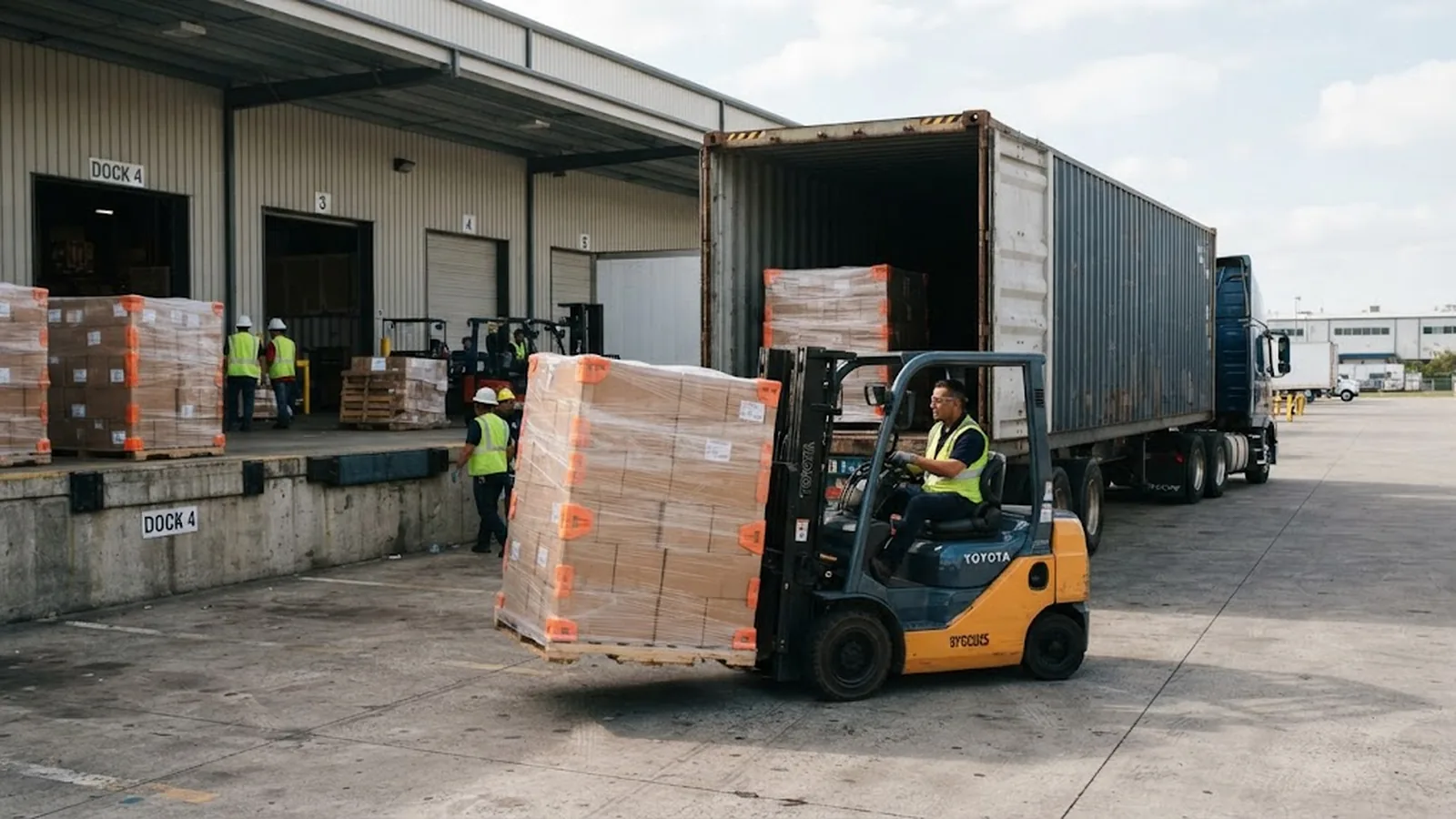
Thermal paper ships like any heavyweight coated paper, but with two extra requirements: the heat-sensitive coating must be protected from moisture and heat, and the roll edges must be protected from impact. Export packing therefore uses moisture-barrier-lined cartons, stretch-wrapped and corner-boarded pallets, and often desiccant inside ocean containers. On the commercial side, most suppliers quote FOB or CIF, classify coated thermal paper under HS heading 4811, and issue a commercial invoice, packing list, bill of lading, certificate of origin, certificate of analysis and safety data sheet. Buyers should confirm Incoterms, classification and documents before the first shipment, then inspect packing, wrap integrity and edges on arrival, and print-test one roll before releasing the batch.
Thermal paper travels well when it is packed for the journey, and badly when it is packed like ordinary office paper. Its heat-sensitive coating is hygroscopic and light-sensitive, and its value density is high enough that a single damaged pallet carries real money. For importers, the cost of a shipment is decided less by the freight rate than by whether the goods arrive dry, square and printable.
This guide covers the export side of the business: how rolls are packed, how containers are loaded, how coated thermal paper is classified and documented for customs, which Incoterms fit which buyer, and what a receiving warehouse should check on arrival. It is written for distributors, converters and procurement teams placing container-quantity orders from an overseas manufacturer.
Numbers such as pallet dimensions, container capacity and transit times vary by route and by packing configuration, so treat the figures here as planning guidance and confirm the specifics with your supplier and freight forwarder before you place a firm order.
- Export packing exists to protect two things: the coating from moisture and heat, and the roll edges from impact.
- Coated thermal paper is normally declared under HS heading 4811; classification should be confirmed with your customs broker for your market.
- FOB and CIF dominate thermal paper supply because the risk point in ocean transit is well understood by both sides.
- Always request the full document set before shipment — invoice, packing list, bill of lading, certificate of origin, COA and SDS.
- Inspect wrap integrity, pallet squareness and roll edges on arrival, then print-test a roll from the oldest carton before releasing stock.
Why thermal paper needs purpose-built export packing
Two properties of thermal paper drive the packing design. First, the coating is sensitive to moisture and heat: sustained humidity can soften roll edges and push the coating chemistry toward background development, while localized warmth greys the surface. Second, a roll is a precision-wound cylinder with a vulnerable edge — a single impact on an exposed edge can crack the coating inside the winding, which only shows up weeks later as a pale band across the print.
The consequence is purpose-built packing: moisture-barrier-lined cartons rather than plain cases, and pallets protected with corner boards and edge protection rather than stretch film alone. The wrapping is a functional barrier, not presentation packaging.
For container quantities the question shifts from protecting individual rolls to controlling the whole load's environment, because a sealed ocean container is a humid and sometimes hot space for weeks at sea.
How thermal paper is packed for export
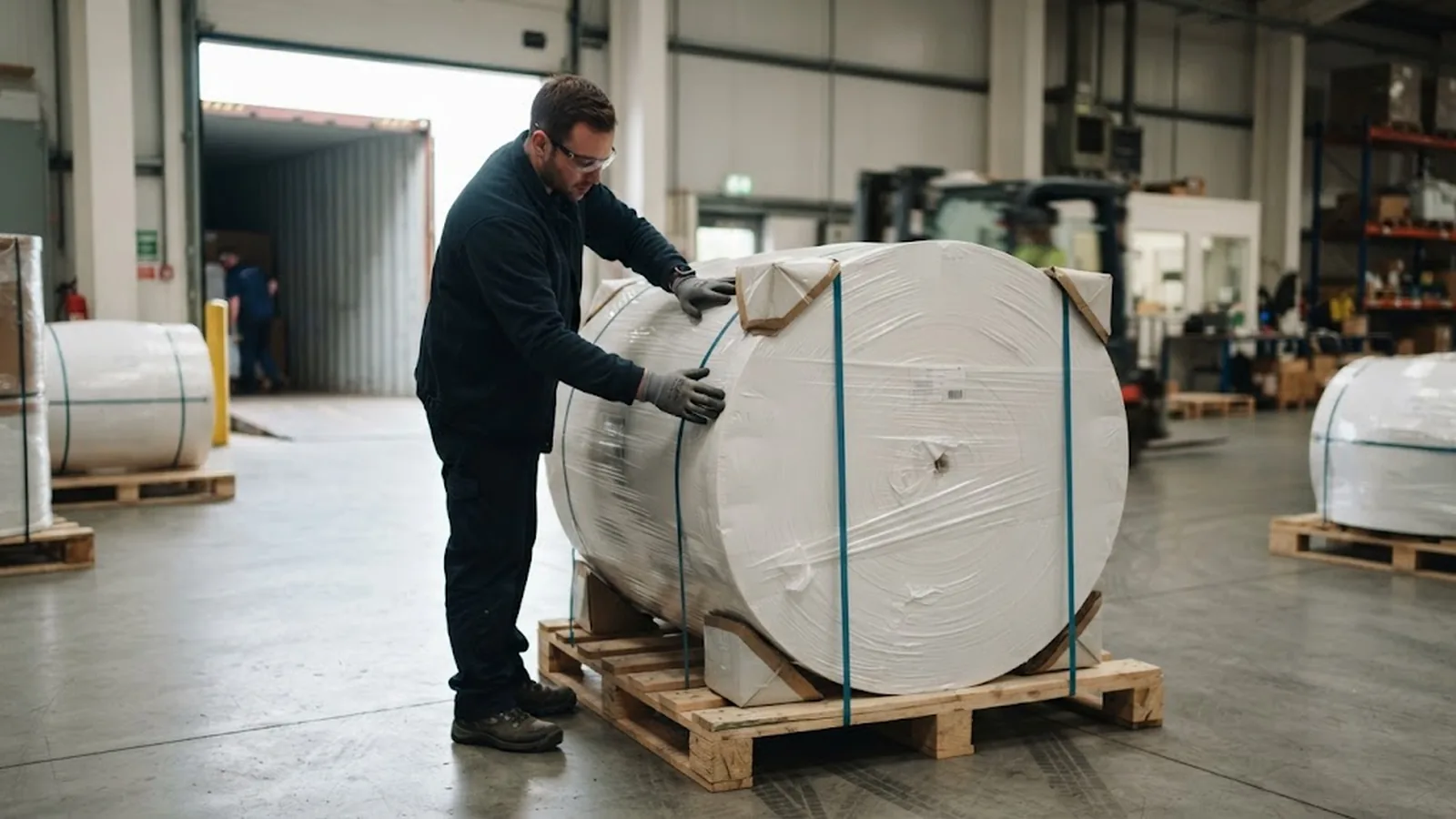
A typical export pack runs from the inside out. Rolls or bundles are wrapped, then packed into cartons lined with a moisture barrier. Cartons are stacked on a pallet in a stable pattern, corner boards are fitted to the four vertical edges, and the whole pallet is stretch-wrapped and often strapped. For long ocean voyages, desiccant packs are added inside the cartons or the container to absorb moisture that condenses as the container moves between climates.
Pallet dimensions follow the destination market's standard so the load fits racking and truck beds without re-palletizing. The common ISO pallet is 1200 by 1000 millimetres, 1100 by 1100 millimetres is container-friendly, and North America uses 48 by 40 inch pallets. Confirm the standard with the buyer before production, because it affects carton layout and price.
Weight discipline matters as much as geometry. Thermal paper is dense, so cartons must be liftable and the pallet must stay within container payload limits. Overloading to save space is a false economy: crushed cartons deform the rolls inside, and the print defects show up after the goods have been paid for.
- Moisture-barrier-lined cartons, not plain corrugated cases.
- Corner boards and edge protection on every pallet, not just stretch film.
- Desiccant for long ocean transit and for humid routes.
- Pallet dimensions matched to the buyer's racking and truck standards.
- Carton weights set so the pallet stays within container payload limits.
Container loading practice
How a container is loaded decides how much damage the paper can suffer en route. Pallets should be blocked so they cannot shift, and the load should be braced away from the container doors, where movement and moisture are greatest. Keeping a gap between the load and the doors reduces both impact risk and the chance of water entering during a storm or at an exposed terminal.
Timing matters around the port. Loading in rain without a canopy wets cartons before the doors close, and that moisture stays inside for the whole voyage. A container that has sat in the sun also holds heat that transfers to the load, so load early in the day where possible.
Once the doors are sealed, document the stow with photographs and the seal number. A supplier who shares those images with the bill of lading gives the buyer a reference point if a claim ever becomes necessary.
Ask for container stow photographs and the seal number with the shipping documents — they cost nothing and settle most transit disputes before they start.
Classification and customs documentation
Coated thermal paper is normally declared under HS heading 4811, which covers paper and paperboard that have been coated, impregnated or surface-coloured. Some shipments, depending on grade and cut, are declared under other paper headings, and the correct subheading depends on coating type, width and form — so classification should always be confirmed with a customs broker for the destination market rather than assumed from a supplier's invoice.
The document set is standard for traded paper goods: a commercial invoice stating value, terms and description; a packing list detailing cartons, pallets and weights; a bill of lading as carrier receipt and contract; and a certificate of origin supporting preferential tariff treatment. Technical documents travel alongside: a per-lot certificate of analysis, a safety data sheet, and any certification the buyer requires.
The practical advice is to agree the document set in writing before the first order. Missing or mismatched paperwork is the most common cause of customs delay, and a delay in a hot or humid terminal is also a quality risk, not just a cost one.
| Document | Purpose | Issued by |
|---|---|---|
| Commercial invoice | Declares value, terms and goods description | Supplier |
| Packing list | Details cartons, pallets, weights and dimensions | Supplier |
| Bill of lading | Carrier receipt, contract of carriage and title document | Shipping line |
| Certificate of origin | Supports tariff treatment under trade agreements | Chamber or authority |
| Certificate of analysis | Confirms grade and lot specifications | Manufacturer lab |
| Safety data sheet | Communicates handling and safety information | Manufacturer |
Incoterms and who carries the risk
Incoterms define where risk transfers from seller to buyer, and thermal paper supply normally uses one of three. Under FOB the supplier delivers the goods on board at the port of loading and the buyer arranges and insures the ocean leg, which suits experienced importers with their own freight contracts. Under CIF the supplier arranges carriage and insurance to the destination port. EXW leaves everything to the buyer and is rarely right for a first shipment.
Whichever term is chosen, two points deserve explicit agreement. The first is insurance: minimum cover under CIF is limited, so buyers moving high-value paper often extend cover themselves. The second is inspection: agree at what point the buyer may inspect the goods, and whether a third-party inspection report is required before shipment. Settling these at order stage avoids arguments after a container has crossed an ocean.
Delivery terms also decide who pays for moisture protection. Under EXW the buyer owns the packing decision from the factory gate, so barrier cartons, corner boards and desiccant must be specified in the purchase order.
Receiving the shipment: a practical inspection routine
Quality problems in shipped thermal paper are usually visible in the first ten minutes if someone looks. Check the container or trailer before unloading: water staining on the walls, a damaged door seal or a strong musty smell all indicate moisture exposure. Then inspect the pallets for film integrity, corner-board damage and carton crushing, and confirm pallet count and carton labels against the packing list.
Inside the cartons, examine the roll edges for dents and the wrap for tears. Reject or quarantine any carton that shows water staining, since the damage will be internal. Before releasing the batch, print-test one roll from the oldest carton on the equipment you will actually use: a light or patchy test print tells you far more about condition than any visual check.
Finally, log reception — date, lot numbers, pallet count, test-print result — and rotate stock first-in, first-out. Receiving is the last point at which responsibility can still be attributed clearly, so make it a written routine.
- Inspect the container for water staining, door-seal damage and odour before unloading.
- Check film integrity, corner boards and carton condition on every pallet.
- Quarantine any carton showing water staining — internal damage will follow.
- Print-test one roll from the oldest carton before releasing the batch.
- Record lot numbers, pallet count and test result, then rotate stock FIFO.
Frequently asked questions
What HS code is used for thermal paper?
Coated thermal paper is normally declared under HS heading 4811, which covers coated and surface-coloured paper and paperboard. The exact subheading depends on coating, width and form, so classification should be confirmed with a customs broker for your destination market rather than copied from an invoice.
Which Incoterm is best for importing thermal paper?
FOB and CIF are the most common. FOB suits importers who manage their own freight and insurance, while CIF simplifies the transaction by putting carriage and insurance with the supplier. EXW is rarely advisable for a first order because the buyer owns every risk from the factory gate.
How is thermal paper protected during ocean transit?
Rolls are packed in moisture-barrier-lined cartons, pallets are corner-boarded and stretch-wrapped, and desiccant is often added for long or humid routes. Pallets are braced away from the container doors to reduce impact and moisture exposure. The wrapping stays on the roll until point of use.
What documents should accompany a thermal paper shipment?
A commercial invoice, packing list, bill of lading and certificate of origin for customs, plus a certificate of analysis, safety data sheet and any certification the buyer requires. Agree the exact set in writing before the first order, since missing paperwork is the most common cause of customs delay.
What should I check when a thermal paper shipment arrives?
Inspect the container for water staining and door-seal damage, check pallets for film integrity, corner-board and carton condition, and examine roll edges and wraps. Quarantine any water-stained cartons, then print-test one roll from the oldest carton before releasing the batch.