
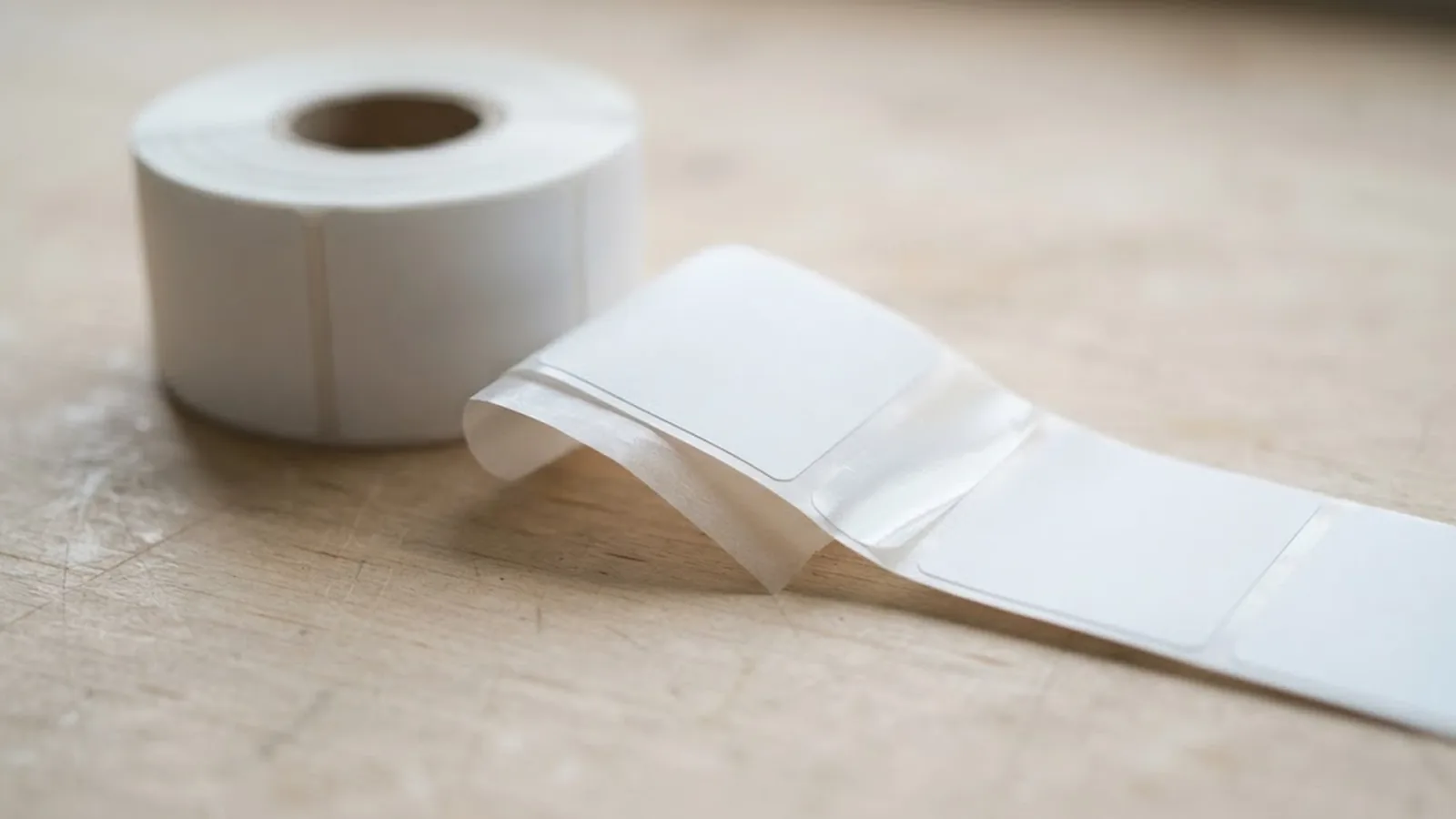
A self-adhesive thermal label is a three-layer system: a direct thermal facestock that receives the image, a pressure-sensitive adhesive, and a silicone-coated liner that carries the label until it is applied. Adhesive choice decides whether the label sticks and stays stuck — hot-melt rubber adhesives give strong initial tack at low cost, while acrylic adhesives resist heat, UV and ageing better. Match the adhesive to two different numbers: the minimum application temperature, below which the label will not bond, and the service temperature range, in which it must keep holding. Freezer, wet, oily and low-surface-energy surfaces each need a specific adhesive, and the liner must suit the die-cutting and dispensing equipment that will run it.
When a label fails, the fault is usually blamed on the facestock, but the adhesive is the layer that decides most outcomes. A direct thermal label can print perfectly and still fall off a frozen carton, lift at the corner on a curved bottle, or leave residue where it should release cleanly. Each of those failures points to an adhesive or liner mismatch rather than a printing problem.
This guide explains how a self-adhesive thermal label is built, how the common adhesive families differ, how to read application and service temperatures, and how to match the construction to the surface and environment the label will face. It is written for label converters, packaging engineers and B2B buyers who need to specify a construction rather than guess at one.
Ratings vary by manufacturer, so the values here are the general industry picture. Where label failure carries real cost, confirm the adhesive's rated performance on the supplier's technical data sheet for the exact product.
- A thermal label has three functional layers — facestock, adhesive and liner — and all three must be specified together.
- Hot-melt rubber adhesives give high initial tack economically; acrylic adhesives resist heat, UV and ageing better.
- Minimum application temperature and service temperature are different numbers, and confusing them causes most cold-application failures.
- Freezer, wet, oily and low-surface-energy surfaces each require a purpose-selected adhesive, not a general-purpose one.
- Liner type and thickness drive die-cutting quality and dispensing speed, so it is an engineering choice, not an afterthought.
The three layers of a self-adhesive thermal label
Reading from the top down, the facestock is the direct thermal paper that carries the heat-sensitive coating and receives the printed image. Beneath it sits the pressure-sensitive adhesive, which is applied as a thin, permanently tacky film. Under that is the liner: a paper or film sheet coated with silicone, which holds the adhesive flat and releases it when the label is peeled. The construction is supplied as a laminate, and the die-cutting process cuts through the facestock and adhesive but not the liner, so the liner becomes the carrier web.
Each layer constrains the others. A heavier facestock needs an adhesive with enough peel strength to carry its stiffness around curves. A thin liner die-cuts cleanly at high speed but can stretch and web-break in fast dispensing lines. A top-coated direct thermal facestock resists water, oil and abrasion and is the right choice for labels that will be handled — but it still depends on the adhesive to stay on the package.
For buyers, specifying 'a thermal label' is incomplete: the order should name the facestock grade, the adhesive family and the liner, because changing any one changes field performance.
Adhesive families and what each does well
Three families dominate pressure-sensitive label adhesives, and the differences are practical rather than academic. Hot-melt rubber adhesives are the workhorse: they offer high initial tack, good adhesion to many surfaces, and the lowest cost, which is why they are common on shipping and logistics labels. Their weakness is ageing — rubber systems degrade faster under heat, UV light and plasticizer contact than acrylics.
Acrylic adhesives cost more but hold up better: they resist UV and oxidation, tolerate higher service temperatures and keep their adhesion longer, which suits labels stored outdoors or expected to stay attached for years. Emulsion and solvent variants differ mainly in application method and moisture tolerance.
A third group covers the special cases: freezer and low-temperature adhesives that stay tacky well below freezing, removable adhesives that peel away cleanly for repositioning or return logistics, and high-tack grades designed for low-surface-energy plastics where ordinary adhesives struggle. The table below shows the usual starting point for each application.
| Adhesive family | Strengths | Typical applications |
|---|---|---|
| Hot-melt rubber | High initial tack, low cost, wide surface tolerance | Logistics and shipping labels, cartons |
| Acrylic (emulsion or solvent) | UV and ageing resistance, higher temperature tolerance | Outdoor labels, long-retention records, retail |
| Freezer / low-temperature | Retains tack below freezing, bonds to cold surfaces | Frozen food cartons, cold-chain logistics |
| Removable | Peels cleanly without residue | Return logistics, temporary promotions, rework |
| High-tack for LSE surfaces | Bonds to polyethylene, polypropylene and coated board | Plastic containers, drums, coated packaging |
Cost per label is a poor guide on its own — the cost of a failed label in the field is far higher than the couple of cents saved on an economy adhesive.
Minimum application temperature versus service temperature
These two ratings are the most commonly confused numbers in label specification, and the confusion causes most cold-application failures. The minimum application temperature is the lowest surface temperature at which the adhesive will wet out and form a bond at the moment the label is applied. The service temperature range is the range in which the applied label continues to hold afterwards. A label can have a low service temperature and a much higher minimum application temperature — meaning it will survive a freezer, but will not stick if applied to a frozen surface.
This distinction matters at the packing line. If labels are applied in an unheated warehouse in winter, or onto cartons straight out of a chiller, the surface may sit below the adhesive's minimum application temperature even though storage temperature is within its service range. Warm the surface, label before chilling, or select a cold-application adhesive — do not simply increase pressure.
When you specify, ask for both numbers in writing and state the actual surface temperature at the point of application, not just the temperature the product is stored at. Supplying both facts to the supplier is the single most effective way to avoid a season of peeling corners.
- Minimum application temperature: the lowest surface temperature at which the bond forms.
- Service temperature range: the range in which the applied label then holds.
- Cold-surface application needs a cold-application adhesive, not extra pressure.
- State the surface temperature at the point of labelling, not the storage temperature.
Matching the adhesive to the surface and the environment
Adhesion is a marriage between adhesive and substrate, and the substrate rarely cooperates. Rough corrugated board needs a softer adhesive or heavier coating weight so the film flows into the valleys rather than bridging them. Low-surface-energy plastics such as polyethylene and polypropylene resist wetting and need a high-tack or specifically formulated adhesive. Glass, metal and painted surfaces are more forgiving, though curved surfaces add a peel force that lifts edges, and small diameters are the hardest case.
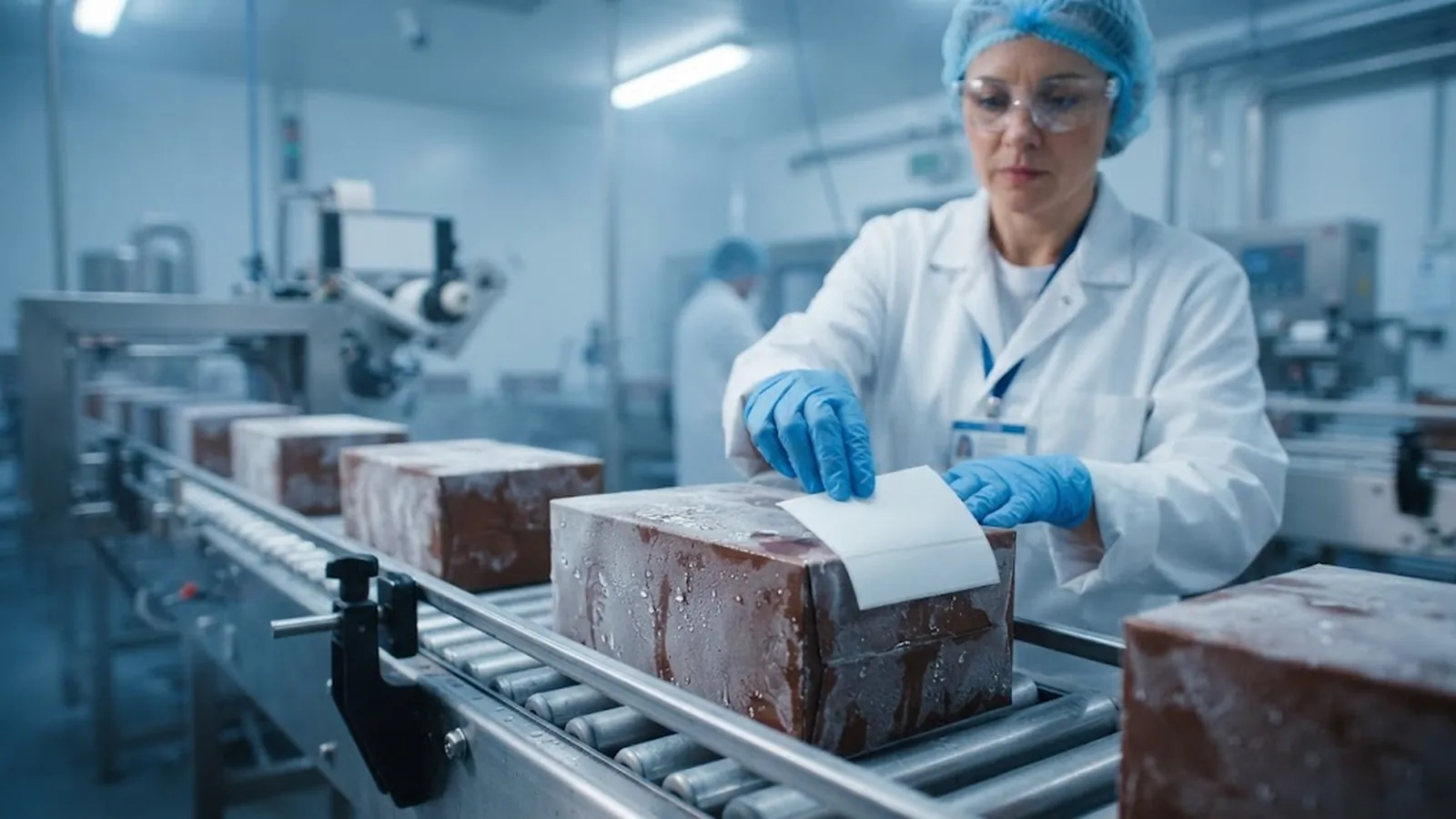
The environment adds a second dimension. Moisture on the surface blocks bonding, oily or dusty surfaces are genuinely difficult, and condensation on cold chain cartons is the classic failure mode. For frozen and chilled applications, the reliable route is a freezer-grade facestock and adhesive, applied before the product is chilled, with the surface verified dry at the point of labelling.
There is also an end-of-life question. Standard permanent adhesives can make a paper label hard to remove for recycling, whereas wash-off adhesives are designed to release in a repulping process. For packaging that is part of a recycling stream, that is worth raising with the label supplier alongside the heat-sensitive chemistry of the facestock itself.
Liner and facestock choices that support the adhesive
The liner looks passive but shapes the whole converting and application process. Supercalendered kraft paper liners, usually called glassine, are the most common: thin, smooth and cost-effective, with good die-cutting behaviour. Film liners, typically polyester, are stronger and dimensionally stable, resist moisture better and are chosen when the label is small, when the die-cut must be very precise, or when the web will be pulled and turned at speed. A thicker liner die-cuts and dispenses more reliably; a thinner liner allows more labels per roll and reduces waste.
Liner choice also affects the label count per roll and therefore applicator uptime, since fewer roll changes per shift is a real productivity gain. On the facestock side, top-coated direct thermal grades resist water, oil, abrasion and plasticizer contact, so for labels that will be handled or exposed, the top-coated facestock and a suitable adhesive belong in the same specification.
Finally, storage rules apply to the finished label stock just as they apply to plain thermal rolls: keep rolls wrapped, cool and dry, and use them within the supplier's stated shelf life. Adhesive that has absorbed moisture or aged on the shelf dispenses badly and bonds poorly, however good the construction was when it was made.
A specification checklist for thermal labels
Good label specifications are short, explicit and written before the order. These are the items that decide whether a construction works:
- Facestock: direct thermal, standard or top coated, and the grammage required.
- Adhesive family: hot-melt, acrylic, freezer, removable or high-tack LSE.
- Minimum application temperature and service temperature range, in writing.
- Surface: material, roughness, cleanliness, curvature and the surface temperature at application.
- Liner: glassine or film, and the thickness your die-cutting and dispensing equipment prefers.
- Label size, corner radius and die layout, plus the labels per roll you need for line uptime.
- Environment: indoor or outdoor, UV exposure, moisture, oils and expected retention period.
Frequently asked questions
What adhesive is best for direct thermal labels?
There is no single best choice. Hot-melt rubber adhesives suit general logistics and carton labels at low cost, while acrylic adhesives are better for outdoor, high-temperature or long-retention use. Freezer, removable and high-tack low-surface-energy adhesives cover specific applications. Choose the family that matches the surface, temperature and lifetime of the label.
What is the difference between minimum application temperature and service temperature?
Minimum application temperature is the lowest surface temperature at which the adhesive will form a bond at the moment of labelling. Service temperature is the range in which the applied label continues to hold. A label can hold well in a freezer yet fail to stick when applied to a frozen surface, which is why both numbers matter.
Why do my labels lift at the corners on curved surfaces?
Curved surfaces create a peel force that constantly tries to lift the label edge, and small diameters are the hardest case. The usual fixes are a thinner, more conformable facestock, a higher-tack or specifically formulated adhesive, and better surface cleaning. On very small diameters, a film facestock may outperform paper.
Do thermal labels work on frozen or damp cartons?
Yes, with the right construction. A freezer-grade adhesive applied to a dry, sufficiently warm surface before the product is chilled gives reliable results. Applying labels to already-frozen or visibly damp cartons is the most common cause of failure, because moisture and low temperature both prevent the adhesive from wetting out.
Does the liner affect dispensing performance?
Considerably. A glassine liner is thin and economical but less forgiving at speed, while a film liner is stronger and holds dimensional stability for small or precise die-cuts. Liner thickness also changes how many labels fit on a roll, which affects how often the applicator must be stopped.