
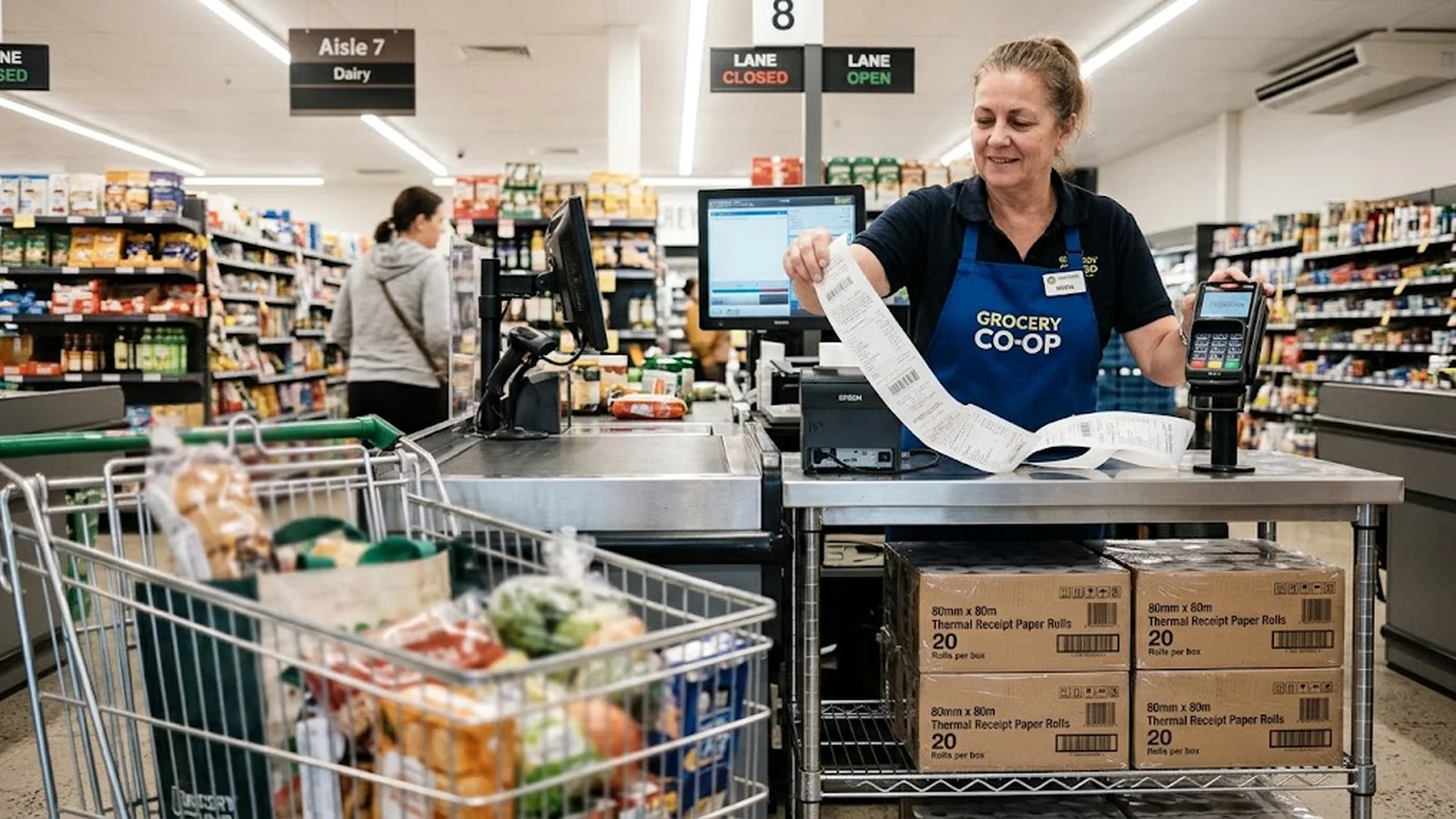
Supermarket receipt rolls are the thermal paper stock specified for grocery front-end printing, and grocery duty differs from other retail in one decisive way: volume concentration. A single supermarket lane can print thousands of long itemised receipts per week, deli and produce counters add weighed-label duty, and self-checkout banks add unattended stations where a paper fault stalls several customers at once. The right specification therefore combines a cost-efficient 55-65 gsm grade class for long front-end receipts, correct 80mm or 57mm geometry per station, moisture-barrier packing for back-room storage, and — increasingly — written developer-class documentation (BPA-free or phenol-free) because grocery chains face public and ESG scrutiny over the receipts handed to shoppers. Buy per station class rather than per store, verify with trial cartons in the actual lane hardware, and consolidate the whole chain onto one specification sheet so every lane prints and files identically.
A supermarket prints more receipts per square metre of trading floor than almost any other retail format. Itemised grocery receipts run long — twenty, forty, eighty lines on a loaded trolley — and front-end lanes, service delis, fish counters, in-store bakeries and self-checkout banks all consume paper simultaneously through the trading day. When a lane runs out or a scale jams, the queue backs up immediately, which is why grocery procurement treats receipt paper as operational infrastructure rather than a commodity footnote.
Supermarket receipt rolls are therefore specified per station class, not per store. The front-end lane, the deli scale, the self-checkout pod and the back-office journal printer each impose different geometry, duty and retention requirements on the same basic stock, and a programme that buys '80mm rolls' generically will pay for that vagueness in jams, faint print and emergency top-ups during peak trade.
Procurement teams standardising receipt supply across every lane can review our POS and receipt paper rolls, where basis weight, coating construction and packing are documented per grade.
This guide works through what grocery duty does to receipt stock, the format and grade decisions per station, and the compliance documentation that supermarket tenders now routinely demand.
- Grocery duty is volume-concentrated: long itemised receipts at high lane throughput make cost per receipt and change frequency the two governing metrics.
- Specify per station class — 80mm front-end lanes, 57mm compact and portable stations, dedicated stock for deli and produce scales, unattended-duty stock for self-checkout banks.
- Grade class sits at 55-65 gsm for most lanes; heavier classes only where stiffness, retention or two-sided handling requirements say so.
- Public-handled receipts carry compliance expectations: written BPA-free / phenol-free developer class with per-batch documentation is now standard in grocery tenders.
- Consolidate the chain onto one specification sheet per station class and verify with trial cartons in actual lane hardware before committing store-wide.
What supermarket duty does to receipt stock
Volume concentration is the defining condition. A busy lane prints long receipts continuously through peak periods, so the paper is consumed — and the print head exercised — at a rate few other retail formats approach. Two consequences follow. First, cost per receipt becomes a board-level number: a five-metre-per-day difference per lane multiplies across dozens of lanes and hundreds of stores. Second, consistency becomes critical, because a grade change mid-quarter shows up as altered print density across an entire estate before anyone has adjusted anything.
Handling conditions add their own demands. Grocery receipts spend their first minutes in a hot, humid environment near checkout hardware, then ride home folded in pockets and bags, and many end up retained for returns, expense or warranty purposes. Stock for this duty needs stable curl behaviour out of the printer, enough stiffness to feed reliably at speed, and a developer system whose image survives ordinary household abuse — all properties that separate a specified grade class from a generic '80mm roll' on a purchase order.
Storage completes the picture. Supermarket back rooms are not climate-controlled warehouses; stock sits near chillers, loading doors and cleaning chemicals for weeks before use. Moisture-barrier carton lining and sensible rotation discipline protect the metres that were bought so carefully, and the packing specification deserves the same attention as the paper itself.
For high-volume front-end lanes where cost per receipt governs, our 48 gsm lightweight thermal paper documents the lightweight class and the metres-per-carton arithmetic behind that decision.
Format and grade decisions per station
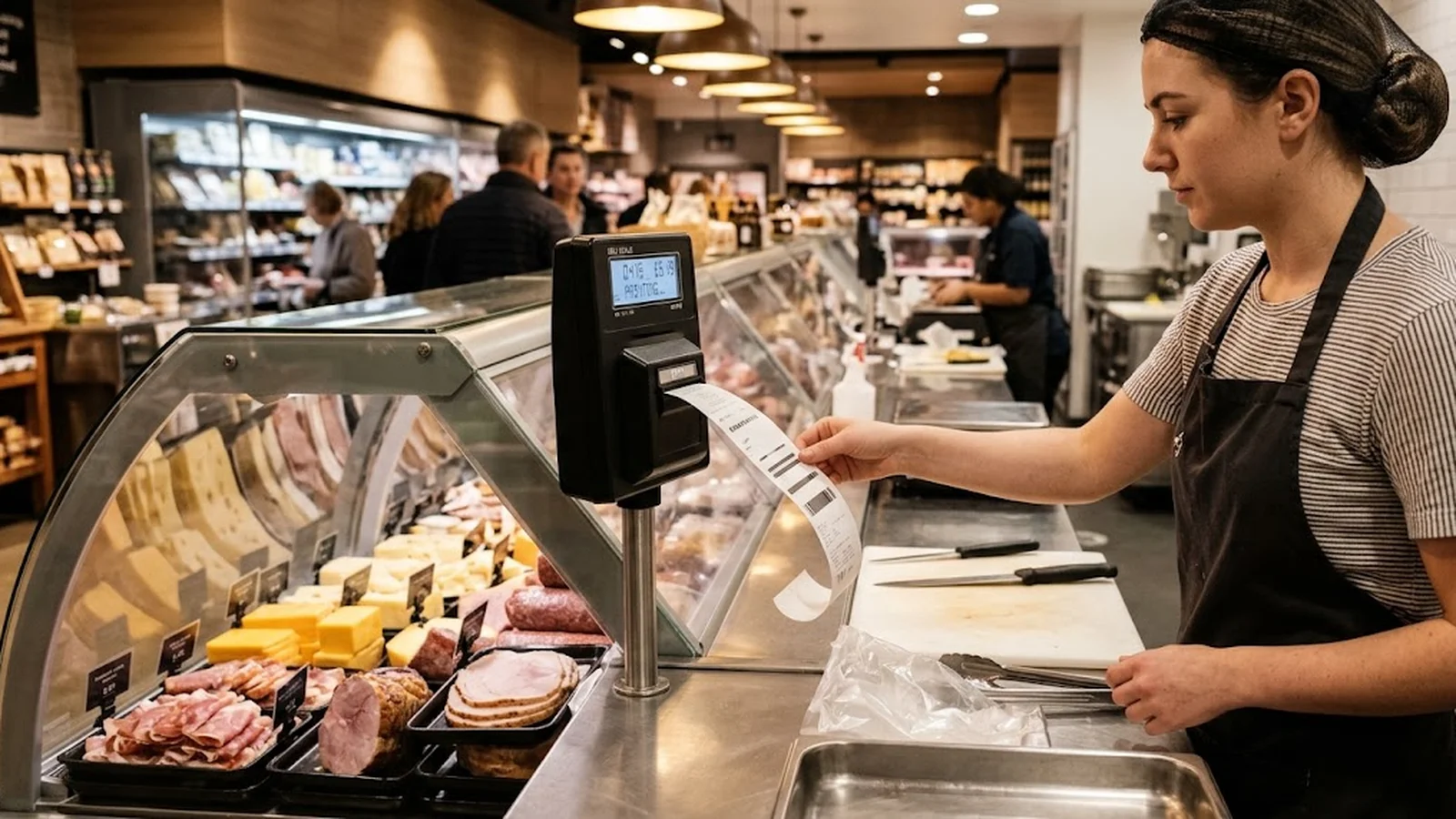
Front-end lanes run 80mm stock almost universally, with the roll diameter set by the lane printer's bay — the taller the diameter the fleet accepts, the fewer changes per trading day. Deli, fish and produce counters add a different duty: many grocery scales print narrow 57mm receipt-and-label combinations where slip stiffness and curl behaviour decide whether the paper feeds cleanly through tight paper paths. Self-checkout pods combine lane-class stock with unattended duty, where a misfeed stalls several customers at once and the stock's feed reliability matters more than its unit price.
Grade class then follows the station map rather than a single estate-wide number. Most lanes sit comfortably at 55-65 gsm; back-office journals and any station where receipts are filed for reference justify a heavier class; and the lightweight end of the range earns its keep precisely where receipt length makes every gram per square metre count. Sensitivity class should be matched per printer family, because lane hardware, scales and self-checkout units frequently run different print-head energy windows.
Requests that combine several formats can be quoted together; see our custom thermal paper programme for the construction options behind each station class.
| Station | Typical format | Grade class | Duty notes |
|---|---|---|---|
| Front-end checkout lanes | 80mm width, largest diameter the bay accepts | 55-65 gsm | Long itemised receipts; cost per receipt governs |
| Self-checkout pods | 80mm width, per machine bay | 55-65 gsm | Unattended duty; feed reliability over unit price |
| Deli / fish / produce scales | 57mm compact rolls per scale model | 55-60 gsm | Stiffness and curl decide clean feeding |
| Service counters and pharmacies | 57mm or 80mm per device | 55-65 gsm | Retention matters for returns and records |
| Back-office / EOD journals | 80mm rolls | 60-70 gsm | Filed records; stability beats cost here |
Compliance documentation for public-handled receipts
Supermarket receipts are handed directly to the public, millions of times a week, and that exposure has moved developer chemistry into the tender document. Grocery chains and their ESG programmes increasingly require written confirmation that receipt stock is BPA-free — and, in markets phasing out all bisphenol developers, phenol-free — together with per-batch traceability that ties each carton to a production lot. The paperwork is not optional decoration: it is what a retailer's compliance team files when a shopper, a regulator or a journalist asks what is in the receipt.
Where developer compliance sits alongside price in the tender, our BPA-free vs phenol-free guide documents the chemistry, the regulations and the paperwork behind each class.
The buying pattern that works is straightforward: fix the station map and grade classes first, require the developer class and per-batch documentation in writing, then run trial cartons through the actual lane hardware of each type before rolling out store-wide. A supermarket that buys this way turns receipt paper from a recurring operational irritant into a settled, auditable line item — which is exactly what a format this volume-concentrated deserves.
Frequently asked questions
What size paper do supermarkets use for receipts?
Front-end lanes overwhelmingly run 80mm-wide rolls, wound to the largest diameter the lane printer's bay accepts so that roll changes stay rare during peak trade. Compact stations — deli scales, service counters, some portable devices — run 57mm stock, with the diameter set per machine. The reliable approach is a station map listing format and diameter per printer model.
What gsm thermal paper is best for supermarket receipts?
Most grocery lanes sit at 55-65 gsm: light enough that long itemised receipts stay economical, heavy enough to feed reliably at lane speed. Back-office journals and filed records justify 60-70 gsm, and deli scale rolls typically run 55-60 gsm where stiffness and curl control decide feed quality.
Do supermarket receipts need to be BPA-free?
In a growing number of markets, effectively yes — either by regulation phasing out bisphenol developers or by retailer policy, since receipts are handed directly to the public at enormous volume. Specify the developer class in writing (BPA-free or phenol-free as the market requires) and demand per-batch documentation so the claim is auditable.
Why do self-checkout stations jam on cheap paper rolls?
Unattended pods combine tight paper paths with long print runs and no operator present to clear a fault quickly. Stock that is dimensionally loose, over-curled or mismatched to the print head's energy window misfeeds at exactly the moments the station is busiest. Feed reliability, not unit price, is the metric for self-checkout duty.
How should a supermarket chain structure its receipt paper supply?
Consolidate onto one specification sheet per station class — format, diameter, grade, sensitivity class, developer class and packing — sourced from a single manufacturer so every lane prints identically and every claim traces to a batch. Verify with trial cartons per hardware type, then hold buffer stock per store sized to the lane duty cycle.