

Verifying a thermal paper supplier's quality control means checking four layers: the batch documents (a COA with density, sensitivity and grammage results, plus an SDS naming the developer chemistry), the in-process controls the mill runs on its coating line, the incoming inspection the buyer runs on arrival, and the pre-shipment or third-party checks that close the loop on each container. A signed retained reference sample turns every later shipment into a comparison against an agreed standard rather than an opinion.
Two quotations for the same thermal paper specification can differ by a margin that disappears the first time a shipment images faintly, curls in a humid warehouse, or arrives with a packing list that does not match the pallets. The difference between suppliers is rarely the paper they describe — it is the control system behind the paper they ship.
Quality control in thermal paper is not a certificate on a website. It is a chain of verifiable steps: what the mill measures per coating batch, what travels with the goods, what the buyer checks on arrival, and what both parties compare against when the next order lands. Buyers who run that chain deliberately catch problems while they are still cheap.
Our custom thermal paper programme publishes the test data behind each grade, so specifications can be verified against the mill's own measurements rather than a catalogue claim — the starting point for the verification programme this guide describes.
The guide covers the batch document set, the incoming tests any buyer can run without a laboratory, what a mill audit should inspect, and the pre-shipment discipline that protects each container.
- The COA and SDS are the minimum batch documents: the COA carries measured grammage, caliper, optical density and sensitivity results for the actual production run; the SDS names the developer chemistry actually used.
- Buyers can run meaningful incoming checks without a laboratory: weight and diameter verification, a print-density test on a reference machine, curl observation after 24 hours in storage conditions, and edge-condition inspection.
- A mill audit is about process, not brochure: coating-batch records, in-line grammage and thickness measurement, sensitivity test logs, and the independence of QC from production targets.
- Pre-shipment inspection — photographs, packing checks against the approved standard, third-party inspection on first orders — is the cheapest insurance in the programme.
- A signed retained reference sample per grade turns quality from a debate into a comparison; drift is caught by holding the new shipment next to the standard both parties approved.
What supplier quality control actually consists of
Thermal paper quality is decided at three moments: when the coating chemistry is formulated, when each jumbo is coated, and when the finished goods are packed. A supplier's quality control is the set of measurements taken at each moment and the records kept of them. Everything else — certifications, slogans, brochure claims — is only as credible as those records.
The buyer's verification programme mirrors the same three moments, at a distance. Before ordering: audit the mill's process and documents. At each shipment: check the batch documents against the specification. On arrival: run incoming inspection against a retained standard. None of the three is heavy; together they separate disciplined mills from lucky ones.
The stakes are specific. Sensitivity drift shows up as faint prints on machines that were previously fine. Grammage drift shows up as fewer meters per roll, silently repricing the programme. Curl drift shows up as jams in one climate and not another. All three are invisible on a pallet and obvious in a record.
The batch document set: COA and SDS
Every shipment should travel with a certificate of analysis tied to the actual production batch — not a template. The COA to expect from a disciplined thermal paper mill lists: grammage (gsm) with its measured value and tolerance, caliper, optical density at a defined print energy, sensitivity class or activation temperature, and the batch number traceable to the coating run. A COA with only nominal values and no measurements is a brochure wearing a lab coat.
The safety data sheet is the second mandatory document. It names the developer system — the chemistry class that decides whether the grade is BPA-containing, BPA-free or phenol-free — along with handling and transport information. Buyers serving regulated markets or public-handled applications should reconcile the SDS against the compliance claim in the contract at every shipment, not once at onboarding.
Both documents should be agreed as a shipment checklist before the first order: which documents, in which language, issued by whom, at what revision. The agreement takes an email; its absence takes a customs delay or a compliance audit to discover.
- COA — measured grammage, caliper, optical density, sensitivity class, batch number per shipment.
- SDS — current revision, naming the actual developer chemistry of the shipped grade.
- Packing list — reconciled against pallet count and roll identification before the container closes.
- Traceability — batch numbers linking finished rolls back to the coating run and its test log.
Incoming inspection without a laboratory
A buyer without a paper laboratory can still run a meaningful incoming check in under an hour per shipment. Weigh a sample of rolls against the declared specification; grammage errors and short-length winding both show up as weight deviations. Measure roll diameters; a consistent shortfall means less paper per roll than bought.
Print a test pattern on a machine the programme actually uses — the same model, the same settings — and compare optical density against the retained reference sample. Density at the same energy is the single most informative number in thermal paper inspection, because it responds to sensitivity chemistry, coating weight and head condition all at once.
Then let the paper sit. Store sample rolls in the environment the goods will live in — the real back room, the real humidity — and check curl and edge condition after 24 and 72 hours. Curl that appears in storage appears at the print head next, and the time to learn that is before the pallets are distributed to stores.
| Check | Method | What it catches |
|---|---|---|
| Weight and diameter | Sample-weigh rolls; measure diameters against spec | Short winding, grammage drift, less paper than invoiced |
| Print density | Test pattern on a reference machine; compare to retained sample | Sensitivity or coating-weight drift, faint-image risk |
| Curl | 24-72 h storage in real conditions, observe flatness | Moisture conditioning failures, seasonal jam risk |
| Edge and winding | Visual inspection of roll edges and cores | Telescoping, star flips, damaged edges from handling |
| Documents | COA values vs specification; SDS chemistry vs contract | Template paperwork, wrong chemistry class shipped |
What a mill audit should inspect
An audit — in person or by video — is worth the trip when it inspects process rather than presentation. The productive questions are concrete: how is coating weight measured on the line and how often; where are the per-batch sensitivity test records; what happens when a batch fails — is there a non-conformance log, and can the buyer see entries in it; who has authority to stop a coating run, and does QC report to production or independently?
Traceability is the thread through all of it. A mill that can pull the test record for the exact coating run behind a given batch number, in minutes, is demonstrating the system that makes every future document trustworthy. A mill that must assemble the answer over days is demonstrating its opposite.
For buyers who cannot travel, the remote approximation works when it is scheduled, not improvised: a live walkthrough of the coating line and laboratory, a screen-shared review of a real batch record, and — the strongest substitute — third-party inspection at first loading, which tests the export process the audit cannot reach.
For production volumes, the same construction logic applies to our thermal paper jumbo rolls, quoted per jumbo roll, slit reel or finished format — batch traceability at jumbo level is what makes the audit findings verifiable on every later shipment.
Pre-shipment checks and the retained standard
Pre-shipment inspection is where documents meet pallets. The core routine: photograph the packing — pallet build, wrapping, strapping, corner protection — and compare it against the approved packing standard; check roll identification and batch numbers against the packing list; and, on first orders or new grades, put a third-party inspector at the loading to witness counts and condition. The photographs also settle arrival disputes in minutes instead of weeks. Buyers comparing these specifications can review our POS and receipt paper rolls, where basis weight, coating construction and packing are documented per grade before an order is placed.
The retained reference standard is the quiet backbone of the whole programme. For each grade, a signed sample from the approved production run is kept by both supplier and buyer; every incoming inspection compares against it. Without the standard, quality arguments degrade into memory and opinion; with it, drift becomes a measurement both parties can see.
Reviews close the loop. After each shipment, reconcile the COA against the incoming results, log any deviation with photographs, and score the supplier on the same dimensions every time. Suppliers keep the discipline buyers inspect — and the scorecard turns an annual review from an anecdote exchange into a decision.
Where container planning is the next step, our export shipping guide covers pallet standards, moisture-barrier packing and the document set for ocean freight — the physical half of the pre-shipment routine above.
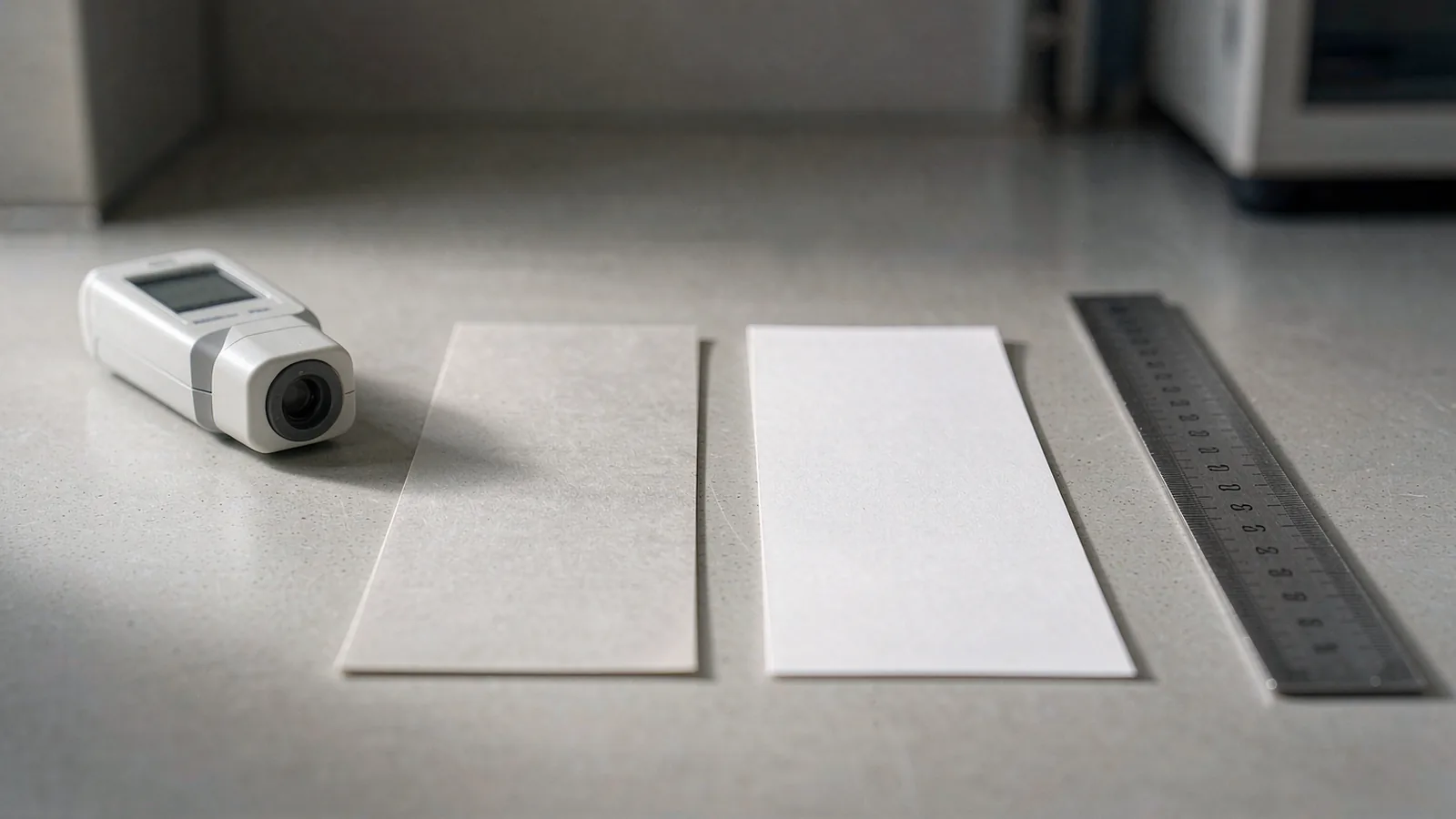
Programme shorthand: 'COA + SDS agreed per shipment, five-check incoming routine, audit the process not the brochure, pre-shipment photos every load, retained standard per grade, scorecard every shipment.'
Frequently asked questions
What should a thermal paper COA contain?
Measured values for the shipped batch, not nominal specifications: grammage in gsm, caliper, optical density at a stated print energy, sensitivity class or activation temperature, and a batch number traceable to the coating run. A COA without measured values is not evidence of anything.
How can I check thermal paper quality without a laboratory?
Five checks cover most risk: weigh and measure sample rolls against the specification, print a test pattern on a reference machine and compare density to a retained sample, store samples in real conditions and observe curl after 24-72 hours, inspect roll edges and winding, and reconcile the COA and SDS against the contract.
Why does the SDS matter if the paper specification is unchanged?
The SDS names the developer chemistry actually used in the batch — the fact behind BPA-free or phenol-free claims. Mills can switch developer systems between batches, so buyers in regulated markets or public-handled applications verify the SDS at every shipment against the compliance clause in the contract.
What is the most important thing to look for in a mill audit?
Process records under stress: per-batch sensitivity and coating-weight test logs, a non-conformance log with real entries, batch traceability that resolves in minutes, and a QC function independent enough to stop a run. These reveal a control system; a showroom tour does not.
What is a retained reference sample and why keep one?
A signed sample from the approved production run of each grade, kept by both buyer and supplier. Every incoming inspection compares against it, so density, curl or winding drift becomes a measurable difference between shipments instead of a dispute between memories.