
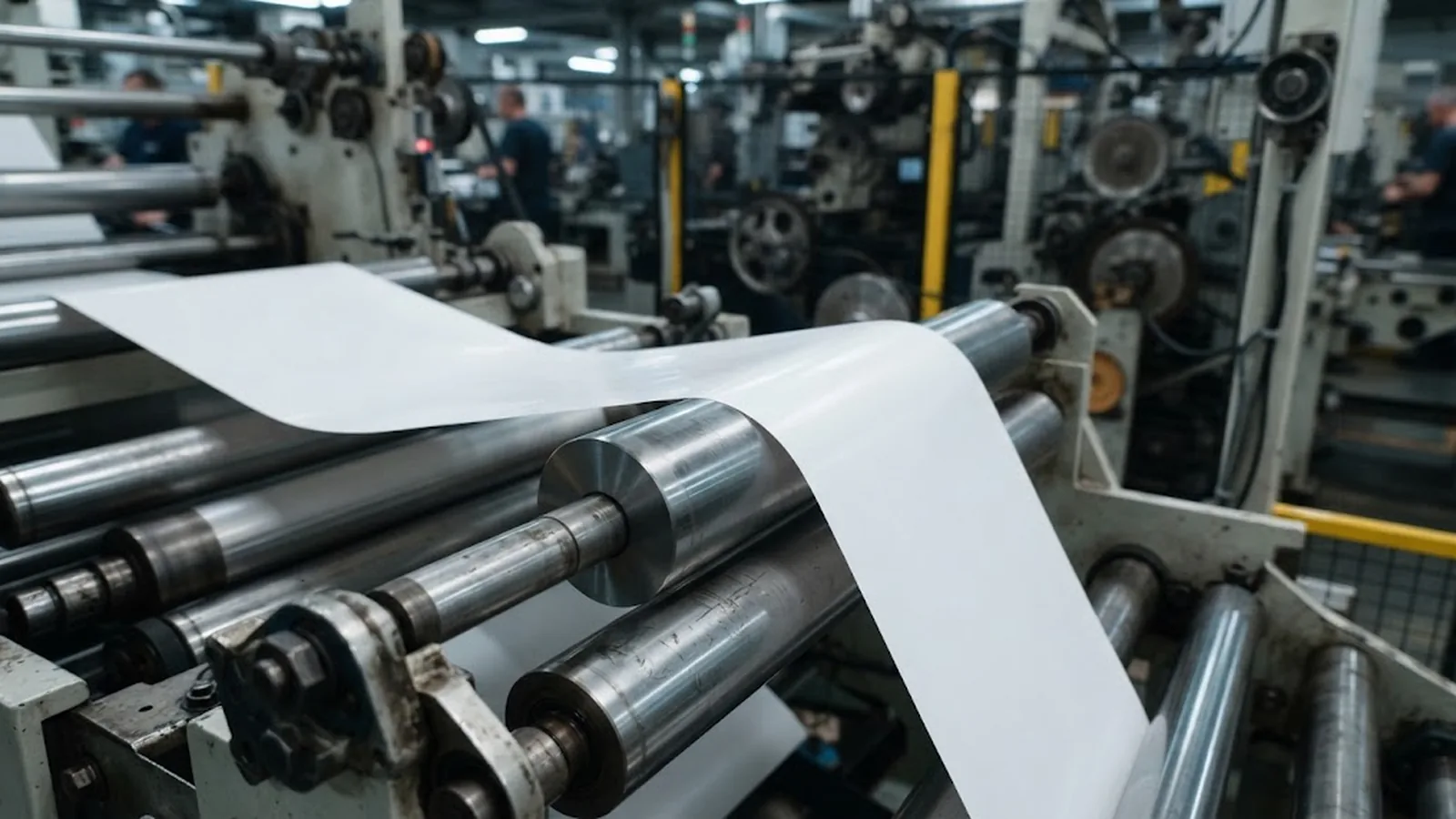
Thermal paper is a layered structure, not a single treated sheet. From bottom to top it consists of: (1) a base paper providing body, stiffness and economy; (2) a precoat that smooths and evens the surface so the active chemistry can sit uniformly; (3) the thermal layer itself — a micrometres-thin film of leuco dye, developer and binder that images under the print head; (4) an optional topcoat that protects the image from water, oil, abrasion and plasticisers; and (5) an optional backcoat on the reverse controlling curl, friction and static. The base paper typically accounts for the great majority of total grammage, while everything that determines print quality lives in the few microns of coating above it. Buyers who understand the structure can read specifications critically: weight tells you about the base, coating descriptions tell you about performance, and anything not stated is where quality differences hide.
Ask for a spec sheet on any thermal grade and you will get grammage, caliper and roll dimensions — the geometry of the product. What the spec sheet rarely shows is the architecture: thermal paper is built in layers, and almost every property a buyer cares about is a property of a specific layer, not of the sheet as a whole.
This matters commercially. Two 55 gsm rolls can look identical side by side and behave completely differently at the print head, because one carries a properly formulated precoat and thermal layer and the other economises on exactly the microns you cannot see. Understanding the structure converts quotation comparison from guesswork into engineering.
This guide walks through the sheet from base to surface: what each of the five layers is, what it contributes, how the weight and thickness split, and how the construction explains the properties — stiffness, curl, sensitivity, image life — that show up in your customers' hands.
- Thermal paper is a five-layer system: base paper, precoat, thermal layer, and optional topcoat and backcoat.
- The base paper dominates grammage and cost; the coatings dominate performance.
- The precoat is the quiet quality layer — it evens the surface so the thermal layer develops uniformly.
- The thermal layer is only micrometres thick but carries the entire imaging function; its formulation sets sensitivity and print density.
- Topcoat and backcoat are optional engineering choices — their presence or absence should map to an application requirement in the spec.
Layer 1 — the base paper
Everything starts with the base stock: a fine, lightweight paper, usually in the 40–70 gsm range, engineered for smoothness, dimensional stability and cleanliness. The base contributes the bulk of the sheet's grammage — typically 80–90% of total weight — and therefore most of its stiffness, caliper and cost structure. This is why weight differences between grades (48 vs 65 gsm) translate directly into feel and rigidity: heavier bases make tickets that survive pockets and machines.
Base quality is not generic. Pulp furnish, fillers and internal sizing are selected for what the finished structure needs: high smoothness so the coatings can be applied thin and even, low porosity so the thermal chemistry does not migrate into the sheet, and stability across humidity so finished rolls do not curl or wavy-edge in the warehouse. Impurities matter more here than in ordinary paper — specks or aggressive residues in the base become visible defects in an imaging surface.
For buyers, the practical reading is: the base paper is the economy lever, and it is also the stiffness and handle lever. When a quotation is far below market, the economy was usually taken here — a thinner or dirtier base — because the buyer cannot see the difference until converting or printing.
- Typical contribution: 80–90% of total grammage; sets stiffness, caliper, hand feel.
- Key base properties: smoothness, low porosity, dimensional stability, cleanliness.
- Heavier bases (65–75 gsm grades) serve tickets, boarding passes and banking records.
Layer 2 — the precoat
The precoat is the layer most outsiders have never heard of and most papermakers consider decisive. Applied directly onto the base, it is a thin mineral-and-binder layer — usually calcite or other fine pigments — whose job is to level the surface: it fills the paper's microscopic fibre texture and presents the thermal layer with a uniform, controlled foundation.
Why it matters so much: the thermal layer is only a few micrometres thick. If the surface under it is uneven, the active chemistry sits in films of varying thickness, and the print head's heat response varies with it — the visible results are weak or patchy print, reduced density and inconsistent sensitivity across the web. A good precoat also controls the absorption balance between layers, keeping the imaging chemistry where it belongs.
Precoat quality is one of the clearest separations between a full-scale manufacturer and a Coater-of-convenience. Coating an even precoat at consistent weight across a full jumbo, at line speed, is a process-control discipline — and it is invisible in a quotation. When auditing a supplier, ask about precoat application and coat-weight control; the answer quality tells you a lot about the plant.
Layer 3 — the thermal layer
The thermal (or sensitive) layer is the product's reason to exist: a film of a few micrometres containing the colour former (a leuco dye), the developer that reacts with it when melted, sensitisers that lower the reaction temperature, and binders that hold the chemistry in place on the sheet. At rest the dye and developer coexist inertly; under the print head's thermal pulse they react and the contact point turns black.
The formulation inside this layer is where grades are actually made. Dye-developer chemistry determines the image colour and the fundamental density ceiling; sensitiser package determines how much energy the print head must deliver — the difference between a grade that prints crisply on an efficient 8-dot head and one that looks grey on the same machine; binder system determines coating integrity, rub behaviour and how the layer ages.
Coating weight here is measured in grams per square metre at single digits and controlled to tight tolerances. Too little and the image starves; too much and the grade wastes chemistry while gaining sensitivity it did not need. This is the layer where a manufacturer's R&D investment is most visible — and where buyers should demand test evidence: print density against a reference head, sensitivity matching to their machine class, and background stability.
| Layer | Indicative weight / thickness | Primary function |
|---|---|---|
| Base paper | ~45 gsm of 55 gsm total | Body, stiffness, economy, stability |
| Precoat | ~5–8 gsm | Surface levelling for uniform imaging |
| Thermal layer | a few micrometres; low gsm | Heat-sensitive imaging chemistry |
| Topcoat (optional) | 1–2 gsm | Water/oil/abrasion protection, image life |
| Backcoat (optional) | 1–2 gsm | Curl control, friction and static management |
Layer 4 — the topcoat
Where an application needs the image to survive the world, the topcoat is the engineering answer: a very thin protective film laid over the thermal layer. It slows moisture ingress, shields the dye system from oils and plasticisers, resists surface abrasion from handling and transport, and buffers minor thermal and light exposure. In practice a good topcoat multiplies usable image life several times over an equivalent uncoated grade.
The topcoat also changes surface behaviour at the print head — slightly different friction and thermal transfer — so it must be tuned together with the thermal layer rather than added independently. That co-tuning is another reason the same plant should control both layers, and why grades from a single coating line tend to print more consistently than blends a reseller assembles from different sources.
Buyers should treat 'top-coated' as a specification with numbers attached: coat weight, water and oil resistance results, abrasion cycles, and accelerated-ageing image retention. A grade that carries a topcoat without published test data should be priced like the uncoated grade it may effectively be.
Layer 5 — the backcoat, and what the stack means for buyers
The reverse of the sheet carries its own optional engineering. A backcoat is a functional layer on the non-printing side that manages the mechanical behaviour of the finished roll: it balances the sheet so moisture changes do not curl it toward the coated face, controls friction so rolls feed cleanly through machines, and can carry static-dissipative function for label converting. Back-coated constructions are common in label stock and in grades destined for humid climates or long warehouse dwell.
Read as a whole, the stack explains the properties that end up on complaint tickets. Curl is a balance problem between layers responding to humidity. Feed jams track friction and stiffness — base and backcoat territory. Weak or patchy print is precoat and thermal-layer territory. Faded images are topcoat and formulation territory. A buyer who can map a symptom to a layer can have a precise, technical conversation with a supplier instead of a vague quality argument.
That is the practical payoff of understanding structure: the spec sheet you write can name the layers that matter for your application, and the supplier who answers those questions precisely is the supplier who actually controls their coating line.
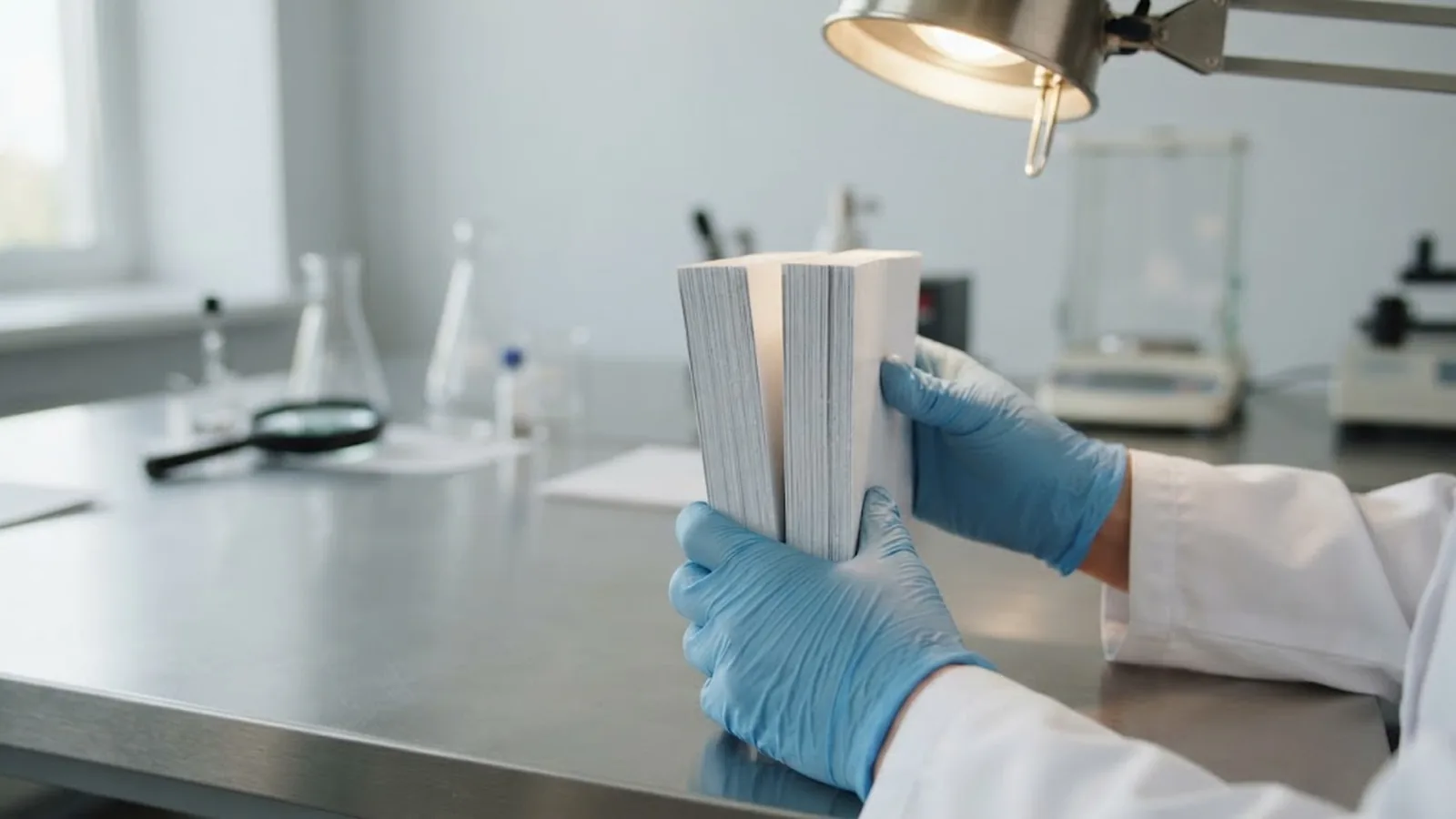
When comparing quotes, ask which layers are included and at what coat weights — two same-price grades can differ by an entire topcoat.
Frequently asked questions
How many layers does thermal paper have?
Structurally up to five: base paper, precoat, thermal layer, and optional topcoat and backcoat. The first three are standard on every true thermal grade; the protective and functional outer layers are engineering choices driven by the application.
What is the precoat and why does it matter?
A thin mineral-and-binder layer applied to the base paper to level the surface before the thermal chemistry. Because the thermal layer is only micrometres thick, the precoat's evenness directly determines print density and consistency. It is one of the clearest quality differentiators between coating plants.
Which layer makes the image?
The thermal layer — a micrometres-thin film containing the leuco dye, developer, sensitisers and binders. Heat from the print head triggers a reaction between dye and developer at the contact points, forming the image inside the coating rather than on top of it.
Is back-coated thermal paper better?
It is different, not universally better. A backcoat manages curl, friction and static — valuable for label converting, humid climates and high-speed feeding. For a standard receipt grade in benign conditions it adds cost without adding print value. Match it to the application.
How should structure knowledge change my specification?
Specify beyond grammage: state which coatings your application requires and ask for coat weights and test evidence. Weight tells you about the base paper; performance lives in the coatings — and unstated layers are where cheap grades economise.