
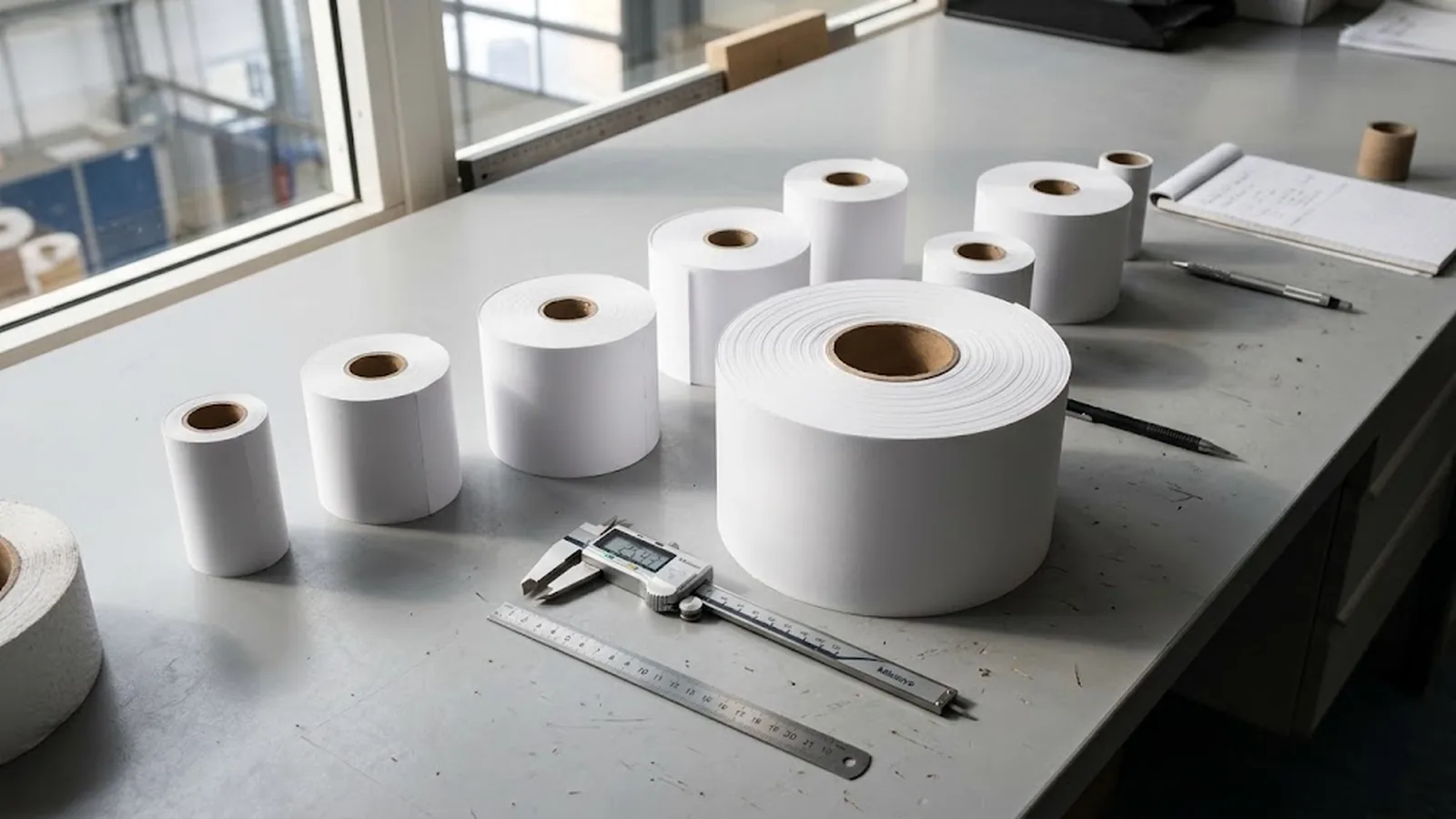
Measure a thermal paper roll in three dimensions: width across the paper edge to edge, outside diameter across the full wound roll, and core inner diameter of the cardboard tube. Roll length can then be estimated from the formula L = π × (R² − r²) / t, where R is the outer radius, r the core radius and t the paper thickness. Specify all four values plus tolerance when ordering, because two rolls with the same width and diameter can hold very different lengths depending on paper thickness and core size.
A large share of thermal paper ordering mistakes start with an incomplete measurement. A roll that looks right can still be too wide for the compartment, too hard for the spindle, or so much thinner than the original that it runs out twice as fast. Measuring properly takes five minutes and prevents an entire container of frustrating stock.
This guide covers the three dimensions to measure directly — width, outside diameter and core inner diameter — how to convert them into an estimated roll length, why each measurement matters to the machine the roll feeds, and how tolerances turn loose numbers into a specification a factory can quote and hold.
It is written for buyers replacing an existing consumable, for converters checking incoming jumbo stock, and for anyone specifying a private-label roll program where the measurement must be written down once and reproduced thousands of times.
- Measure width, outside diameter and core inner diameter; calculate or specify length as the fourth value.
- Always measure width across the paper, never including the core or flanges.
- Roll length follows from diameter, core and paper thickness — estimate it with the winding-area formula.
- Tolerances matter: typical commercial practice is roughly ±0.5 mm on width and ±1 mm on diameter.
- GSM affects all four values: at the same diameter, a lighter paper simply holds more metres.
The three measurements that define a roll
Every finished roll is defined by three directly measurable dimensions plus one derived value. Width is the distance across the paper from one edge to the other, measured perpendicular to the core axis. Outside diameter is the distance across the full wound roll at its widest point. Core inner diameter is the clear inside diameter of the cardboard tube the paper is wound onto.
Length — how many metres of paper the roll contains — cannot be measured directly without unwinding, so it is either calculated from the other dimensions and the paper's caliper, or taken from the supplier's specification. It is nevertheless the number with the biggest effect on cost per usable metre.
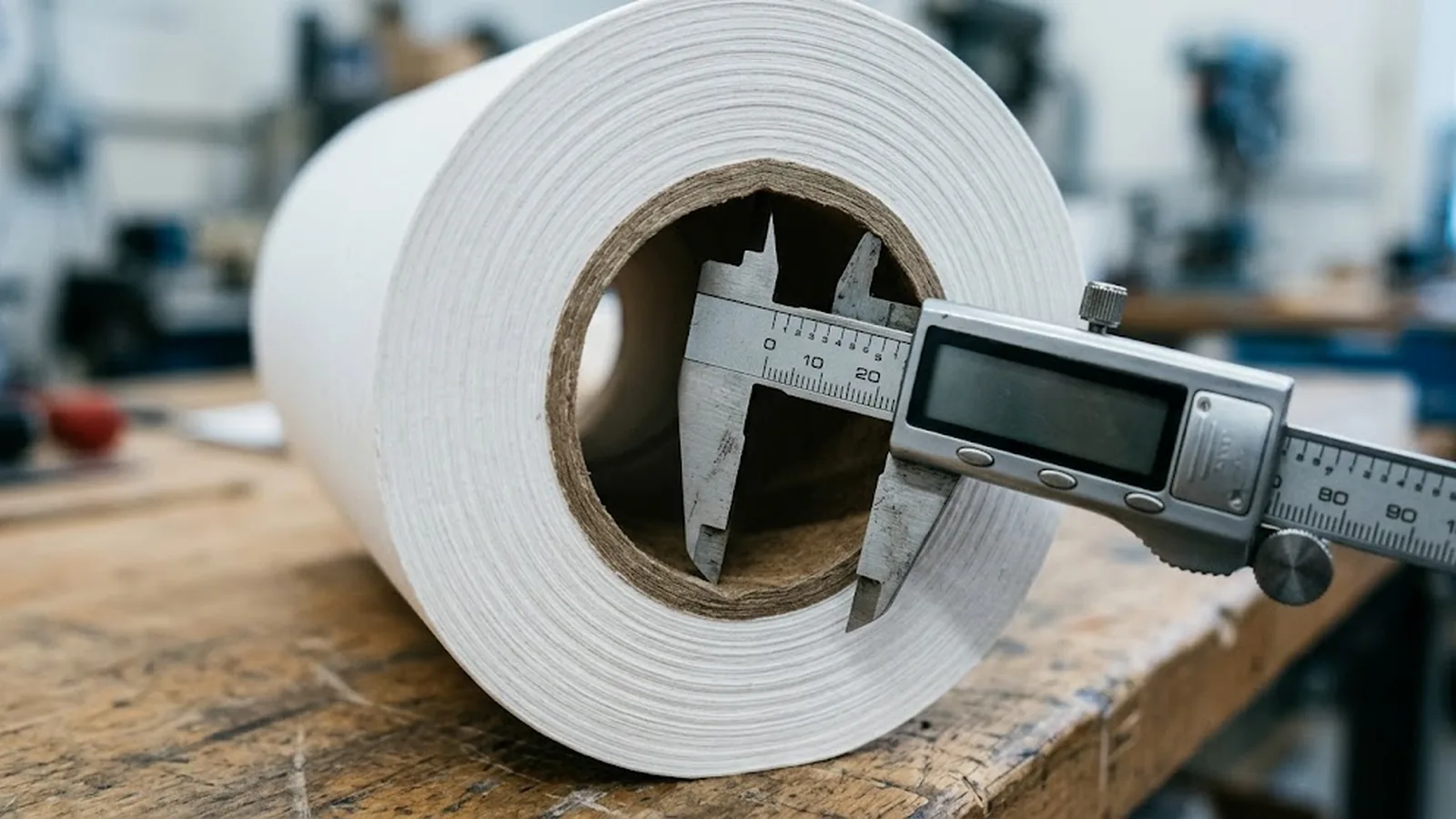
Measure with a ruler or steel tape for width and diameter, and a caliper gauge for the core if one is available. Take each measurement at two or three points around the roll and average; a roll that is slightly out of round will otherwise give you a misleading single reading.
| Dimension | What it controls | Typical tolerance |
|---|---|---|
| Width | Fits the paper path edge-to-edge; feeds straight without skewing | ±0.5 mm |
| Outside diameter | Fits the roll compartment; determines how many metres per load | ±1 mm |
| Core inner diameter | Fits the spindle or centre pin that drives the roll | ±0.5 to ±1 mm |
| Length | Roll change frequency and cost per metre | −0% / +2% (never short) |
Tolerances shown are common commercial planning values; agree exact tolerances with your supplier for the specific machine.
Measuring width correctly
Lay the roll on a flat surface and measure straight across the face of the paper from one cut edge to the other. Do not include the core — on coreless rolls the paper is its own core, but on standard rolls the cardboard tube must be excluded from the width reading, and on rolls with protective flanges the flanges obviously do not count either.
Check the measurement at two or three spots around the circumference, because a slightly angled cut can make one side a fraction of a millimetre wider. If your machine is tight on clearance, record the widest reading, not the average.
Width is the dimension buyers most often mis-measure by rounding. A roll that measures 79.5 mm is not an 80 mm roll if the compartment allows 80 mm exactly; it may be intended as a 79.5 or 79 mm product. Write down what you measured, then ask the supplier which standard size it corresponds to — the common receipt families include 57 mm and 80 mm widths alongside 2 1/4 inch and 3 1/8 inch formats in inch-based markets, and label stock is usually quoted in metric such as 100x150 mm.
Measuring outside diameter and core size
Stand the roll on end and measure straight across the widest point of the wound paper. Measure twice, rotating the roll a quarter turn between readings, and average the two. Diameter is the dimension that decides whether the roll fits the compartment, so it is also the dimension where oversize causes jamming rather than mere inefficiency.
For the core, measure across the open centre. Standard receipt-roll cores are commonly 12.7 mm (half inch) in card-machine formats, with 25.4 mm (one inch) and larger cores used on wider rolls and label stock; jumbo rolls typically run on 76 mm (three inch) cores. Getting core size wrong is the most absolute of all fitting errors — a roll that does not fit the spindle simply cannot be loaded.
While you are at the core, check core condition on incoming stock: a crushed or delaminated core causes telescoped winding and will not track straight even though every paper dimension is correct.
Estimating roll length from your measurements
Roll length can be estimated because the paper in a roll forms an annulus — a ring — whose cross-sectional area divided by paper thickness gives the total length. The working formula is L = π × (R² − r²) / t, where L is length, R is the outside radius, r is the core outer radius (effectively the inner radius of the paper ring), and t is the caliper of the paper in the same units.
Worked example: an 80 mm diameter roll on a 12.7 mm core, wound from paper at roughly 0.06 mm caliper. R is 40 mm, r is about 6.35 mm, so the area term is π × (1600 − 40.3) ≈ 4900 mm², and dividing by 0.06 mm gives roughly 81,700 mm — about 81 metres. The same diameter wound from a 75 gsm grade at a heavier caliper of around 0.10 mm yields only about 49 metres.
That comparison is the whole economic story of roll sizing: at fixed width and diameter, lighter paper means more metres. Use the formula as a sanity check on quotes — if a supplier's stated length implies a thinner paper than your sample, the rolls will look identical but run out sooner. Converters buying jumbo stock apply the same formula at jumbo scale, where the outer radius is hundreds of millimetres and the length runs into thousands of metres.
- Keep all units consistent — the formula works in millimetres or metres, never mixed.
- Use the paper's caliper, not its gsm number; convert via the grade's datasheet if needed.
- Treat results as estimates: winding tension and caliper tolerance move real length a few percent.
- For programme buying, agree length per roll contractually rather than trusting diameter alone.
Turning measurements into a specification
A complete specification converts your measurements into language a factory can quote, produce and hold to tolerance. The minimum set is width with tolerance, outside diameter with tolerance, core inner diameter and core type, target length or minimum length per roll, paper grade or gsm, and winding direction — which end of the paper prints on the outside, an easily overlooked detail that changes how the roll loads into some machines.
If you are replacing an existing consumable and cannot find its specification, measure as described and send the numbers plus a photo of the roll in its machine. An experienced manufacturer can usually identify the standard size family immediately and confirm whether an off-the-shelf construction matches or a custom width is needed.
Finally, record the measurement on the packaging or in your purchasing system. When the next order goes out six months later, the specification — not a remembered roll — is the reference, and the sample you kept in the drawer becomes the arbitration standard if the delivery differs.
Frequently asked questions
How do I measure the width of a thermal paper roll?
Measure straight across the face of the paper from one cut edge to the other, excluding the core and any flanges. Take the reading at two or three points around the roll and use the widest value if the machine compartment is tight on clearance.
How do I calculate how many metres are on a roll?
Use L = π × (R² − r²) / t, where R is the outside radius, r is the core outer radius and t is the paper caliper, all in the same units. For example, an 80 mm roll on a 12.7 mm core at 0.06 mm caliper holds roughly 81 metres; the same size at 0.10 mm caliper holds about 49 metres.
What core sizes are standard for thermal paper rolls?
Receipt and card-machine rolls commonly use 12.7 mm (half inch) cores, wider rolls often use 25.4 mm (one inch), and jumbo parent rolls are typically wound on 76 mm (three inch) cores. Always verify with a measurement, since non-standard cores exist for specific machines.
Can two rolls with the same size hold different lengths?
Yes, and it is common. Length depends on paper caliper and winding tension, so two rolls identical in width and diameter can differ by tens of percent in metres. Compare length per roll, not size alone, when evaluating prices.
Why do I need to specify winding direction?
Rolls can be wound so the printing surface faces out or in. Machines that unwind from a specific orientation need the matching winding, otherwise the image ends up on the wrong side or the roll feeds backwards. It is a one-line item in a specification that prevents a full delivery being unusable.