
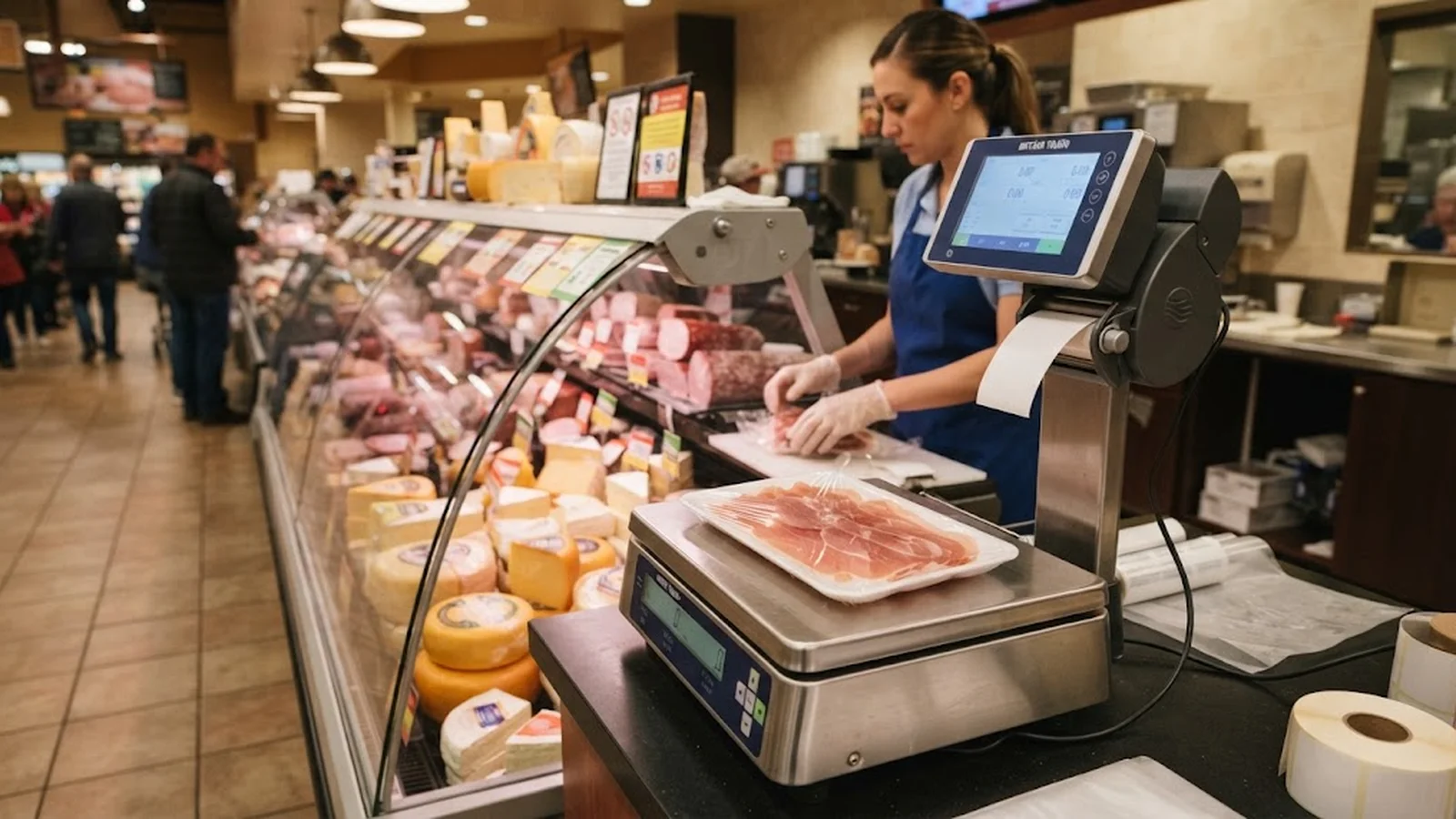
Weighing scale labels are die-cut direct thermal labels sized and finished for in-store weighing printers — the units at deli, butcher, seafood, cheese and produce counters that print weight, unit price, total, barcode and product data onto a label applied straight to a food pack or wrap. The specification has three sides: the die (diameter, gap or mark sensing, layout for barcode and text zones), the construction (facestock weight, adhesive class for film trays, wet or frozen surfaces, and a topcoat where chiller humidity or shelf life demand it), and the compliance side (scannable barcode grades and food-adjacent chemistry declarations). Labels that ignore any of the three show up in store as misreads, lifted corners and re-prints at the worst possible moment — the customer queue.
The weighing scale is the hardest-working printer in a supermarket. A busy deli counter, butcher shop or produce department pushes out hundreds of labels a day — each one a small document carrying product name, weight, unit price, total, a scannable barcode and, increasingly, ingredient or traceability lines. When the label stock is right, nobody notices; when it is wrong, the failures are loud and public: a barcode the scanner rejects at the checkout, a label curling off a chilled pack, a roll that jams the scale at lunchtime rush.
Weighing scale labels therefore sit at the intersection of three specification disciplines that buyers usually meet separately: die-cutting and printer sensing, label construction and adhesive science, and image life in cold, humid, food-adjacent conditions. Getting all three right at once is what separates label stock specified for scales from generic thermal labels repurposed for them.
For construction options behind each label format, buyers can review our top-coated thermal label stock, where facestock weight, coating structure and adhesive class are documented per grade before ordering.
This guide covers where scale labels fit in the store's paper programme, how the die and sensing system constrain the buy, which constructions survive chillers and condensation, the size and format landscape, and the compliance points — barcode grades and chemistry declarations — that retail audits increasingly check.
- Scale labels are a die-first product: diameter, gap or black-mark sensing and the label layout must match the scale printer fleet before any construction decision is made.
- Adhesive class decides real-world performance — general-purpose adhesive lifts off film trays, wet surfaces and frozen packs; each counter condition needs its matched class.
- Chiller humidity and condensation are the main image-life threat; a top-coated construction buys density and scan reliability over shelf life.
- Label geometry drives barcode readability: quiet zones, print contrast and curl control matter as much as the scale's print engine.
- Food-adjacent positioning raises the chemistry bar: declared BPA-free or phenol-free structures with batch documentation are the audit-proof default.
Where scale labels sit in the store's paper programme
A grocery or fresh-market operation runs two distinct thermal paper streams. Receipt paper — till rolls, payment terminal rolls, kiosk slips — is wound, core-fed and printed edge to edge. Scale labels are the other stream: die-cut shapes on a liner, gap-sensed, applied to food packaging rather than handed to a customer. Mixing the two procurement tracks is the classic error; the label stream has its own die inventory, adhesive classes and storage rules.
The counters that consume labels are predictable: service deli, butcher and seafood counters, in-store bakery and hot-food packaging, cheese islands, self-service produce scales and pre-pack rooms where central scales batch-label for the floor. Volume concentrates where staff weigh and pack to order, which is why label programmes are usually specified per department rather than per store — a pre-pack room running one label size all day has a different buy than a multi-size deli counter.
The buying unit follows the scale fleet. Label rolls are specified by outer diameter and core to match the scale's media bay, and by die-cut size and layout to match what the scale's firmware prints. Because scales from different generations often coexist in one store, the label schedule usually carries two or three diameters and several die sizes at once — a consolidation opportunity for a converter, but only if the constructions are aligned first.
Die, sensing and the printer fit
In-store weighing scales feed label stock from a roll, detect the leading edge of each label by its gap (or, in some formats, a printed black mark), and stop precisely for printing and dispensing. That mechanism makes the die-cut specification non-negotiable: label length, inter-label gap, roll diameter and core size all must sit inside the scale manufacturer's media tolerance, or the printer misfeeds, misprints or stops mid-queue.
Label layout inside the die is equally structured. A typical grocery label carries a barcode zone with defined quiet zones, fixed text blocks for product and store data, and variable zones for weight and price — all positioned by the scale's label editor. Stock changes that shift the printable area (a shorter die, a different gap) require a firmware template change on every scale, so die changes are fleet decisions, not station decisions. Common family sizes run from small produce prints of roughly 40 x 30 mm through 58 x 40 mm service-counter formats up to larger ingredient and traceability labels, but the right schedule comes from the installed fleet, not from a catalogue.
For production volumes, the same fit logic applies to our thermal paper jumbo rolls, quoted per jumbo roll, slit reel or finished format — the stock behind die-cut label programmes once the die schedule is fixed.
Construction: facestock, adhesive and the chiller problem
Label construction starts with the facestock — the direct thermal paper that carries the image. Weight and stiffness affect how the label lies on curved trays and film wraps; caliper affects die-cutting and dispensing reliability. The thermal coating determines print sensitivity and, with it, how well the label scans at checkout — an under-specified coating prints grey barcodes that fail first-pick scans and slow every queue behind them.
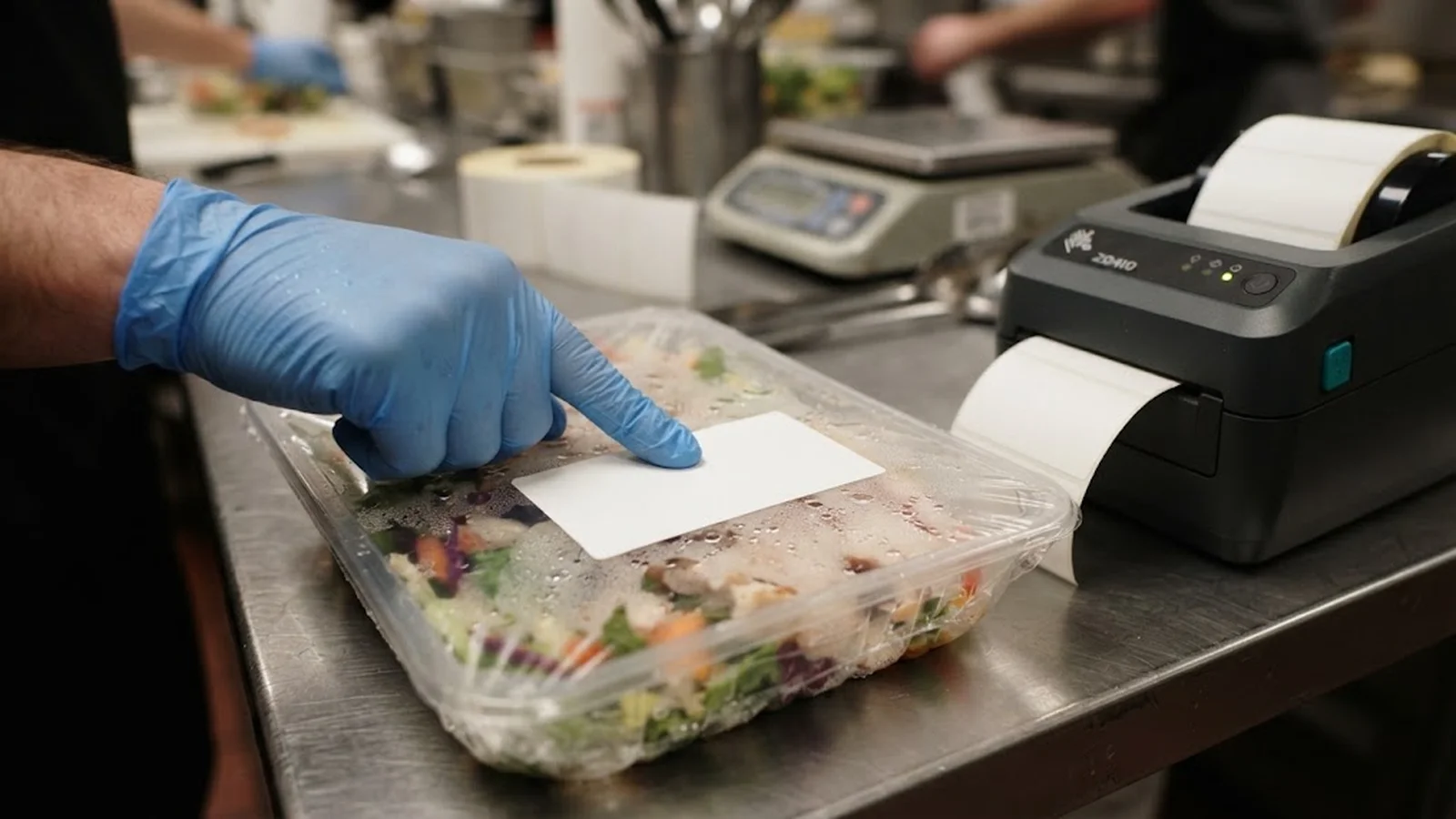
Adhesive is where generic labels fail hardest at the fresh counter. A general-purpose adhesive bonds well to cartons and dry surfaces but lifts on the films, trays and moist cut surfaces of a deli pack. Service counters need adhesives rated for high-surface-energy films and cold or damp application; pre-pack rooms label straight from the chiller, where condensation on the pack is routine; frozen-programme labels need a class that grips through frost and stays put through the freeze-thaw cycle. Matching adhesive class to counter condition is a specification exercise, not an upgrade at checkout.
Image life adds the third dimension. Chilled display cases keep packs in cool, humid air, and condensation forms when packs move between zones — exactly the environment where uncoated thermal surfaces lose density fastest. Where a pack must stay scannable and legible for its full shelf life, our top-coated vs non top-coated guide compares the two constructions on retention, cost and machine behaviour — for weighed fresh labels, the top-coated construction usually earns its premium.
Where developer compliance is part of the specification, our BPA-free vs phenol-free guide documents the chemistry, the regulations and the paperwork behind each class — the reference most retail compliance teams attach to the label tender.
Formats, barcodes and compliance
The barcode is the label's contract with the checkout. A weighed-item barcode encodes the PLU or article number with the weight or price embedded, and it must scan first time from a label that has been handled, chilled and possibly condensed on. Practical reliability comes from three quiet disciplines: enough quiet zone around the code, print contrast from a coating that develops full density, and label flatness — curl or a lifted edge is the most common cause of scan failures on weighed packs.
Beyond the barcode, grocery labels increasingly carry regulatory and trust content: ingredient and nutrition lines where the label is the product's declaration, country-of-origin or traceability fields, and date-of-packing marks for food safety. Retailers operating in markets with bisphenol restrictions — the EU limits BPA in thermal paper and several other jurisdictions have followed — increasingly write declared BPA-free or phenol-free constructions into the label tender, with the chemistry named on datasheet and batch documentation.
Audit readiness is therefore part of the specification, not an afterthought. A label programme should arrive with its paper trail: the construction sheet naming facestock, adhesive class and developer system; die and gap tolerances against the scale fleet; and batch documentation tying shipments to the approved grade. Retail quality teams treat scale labels the way they treat food-contact packaging — checkable, traceable and specified in writing.
| Specification point | What to fix | Why it matters |
|---|---|---|
| Die size & layout | Label length/width, gap, barcode and text zones | Must match scale firmware templates fleet-wide |
| Roll format | Outer diameter, core size, winding direction | Feeds the scale media bay without misfeeds |
| Facestock & coating | GSM, sensitivity, top-coated or not | Barcode density and scan first-pick rate |
| Adhesive class | Film, cold/damp, frozen as needed | Label stays put on trays through shelf life |
| Chemistry declaration | BPA-free / phenol-free on datasheet & COA | Retail audit and market regulatory compliance |
Sourcing a scale label programme
The clean sourcing sequence starts with the fleet audit: list every scale model, its media format and its label templates, and consolidate the die schedule where the fleet allows. Then specify construction per counter condition — one adhesive class rarely covers a wet seafood counter and a dry produce pre-pack room equally well, and pretending it does is how labels end up in the bin at closing time.
Custom die sizes and programme-specific layouts are standard converting work; requests that combine several formats can be quoted together through our custom thermal paper programme, where die tooling, constructions and packing are specified per line before an order is placed. Sampling then closes the loop: run candidate labels on the actual scales, apply packs through a full day of counter work, and check scan rates and edge adhesion after a night in the chiller — a test that takes one store day and prevents a chain-wide mistake.
Tender shorthand: 'Die-cut direct thermal labels per fleet schedule; top-coated construction for chiller lines; adhesive class per counter (film / cold / frozen); BPA-free declared on datasheet and batch COA; barcode first-pick test on store scales before award.'
Frequently asked questions
What sizes do weighing scale labels come in?
Common grocery families run from small produce labels around 40 x 30 mm through 58 x 40 mm service-counter formats to larger ingredient and traceability labels, but the correct schedule comes from the installed scale fleet — die length, gap and roll diameter must match each scale's media specification and firmware templates.
Do scale labels need a top coating?
For chilled and fresh-food applications, usually yes. Chiller humidity and condensation are the fastest routes to density loss on uncoated thermal surfaces, and a top-coated construction holds barcode contrast and legibility through the pack's shelf life. Dry, short-turn environments can justify the economy of non-top-coated stock.
Why do scale labels fail to scan at checkout?
The usual causes are insufficient quiet zone around the barcode, low print density from an under-specified coating, and label curl or lifted edges from adhesive mismatch. All three are specification issues, and all three are caught by testing labels on the actual scales and checking scan rates after chilled storage.
Can one adhesive work for deli, produce and frozen labels?
Rarely. Deli and seafood counters need adhesives that bond to films and damp surfaces, produce pre-pack rooms label chilled packs with condensation, and frozen programmes need grip through frost and freeze-thaw cycles. Specifying adhesive class per counter condition is the standard approach.
Are BPA-free scale labels required?
In markets that restrict BPA in thermal paper, including the EU, compliance requires declared developer chemistry, and retailers increasingly extend that requirement to all food-adjacent labels. A declared BPA-free or phenol-free construction with the statement on datasheet and batch documentation is the audit-proof default for weighed fresh labels.