

A cash register paper jumbo roll is the wide, long parent roll of direct thermal paper from which converters slit the finished till and cash-register rolls that feed retail and hospitality POS fleets. Buying jumbo instead of finished rolls moves the slitting step in-house or to a nominated converter, which lowers cost per roll, unlocks custom widths and core sizes for local cash-register models, and gives the distributor control over winding quality, packaging and labels. The specification that matters is not width alone: GSM and coating class decide print performance in older single-station registers as much as in modern hybrid terminals, wound-in tension and core tolerance decide whether the finished roll tracks straight, and length-per-jumbo decides the yield arithmetic that makes the programme profitable. For export buyers, jumbo programmes are planned in containers — pallet height, moisture-barrier wrapping and documents are part of the quote, not an afterthought.
Every cash-register receipt starts life as a roll several metres wide and kilometres long. Before it is the 57mm or 76mm roll dropped into a till, it is a jumbo — a parent roll of direct thermal paper coated, calendered and wound at the mill, waiting to be slit into the formats a local market actually uses. The economics of the receipt-paper trade live in that conversion step: whoever controls the jumbo controls the margin.
For distributors, importers and converters supplying cash-register paper, buying finished rolls is convenient but expensive; buying a cash register paper jumbo roll and slitting locally converts freight into product. A single 800mm-wide jumbo carrying several thousand metres of yield can replace pallets of finished rolls at a fraction of the shipped volume, and the same parent stock feeds every till width the customer's market demands — provided the slitting, winding and quality checks are specified as carefully as the paper itself.
For production volumes, the same construction logic applies to our thermal paper jumbo rolls, quoted per jumbo roll, slit reel or finished format.
This guide walks the jumbo-to-till chain end to end: what a cash-register jumbo actually is, how parent-roll specifications map to finished till formats, the yield arithmetic converters run before committing to a container, the quality and winding checks that separate clean-running rolls from rejects, and the export logistics that move jumbo stock profitably between continents.
- A cash register paper jumbo roll is parent stock: wide, long, and slit into finished till rolls, so the converter — not the mill — decides the final formats, cores and packaging.
- Buying jumbo lowers landed cost per finished roll and centralises freight, but only pays back when slitting quality, yield assumptions and roll geometry are engineered, not guessed.
- Width, GSM, coating class, core ID, outside diameter and wound-in tension are the six jumbo parameters that determine every downstream till format.
- Yield arithmetic — linear metres per jumbo divided by roll length per format, minus trim and setup losses — decides programme margin; verify it against the mill's own meter readings.
- Jumbo programmes are container-scale purchases: palletisation, moisture-barrier packing and export documentation belong in the specification, not the after-sales conversation.
What a cash-register jumbo roll actually is
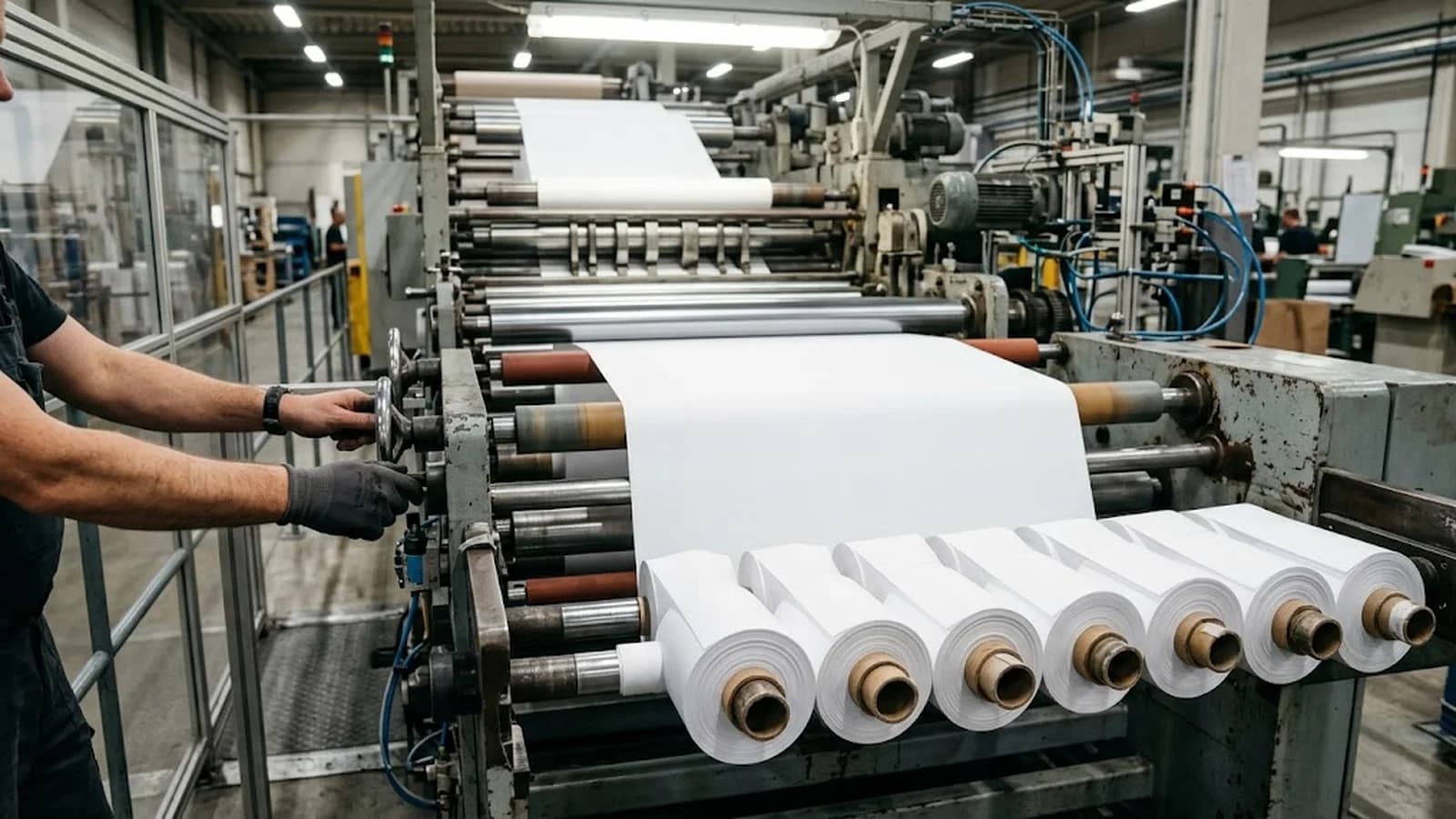
At the mill, direct thermal paper is coated and finished in widths that suit the coating line — commonly 565mm to 844mm and beyond — and wound onto cores into parent rolls thousands of metres long. Nothing about that width suits a cash register; the jumbo exists because coating machinery, quality control and freight all favour big, uniform rolls. The cash register paper jumbo roll is therefore the last common ancestor of every till roll a distributor will ever sell: the same parent stock can become 57x40 till rolls for a convenience chain, 76x70 rolls for a supermarket's hybrid registers, or 80mm rolls for a banking counter, depending only on how it is slit.
The distinction matters commercially because it decides who adds value where. The mill adds chemistry and coating; the converter adds geometry — width, core, diameter, wind direction, packaging; the distributor adds market access and service. A buyer purchasing finished till rolls pays for all three layers plus the freight on air (cores and packaging ship as volume). A buyer purchasing jumbo compresses the chain: the mill's product is shipped at maximum density, and the geometry layer is executed locally where it is cheapest and most responsive.
Cash-register applications also shape the paper itself. Older single-station print mechanisms and many value-line registers are less forgiving of marginal sensitivity than modern terminal printers, so till-stock buyers frequently specify mid-weight grades in the 55-65 gsm band, or heavyweight 70-80 gsm stock where receipts carry legal retention duties. The jumbo specification inherits all of these end-market demands — which is why converter-grade jumbos are quoted with GSM, sensitivity class and developer system stated, not implied.
Buyers comparing these specifications can review our POS and receipt paper rolls, where basis weight, coating construction and packing are documented per grade before an order is placed.
Mapping jumbo specifications to finished till formats
The conversion from jumbo to till roll is arithmetic before it is engineering. Slit width per register format determines how many lanes run across the jumbo: an 800mm parent might carry fourteen 57mm lanes with trim, or ten 76mm lanes, and the lane plan decides both yield and slitter setup time. Core size — 12.7mm and 25.4mm dominate cash-register markets — must be matched to the end printers, because a wrong core is a returned container. Outside diameter is bounded by the till's roll cavity, so the converter, not the mill, sets the final diameter by choosing where to stop rewinding or how many plies the finished roll carries.
Wound-in tension and edge quality are where jumbo specifications quietly become finished-roll quality. Too little tension and the finished roll loosens in the till, misfeeding at the printer's drive rollers; too much and the paper's micro-encapsulated chemistry can be stressed, or the outer laps telescope in humid climates. Edge trim must be clean — a whiskered edge sheds dust into the print mechanism — and lane spacing must hold tolerance across the full jumbo width so every lane, not just the centre, produces straight-tracking rolls.
Coating class follows the receipt's life. Till receipts that die in a pocket can run economical non-top-coated stock; receipts backing warranty claims, fiscal requirements or kitchen-exporder duty justify top-coated construction for scan-and-read retention. The converter should agree the class per end-customer programme, because the same jumbo width can carry either construction and the price difference is visible per finished roll.
Requests that combine several formats can be quoted together; see custom thermal paper programme for the construction options behind each one.
| Parameter | Jumbo-side value | Finished till format it controls |
|---|---|---|
| Parent width | 565-844 mm typical | Lane count and slit pattern per till width |
| GSM | 48-80 gsm | Roll length per diameter, register feel, receipt stiffness |
| Core ID | 12.7 mm / 25.4 mm | Fit on the till's spindle — a hard return if wrong |
| Length per jumbo | 2,000-7,000 m typical | Yield per jumbo and container planning |
| Wound-in tension | Mill-controlled | Tracking, telescoping, feed reliability in the till |
| Coating class | Top-coated or non-top-coated | Receipt image life and storage behaviour |
Yield arithmetic, quality gates and container-scale logistics
Programme margin lives in the yield calculation, and experienced converters run it before the quotation, not after the container arrives. Linear metres per jumbo divided by finished roll length gives theoretical roll count; trim allowances, splicing losses, setup reels and quality rejects shave the real number by a few percent. A jumbo quoted at a generous diameter but short on verified metres can quietly erase the conversion margin, so serious buyers tie payment terms to the mill's meter-counter readings or accept jumbos only with per-roll length verification.
Quality gates belong at two points: incoming jumbo inspection and finished-roll audit. At incoming, the converter verifies width and diameter against the packing list, checks core integrity, and runs a sensitivity patch test against a reference printer before committing the stock to a lane plan. At the finished end, spot checks on diameter consistency, roll squareness, core concentricity and end-cap cleanliness protect the distributor's returns rate. A documented incoming-and-outgoing routine turns slitting from a craft into a process that a container-scale business can rely on.
Logistics is the third discipline. Jumbos ship at high density but are unforgiving of moisture and rough handling: ocean containers need moisture-barrier wrapping and desiccant practice, pallet heights must survive double-stacking, and each jumbo needs end protection so a forklift kiss does not become a lane-wide defect. Buyers who treat the container as part of the specification — pallet layout, wrap class, labelling per jumbo — land stock that slits cleanly on day one.
Where container planning is the next step, our export shipping guide covers pallet standards, moisture-barrier packing and the document set for ocean freight.
Converter's jumbo specification shorthand: 'Direct thermal jumbo, [width] mm x [length] m on [core] mm core; [GSM] with tolerance; sensitivity class and developer system declared; wound-in tension per converter standard; meter-counter length certificate per roll; moisture-barrier export packing.'
Frequently asked questions
What is a cash register paper jumbo roll?
It is the wide, long parent roll of direct thermal paper from which finished cash-register and till rolls are slit. Jumbos typically run 565-844 mm wide and several thousand metres long, and the converter's lane plan turns that width into the 57mm, 76mm or 80mm formats end markets use.
Why buy jumbo rolls instead of finished till rolls?
Jumbo purchasing lowers landed cost per finished roll because freight ships at maximum paper density, and it lets the converter set final width, core, diameter and packaging for the local register fleet. The trade-off is that slitting capability, yield discipline and quality control move in-house.
How many till rolls come out of one jumbo roll?
Divide the jumbo's linear metres by the finished roll's length, then deduct trim, splices and setup losses. An 800mm x 6,000m jumbo carrying fourteen 57mm lanes can yield tens of thousands of short till rolls; the exact figure depends on format length, GSM and loss allowances.
What GSM should cash-register paper be?
Most till programmes run 55-65 gsm for a balance of roll length and stiffness; value formats may drop to 48-55 gsm, and receipts with retention or fiscal duties often use 70-80 gsm heavyweight stock. Match GSM to the register's roll cavity and the receipt's image-life requirement.
How should jumbo rolls be packed for ocean freight?
Moisture-barrier wrapping with desiccant, end protection on every roll, pallet layouts rated for the container and double-stacking, and per-jumbo labels tying the roll to its certificate. Thermal chemistry is humidity-sensitive, so packing class belongs in the purchase specification.