
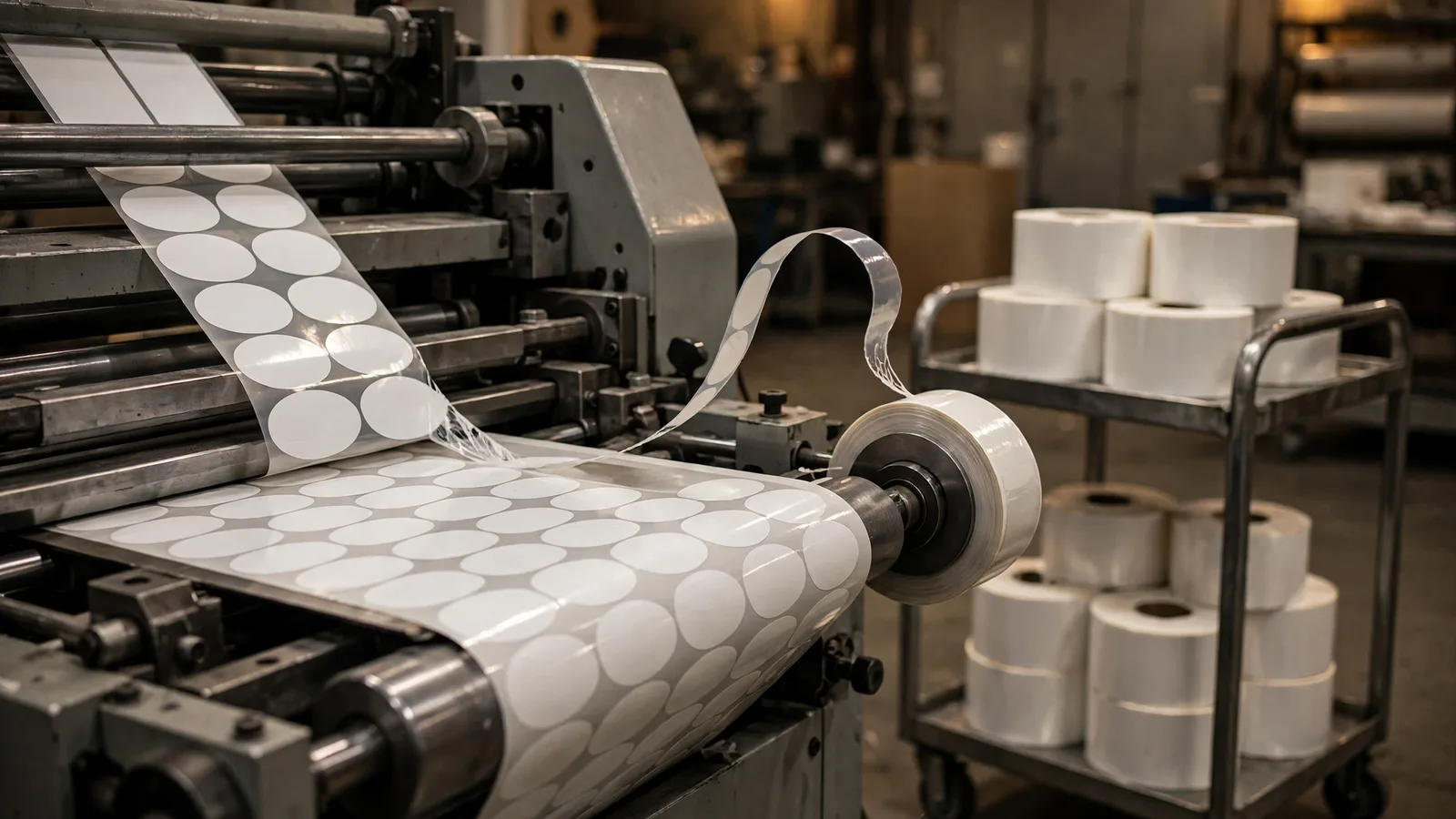
A self adhesive direct thermal label is a three-layer construction — a direct thermal facestock that images without ink, a pressure-sensitive adhesive layer, and a release liner that carries the stack until application — die-cut into shapes and wound into rolls. Buying it well means specifying all three layers, not just the imaging face: facestock grade and coating class, adhesive family matched to the application surface and environment, liner type matched to the dispensing method, die-cut pitch and matrix pull-off behaviour, plus roll geometry and packing. The imaging layer gets the attention; the adhesive and liner decide whether the label actually works in the field.
Receipt paper is a single layer with a coating; a self adhesive direct thermal label is a laminated system pretending to be a product. Three layers — imaging facestock, adhesive, liner — must be chosen to work together, then die-cut cleanly, wound consistently and dispensed without failures, before a single label prints. That complexity is why label stock behaves differently from paper rolls in quotations: two constructions with the same printed appearance can convert, dispense and adhere completely differently, and the differences live in specification lines most buyers never see.
This guide walks the construction the way a converter or an import programme should evaluate it: what each of the three layers contributes and how they interact, how die-cutting and matrix pull-off behave at the converting stage and what that means for application equipment, the specification lines that belong in the sheet before price is discussed, where the construction is made — converting from jumbo stock versus buying finished rolls — and the packing and documentation checks that carry labelstock through an export container intact.
Where a programme needs label constructions with documented coating classes, our top-coated thermal label stock shows how facestock grade, coating construction and packing are documented per specification — the starting point for comparing constructions honestly.
The sections follow the construction: layers first, converting behaviour second, the specification sheet third, the make-versus-buy question fourth, and the buying checks last.
- The construction is three decisions, not one: direct thermal facestock (plain or top-coated), adhesive family, and liner type — each specified independently and validated together.
- Die-cut quality and matrix pull-off are converting behaviours, not paper properties: they decide whether application equipment feeds cleanly or jams, and they are testable on a sample before volume.
- The specification sheet must carry all three layers plus roll geometry — facestock gsm and coating class, adhesive family, liner, die-cut pitch, OD and core — because adhesives and liners cannot be inspected on arrival.
- Converters can slit and die-cut labelstock from jumbo parent rolls; import programmes without converting equipment buy finished rolls — the make-versus-buy line is decided by equipment and volume, not preference.
- Labelstock is more packaging-sensitive than paper rolls: liner edges, roll shoulders and adhesive bleed all punish bad packing, so barrier wrap and pallet standards matter even more per container.
The three layers: facestock, adhesive and liner
The facestock is the layer everyone sees: direct thermal paper, coated so that it images against a heated element without ribbon or ink. It carries the same grade logic as receipt paper — basis weight, sensitivity class, and whether it is plain or carries a protective top coat that resists moisture, abrasion and the oils that shorten image life. The choice between plain and top-coated construction is an application decision: short-life logistics documents tolerate plain facestock, while labels that must stay scannable through handling, condensation or months of storage justify the top-coated construction's premium.
The adhesive is the layer everyone blames. Pressure-sensitive families differ in initial tack, ultimate bond, temperature range and behaviour on the surfaces a label actually meets — corrugated carton, film, plastic, recycled stock with variable surface energy. Cold chain, humid destinations and rough-surface applications each push the adhesive choice; a family that bonds beautifully to dry corrugated at room temperature can fail cold or lift on film. The adhesive is invisible on arrival and unfixable after application, which makes it the layer to specify hardest.
The liner is the layer everyone ignores until dispensing fails. Glassine, clay-coated or filmic liners release differently, caliper differently and survive die-cutting and humid storage differently. The liner must carry the stack through die-cutting without cutting through, release predictably at application speed, and lie flat in storage — three jobs that compete, which is why liner type belongs in the sheet rather than as a factory default.
Where image life is the deciding factor, our top-coated vs non top-coated guide compares the two facestock constructions on retention, cost and machine behaviour — the facestock half of the three-layer decision.
Converting behaviour: die-cutting, matrix pull-off and dispensing
Between laminated stock and finished roll sits the converting stage, and this is where self-adhesive constructions earn or lose their reputation. Die-cutting must cut through facestock and adhesive cleanly while leaving the liner intact — a cut that is too light tears fibres and leaves adhesive strings; too deep scores the liner and weakens it at dispensing. Matrix pull-off — the removal of the waste skeleton around each cut label — must happen without lifting label corners, or the roll feeds with lifted edges and misapplies downstream.
These behaviours are measurable on a sample and invisible on a datasheet. A roll can carry the right facestock grade and the right adhesive family and still convert badly if the die pressure, blade condition and pull-off tension are set for a different construction. This is why converters insist on trial material: run the proposed stock through the actual die and the actual applicator, count the jams, inspect the matrix release, and only then commit the specification. Buyers importing finished rolls should ask their supplier for the same evidence — a construction that converts cleanly at the factory converts cleanly in the field.
For production volumes, the same construction logic applies to our thermal paper jumbo rolls, quoted per jumbo roll, slit reel or finished format — converters die-cutting their own labelstock start from the parent stock rather than finished rolls.
The specification sheet: lines a labelstock buyer should insist on
Labelstock quotations hide more than paper quotations because two of the three layers cannot be inspected on arrival. The sheet should therefore name each layer explicitly, plus the roll geometry the application equipment expects. Facestock: basis weight with tolerance, coating class (plain or top-coated), sensitivity class. Adhesive: family, intended surface types, application temperature range, service temperature range. Liner: type, caliper, release behaviour class. Construction: die-cut shape and pitch, matrix pull-off standard, roll winding direction (labels out or labels in — applicators care). Geometry: outer diameter, core, rolls per case.
None of these lines costs anything to write and each prevents a specific failure: missing adhesive family becomes cold-weather lift-off; missing liner caliper becomes dispensing jams; missing winding direction becomes a pallet of rolls that feed backwards. The specification sheet is where a buyer converts a visual match into a functional match — the document a goods-in inspection can actually test against.
Where a programme needs several formats from one supplier, our custom thermal paper programme covers width, core, roll diameter and developer class in a single specification sheet — the basket structure that mixed paper-and-labelstock orders are built on.
- Facestock: gsm with tolerance, plain or top-coated class, sensitivity class.
- Adhesive: family, target surfaces, application and service temperature ranges.
- Liner: type and caliper, release class matched to the dispensing method.
- Construction: die-cut shape and pitch, matrix pull-off standard, winding direction.
- Roll geometry: OD, core, rolls per case; packing: barrier wrap and pallet pattern for the route.

Convert from jumbo or buy finished: where the construction is made
The make-versus-buy line for self-adhesive labelstock is decided by equipment and volume, not preference. Converters with slitters and label die-cutting lines buy parent stock — thermal jumbo rolls for the facestock, laminated labelstock parent constructions for the full stack — and produce finished rolls in the formats their customers need, with control over die, pitch and winding. Import programmes and end users without converting equipment buy finished rolls from a manufacturer's format list, trading format flexibility for the certainty of factory-set converting parameters.
Either route works; what does not work is mixing the assumptions. A buyer purchasing finished rolls still needs the converting evidence — matrix pull-off, die-edge quality and winding standard are factory properties being purchased, so the supplier should document them the way it documents grades. A converter purchasing parent stock needs the facestock and adhesive layers specified at the parent level, because a construction that laminates cleanly at the mill and dies cleanly on the buyer's line is a two-party specification, not a one-party hope.
Whichever route a programme takes, the deciding evidence is the same: the construction converts cleanly at the point where it will actually be used. Finished-roll buyers sample through their applicators; converter buyers trial the parent construction through their own dies — both before volume is committed.
Buying checks and documentation for export labelstock
Export adds physics to the checklist. Labelstock punishes poor packing faster than paper rolls: liner edges wick moisture, roll shoulders dent, and adhesive can bleed at the roll face in hot containers — each a defect that appears at dispensing months later. Barrier wrap per case, stable pallet patterns, corner protection and desiccant practice for tropical routes are therefore more than paper-roll hygiene; they are construction-preservation. The document set follows the same logic: COA for the facestock grade, SDS naming the adhesive and developer chemistry, and batch traceability that lets a goods-in inspection match what shipped to what was specified.
Where container planning is the next step, our export shipping guide covers pallet standards, moisture-barrier packing and the document set for ocean freight — the logistics half of a labelstock order.
Close the buying loop with the same trial discipline converters use: sample the proposed construction through the destination's application equipment, on the destination's surfaces, before the first volume container. Three layers specified on paper become one behaviour in the field, and the field is where the specification is finally graded.
Frequently asked questions
What is the difference between a self adhesive direct thermal label and plain thermal paper?
Plain thermal paper is a single imaging layer; the self adhesive label adds a pressure-sensitive adhesive and a release liner, then is die-cut into shapes and wound as labels. The imaging layer works like receipt paper, but adhesive family, liner type and die-cut quality decide whether the label applies, stays and dispenses correctly.
Which specification lines matter most for a self adhesive direct thermal label?
The three-layer lines: facestock gsm and coating class, adhesive family with surface and temperature ranges, liner type and caliper — plus die-cut pitch, matrix pull-off standard, winding direction and roll geometry. Adhesive and liner cannot be inspected on arrival, so they are the lines to specify hardest.
Why do converters insist on trial material before volume orders?
Because converting behaviour — die-edge quality, matrix release, dispensing feed — depends on how the construction interacts with a specific die and applicator, not just on datasheet values. A trial run on the actual equipment measures jams and release quality before volume is committed.
Can labelstock be converted from jumbo stock instead of bought as finished rolls?
Yes — converters with slitting and die-cutting equipment purchase parent constructions and produce finished formats in-house, controlling die, pitch and winding. Buyers without converting equipment buy finished rolls and should ask the supplier to document the same converting parameters, since those properties are factory-set.