
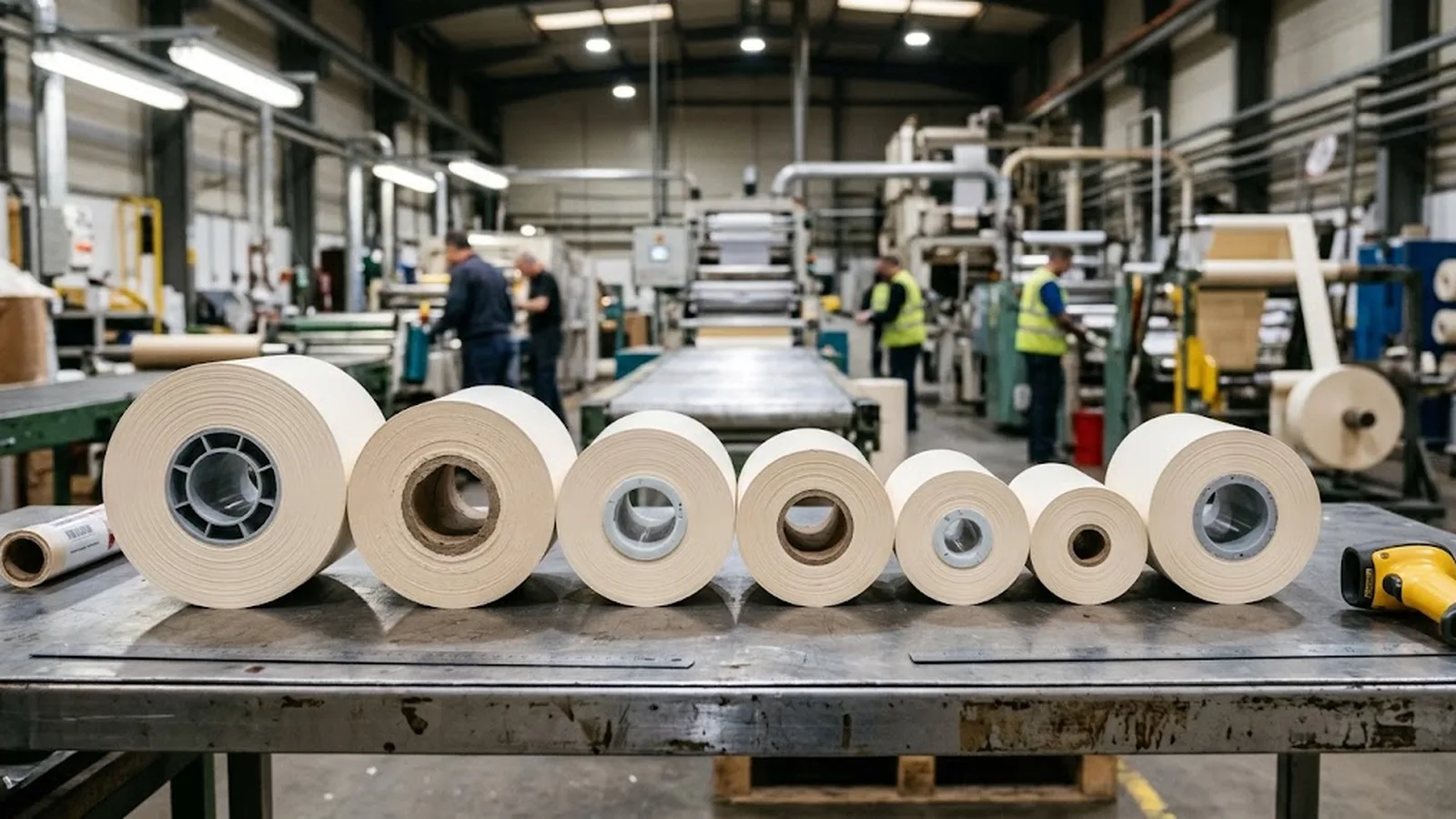
A custom core size in thermal paper is a non-standard inner core — diameter, wall thickness, material or length — engineered to fit a specific machine spindle, automation feeder or automation requirement. It is worth commissioning when the standard 12.7mm or 25.4mm core causes free play, feeding misalignment or packaging mismatch; typical MOQ starts at pallet volume per specification, and the programme should fix core ID, wall, material, length and runout tolerance in the specification sheet.
Most thermal paper rolls run on one of two standard cores — 12.7mm (half-inch) for receipt mechanisms, 25.4mm (one-inch) for tabletop and label units — and the industry's stock-keeping logic is built around them. But a meaningful share of programmes cannot run on standard cores: automation feeders engineered around a specific spindle, machines with non-standard spindles, humid-climate sites that need plastic instead of cardboard, or packaging systems where core length drives the whole roll geometry.
Custom cores are a manufacturing decision, not an afterthought: core dimensions affect winding tension, roll concentricity, metres per roll and how the roll behaves in the machine at the end of its life. This guide covers when a custom core earns its cost, how the core specification is actually engineered — ID, wall, material, length and runout — what MOQ and lead time to expect, and how to structure the programme so a core change is a controlled requalification rather than a field experiment.
Where a programme needs several formats from one supplier, our custom thermal paper programme covers width, core, roll diameter and developer class in a single specification sheet — core customisation is one axis of that same construction envelope.
The sections follow the order a buyer would settle them: when custom is justified first, core engineering second, MOQ and lead time third, validation and programme structure last.
- A custom core is justified by fit problems, not preference: free play on the spindle, feeding misalignment, core crush in automation or humidity-driven cardboard deformation are the signals.
- The core specification has five independent variables — inner diameter, wall thickness, material, length and runout tolerance — and each one is measurable at goods-in.
- Plastic cores cost more but hold dimension in humidity and give cleaner automation handling; cardboard cores cost less and suit standard retail and hospitality environments.
- Custom-core MOQ typically starts at pallet volume per specification because the core stock is a purchased component with its own minimums; lead time adds the core procurement cycle.
- A core change is a requalification: winding tension, roll concentricity and end-of-life behaviour should be validated on the destination machines before the programme switches.
When a custom core is worth commissioning
The honest trigger list is short and mechanical. Free play: a core whose inner diameter runs loose on the spindle produces registration drift and, in the worst cases, slipped rolls mid-print — the most misdiagnosed fault in the field, reported as a machine problem when it is a core fit. Crush and deformation: cardboard cores loaded into automated feeders or stored in humid climates can ovalise, and an out-of-round core chatters on the spindle and walks the web off register.
Environment: coastal and tropical sites deform cardboard cores that would hold dimension for years in a temperate distribution centre — plastic cores remove the variable. Automation: pick-and-place feeders and vending mechanisms engineered around a specific core length or wall grab surfaces cannot take the nearest standard core. And packaging: some private-label programmes size the core to make the finished roll hit a target outer diameter with a fixed paper length — the core becomes a packaging variable.
What does not justify a custom core: preference. Every non-standard core is a permanent SKU complication — special core stock, separate forecasting, a requalification whenever it changes. If the standard core fits the machine and environment, the programme is better off standard, and the effort goes into gsm, sensitivity and chemistry instead.
Buyers comparing these specifications should bring the machine spindle drawing or the existing roll's core dimensions to the first conversation — the core fit is decided there, before any paper variable is discussed.
Engineering the core: the five variables that matter
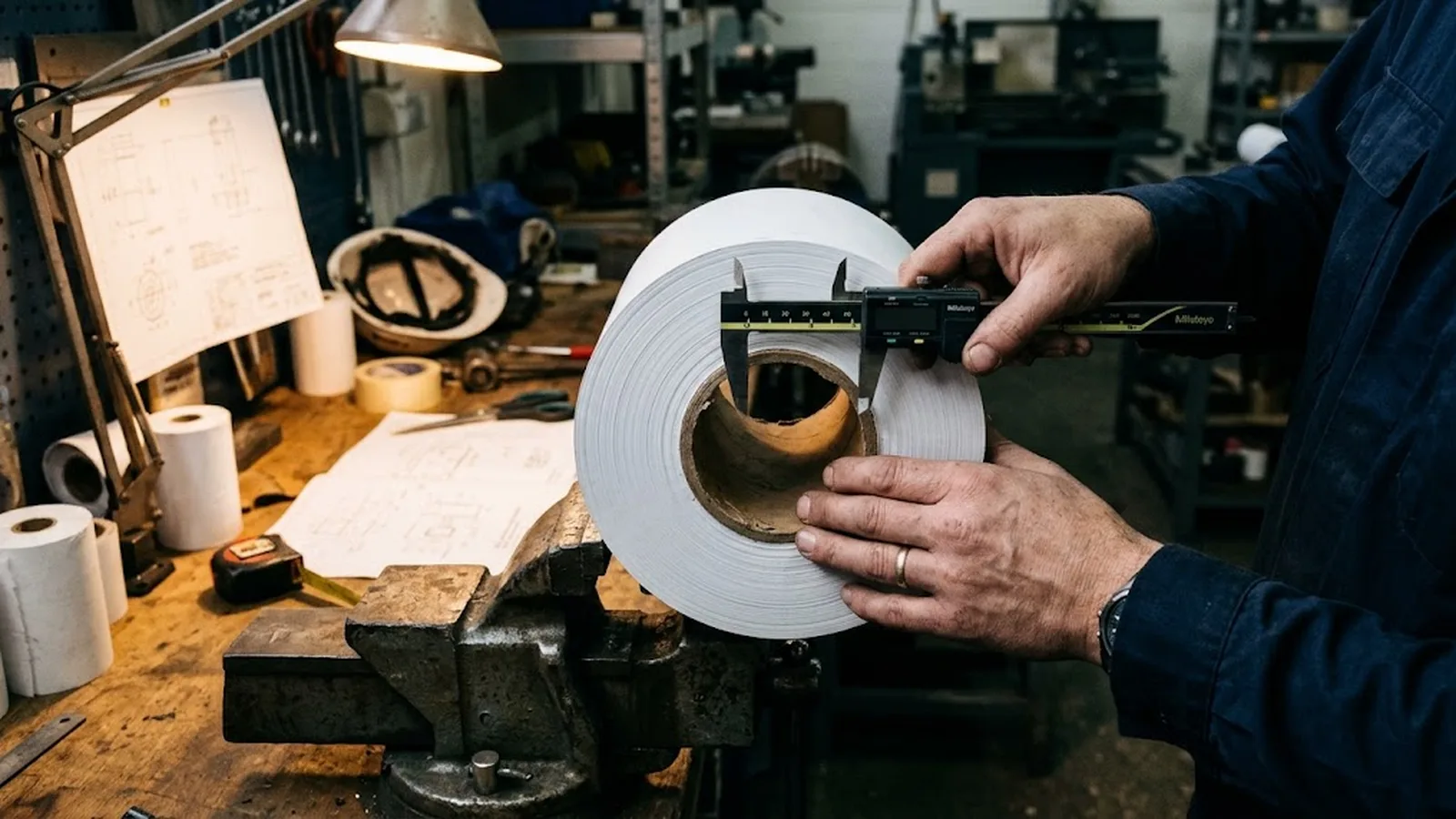
Inner diameter is the fit: it must locate on the spindle without free play (a few tenths of a millimetre of clearance is the working band) while still sliding off the core chucks of converting equipment. Wall thickness carries the roll's weight and the winding tension without collapse at end-of-life — heavier 75-80 gsm stocks and long 6000m jumbos need thicker walls than a 48 gsm receipt roll. Length sets the roll width plus any overhang; cores that are shorter than the paper width lose edge support and let the outer wraps dish.
Material is the environment decision: cardboard (spiral-wound paper core) is the cost default and holds dimension well in controlled storage; plastic (typically rigid PVC or ABS tube) holds dimension in humidity, resists crushing in automation, and gives a cleaner surface for spindle contact — the premium is usually justified where rolls face tropical storage, long automation runs or return-trip reuse. Runout tolerance — how true the core runs on its axis — is the variable nobody specs until an automation feeder jams: concentricity and roundness belong on the drawing, not in the supplier's discretion.
Procurement teams standardising on one supplier can review our 75 gsm heavyweight thermal paper alongside the comparisons in this guide — heavyweight document-grade stock is exactly the case where core wall and crush strength need engineering attention rather than defaults.
| Variable | What it decides | Typical spec point |
|---|---|---|
| Inner diameter | Spindle fit, no free play | Standard 12.7 / 25.4mm; custom to drawing, ±0.1–0.2mm |
| Wall thickness | Crush strength, end-of-life integrity | Scaled to roll weight and winding tension |
| Material | Humidity and automation behaviour | Cardboard default; plastic for humid/automated |
| Length | Edge support, roll width | Roll width + overhang per machine spec |
| Runout / roundness | Automation feeding, register stability | Concentricity on the drawing, checked at goods-in |
MOQ, lead time and the cost structure of custom cores
The core is a purchased component with its own supply chain: core manufacturers run tube dies and minimum order quantities per tube specification, which is why a custom-core thermal paper order starts at pallet volume per specification rather than case volume. The thermal paper conversion itself is unchanged — the same jumbo stock slits and winds onto whatever core the programme specifies — so the premium is the core stock and the changeover, not the paper.
Lead time adds the core procurement cycle ahead of the conversion run: for a first custom-core order, plan for the core stock to be produced and delivered to the mill before winding can be scheduled — typically adding weeks to the first delivery, while repeat orders run on the standing core stock. Programmes that forecast consistently can hold a core stock buffer at the mill, collapsing repeat lead time back to the standard conversion cycle.
Cost per roll scales with the premium on the core and the volume over which it is spread: at container volumes, the difference between cardboard and plastic cores is usually a small single-digit percentage of the roll cost, which is why environment-driven plastic cores are common in exactly the programmes — tropical distribution, automation-heavy retail — where they prevent the most complaints.
Validation and programme structure: switching cores without surprises
A core change alters how the paper is wound and how the finished roll behaves, so the programme should treat it as a requalification. The validation sequence: wound samples on the new core through the destination machines at production speed — registration, feeding, end-of-roll behaviour — then a storage trial for the actual climate the rolls will see, then a first production batch with tightened goods-in checks before the sheet is signed off.
The specification sheet for a custom-core programme carries the full core drawing — ID with tolerance, wall, material, length, runout — plus the paper construction (gsm, sensitivity class, chemistry class with SDS) and the goods-in checks that verify both: core dimensions measured with calipers, roundness on a gauge, roll squareness with a straightedge, and the standard paper checks. A retained reference roll per specification closes the loop.
Where developer compliance is part of the specification, our BPA-free vs phenol-free guide documents the chemistry, the regulations and the paperwork behind each class — the chemistry line travels with the core change so the whole construction is requalified in one pass.
Close the programme loop: log feeding and registration incidents per batch against the retained samples, requalify on any core drawing revision, and version-control the core drawing itself so the core that arrives in year three is the core the machines were validated against in year one.
Frequently asked questions
What core sizes are standard in thermal paper rolls?
12.7mm (half-inch) dominates receipt mechanisms; 25.4mm (one-inch) is standard for tabletop and label units; some converters and label applicators use 76.2mm (three-inch) cores. Anything outside these is a custom core, engineered to the machine's spindle drawing.
What MOQ applies to thermal paper rolls with a custom core size?
Typically pallet volume per specification, because the core itself is a purchased component with manufacturer minimums. First orders also carry the core procurement lead time; repeat orders can run on standing core stock at the mill, returning lead time to the standard conversion cycle.
When should I choose plastic cores instead of cardboard?
Where rolls face humid or tropical storage (cardboard ovalises), where automated feeders demand crush resistance and clean spindle contact, or where cores are reused on return trips. In controlled temperate retail storage, cardboard remains the cost-appropriate default.
Does changing the core change how the paper performs?
The paper construction is unchanged, but winding tension, roll concentricity and end-of-life feeding behaviour shift with the core. That is why a core change should be validated on the destination machines and requalified as a construction change in the specification sheet.