
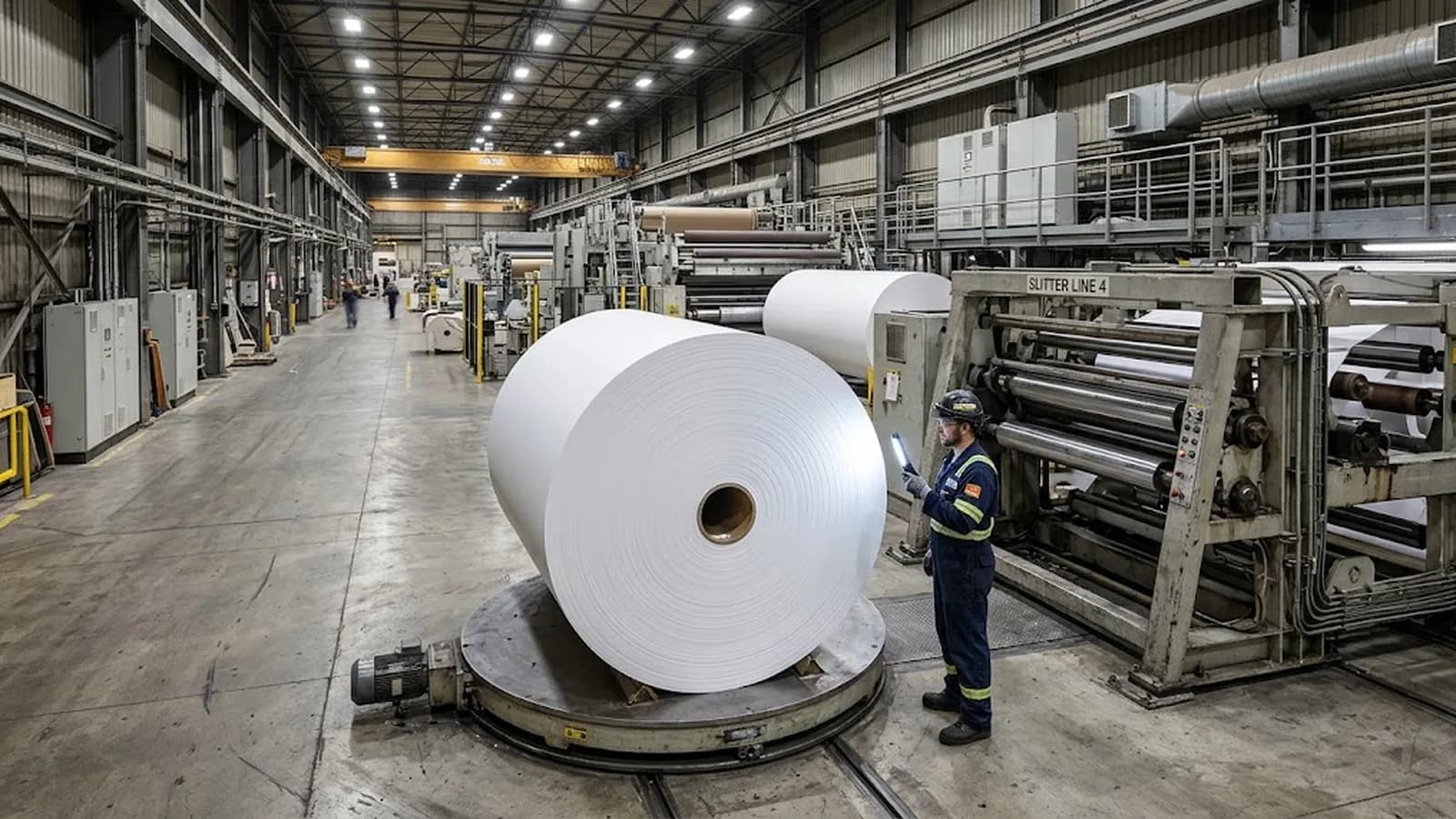
A 636mm thermal paper jumbo roll is a mid-width parent stock that suits converters running high lane counts of narrow formats — roughly eleven lanes of 57mm receipt stock per revolution with economical trim — or mixed plans that combine narrow receipt lanes with one or two wider lanes. It specifies like any direct thermal parent roll: gsm class with tolerance, caliper, length per roll, core diameter, chemistry class and winding quality, with packing and splice policy agreed for the export leg.
Among the standard thermal paper jumbo widths — 565mm, 636mm, 790mm, 800mm and up — the 636mm parent roll occupies a specific slot in a converter's planning: it is the width that maximises lane count for 57mm-class receipt formats while staying light enough for mid-size slitters and standard pallet handling. Choosing it over a wider parent roll is not a price decision first; it is a slit-plan decision, and the price follows the plan.
This guide covers where 636mm fits against the other common widths, how to work out lanes and trim loss for your own format basket, which specification lines belong in the enquiry (gsm, caliper, length, core, sensitivity class and developer chemistry), and the winding, splicing and packing points that decide how the roll behaves on your unwind stand and inside a container.
For production volumes, the same construction logic applies to our thermal paper jumbo rolls, quoted per jumbo roll, slit reel or finished format — 636mm is one width on the same coating platform, so grade data carries across the family.
The sections follow the decision a converter would actually make: width fit first, slit-plan arithmetic second, the specification sheet third, and the winding, splice and packing terms that protect the plan in transit.
- 636mm is the high-lane-count width for 57mm-class receipt converting — roughly eleven lanes per revolution with trim that stays in single-digit millimetres per knife.
- Width choice is a slit-plan decision: compare planned lane counts and trim across 565, 636, 790 and 800mm against your actual order mix before comparing prices.
- Specify the parent roll the way your slitter will see it — gsm with tolerance, caliper, length, core 76mm, outer diameter, sensitivity class and developer chemistry with SDS.
- Winding hardness, splice count per roll and edge quality are converting-critical properties; they belong in the specification sheet, not in the claims conversation afterwards.
- Export packing for jumbo rolls — PE barrier wrap, edge protection, pallet or cradle choice — decides whether the slit plan survives the ocean.
Where 636mm sits among the standard jumbo widths
Thermal parent rolls come in a family of widths that mirrors the coating head of the mill and the format basket of its converter base. Narrow parents (565mm and below) suit short-finish slitters and narrow-format programmes. The 636mm width is the classic mid-point: wide enough to run eleven lanes of 57mm receipt stock, narrow enough that roll weight, unwind brakes and pallet logistics stay manageable on mid-class converting lines. Wider parents — 790, 800, 820mm and beyond — earn their place on 80mm-heavy plans where eight or more lanes per revolution justify the heavier handling.
The practical trade-offs follow the plan, not the catalogue. A converter running mostly 57x40 and 57x50 receipt formats gains lane count and lowers per-lane trim on 636mm compared with a 565mm parent. The same converter running a mixed basket of 57mm and 80mm formats may find 636mm leaves the 80mm lanes plan awkward — a 790mm or 800mm parent pairs the wide lanes better. Matching the width to the order mix is worth more than any single-width price comparison.
Where a programme needs several formats from one supplier, our custom thermal paper programme covers width, core, roll diameter and developer class in a single specification sheet — the same grades are coated across the width family, so a converter can hold one chemistry standard while varying parent widths.
Slit-plan arithmetic: lanes, trim and splice budget
The arithmetic that justifies a 636mm parent is lane count. Take the 57mm receipt family: eleven lanes of 57mm consume 627mm, leaving about 9mm to distribute across the slitting kerfs — under a millimetre per knife on a well-ground blade set. The same plan on a narrower parent drops a lane per revolution; on a much wider parent it adds trim that converts into waste per tonne unless another format fills it. Converters who run the arithmetic per format basket — lanes times metres per revolution against order volume — see quickly whether 636mm, 565mm or a wider parent minimises waste on their actual mix.
Trim is not the only yield factor. Splices matter equally: every splice in the parent roll is a stop, a re-thread and a rejected length on the slitter. Ask for the splice policy in writing — maximum splices per roll, splice marking (flagged or flagged-and-labelled), and minimum length between splices. A 636mm parent at a typical length for the gsm class carries a predictable splice budget; holding the supplier to it converts directly into slitter uptime.
Mid-article spec snapshot — the enquiry lines that decide the plan:
- Width 636mm with tolerance (typically plus or minus 1mm, stated).
- Gsm class with tolerance and caliper — the pair that fixes metres per tonne.
- Length per roll and outer diameter — mutually consistent figures at the stated gsm.
- Core: 76mm (3 inch) standard for this width class, wall thickness stated.
- Sensitivity class and developer chemistry (BPA-free / phenol-free) with SDS to match.
- Winding hardness and splice policy: maximum splices per roll, marked splices, minimum segment length.
| Parent width | Typical 57mm lanes | Trim character | Best fit |
|---|---|---|---|
| 565mm | 9 lanes | Comfortable per-knife trim, one lane fewer | Narrow-format lines, shorter runs |
| 636mm | 11 lanes | Single-digit mm per knife at full lane count | High-lane 57mm receipt converting |
| 790mm | 13-14 lanes | Heavier roll, wider trim unless mixed plan | 80mm-heavy mixed baskets |
| 800mm | 13-14 lanes | Same as 790mm with marginally more trim room | Long-run mixed plans with wide lanes |
Specifying the roll: grade, gsm, core and chemistry
A 636mm parent roll is specified identically to the rest of the jumbo family — the width does not change the vocabulary, only the handling numbers. Basis weight comes with a tolerance (a 55 gsm grade delivered converting at 57 gsm is a metre shortfall on every downstream roll), caliper is stated because it fixes the metres wound per outer diameter, and length per roll must reconcile with the gsm and the stated outer diameter — three figures that a mill quoting from real production data will quote without hesitation.
Core specification is simple but consequential: 76mm inner diameter is standard for this width class, with wall thickness and core roundness affecting unwind stability at converting speeds. Sensitivity class matters for the end format — a high-sensitivity grade lets low-energy printheads image cleanly, while a standard class may price better for high-speed POS stock. The developer chemistry class — BPA-free or phenol-free — is now a specification line in most export channels, documented with an SDS rather than asserted.
Buyers comparing these specifications can review our top-coated thermal label stock, where basis weight, coating construction and packing are documented per grade before an order is placed — the same documentation discipline applies across the jumbo widths.
Winding, edge and packing: how the roll survives to the unwind stand
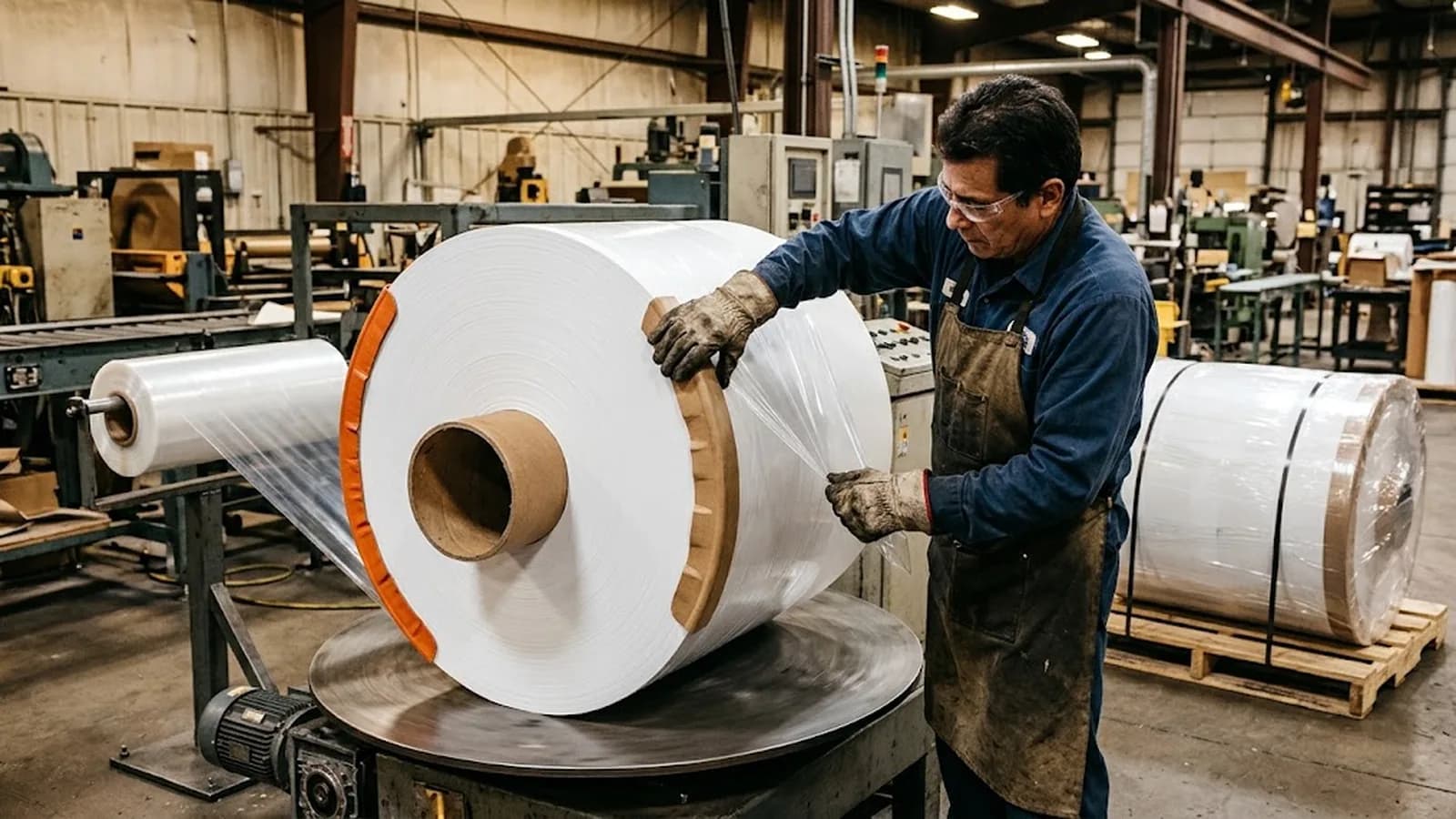
A parent roll's converting behaviour is set by three properties that never appear on a price list. Winding hardness: too soft and the roll breathes in humid transit, telescopes and creases at the edges; too hard and set-in stresses release as the outer layers unwind. Edge quality: a rolled or damaged edge shows up as web breaks at exactly the lanes your plan counted on. Moisture protection: thermal coating is hygroscopic, and a jumbo roll shipped without barrier wrap and edge protection arrives with curl and fade risk at the outer wraps.
Packing for 636mm jumbos follows export practice: each roll wrapped in PE barrier film, edges protected, rolls packed on pallets or in cradles agreed in advance, with desiccant practice matched to the destination climate. Splice flags must stay findable after wrap. Container loading — the roll count per container and the securing pattern — should be part of the order confirmation, not discovered at the port.
Where container planning is the next step, our export shipping guide covers pallet standards, moisture-barrier packing and the document set for ocean freight — the logistics half of a parent-roll programme.
From first order to standing programme
Converters who settle on a width tend to stay on it — the slitting plan, tooling and order basket stabilise around it. That makes the first 636mm order the moment to fix the programme terms: retained samples per batch, a goods-in check of gsm, caliper and length against the sheet, and an agreed remedy path if a batch lands off-spec. Mills reward the discipline with stable pricing; the converter's reward is a slit plan that stops being re-argued.
Keep the width decision under periodic review as the basket drifts. Format mixes change — 80mm volume grows in some markets, 57mm holds in others — and the width that minimised trim this year may not next. A quarterly check of lanes, trim and splice incidents against the actual order mix keeps the parent-width choice honest, and costs one spreadsheet hour per quarter.
Frequently asked questions
What formats does a 636mm thermal paper jumbo roll suit best?
It is the classic high-lane-count width for 57mm-class receipt converting — roughly eleven lanes of 57mm per revolution with economical trim — and works for mixed plans that combine narrow receipt lanes with a limited number of wider lanes. For 80mm-heavy baskets, wider parents such as 790mm or 800mm usually pair better.
Which gsm classes are available in 636mm jumbo rolls?
The standard direct thermal range — lightweight classes around 48 gsm for economy receipt stock, mid classes around 55-65 gsm for general POS and label stock — coated on the same platform across the width family. Each class is specified with a gsm tolerance and caliper so metres per roll reconcile with the outer diameter.
What core size and roll length should I specify?
76mm (3 inch) inner diameter is standard for this width class, with wall thickness stated. Length per roll depends on gsm and the outer diameter your unwind stand and floor handling accept — quote the outer diameter limit and let the mill return the consistent length figure, rather than fixing length and diameter independently.
How are 636mm jumbo rolls packed for export?
Each roll is wrapped in PE moisture-barrier film with edge protection, packed on pallets or cradles agreed in the order confirmation, with splice flags left findable and desiccant practice matched to the destination climate. The container roll count and securing pattern belong in the confirmation, not at the port.