
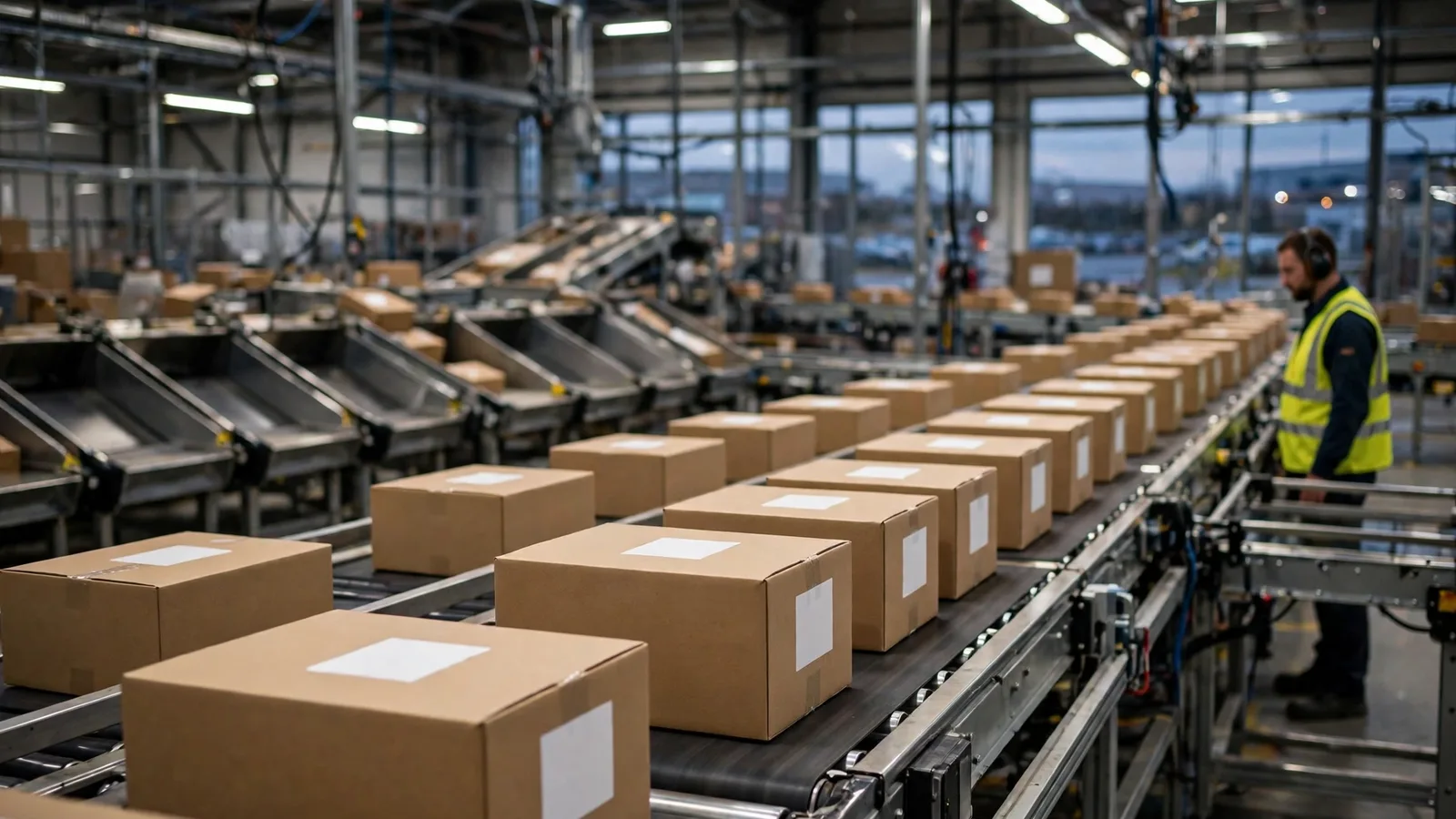
Parcel labels fail for environmental reasons before they fail for print reasons: abrasion as cartons slide down sorter chutes, condensation when parcels move between cold docks and warm trailers, adhesive creep on poly mailers and stretch wrap, and images that scuff illegible before the parcel reaches the delivery scan. Specifying parcel thermal labels therefore starts from the sortation environment, not the price list: facestock weight matched to label size and surface, adhesive class matched to the corrugated-and-filmic surface mix, top-coated construction wherever labels must survive weeks of handling and remain scannable, and roll geometry matched exactly to the print-and-apply benches and desktop devices at the hub. Programmes that pin down those four choices — and hold the label stock to a storage and rotation discipline — get predictable cost per labelled parcel and stop re-printing labels that should have survived the first application.
Every parcel in a network carries at least one label, and that label is the parcel's identity for the whole journey: the shipping label printed at origin, the route and sort labels added at hubs, and the delivery-confirmation label closed out at the last mile. When a label fails — lifts off a poly mailer in the trailer, scuffs unreadable in a sorter chute, will not scan at the outbound tunnel — the cost is not the label. It is the mis-sorted parcel, the manual re-entry at the hub, and the customer complaint that follows.
That is why parcel labelling is specified against the operating environment rather than against a catalogue. The sorter line sets the abrasion exposure; the surface mix (corrugated, poly mailers, stretch wrap, reusable totes) sets the adhesive chemistry; the dock-to-trailer temperature swing sets the minimum application temperature; and the intended label life sets the coating class. For programmes buying label stock in volume, our top-coated thermal label stock is documented for width, core, roll diameter and developer class in a single specification sheet, so the specification can be verified against measured data before an order is placed.
This guide works through the specification in the order failures actually happen on a parcel network: the sortation environment, the construction choices that answer it, roll geometry and print-and-apply compatibility, and the image-life and cost disciplines that keep the programme honest over a peak season.
- Specify parcel labels from the sortation environment: abrasion, surface mix, temperature swing and label life decide the construction, not the per-roll quote.
- Top-coated construction is the default for shipping labels that must stay scannable through weeks of handling; uncoated stock suits short-life route and sort labels.
- Adhesive class must cover the full surface mix — corrugated, poly mailers and stretch wrap behave differently; state substrate and application temperature in the spec line.
- Roll geometry (width, core, diameter, sense-mark position) matched to the print-and-apply benches prevents more downtime than any price negotiation recovers.
- Cost per labelled parcel — folding in waste, jams and reprints — is the honest metric, not price per roll.
Where parcel labels fail: the sortation environment
Abrasion is the primary killer on a parcel network. Cartons sliding down metal chutes, parcels tumbling into gaylords, labels rubbing against each other in trailer loads — edge scuffing eats the barcode long before the adhesive gives up. A label that scans at origin and fails at the destination hub is almost always an abrasion-and-coating problem, not a print-quality problem. The specification should therefore begin with the longest, harshest leg of the journey and work backwards.
Temperature swings come second. Parcels move from cold cross-docks into warm trailers and back again, and condensation on a cold surface defeats a standard adhesive applied below its minimum application temperature — the label looks correct at the bench and lifts within days. Two numbers belong in the specification: the lowest surface temperature at application, and the lowest storage temperature the label must survive afterwards.
Surface mix rounds out the environment. Corrugated, poly mailers, stretch wrap and reusable plastic totes each present a different surface energy, and an adhesive class that excels on kraft board can creep on filmic mailers. Map the surfaces the label will actually meet — including what it meets after leaving your own dock — and let the adhesive choice follow the map.
Construction choices: facestock, adhesive and coating class
Facestock weight follows label size and duty. High-volume parcel operations printing millions of 100 x 150 mm labels a quarter run the economics on facestock weight: a lighter construction buys freight, roll yield and printer behaviour without giving up anything a shipping label needs, provided the adhesive and coating are right. For networks printing at that scale, the lightweight class is where the unit economics live: for production volumes, the same construction logic applies to our 48 gsm lightweight thermal paper, quoted per jumbo roll, slit reel or finished label format.
Adhesive class is the environment answer: permanent for corrugated shipping cartons, filmic-rated systems for poly mailers, freezer-grade wherever the flow touches chilled zones. 'Permanent, corrugated, +5 °C application' is a specification; 'permanent' is a wish. State the substrate and the temperature floor on the same line as the adhesive class so every supplier quotes against the same duty.
Coating class follows label life. A shipping label must remain scannable from origin print to delivery confirmation — days to weeks of handling, chuting and stacking. Top-coated construction protects the image from moisture, abrasion and finger oils and is the default for that duty; uncoated stock suits short-life route labels consumed within the same shift. The trade is testable, and on a parcel network it should be tested with real cartons on real chutes rather than decided on a datasheet.
Roll geometry and print-and-apply compatibility
Parcel labels feed two kinds of equipment: desktop devices at the origin bench and print-and-apply applicators on the line. Both are unforgiving about roll geometry. Roll width, core size, outside diameter and sense-mark position must match the installed equipment exactly, because a roll that tracks badly or mis-feeds costs more in downtime and reprints than it saves in price. The roll specification deserves the same discipline as the label construction — documented tolerances, not catalogue approximations.
Media path behaviour matters as much as dimensions. Label stock that curls after printing jams applicators; stock with inconsistent liner release lifts labels mid-cycle. These behaviours are predictable from the base paper and the converting quality, which is why sourcing the roll stock from the same mill that controls the coating pays for itself at the applicator.
Where operations convert their own roll stock or feed co-operated sites from a central inventory, parent-roll supply keeps the specification uniform across every site: our thermal paper jumbo rolls give converting operations the same base construction the finished formats are built on, slit to each site's equipment list.
Image life, scan reliability and cost per labelled parcel
Scan reliability at end of life is the acceptance criterion, not contrast on the day of printing. The test that matters: print the label as the workflow prints it, subject it to the worst leg of the network — chute, trailer, rain exposure at the doorstep — and scan it at the interval the process demands. A faint image that scans at origin may fail the delivery scan, and a delivery scan failure is the most expensive kind in the network because the parcel is already in the customer's hands.
The label stock itself has a shelf life, and parcel networks hold inventory across peak seasons, so the specification carries storage conditions and first-expiry-first-out rotation. Direct thermal stock degrades in heat and humidity long before it reaches a device; a pallet of labels warehoused beside the dock doors through a summer is a pallet of reprints waiting to happen.
Cost per labelled parcel is the honest metric. It folds in roll price, labels per roll, waste at application (mis-feeds, mis-applies, jams), and reprints caused by early failure in the network. Where image life is the deciding factor, our top-coated vs non top-coated guide compares the two constructions on retention, cost and machine behaviour — and on a parcel network the top-coated label that never needs reprinting routinely wins that calculation.

Frequently asked questions
What adhesive should parcel labels use on poly mailers?
A filmic-rated adhesive system, specified with the substrate and the application temperature. Poly mailers are low-energy, sometimes silicone-tainted surfaces, and standard adhesives rated for corrugated will creep or lift on them. Where possible, apply the label to a printed flap or dedicated label patch rather than directly onto the film.
Do parcel shipping labels need top coating?
Shipping labels should be top-coated, because they must remain scannable through days to weeks of sortation handling, chuting and trailer loads. Uncoated direct thermal stock images sharply and costs less, but its exposed image scuffs and fades — suitable only for short-life labels consumed within a shift.
Why do parcel labels fail to scan at the destination hub?
Almost always abrasion and environment, not print quality. Edge scuffing in sorter chutes, moisture exposure and handling oils degrade an unprotected image over the journey. Top-coated construction plus an end-of-life scan test on the harshest network leg is the fix.
What roll specification matters most for print-and-apply applicators?
Width, core size, outside diameter and sense-mark position, matched exactly to the installed equipment, plus consistent curl and liner-release behaviour. Media-path failures cost more in downtime than the price difference between roll suppliers.
How should parcel label roll stock be stored between seasons?
Cool, dry, away from direct heat and sunlight, with first-expiry-first-out rotation. Direct thermal stock degrades in heat and humidity long before it is loaded into equipment, and peak-season inventory held for months feels that degradation first.