

Inventory labels fail for environmental reasons before they fail for print reasons: condensation when cartons leave a cold room, abrasion as totes slide along shelving, adhesive creep on shrink-wrapped or dusty surfaces, and images that fade through a season of handling. Specifying direct thermal labels for inventory therefore starts from the operating environment, not the catalogue: facestock weight matched to label size and surface, adhesive class matched to substrate and temperature floor (freezer-grade where goods move through chilled zones), top-coated construction where labels must stay legible through months of touching, and roll geometry matched to the on-demand equipment at the goods-in desk. Programmes that pin down those four choices — plus a carton-level packing and shelf-life discipline for the label stock itself — get predictable cost per labelled unit and stop re-printing labels that should have survived the first application.
Every unit in a stockroom carries at least one label: the item label applied at goods-in, the bin and location labels on the racking, the tote and carton labels that travel with goods between zones, and the reorder or count labels that drive cycle counting. When one of them fails — peels off in a cold aisle, scuffs illegible after two weeks of sliding, will not stick to a dusty shrink wrap — the cost is not the label, it is the mis-pick, the mis-count and the manual reconciliation that follows.
That is why inventory labelling is specified against the environment, not against a price list. The cold chain zone sets the adhesive temperature floor; the shelving system sets the abrasion exposure; the surface mix (cardboard, shrink wrap, plastic totes, metal racking) sets the adhesive chemistry; and the intended label life sets the coating class. Where a programme needs several formats from one supplier, our top-coated thermal label stock covers width, core, roll diameter and developer class in a single specification sheet.
This guide works through the specification in the order failures actually happen: the operating environment, the construction choices that answer it, on-demand versus preprinted supply, and the image-life and cost disciplines that keep the programme honest over a full season of handling.
- Specify from the environment: cold zones, abrasion, surface mix and label life decide the label, not the other way round.
- Freezer-grade adhesive and the minimum application temperature rating are mandatory wherever goods pass through chilled areas.
- Top-coated construction is the default where labels must stay legible for months of handling; uncoated stock suits short-cycle tote and pick labels.
- Match facestock weight to label size and surface — heavy labels on light stock curl and lift at the edges in dry storage.
- Cost per labelled unit is decided by roll geometry and waste at application, not by the per-roll quote.
Where inventory labels fail: the operating environment
Cold zones are the classic failure. Cartons leaving a chill room arrive at the labelling bench with a surface film of condensation, and a standard adhesive applied below its minimum application temperature never develops full tack — the label looks fine at goods-in and lifts within days. The specification needs two numbers from the operator: the lowest surface temperature the label will be applied at, and the lowest storage temperature it must survive afterwards. Freezer-grade adhesive systems exist for exactly this duty and are quoted as a class, not an afterthought.
Abrasion is the quieter killer. Totes and cartons sliding along shelving, bins pressed against each other in picking flows, labels rubbed by gloves — edge scuffing eats the image long before the adhesive gives up. Labels applied to curved or flexing surfaces (stretch wrap, sack goods, drum ends) add lifting stress at the edges, which is a facestock stiffness problem as much as an adhesive one.
Surface mix rounds out the environment. Corrugated cardboard, shrink wrap, poly totes and painted racking each present a different energy surface, and a programme that specifies one adhesive for all of them will watch that adhesive excel on one substrate and creep on another. Map the surfaces first; the adhesive choice follows.
Construction choices: facestock, adhesive and coating class
Facestock weight follows label size and duty. Small item labels for high-volume application run on lightweight facestock — the volume economics favour it, and for a label that lives a few weeks on a tote, weight buys nothing. Larger location and pallet labels need heavier stock for stiffness and coverage; a heavy label on light facestock curls in dry storage and lifts at the corners. For programmes printing millions of small labels a year, the lightweight class is where the unit economics live: for production volumes, the same construction logic applies to our 48 gsm lightweight thermal paper, quoted per jumbo roll, slit reel or finished format.
Adhesive class is the environment answer: permanent for racking and bin locations, removable where cartons are relabelled between zones, freezer-grade through the chilled chain. State the temperature floor and the substrate in the specification line — 'permanent, corrugated, +5 °C application' is a spec, 'permanent' is a wish.
Coating class follows label life. Uncoated direct thermal stock images sharply and costs less, but its image is exposed to moisture, oil and handling — right for short-cycle tote and pick labels, wrong for anything that must read at audit time six months later. Top-coated construction protects the image and is the default for location labels, asset labels and anything crossing the returns desk. Procurement teams standardising on one supplier can review our thermal paper jumbo rolls alongside the comparisons in this guide.
On-demand versus preprinted stock
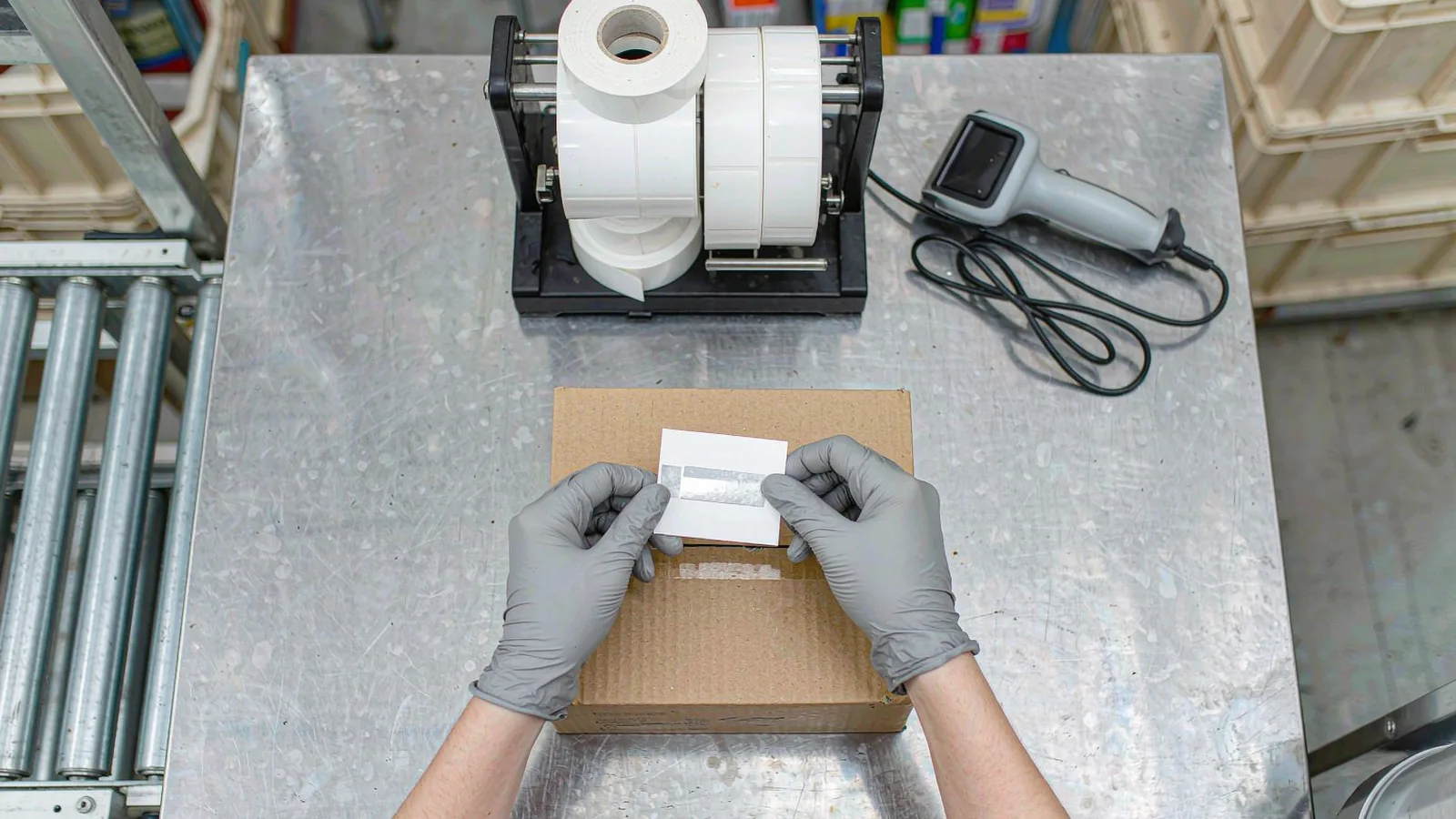
Most inventory programmes are hybrid. Variable data — item, quantity, receipt date, count results — prints on demand at the goods-in desk or the picking bench, which puts the roll specification in service of the equipment: roll width, core size, roll diameter and sense-mark position must match the installed devices exactly, because a roll that feeds badly costs more in jams and reprints than it saves in price. Fixed data — company name, colour codes, zone identifiers — converts better as preprinted stock, ordered against artwork with the same roll discipline.
The programme should also state where printing happens relative to application. Labels printed in a cold anteroom and applied in the chill aisle face the condensation problem head-on; a workflow that applies labels at ambient and moves goods afterwards avoids it entirely. Equipment placement is a label-durability decision as much as an operations one.
Supply follows the split: on-demand formats run as a standing SKU list with consumption-based replenishment, preprinted formats run against artwork revisions with agreed obsolescence rules. Both ride on the same base specification, so a stockroom never trades an adhesive class to get a print run scheduled.
Image life, scan reliability and cost per labelled unit
Image life is testable, and on an inventory programme it should be tested rather than assumed: apply the label as the workflow does, store it in the worst zone the workflow serves, and read it at the intervals the process demands — two weeks for totes, a quarter for location labels, a year for asset labels. Darkness settings and sensitivity class interact with that test: a faint image that scans at day one may be unreadable at week six, which is why the acceptance criterion is scan reliability at end of life, not visual contrast at application.
The label stock itself has a shelf life, and an inventory programme consumes stock slowly enough for it to matter. Direct thermal stock degrades in heat and humidity long before it reaches a device, so the specification carries storage conditions and first-expiry-first-out discipline at the distribution centre — a pallet of labels held for a year beside the dock doors is a pallet of reprints waiting to happen.
Cost per labelled unit is the honest metric. It folds in roll price, labels per roll, waste at application (jams, mis-feeds, mis-applies), and reprints caused by early failure. Where image life is the deciding factor, our top-coated vs non top-coated guide compares the two constructions on retention, cost and machine behaviour. A slightly dearer top-coated label that never needs reprinting routinely wins that calculation in cold or abrasive zones.
Frequently asked questions
What adhesive should inventory labels use in cold storage areas?
A freezer-grade adhesive system, specified with two numbers: the minimum surface temperature at application and the lowest storage temperature afterwards. Standard adhesives applied below their minimum application temperature never develop full tack and lift within days, even if they look correct at goods-in.
Do inventory labels need top coating?
Labels that must stay legible for months — location labels, asset labels, anything that returns to a desk for reading — should be top-coated, because the coating protects the image from moisture, oils and abrasion. Short-cycle tote and pick labels consumed within days can run uncoated and save the cost.
Why do my inventory labels peel off shrink-wrapped cartons?
Shrink wrap is a low-energy, sometimes silicone-tainted surface, and some wraps exude plasticiser that softens adhesives. The fix is an adhesive class matched to filmic surfaces and, where possible, applying the label to a printed flap or a dedicated label patch rather than directly onto the film.
How long do direct thermal inventory labels last?
It depends on coating class and storage. Uncoated stock suits weeks-to-months duty in dry conditions; top-coated construction holds legibility for a year or more in handling-heavy, cold or humid environments. The acceptance test is scan reliability at end of life in the worst zone the workflow serves, not contrast on the day of application.
How should label roll stock be stored before use?
Cool, dry and out of direct heat and sunlight, with first-expiry-first-out rotation at the distribution centre. Direct thermal stock degrades in heat and humidity long before it is loaded into equipment, and slow-moving programmes feel this more than fast ones.