
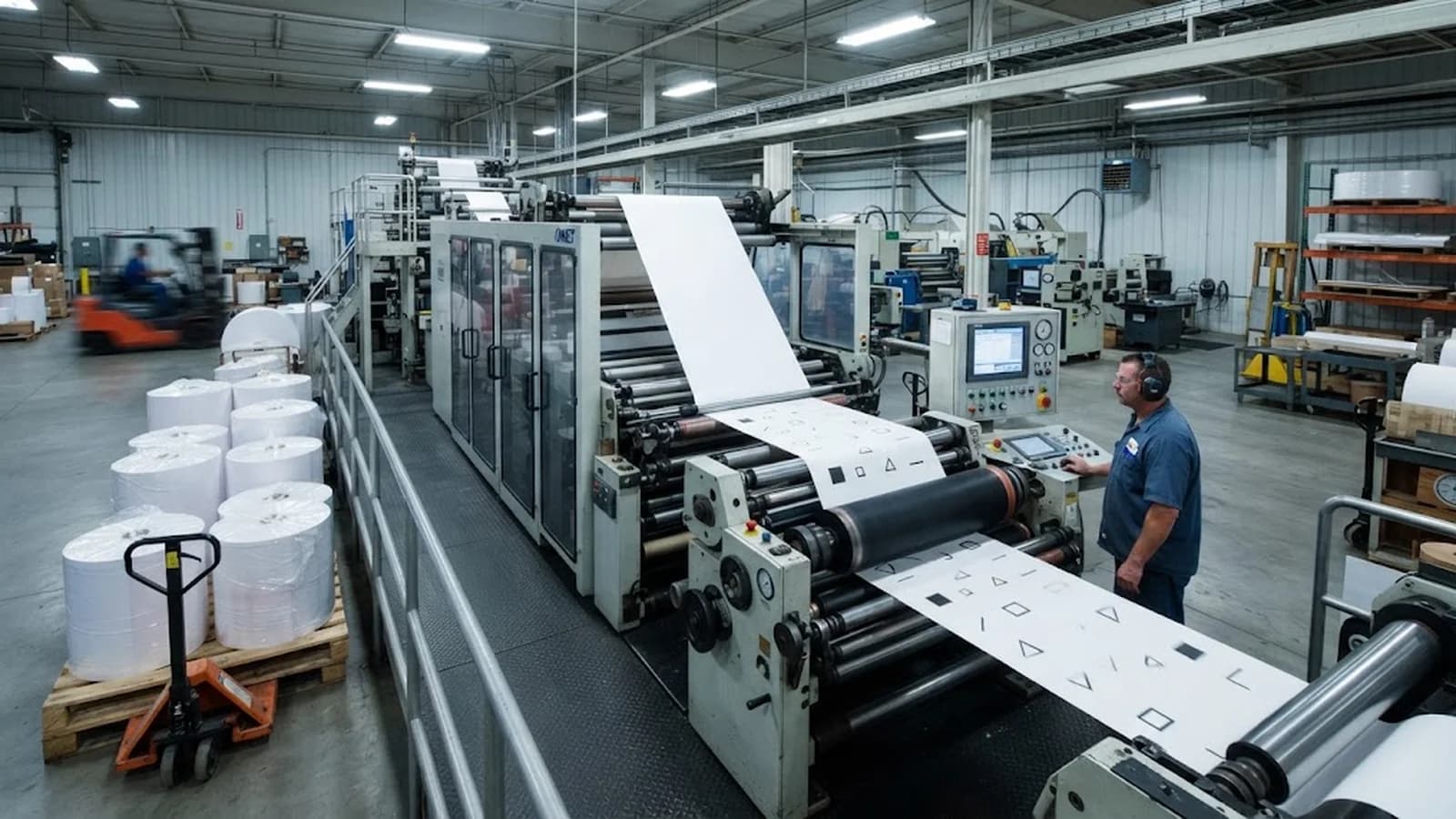
Logo printed thermal paper rolls are direct thermal rolls that carry a buyer's artwork — a logotype, a legend, terms of sale or a faint security feature — applied before the roll is slit and packed. The specification question that decides whether the programme works is print position: ink applied under the thermal coating behaves like part of the paper, while ink applied over the coating competes with the print head and can smear, flake or shorten head life. A workable preprint programme also fixes the practical boundaries early — which colours survive flexo printing on coated stock, what a two-colour minimum run looks like, how plate and setup costs amortise over the order, and what sample approval sequence confirms both the artwork and the thermal performance before volume production.
Every chain that hands out receipts eventually asks the same question: should the roll carry our name? A logo at the top of a slip, a return policy printed on the reverse, a loyalty message under the transaction block — preprinted rolls turn a disposable slip into a small piece of owned media, and for multi-site retailers and QSR groups the cumulative impression is real. The buying conversation, however, is not about graphic design; it is about printing on a chemically coated product without damaging the one function the roll must never lose: the thermal image.
That is what separates logo printed thermal paper rolls from ordinary printed paper goods. The thermal coating is a sandwich of sensitizers and developers that reacts to heat from the print head, and anything layered onto it — ink, varnish, adhesive residue from the converting process — either sits where the head contacts the paper or migrates into the image layer. Print in the wrong place with the wrong ink and the result is faded receipts, clogged heads and warranty arguments three months into the contract.
Buyers comparing these specifications can review our custom thermal paper programme, where basis weight, coating construction, developer class and packing are documented per grade before an order is placed.
This guide walks through the decisions that make a preprint programme manufacturable: where the ink goes relative to the coating, which printing methods and colour counts are realistic, how artwork and security features translate to a 57 or 80 mm web, and how MOQs, plates and sampling should be sequenced so the first production carton matches the approved sample.
- Print position is the deciding specification: under-coat printing protects both the artwork and the thermal image; over-coat printing needs explicit head-wear and smear testing before approval.
- One or two spot colours are the economic norm for receipt preprint; full process colour belongs on labels or packaging, not on a commodity receipt roll.
- Artwork must respect the thermal zone — keep critical marks out of the image area and allow for slit tolerance across the web.
- MOQ and plate amortisation drive unit cost: longer runs, single artwork families and multi-width gang-ups move the price closer to unprinted stock.
- Sample approval is two-dimensional: the artwork proof confirms the brand, and the thermal test confirms the roll still prints — both belong in writing before volume production.
What preprinting changes on a thermal roll
A thermal roll is manufactured in layers: base paper, one or more thermal coating layers, and in better constructions a protective topcoat. Preprinting happens on the converting side, on wide jumbo stock or on the finished web before slitting. The standard method is flexography — fast, economical on repeat orders, and happy with the simple line work and spot colours a receipt needs. Letterpress and dry offset appear in legacy programmes; digital toner-based printing is generally unsuitable because toner sits exactly where the print head strikes.
The printer's ink choice is constrained by the coating chemistry. Inks for thermal substrates are formulated to be non-reactive with the developer system and to cure without heat that could pre-activate the coating. This is why a buyer should never treat preprint as a job for a local commercial printer — a general print house without thermal experience can produce rolls that look perfect and fail on the machine.
The other structural decision is what gets printed where. Top-of-slip branding, footers and reverse-side legends are the common zones; the transaction area between them must stay clean. Slitting tolerance across a wide web means artwork should sit inside a defined safe margin so a roll cut fractionally wide or narrow does not clip the mark.
Print position: under the coating, not over it
The industry's default answer is under-coat printing: artwork is applied to the base paper before the thermal coating is laid down, so the coating covers the ink exactly as it covers the fibre. The finished slip reads as a printed receipt, the ink cannot abrade the print head, and the thermal image develops through and around the printed areas without interference. Under-coat printing happens at the mill, which means it is specified with the jumbo order — it is a manufacturing step, not a converting afterthought.
Over-coat printing — ink applied on top of the finished thermal surface — exists for programmes that need artwork on rolls already coated, and it is the variant that demands testing. Ink over the coating changes the head-to-paper interface: poorly chosen inks smear under heat, flake onto the head, or interfere with density at the leading edge of the image. Where image life is the deciding factor, our top-coated vs non top-coated guide compares the two constructions on retention, cost and machine behaviour — the same construction logic determines how much protective topcoat is available beneath printed artwork.
Either way, the acceptance test is practical and non-negotiable: run approved samples on the buyer's own printer fleet at real transaction volume, then inspect image density, artwork legibility and the head itself. A preprint programme that skips this step is buying an argument, not a supply contract.
For production volumes, the same construction logic applies to our thermal paper jumbo rolls, quoted per jumbo roll, slit reel or finished format — the converter's starting point for any under-coat preprint specification.
Artwork, colour and security features on a receipt web
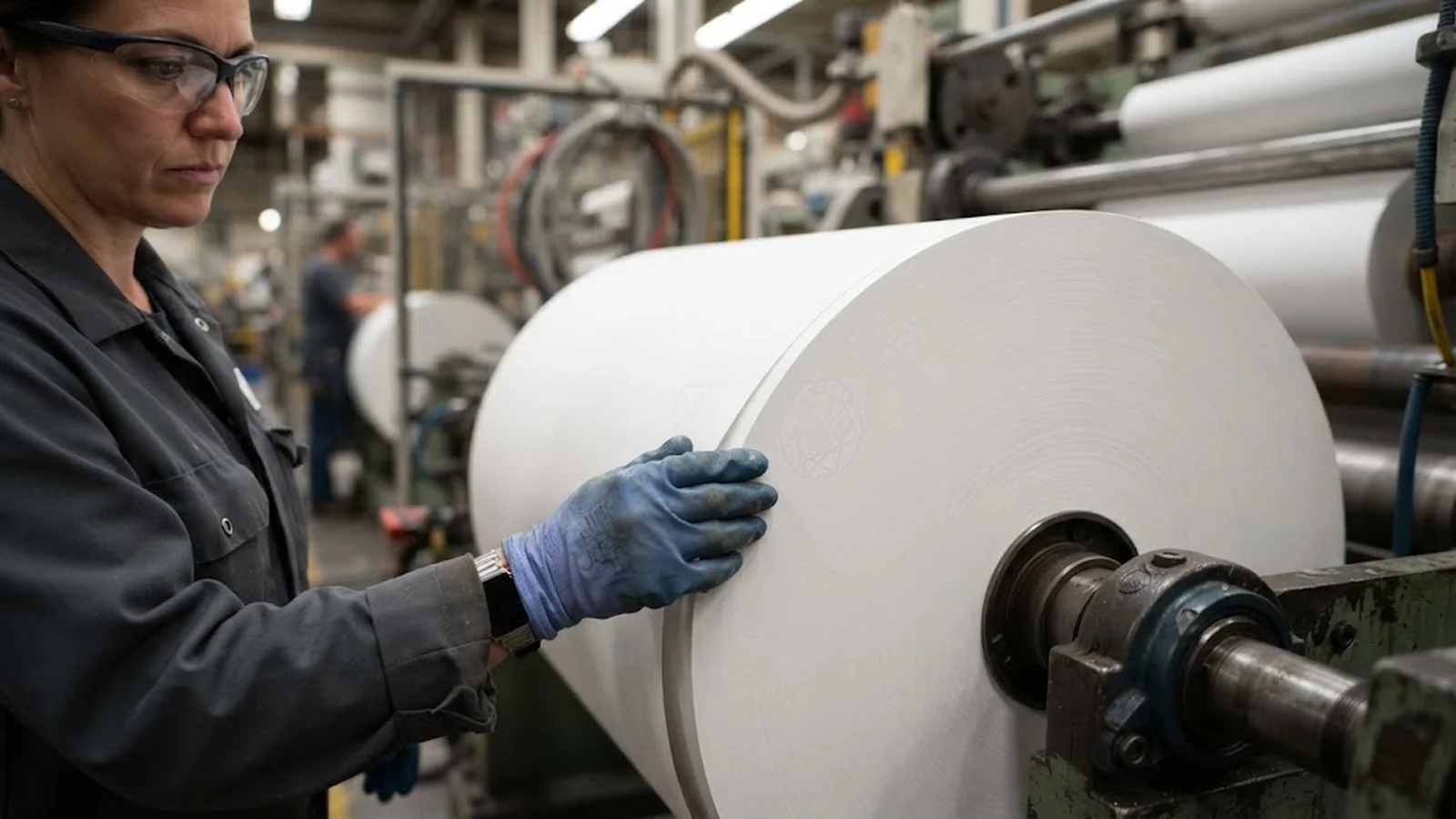
Receipt preprint lives within narrow graphic boundaries. One spot colour is the workhorse — a logotype in the brand colour plus black transaction text is the classic construction. Two spot colours are common where the brand needs a secondary tone; full process colour on a receipt roll is technically possible but rarely economic, and registration across a fast-moving web makes fine detail fragile. Fine serif typography and thin rules should be avoided at narrow widths, where slitting vibration can break strokes.
The reverse of the roll is the most underused surface. Terms of sale, return windows, loyalty programme rules and promotional codes print economically on the back of the web, turning a compliance obligation into usable content. Front-of-slip security features are similarly practical in moderation: a faint background tint, micro-legend lines or a simple anti-copy mark deter casual receipt forgery for refund fraud — a real cost in high-volume retail — without touching the thermal chemistry.
Artwork logistics are simpler than buyers expect. A converter needs vector artwork with the brand palette converted to spot references, a defined print zone map for the width in question, and a signed proof. Changes later cost a new plate and a new proof cycle, so locking the artwork family — one design covering 57, 76 and 80 mm widths, for example — saves tooling money across the programme.
MOQ, plates and the unit economics of preprint
Preprint economics revolve around setup. Flexo plates, ink changes and web make-ready are fixed costs amortised over the run, which is why printed rolls carry a minimum order quantity well above unprinted stock — the MOQ scales with the number of colours and artwork versions, not with the paper specification. A single-colour programme on one width has a materially lower floor than a two-colour programme across four widths.
The levers that close the price gap to unprinted stock are run length and consolidation. Longer runs per artwork, a single design family across widths, and gang-up planning that lets one plate set serve multiple SKUs all spread the setup cost thinner. Buyers should also ask how the printer prices plate changes: programmes that refresh promotional artwork quarterly pay a different amortisation than those that print the same logo for two years.
Requests that combine several formats can be quoted together; see POS and receipt paper rolls for the construction options behind each one, including the preprint variants that run alongside unprinted stock in the same programme.
| Decision | Low-cost choice | Higher-cost choice | Effect on unit cost |
|---|---|---|---|
| Colour count | 1 spot colour | 2+ spot colours | Extra plate + ink change per colour |
| Artwork versions | One family, multi-width | Per-SKU designs | Each version is a separate setup |
| Print position | Under-coat at mill | Over-coat at converting | Over-coat adds test and handling cost |
| Run length | Annual programme runs | Short promotional runs | Setup amortised over metres ordered |
| Security features | Faint tint or micro-legend | Multi-feature construction | Added plate and inspection step |
Sequencing the programme: sample, test, then scale
A disciplined preprint programme runs in three gates. First, artwork proof: the converter returns a digital proof and, ideally, a short printed web for brand sign-off. Second, thermal sample: rolls produced on the intended construction — grade, gsm, developer class, print position — are shipped for on-machine testing across the buyer's printer fleet, with image density and head condition checked after sustained running. Third, pilot volume: a production-scale run through the same setup that will serve the contract, packed and labelled exactly as the recurring order will be.
Only after the third gate should the buyer compare preprint pricing against unprinted stock on an equal basis, because the comparison that matters is landed cost per usable roll, not catalogue price per carton. At that point the quotation can be issued against the tested construction rather than a catalogue guess, and the artwork file, plate references and thermal test results travel with the RFQ.
The final habit that keeps a programme healthy is documentation. The approved artwork version, plate references, construction specification and thermal test results should live in one file, referenced on every purchase order — so that a roll shipped eighteen months later is verifiably the roll that was tested, and a design refresh re-enters the sequence at gate one rather than arriving as a surprise in a carton.
Programme shorthand: 'Logo preprint, under-coat, one spot colour plus black; artwork family across 57/76/80 mm; grade per application with declared developer class; sample approval on buyer fleet before volume; plate reference cited on each PO.'
Frequently asked questions
What is the minimum order for logo printed thermal paper rolls?
It depends on colour count and width count, because plates and make-ready are fixed costs amortised over the run. A single-colour programme on one width has the lowest floor; each additional colour or artwork version raises it. The practical approach is to ask for the MOQ against your specific artwork family and widths rather than a generic figure.
Does preprinted ink interfere with the thermal image?
Not when the printing is done under the thermal coating, which is the standard construction — the coating covers the ink and the image develops normally. Over-coat printing is the variant that requires testing, since ink sitting on the thermal surface can smear, flake or affect print density where the head strikes.
Can both sides of the roll be printed?
Yes. The reverse of the web is commonly used for terms of sale, return policies and loyalty rules, and it prints economically as part of the same pass. The transaction area on the front must stay clear of ink so the print head always contacts clean thermal surface.
How many colours are realistic on a receipt roll?
One spot colour plus the black transaction print is the economic norm; two spot colours are common where the brand requires it. Full process colour is rarely worthwhile on receipt stock — registration across a fast web is fragile and the setup cost is hard to amortise on thin rolls.
Can preprinted rolls carry security features?
Simple ones, yes. A faint background tint, micro-legend lines or an anti-copy mark deter receipt forgery for refund fraud and print within a normal flexo pass. Elaborate security constructions belong on high-value documents, not commodity receipt rolls, and should never compromise the thermal zone.