

Courier shipping labels are direct thermal labels specified for express-carrier and last-mile parcel operations, where the label is not stationery but infrastructure: every sort decision, proof of delivery and customs hand-off runs through the barcode on that label, at hub throughput measured in thousands of parcels per hour. Specifying stock for this duty means holding four variables at once — format (100x150mm or 4x6 for the main parcel label, with smaller formats for summary and pouch labels), adhesive (matched to recycled corrugate, poly bags and cold or damp surfaces), facestock construction (top-coated for dense, scannable barcodes and abrasion resistance through the network), and supply structure (rolls dimensioned per printer family, packed for high-humidity hub back rooms, documented batch by batch). Buy per printer family and surface class, verify scan grade with trial rolls through the actual sortation hardware, and consolidate the network onto one specification sheet.
A courier hub is a machine for reading barcodes. Every parcel entering the building — trailer after trailer at dawn sortation — passes under fixed scanners and handheld terminals that route it by the label on its face. When a label prints faint, lifts at the corner or scuffs to unreadability in transit, the parcel does not merely look untidy: it diverts to manual handling, misses a sort wave, or stalls a delivery. Label stock is therefore an operational input, and carrier procurement treats it with the same rigour as vehicle fuel.
Courier shipping labels concentrate several duties that other logistics environments spread out: print-and-apply speed at origin, survival through automated sortation, scannability across hand-held and fixed scanning, and legibility on the doorstep for proof of delivery. This guide works through what that duty profile demands, format by format and surface by surface.
Buyers comparing label constructions across a network can review our top-coated thermal label stock, where coating construction, adhesive classes and packing are documented per grade before an order is placed.
The end state this guide aims at is a network where every hub, depot and delivery route prints on the same specified stock — so scan performance is a property of the specification, not of whichever carton a depot happens to open that morning.
- Courier duty is scan-first-time duty: label stock is selected for barcode readability through sortation, not for print looks alone.
- The format map starts at 100x150mm (4x6) for the main parcel label and branches into waybill, summary and pouch formats per printer family.
- Adhesive choice is surface-driven: recycled corrugate, poly bags and cold or damp surfaces each demand a different adhesive class.
- Top-coated constructions earn their premium at hub speed — denser barcodes, better abrasion resistance, more stable print through temperature swings.
- Consolidate the network onto one specification sheet per printer family and verify scan grade with trial rolls through actual sortation hardware.
What courier duty does to label stock
Volume and speed define the environment. A sortation line moves parcels at conveyor speed past fixed scanners, and a label has one chance to be read per pass. That single fact drives most of the specification: the print must be dense and high-contrast at the moment of application, and it must stay legible through automated handling, belt friction, stacking pressure and the temperature and humidity swings of cross-dock operations.
Then there is the last mile. Labels ride on parcels loaded into canvas bags, cages and vehicle decks, rubbed against other cartons for hours, and are finally scanned outdoors in rain, dust or cold by a driver holding a terminal in gloves. Facestock and adhesive that perform adequately in an office print room routinely fail this itinerary — which is why carrier specifications read like field-test reports rather than catalogue pages.
The failure modes worth specifying against are known and measurable: corner lift on rough or recycled corrugate, print fade on uncoated facestock through abrasion, scan failures from low-density barcodes, and adhesive ooze or dead stick after cold-night storage. Each maps to a construction decision covered in the sections below.
The courier label format map
Courier operations standardise on a small set of formats, each tied to a printer family and a job. The 100x150mm label — the 4x6 format — is the workhorse: parcel address, routing barcode and service flags on one label applied at origin. Around it cluster the smaller formats: 100x100mm summary labels for manifest closure, compact 57mm-wide rolls for handheld receipt-and-label devices at the doorstep, document pouches and waybill formats where customs paperwork rides with the parcel, and pre-printed carrier-brand layouts where the label face carries fixed routing graphics under the variable data.
Roll geometry follows the printer fleet, not the label shape. Desktop and industrial printers in hubs typically run label rolls on 25.4mm or 76.2mm cores wound to the machine's maximum outer diameter, while mobile and handheld devices take narrow, small-core formats. A network procurement sheet therefore names, per printer family: width, core, outer diameter, wound-in or wound-out facestock, and the format layout — the five lines that eliminate the misordered-carton problem that plagues mixed fleets.
| Operation | Typical format | Printer family | Duty notes |
|---|---|---|---|
| Main parcel label | 100x150mm (4x6) | Industrial / desktop | Routing barcode and address; top-coated stock |
| Summary / manifest closure | 100x100mm | Desktop | End-of-wave totals; moderate duty |
| Doorstep handheld labels | 57mm class narrow rolls | Mobile / handheld | POD receipts and reprints; small core |
| Waybill / document pouch | Custom per carrier layout | Desktop | Customs and document carriage |
| Brand-preprinted parcel label | 100x150mm with fixed graphics | Industrial | Flexo pre-print under thermal variable data |
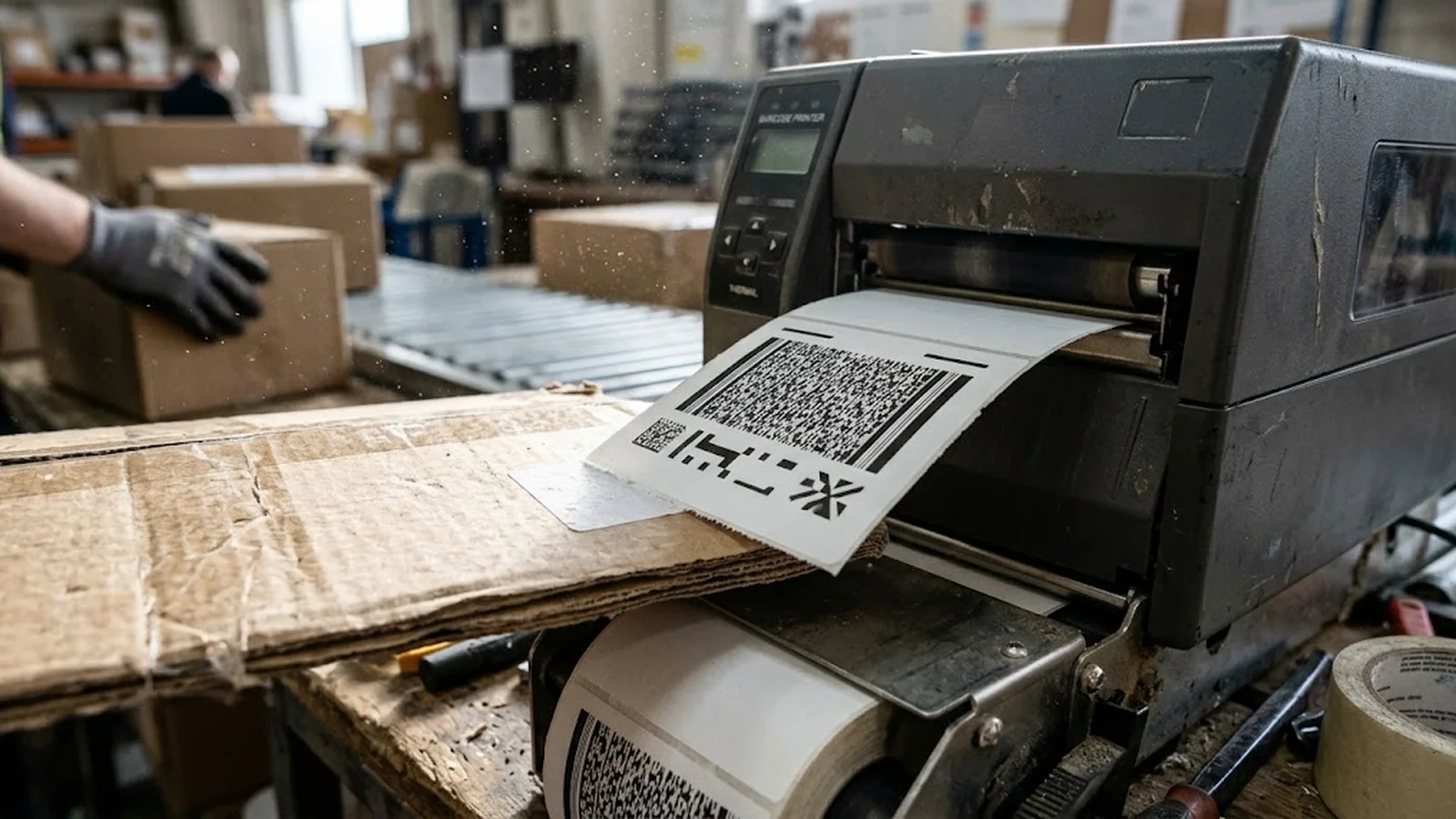
Adhesive, facestock and surface performance
The parcel surface is the variable most often ignored and most often decisive. Recycled corrugate — now the majority of e-commerce carton stock — carries dust and release agents that undermine general-purpose adhesives; poly bags and shrink wrap present a low-surface-energy challenge of their own; and parcels that sit overnight in unheated depots meet the label with a cold, sometimes condensing surface. A network specification therefore names the adhesive class per surface family, and a general-purpose adhesive is chosen deliberately, not by default.
Facestock construction follows the same logic. Direct thermal top-coated stock prints denser barcodes, resists abrasion through sortation, and holds stability across temperature swings better than uncoated stock — a difference that shows up directly in scan-first-time rates at hub speed. Where labels are applied minutes after printing in a cross-dock, or survive multi-leg journeys, the coated construction earns its premium; short-haul, low-handling routes may justify economy stock on measured evidence rather than habit.
Print quality and scannability at hub speed
A barcode that fails to scan first time is a routing failure, and routing failures compound. Print quality on thermal stock is governed by the match between print-head energy and sensitivity class, by print-head cleanliness and wear, and by the consistency of the stock itself — caliper variation and coating uniformity show up as density variation along the roll. Carriers that track scan-fail rates by depot find that stock changes and head-maintenance schedules explain most of the variance, which makes stock consistency a measurable procurement criterion rather than a cosmetic one.
Verification is straightforward and worth institutionalising: trial rolls through the actual printer families and scanner estate, graded on printed density and first-pass scan rate at representative line speed, before a network-wide order. The trial converts two abstract properties — sensitivity class and coating construction — into a number the operations team can sign off.
Structuring label supply across a courier network
Networks buy labels in volume and distribute them to hubs, depots and onboard stocks, so the supply structure matters as much as the label spec. Consolidating onto one manufacturer keeps print density, adhesive behaviour and roll geometry identical across every depot; per-batch documentation ties each carton to a production lot so that a field complaint traces to a batch instead of vanishing into folklore. Packing is part of the spec: hub back rooms are humid, and moisture-barrier carton lining protects stock that waits weeks before use.
Our custom thermal paper programme publishes the test data behind each grade, so network specifications can be verified against the manufacturer's own measurements rather than a catalogue claim — including pre-printed layouts, custom formats and private-label packing for carrier-branded stock.
For networks importing label stock across borders, container-level planning closes the loop: our export shipping guide covers pallet standards, moisture-barrier packing and the document set for ocean freight, so the stock that arrives at the hub matches the stock that was specified at the factory.
Frequently asked questions
What size is a standard courier shipping label?
The workhorse format is 100x150mm — the 4x6 label — carrying the address block, routing barcode and service flags for a parcel. Networks add 100x100mm summary labels, narrow 57mm-class rolls for handheld devices at the doorstep, and carrier-specific waybill and document-pouch formats. The format map is fixed per printer family in the network specification.
Are courier labels direct thermal or thermal transfer?
Carrier parcel labels are overwhelmingly direct thermal: the label is its own stock, no ribbon to manage across hundreds of print stations, and print-and-apply speed suits hub operations. Thermal transfer persists only where labels must survive extreme outdoor exposure for months — a duty most courier journeys do not impose.
Why do labels peel off recycled cartons?
Recycled corrugate carries surface dust and release residues, and general-purpose adhesives formulated for clean surfaces lose grip on it. Low-surface-energy poly bags are a second common culprit. The fix is specification, not reapplication: name the adhesive class per surface family and verify with application trials on the actual carton and bag stock your network handles.
How do I compare label stock for scan performance?
Trial rolls through your actual printer families and scanner estate, graded on printed density and first-pass scan rate at representative line speed. Top-coated constructions typically print denser, more abrasion-resistant barcodes than uncoated stock, but the trial converts that general claim into a number your operations team can act on.
How should a courier network structure label supply?
Consolidate onto one manufacturer with a specification sheet per printer family — width, core, outer diameter, facestock wind direction, format layout, adhesive class and developer documentation — and require per-batch traceability so field complaints resolve to production lots. Verify with trial rolls per hardware type, then hold buffer stock per hub sized to sortation volume.