
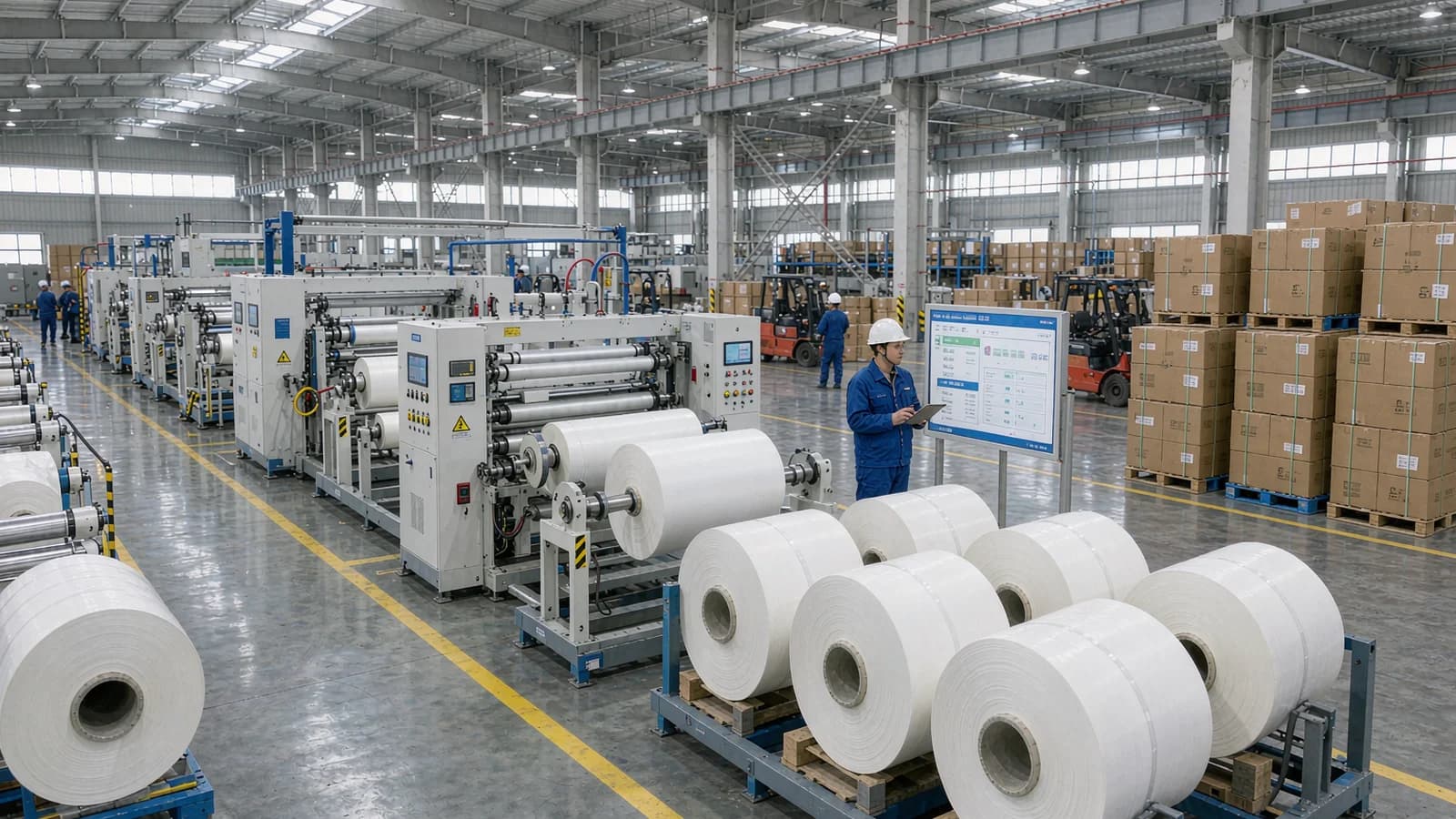
Factory capacity in thermal paper supply is not one number but three: coating capacity (tonnes of sensitized jumbo produced per month), converting capacity (tonnes or pallets of finished rolls and labels slit and packed per month), and schedule headroom (the share of that capacity already committed). Your realistic lead time, MOQ and price stability are set by the tightest of the three, not the biggest. Verify capacity the way an auditor would — with line counts and widths, run rates, utilization data for your season, and one reference customer — and record the answers in a checklist so every supplier is compared on the same basis.
Every thermal paper quotation implies a capacity claim. When a supplier promises three weeks to production and a firm price for six months, they are telling you their lines are running below demand, their raw material position is secure, and their schedule has room for your widths. When a competitor quotes the same item cheaper with a five-week lead time, they are telling you something about their order book too. Buyers who read quotations only as prices miss this second message entirely — and then discover it in September, when peak season starts and their rolls are behind forty other containers.
Capacity is also where the least honest numbers in this industry live. 'One coating line' can mean a 1.6 m pilot coater running five days a month or a 2.4 m line running around the clock. 'We can do twenty containers monthly' may refer to total converting output, not to your width, your grade, or the months you actually need the goods. The vocabulary is not standardized, so the only protection is to ask questions that force the numbers into comparable units.
This guide defines thermal paper factory capacity in the three terms that matter to a buyer, explains how MOQ and lead time are actually set by the production schedule, and provides a factory audit checklist for capacity verification — the questions, the documents and the arithmetic that separate a real twenty-container plant from a trading office with a good story.
Where a programme needs several formats from one supplier, our thermal paper jumbo rolls covers width, core, roll diameter and developer class in a single specification sheet.
- Capacity is three numbers: coating output (jumbo tonnes), converting output (finished rolls), and uncommitted schedule headroom — your order lives in the third.
- Your widths and grade determine which machine you actually need; total plant capacity is irrelevant if no line that runs 790 mm is free in your month.
- MOQ is a scheduling statement, not a policy: it reflects setup time, width changeover and minimum economic run length on the converting line.
- Lead time is capacity utilisation made visible — the same factory quotes 2 weeks in February and 7 weeks in October.
- Verify with line counts and widths, run rates in metres per minute, utilization by month, and reference customers; one factory visit is worth fifty email claims.
The three capacity numbers, and why the tightest one wins
Coating capacity is where thermal paper is made. A coating line takes base paper and applies the pre-coat and thermal layers, producing sensitized jumbo rolls in widths up to 2.4 m and diameters over 1.5 m. Its output is measured in tonnes per month, and it is the upstream constraint for the whole plant: if the coater produces 3,000 tonnes a month and converting only consumes 2,200, the plant is converting-limited and jumbo is stock — usually good for lead times. If the coater is the bottleneck, finished-goods lead times stretch whenever base paper supply or machine time tightens.
Converting capacity is where your product is actually made. Slitter-rewinders cut jumbo into finished receipt rolls, labels or sheets; its output is measured in tonnes or pallets per month, and — critically — per width. A slitter configured for 57 mm and 80 mm receipt lines produces those sizes efficiently; switching to an odd width costs changeover time, and some widths need tooling the plant may not have on the shelf. This is why 'the factory runs twenty containers a month' can be true and useless at once: the question is whether twenty containers of your size mix are producible in your month.
The third number is schedule headroom — committed versus available machine hours for the weeks you need delivery. Headroom is seasonal in this industry: retail roll demand peaks ahead of Q4 and the northern-hemisphere summer again for logistics labels, and the same plant that quotes two weeks in February quotes six or seven in September. Ask for utilization by month, not an annual average. An annual figure averages away exactly the risk you are buying insurance against.
| Question | Good answer | Warning sign |
|---|---|---|
| How many coating lines, at what web width? | Specific: e.g. one 1.6 m and one 2.4 m line | Vague 'modern lines' with no width or count |
| Run rate on your grade? | m/min figure plus gsm range the line runs | Refuses to state; only 'high speed' |
| Utilisation for the delivery month? | Monthly figure, ideally with last year's curve | Annual average only, or 'always available' |
| Slitters that run your width? | Machine count, min/max width, changeover time | Only aggregate finished-goods tonnage |
| Raw material position? | Named base paper stock cover in weeks | Purchases only after order confirmation |
How MOQ and lead time are actually set
MOQ in thermal paper is rarely a commercial caprice — it is arithmetic from the converting line. Setup for a width change consumes time and materiel: blades set, cores loaded, splice tuned, first metres scrapped until the line is stable. A run that lasts less than a shift cannot amortize that setup, so the factory sets minimums per item that equal roughly one economic run. This is why custom widths carry higher MOQs than standard 80 mm or 3-1/8 in items, and why jumbo roll enquiries have MOQs quoted in tonnes while finished-roll MOQs are quoted in cartons or pallets.
Lead time is the production schedule made visible. After order confirmation the sequence is: material check (base paper and chemistry in stock or to be produced), coating slot (if jumbo is not stocked), converting slot, QC and packing, container loading and sailing. Where a plant holds jumbo stock in common grades — 48, 55, 65, 75 gsm in standard widths — converting-only lead times of one to two weeks are genuine. Where your order needs a dedicated coating run, add the coating slot and the curing and aging time before converting; that is the difference between the two-week and five-week quotations on your desk.
Both numbers move together in peak season, and the movement is the honest signal. A factory at 95% utilization must either quote longer lead times, decline small runs, or accept overbooking and deliver late — and plants that always say yes are usually choosing the third option quietly. The most reliable suppliers are the ones whose lead times visibly breathe with the calendar, because that means the schedule you are being fitted into is real.
Buyers comparing these specifications can review our 48 gsm lightweight thermal paper, where basis weight, coating construction and packing are documented per grade before an order is placed.
- MOQ per item ≈ one economic run length on a slitter: setup time divided by run rate, at your width.
- Custom widths, printed cores and private-label packing all add setup steps — expect higher minimums and longer first-lead times than repeat orders.
- Jumbo stock cover in standard grades is the single biggest lever on finished-roll lead time.
- Quote validity is a capacity statement: a six-month validity on a firm price implies raw material cover, not just confidence.
Verifying the claims: data, questions and the factory visit
Remote verification starts with three documents. Ask for a machine list with line counts, web widths and rated speeds — most genuine manufacturers produce this in a day because they use it for every audit. Ask for monthly production tonnage for the last twelve months, or at least utilization figures; a real plant has this in its ERP and can share aggregates under NDA. And ask for two reference customers buying your product category, then actually contact one. Trading companies fail this test quietly: the machine list arrives with converting equipment only, the tonnage figure is 'not available', and the references are colleagues.
The arithmetic checks matter as much as the documents. One 1.6 m coating line at 300 m/min on 55 gsm paper produces roughly 800–1,000 tonnes a month at realistic efficiency — if a 'factory' claims 5,000 tonnes from a single line, the number is a converting hall, not a coating plant. Similarly, count slitters and multiply: a two-slitter shop cannot ship twenty containers of finished rolls a month at mixed widths. You do not need the plant's books; rated speed, web width and basic conversion factors expose most inflated claims.
A factory visit settles everything the documents cannot: whether the coater's dryer section is running, how many slitters are staffed, whether jumbo stock is actually on the floor, how QC is organized, and whether the packing line matches the export cartons in your quotation. Treat the visit as an audit against a written checklist, not a tour — walk from warehouse to coater to slitters to QC to packing in that order, and ask to see the width changeover on your size. A plant confident in its thermal paper production capacity will schedule the changeover; a plant quoting from a spreadsheet will offer lunch instead.

Capacity verification is a matching exercise: your width, your grade, your month. Keep one checklist and score every supplier identically.
A capacity audit checklist you can reuse
Build the checklist once and reuse it for every supplier, so the comparison is like-for-like. The checklist below is ordered the way an auditor walks a plant, and every line is answerable with a number, a document or a demonstration. Suppliers who complete it honestly are rarely the ones who disappoint later — the correlation between willingness to document and willingness to deliver is strong in this industry.
Use the answers to construct a simple capacity model for your program: your annual volume divided by twelve, plus peak-season factor, compared against the verified converting capacity available in your widths. The gap tells you whether one supplier suffices, whether you need a second source, or whether the right answer is contract manufacturing with reserved slots — a booking that costs margin but buys delivery certainty in exactly the months when spot capacity disappears.
Where image life is the deciding factor, our top-coated vs non top-coated guide compares the two constructions on retention, cost and machine behaviour.
| # | Item | Evidence to request |
|---|---|---|
| 1 | Coating lines: count, web width, rated speed | Machine list; nameplate photo on visit |
| 2 | Monthly coating tonnage, last 12 months | ERP aggregate or utilization chart under NDA |
| 3 | Slitter count and width range per machine | Machine list; watch a changeover |
| 4 | Jumbo stock: grades, widths, weeks of cover | Warehouse stock report; floor inspection |
| 5 | Utilisation for your delivery month, both years | Last year's curve plus current booking |
| 6 | MOQ derivation for your item | Setup time and run rate arithmetic |
| 7 | Standard lead time by scenario | Stock converting vs dedicated coating run |
| 8 | Two reference customers in your category | Contact details; one reference call |
Frequently asked questions
What is a realistic production capacity for a thermal paper factory?
A single mid-size coating line (1.6–2.4 m web) running 55–65 gsm grades at typical efficiency produces roughly 800–1,200 tonnes of sensitized jumbo per month. Converting output depends on the number of slitter-rewinders and the width mix. When a supplier quotes figures far above what their line count and speeds can produce, the excess is trading volume, not factory capacity.
Why is the MOQ for custom thermal paper sizes so much higher?
MOQ tracks setup economics. Each width change on a slitter consumes time and scrap — blade setting, core loading, splice tuning and stabilising metres. Custom sizes also often need dedicated cores, tooling or packing. The minimum order is roughly one economic run that amortizes that setup; standard sizes share setups across many customers, so their minimums are lower.
How far ahead should I order before peak season?
Work backwards from the capacity curve, not the calendar. Ask the factory for utilization in your target shipping month and book production slots when utilization is quoted above roughly 80%. For Q4 retail demand, orders placed in July with reserved slots ship on time; orders placed in September take whatever schedule is left, usually at longer lead times and softer price validity.
Can a factory verify capacity remotely, without a visit?
Partly. A machine list, twelve months of production or utilization data, and two contactable references verify most claims. The remaining gaps — whether jumbo stock physically exists and whether lines actually run — are best closed with a live video walkthrough of the warehouse and coating hall, or a third-party inspection. A visit remains the gold standard for a program-sized commitment.
Does higher capacity mean better prices?
Only through the schedule. Capacity above committed demand lets a plant batch similar widths, hold jumbo stock and quote firm prices with long validity — all of which support stable pricing. But headline capacity without headroom in your month delivers neither. Compare suppliers on uncommitted capacity in your widths for your delivery month, not on total annual tonnes.