
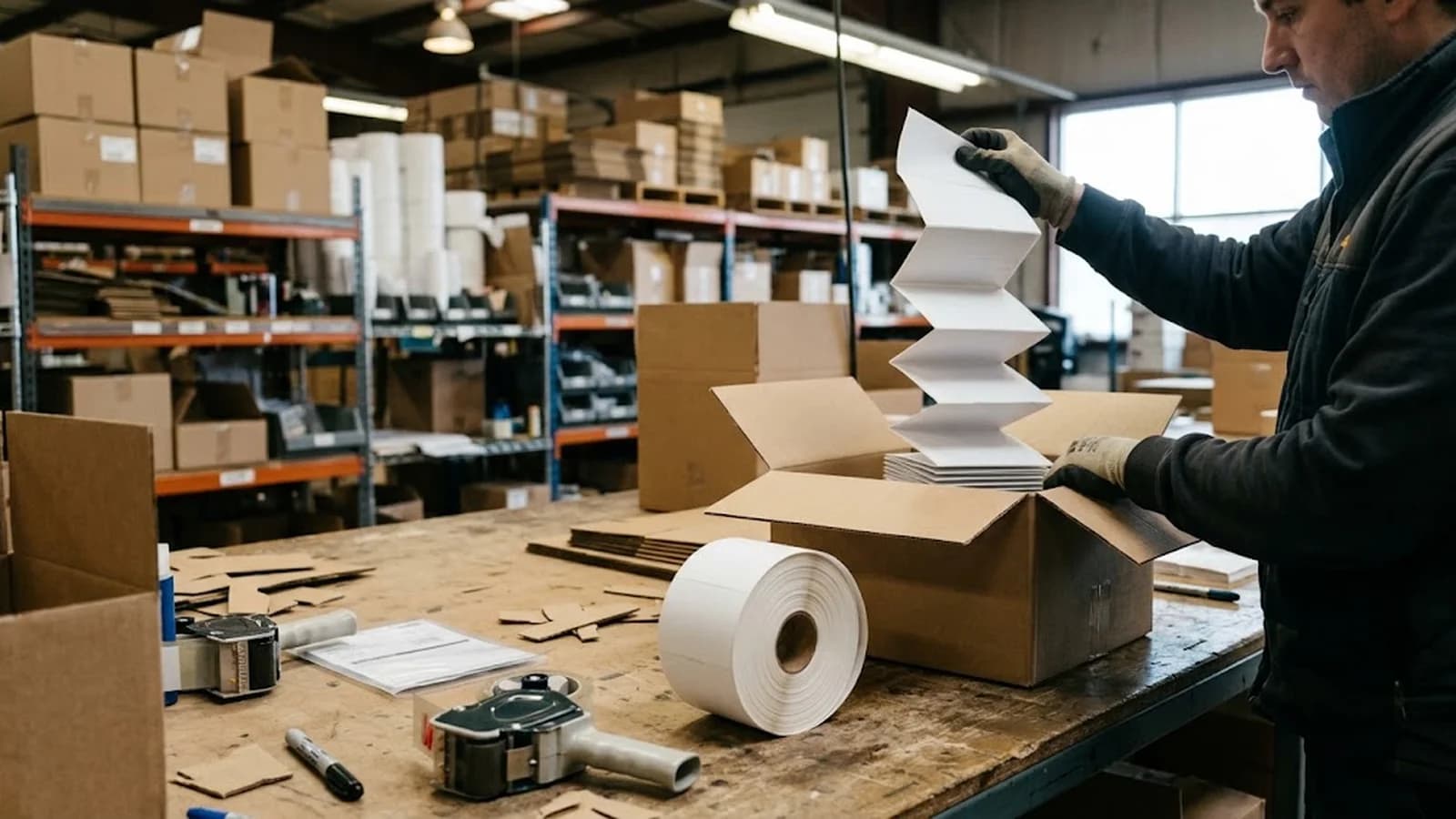
Fanfold thermal labels are direct thermal die-cut labels supplied as a continuous zigzag-folded stack in a carton instead of a wound roll. The media carries the same thermal coating and adhesive as rolled stock; only the presentation changes. Folded stacks feed through the same thermal mechanisms as rolls, hold four to eight times more labels per carton, store flat in less space, and eliminate roll changeout downtime on long runs — while rolls remain the better choice for mobile terminals, tight spaces and machines whose paper path is designed around a spool. Choose fanfold for high-volume fixed stations shipping thousands of identical labels a day; choose rolls everywhere else. Specify the same three numbers as rolled stock — label size, liner width and core-independent count per box — plus fold direction.
Most thermal label buyers meet fanfold stock the same way: a supplier quotes the familiar 4 x 6 shipping label both as rolls and as a folded stack, at a visibly different price per label, and the buyer has to decide which line item actually suits the operation. The media is identical — same direct thermal coating, same adhesive, same liner — so the decision rests entirely on how the labels are presented to the machine and to the warehouse.
Fanfold thermal labels solve problems that rolls create. A roll spends most of its volume on wind and core, forces a machine stop every few thousand labels, and stores as awkward cylinders in racks. A folded stack packs flat, carries no core waste, feeds continuously from a carton behind the machine, and can hold tens of thousands of labels in one box. But fanfold is not universally better: mobile and countertop devices are mechanically built for spools, and some fixed machines feed folded stock less reliably than a well-tensioned roll.
This guide explains what fanfold stock is and how it is converted, compares folded and rolled labels across the variables that matter in operation — feeding, footprint, changeout, cost and storage — and closes with the specification line and incoming checks that keep folded-stock shipments predictable.
Our POS and receipt paper rolls programme publishes the test data behind each grade, so specifications can be verified against the mill's own measurements rather than a catalogue claim.
- Fanfold labels are the same direct thermal media as rolls, presented as a zigzag-folded stack — the comparison is about presentation, not chemistry.
- Folded stacks pack 4–8 times more labels per carton volume, store flat, and eliminate roll changeout stops on long production runs.
- Rolls remain the right choice for mobile terminals, compact devices and any machine whose feed path is engineered around a spool.
- Fold quality decides feeding reliability: consistent zigzag geometry, clean perforation-free folds and low stack compression matter more than paper brand.
- Specify fanfold with label size, liner width, count per box and fold orientation — and verify on receipt with a flat-stack, edge and feed test.
What fanfold thermal labels are and how they are made
Fanfold — also called z-fold after the zigzag geometry, or simply folded stock — starts life on the same converting line as rolled labels. A jumbo of direct thermal label stock, with liner typically 565 or 636 mm wide, is die-cut to the label shape, the matrix waste is stripped away, and the label web is then folded back on itself in a repeating zigzag rather than wound onto a core. The emerging stack collapses into a dense rectangular block that is stacked into cartons, typically 5,000 to 15,000 labels per box depending on size.
The converting step that matters most is the fold itself. Each fold is a crease in the liner, made at a precise angle so the stack lies flat and the leading edge of each label presents square to the feed mechanism. Poor fold converting shows immediately in the field: skewed stacks that lean in the carton, labels that curve at the crease, leading edges that catch in the feed path. Fanfold label converting quality is therefore judged on stack geometry — how flat the block sits, how square the edges are, how uniformly the zigzag repeats — long before any label is printed.
Because the media is unchanged, everything buyers already know about direct thermal labels transfers directly: the same top-coated or uncoated facestocks, the same adhesive families, the same 4 x 6 inch and 100 x 150 mm shipping formats, and the same storage cautions against heat and humidity. Folded stock is available in the standard logistics sizes as well as smaller 4 x 2 and 3 x 2 formats for address and barcode work.
- Same media as rolled labels: direct thermal facestock, adhesive, silicone liner — only the presentation differs.
- Converted from jumbo stock by die-cutting, matrix stripping and continuous zigzag folding, then cartoned in flat stacks.
- Standard formats: 4 x 6 inch / 100 x 150 mm shipping labels dominate; 4 x 2 and 3 x 2 for address and barcode labels.
- Counts per box typically 5,000–15,000 for shipping sizes, far beyond any single roll equivalent.
Fanfold vs roll labels across the variables that matter
Feeding and compatibility come first in any fanfold vs roll labels comparison. Rolls feed through a defined path: spindle, tension arm, guide. Folded stock feeds straight from the carton through a rear slot, and the machine must be designed or configured for it — many desktop and industrial units accept both, feeding the stack from behind. Mobile terminals, compact countertop units and card machines are built around spools and cannot take stacks at all. The first check is therefore not a preference but a mechanism question: does the machine have a rear feed for fanfold, or only a spindle?
Throughput and downtime favour folded stock decisively in fixed high-volume stations. A 4 x 6 roll holds a few hundred to around a thousand labels; a fanfold carton holds ten to twenty times that. Every roll change is a machine stop with thread-up and waste, while a new carton is presented to the feed slot in seconds, and stacks can even be spliced-fed on some lines. Operations shipping thousands of parcels daily report measurably fewer interruptions on fanfold — which is why courier depots and fulfilment centres converted their fixed stations years ago.
Storage, handling and cost complete the comparison. Folded stacks are rectangular bricks: they palletise with no voids, need no spindle racks, and pack more labels per cubic metre of warehouse than rolls by a wide margin. Cost per label usually runs lower on fanfold at equal quality, because converting skips winding and the buyer pays no core. The roll keeps three genuine advantages: it feeds with more consistent tension on machines sensitive to it, it suits locations where a carton behind the machine is impossible, and it travels into mobile workflows that stacks never can.
Requests that combine several formats can be quoted together; see 75 gsm heavyweight thermal paper for the construction options behind each one.
| Variable | Fanfold stack | Roll |
|---|---|---|
| Machine compatibility | Rear-feed fixed stations only | Any spool-based mechanism, including mobile |
| Labels per carton | 5,000–15,000+ (shipping size) | 300–1,000 typical |
| Changeout downtime | Seconds; next carton into the slot | Machine stop, thread-up, tail waste |
| Storage footprint | Flat bricks, dense pallets | Cylinders, rack space, void losses |
| Cost per label | Usually lower (no core, no winding) | Core and winding in the price |
| Feed consistency | Depends on fold quality and stack weight | Tension-controlled, very consistent |
Where folded stock wins, and where it does not
Fanfold thermal labels earn their carton in three settings. High-volume fixed shipping stations — courier hubs, e-commerce fulfilment lines, warehouse dispatch benches — combine every advantage: continuous feed, minimal changeouts, dense storage, lowest cost per label. Back-office and mailroom benches running one or two print stations a day benefit from the same economics at smaller scale. And operations with irregular, bursty volume appreciate that a carton of 10,000 labels sits on a shelf for months without the standing-start issues a long-stored roll can develop at its outer wrap.
The cases against folded stock are equally concrete. Any mobile workflow — delivery confirmation, field service, route sales — requires rolls, full stop. Compact countertop spaces without rear clearance cannot present a carton. Machines whose feed path and tension system are tuned for spool supply may show skewed or slipped feeds on stacks, especially near the end of a carton when stack weight drops and the feed angle changes. And very small label formats can fold poorly, with creases eating into usable label area; below about 2 inches of label height, rolled stock is usually the safer order.
A practical hybrid exists in most operations, and it is the answer experienced buyers land on: fanfold cartons for the fixed high-volume stations that consume the overwhelming majority of labels, and rolls in a few standard formats for the mobile and marginal devices. Standardising on one 4 x 6 media specification across both presentations keeps adhesive, coating and print quality identical everywhere while letting each station use its most efficient supply format.

Buyer rule: the station that prints more than a few thousand labels a day on a fixed bench is a fanfold candidate; everything on wheels or a countertop stays on rolls.
Specifying and inspecting fanfold stock
A fanfold specification extends the rolled-label line with two folded-specific fields. Base line: label size (e.g. 4 x 6 inch / 102 x 152 mm), liner width, facestock class (top-coated or uncoated), adhesive family and count per carton. Folded-specific fields: fold orientation — which edge leads into the machine, defined as the printing side up or down at feed — and stack geometry limits, typically expressed as stack squareness and maximum lean in the carton. Because folded stock has no core, count per box replaces core size as the yield variable, and it should be a declared minimum, not an approximation.
Incoming inspection for folded stock takes minutes per carton and predicts field performance well. Open a carton and check the stack sits flat and square with no lean; flip through the leading hundred labels and look for creased corners, matrix remnants and adhesive skip; feed a stack through a representative machine and watch the first and last fifty labels for skew or slip; print a barcode test and scan it. Weigh one carton against the declared count to verify yield. Fold quality faults — leaning stacks, curved creases, catching edges — are all visible at this stage, and all of them become downtime later.
Supplier questions worth asking before the first order: how is fold angle controlled and checked in converting; what stack squareness limit ships as standard; how are counts verified per carton; and how are cartons sealed against humidity in transit, since a liner that absorbs moisture in a container changes its fold behaviour. A converter who runs folded stock as a standard product answers all four from process records; one who treats it as an occasional run will improvise — and the difference shows up at your feed slot.
Where container planning is the next step, our export shipping guide covers pallet standards, moisture-barrier packing and the document set for ocean freight.
| Item | Specification example | Incoming check |
|---|---|---|
| Label size / liner | 4 x 6 inch on 108 mm liner | Caliper check on sample labels |
| Facestock / adhesive | Top-coated, permanent general purpose | Print and peel sample test |
| Count per carton | 10,000 labels minimum | Weigh carton against declared count |
| Fold orientation | Leading edge per machine feed spec | Feed test on representative machine |
| Stack geometry | Flat, square, no lean beyond agreed limit | Visual check on open carton |
| Carton protection | Sealed, humidity-buffered for export | Check seals and inner liner |
Frequently asked questions
What are fanfold thermal labels?
They are standard direct thermal labels supplied as a continuous zigzag-folded stack in a carton rather than wound on a core. The facestock, adhesive and liner are the same as rolled stock — only the presentation changes, which changes feeding, storage density, changeout effort and cost per label.
Can any thermal label machine use fanfold stock?
No. The machine needs a rear feed slot or an explicit fanfold mode, which most desktop and industrial fixed stations have. Mobile terminals, compact countertop devices and card machines are built around a spool and take rolls only. Check the machine's media path before ordering folded stock.
Why is fanfold often cheaper per label than rolls?
Converting skips the winding step and there is no core, so less material and less machine time sits inside each label. Folded stacks also pack more labels per carton and per pallet, which lowers freight and storage cost per label. The saving holds at equal quality — the media is identical, so compare specifications, not just prices.
Do fanfold labels feed as reliably as rolls?
On machines designed for rear feed, yes, provided fold quality is good. Reliability problems trace to converting faults — leaning stacks, skewed folds, rough leading edges — or to running a stack in a machine tuned for spool tension. Inspect stacks on receipt and run a feed test; consistent zigzag geometry is the variable that decides feeding.
How should fanfold cartons be stored?
Flat, sealed and off hot surfaces, in the same cool dry conditions as any direct thermal media. Folded stock has no roll stress to worry about, but humidity can stiffen the liner and change fold behaviour, and heat can develop the coating. Keep cartons closed until use and buffer them for long sea shipments.