

For most receipt applications, 55 gsm thermal paper is the practical answer: it is the global default for 80 mm POS rolls and 57 mm credit-card slips, balancing image quality, stiffness and cost. Economy programmes and high-volume supermarkets commonly step down to 48–50 gsm to gain more metres per kilogram, while hospitality, banking and kiosk operators who want a stiffer, more premium-feeling slip move up to 60–65 gsm. The decision rule is simple: match the weight to the machine's spec range first, then to the document's required hand feel and image life, and only then optimise price — because gsm directly drives both metres per roll and receipts per kilogram.
Ask three suppliers what gsm thermal paper for receipts should be and you may get three different answers — 48, 55, 65 — each defended with real logic. The confusion is not because anyone is wrong; it is because 'receipt paper' covers everything from a two-inch payment slip printed ten times a day to a supermarket roll consumed by the kilometre. The right weight is a trade-off, and the trade-off has a structure.
GSM — grams per square metre — is the single most consequential number on a receipt paper quotation after the roll dimensions. It determines how many metres a roll contains, how many receipts a tonne of paper yields, how stiff the slip feels in a customer's hand, how the paper feeds through compact mechanisms, and where the price per receipt lands. Get the weight decision right and everything downstream aligns; get it wrong and you either pay for stiffness nobody needs or field complaints about flimsy, curling slips.
This guide gives procurement teams and distributors a clear framework: the common receipt weights and who uses them, what physically changes when the number moves, how yield and cost per receipt calculate, and a method for locking the specification before comparing quotations.
Our POS and receipt paper rolls programme publishes the test data behind each grade, so specifications can be verified against the mill's own measurements rather than a catalogue claim.
- 55 gsm is the global default for receipt rolls — the safe specification for 80 mm POS paper and 57 mm payment slips unless a programme dictates otherwise.
- 48–50 gsm is the economy tier: more metres per kilogram and a lower cost per receipt, at the cost of stiffness and a thinner hand feel.
- 60–65 gsm serves premium receipts, hospitality checks, banking slips and kiosk output where stiffness and durability matter more than yield.
- Weight must sit inside the device's specified paper range — feed reliability and print head contact are engineered around a gsm band, not any value.
- Compare quotations on cost per receipt or cost per metre, never on roll price alone: weight changes the metres in every roll.
The common receipt weights and who uses them
Receipt-grade thermal paper clusters into three weight bands. The light band, 48–50 gsm, is the economy workhorse: supermarket chains, courier networks and any operator printing very high volumes gravitate here because every gram of basis weight saved converts directly into extra metres per roll. The mid band, 55–60 gsm, is the global default — most branded receipt rolls sold through distribution sit at 55 gsm, and payment-terminal slips commonly use it too. The upper band, 60–65 gsm, appears where the document must feel substantial: restaurant guest checks, hotel folios, bank counter slips, parking receipts and kiosk output that customers handle and keep.
It is worth understanding why 55 gsm became the default rather than an accident. At 55 gsm, the sheet is opaque enough that printing shows a clean black image with no show-through, stiff enough to feed reliably through the compact mechanisms of 57 mm and 80 mm devices, and light enough that a standard 80 × 80 mm roll still carries roughly 80–85 metres of paper. Move ten grams in either direction and each of those properties shifts enough that operators notice — which is exactly why the market settled in the middle.
Regional habits matter as well. North American converters frequently quote 48 gsm and 55 gsm side by side; European retail buyers tend to standardise on 55 gsm and step to 65 gsm for hospitality; in parts of Asia and the Middle East, 60 gsm is a common receipt standard where a premium hand feel is expected. None of these habits is wrong — but a quotation should state the weight explicitly, because 'same roll, different supplier' comparisons fall apart when one side quoted 48 gsm and the other 55 gsm.
| Weight | Common formats | Typical applications | Positioning |
|---|---|---|---|
| 48–50 gsm | 57 × 40, 76 × 76, 80 × 80 mm | Supermarket receipts, courier slips, high-volume retail | Economy — maximum metres per kilogram |
| 55 gsm | 57 × 40, 80 × 80, 80 × 60 mm | General POS receipts, payment slips, pharmacy and convenience retail | Global default — balanced cost and feel |
| 60 gsm | 80 × 80 mm, 76 × 76 mm | Retail with premium expectations, service receipts, weighing-scale slips | Mid-premium — stiffer hand feel |
| 65 gsm | 80 × 80 mm, kiosk and wide rolls | Restaurant checks, hotel folios, banking slips, kiosk receipts | Premium — stiffness and durability first |
What physically changes when the weight changes
GSM is the mass of one square metre of paper, and because thermal receipt paper is a base sheet plus a coated imaging layer, the number moves in two ways: the base paper can be lighter or heavier, and the coating loading can vary. Within a single manufacturer's range, moving from 48 to 65 gsm mostly means a thicker, denser base sheet carrying a comparable thermal coating. That has predictable consequences.
Yield is the first consequence. Receipt paper is bought by the tonne and sold by the roll, so basis weight converts directly into length: a kilogram of 48 gsm paper contains roughly 20,800 square metres of area per tonne-equivalent, while a kilogram of 65 gsm contains about 15,400 — put simply, the lighter sheet delivers roughly 25–30 percent more metres per kilogram. On an 80 mm roll that difference is the gap between about 85 metres and about 62 metres, which is why weight is the first lever procurement reaches for when cost per receipt must fall.
Stiffness and opacity are the second consequences. The heavier sheet resists curl better in humid conditions, feeds more positively through long paper paths, and produces a slip that feels like a document rather than a film. Opacity rises too, which matters when receipts are filed back-to-back. Against that, lighter sheets cost less per image, produce less waste per till roll consumed, and suit compact mechanisms where jam clearance is harder. Neither direction is universally right — which is why the device's own specification comes first.
Requests that combine several formats can be quoted together; see 75 gsm heavyweight thermal paper for the construction options behind each one.
- Metres per roll fall as gsm rises: weight, not diameter alone, decides how long a roll lasts.
- Cost per receipt favours lighter grades; hand feel, stiffness and durability favour heavier ones.
- The imaging coating is broadly similar across receipt weights — the base sheet does most of the changing.
- Curl, feed reliability and jam rates all sit inside a device's specified gsm band; staying inside it matters more than the exact number.
How to choose: a four-step method
Step one is the device, not the paper. Every receipt mechanism has a paper specification — a weight range, a thickness range and a roll geometry. The chosen gsm must sit inside it, because feed rollers, print head pressure and sensor thresholds are calibrated for that band. An 80 mm kiosk unit specified for 55–65 gsm will misfeed film-like 48 gsm stock; a compact 57 mm terminal calibrated for 48–55 gsm may struggle with the stiffness of 65 gsm. Confirm the band from the device documentation before anything else.
Step two is the document's job. Ask what happens to the receipt after printing: discarded within minutes in a supermarket flow, or retained as a warranty record, an expense proof or a guest check carried through a shift? High-churn receipts justify economy weights; documents that survive pockets, wallets and kitchens justify 55 gsm at minimum and often a top-coated grade, because the coating — not the weight — governs image life against water, oil and plasticiser attack.
Step three is the commercial calculation. Convert every quotation to cost per receipt or cost per metre: roll price divided by metres per roll divided by receipts per metre. This single normalisation exposes the true difference between a 48 gsm offer and a 55 gsm offer, and prevents the classic error of comparing roll prices across different weights. Step four is validation: run a two-week line trial in the worst environment the paper will see — a hot kitchen, a humid coastal store — and check feed reliability, print density and curl before committing to a programme volume.
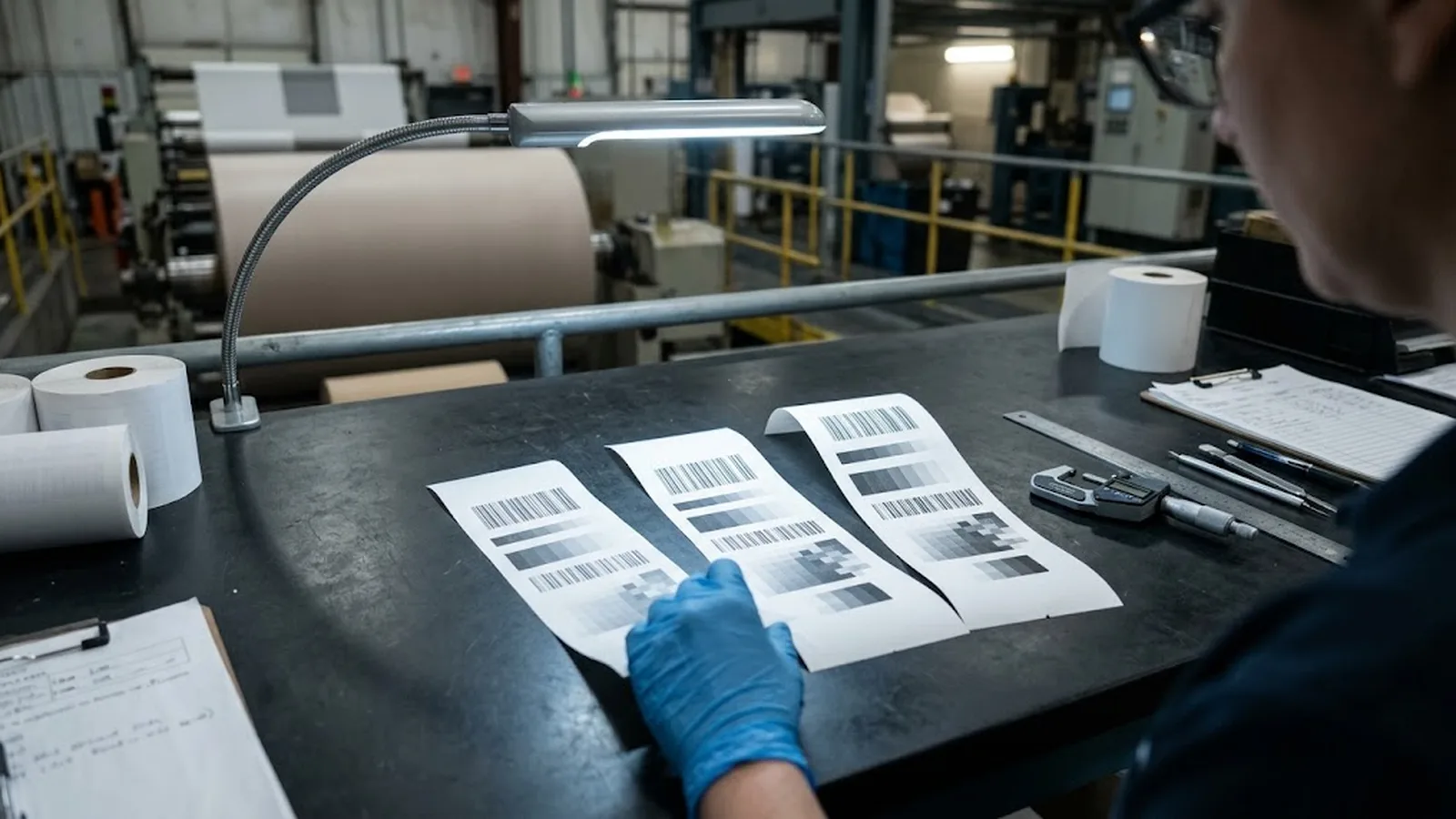
Rule of thumb: let the device set the band, let the document set the tier, let the trial confirm — only then let price decide between qualified suppliers.
What buyers should specify in an RFQ
A weight-led receipt paper specification is short but must be explicit. State the gsm with a tolerance (typically ±1 gsm at manufacture), the roll width and diameter, the core type and size, the coating type (standard or top-coated), the image colour and the target image-life expectation with its storage assumptions. Add packing details — individual wrapped or bulk, rolls per carton — because for receipt programmes packing affects both hygiene at the till and landed cost per cubic metre of container.
Then qualify what sits behind the number. A manufacturer with its own coating line controls the variables that make one 55 gsm paper print densely and another print grey: coating weight, sensitivity, and the uniformity of application across the web. Ask for print density measurements, background ageing data and a consistent production batch policy. Distributors reselling unknown stock cannot answer those questions; manufacturers can — and for a product consumed by the billion images, that traceability is what keeps the thousandth roll as good as the first.
Where image life is the deciding factor, our top-coated vs non top-coated guide compares the two constructions on retention, cost and machine behaviour.
Frequently asked questions
What gsm thermal paper is best for receipts?
For most applications, 55 gsm is the best default: it balances print quality, stiffness, feed reliability and cost, and it is the weight most 80 mm and 57 mm receipt devices are specified around. Choose 48–50 gsm for maximum economy in high-volume retail, or 60–65 gsm where a stiffer, more premium document is wanted.
Is 48 gsm thermal paper too thin for receipts?
Not if the device accepts it. 48 gsm is a legitimate economy grade used widely in supermarket and courier receipts; it simply feels thinner and yields more metres per kilogram. The decisive check is the machine's specified paper weight range — if 48 gsm is inside it, the grade will feed and print correctly.
Does higher gsm mean better print quality on receipts?
Only indirectly. Print density comes mainly from the thermal coating quality, which is similar across receipt weights. Higher gsm improves stiffness, opacity and durability of the sheet, but a well-coated 48 gsm paper can print darker than a poorly coated 65 gsm one. Judge coating quality from print density data, not weight alone.
How many metres are in an 80 × 80 mm receipt roll at different gsm?
Approximately 83–85 metres at 48 gsm, 78–80 metres at 55 gsm, and 62–65 metres at 65 gsm, depending on core size and winding density. Because metres fall as weight rises, always compare quotations on cost per metre or cost per receipt rather than roll price.
Can I mix 48 gsm and 55 gsm rolls across the same fleet of devices?
Usually yes, provided both weights sit within each device's specified paper band. Problems appear at the edges: very light paper in a kiosk unit built for stiff stock can misfeed, and very heavy paper in a compact terminal can drag. Standardise per device type rather than per site.