
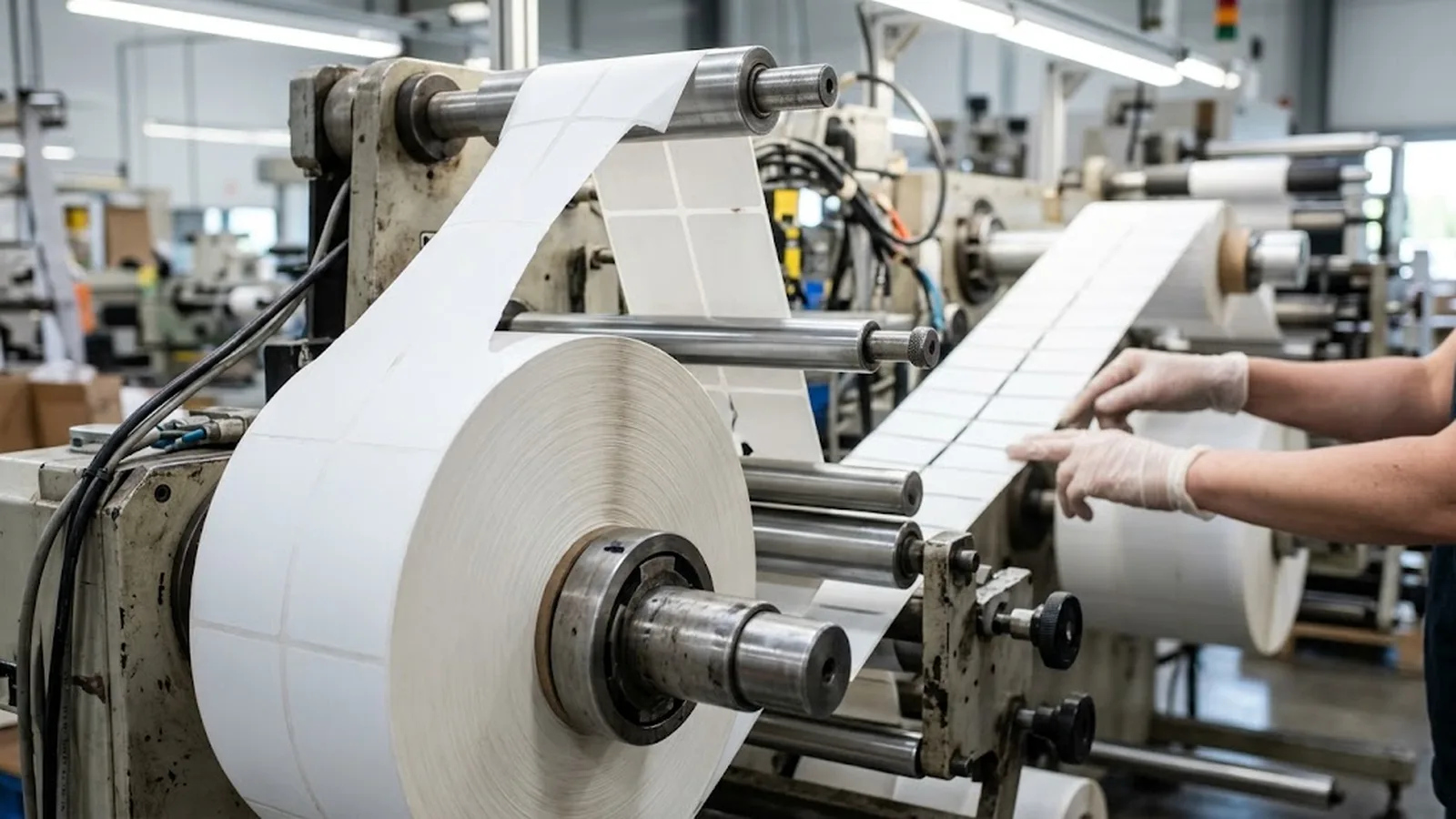
Blank thermal labels are unprinted, die-cut direct thermal label stock supplied on rolls or fanfold for variable-data printing at the point of use. Buyers should specify label dimensions and die-cut tolerance, face paper structure (standard or top-coated), adhesive class per surface and environment, liner type, roll geometry and winding direction — then buy against a fixed specification sheet with die-cut accuracy and release quality checked on arrival.
Blank thermal labels are the quiet workhorse of variable-data printing: shipping labels, barcode labels, price and shelf labels, warehouse locations — anything printed once, at the moment it is needed, with no pre-printed content to go stale. Because the stock is blank, buyers sometimes treat it as a commodity and buy on price alone. That is where the complaints come from: die-cuts that break the liner, adhesives that lift in cold rooms, labels that curl off corrugate overnight.
This guide covers blank label stock as a specification: what the die-cut and liner actually do, how to choose the face structure for the application's image-life requirement, how adhesive classes map to surfaces and environments, the roll geometry and winding details that decide how the labels feed in the applicator or desktop unit, and the arrival checks that separate a good batch from a future claim.
For production volumes, the same construction logic applies to our top-coated thermal label stock, quoted per slit reel or finished roll with face structure, adhesive and liner documented per grade.
The sections follow the order a label buyer would settle them: construction and die-cut first, face structure second, adhesive third, roll geometry fourth, and the buying and inspection routine last.
- Blank does not mean unspecified: dimensions, die-cut tolerance, face structure, adhesive, liner and winding all need to be in the sheet — every one of them is checkable on arrival.
- Face structure decides image life: standard direct thermal suits short-cycle shipping and receipts, top-coated stock earns its premium where labels face moisture, abrasion or long warehouse dwell.
- Adhesive is matched to surface and environment — general permanent for corrugate and cartons, cold-temperature and all-temperature grades for chilled or frozen chains, removable for retail shelf use.
- Roll geometry (core, outer diameter, winding direction, labels across) must match the applicator or desktop unit; a wrong-wound roll is a full-batch return, not a tuning issue.
- Die-cut accuracy and release quality are the two arrival checks that predict feeding performance — one mis-cut edge shows up as liner breaks or double-feeds downstream.
What a blank thermal label consists of: face, adhesive, liner — and the die-cut
Every blank thermal label is a laminate: the direct thermal face paper that images, a pressure-sensitive adhesive layer, and a release liner that carries the die-cut. The die-cut cuts through face and adhesive to the liner's surface, defining the label shape while leaving the liner intact as a carrier web. That is why die-cut quality is the core manufacturing variable: the cut must sever face and adhesive completely (or the matrix strips badly) without penetrating the liner (or it breaks under tension in the printer).
Buyers should hold the die-cut to a stated tolerance — typically ±0.3mm on dimensions — and check edge quality on arrival: clean, complete cuts, no nicks at corners, matrix stripping cleanly during unwind. Round-corner dies last longer in dispensing than square corners, and the corner radius belongs in the spec, not in the supplier's discretion.
Liner choice follows the application: glassine and kraft liners for standard rolls, thicker or PET liners where the labels are die-cut to fine shapes or applied by automated applicators that need liner stiffness. Liner release is measured, not felt — excessive release tension feeds poorly, insufficient release lets labels ride up in the roll.
| Layer | What it decides | Buyer's check |
|---|---|---|
| Face paper | Image life, scan reliability, print darkness | Structure (standard/top-coated), gsm, sensitivity class |
| Adhesive | Bonds to surface, survives environment | Class (permanent/cold/removable), min. application temperature |
| Liner | Die-cut carrier, feeding, applicator behaviour | Type, thickness, release value |
| Die-cut | Label shape, matrix stripping, liner integrity | Dimensions ±0.3mm, clean edges, corner radius |
Face structure: standard vs top-coated for blank stock
The face structure is the biggest cost-versus-performance decision in blank thermal labels. Standard direct thermal face papers image crisply and suit the short-cycle majority — parcel shipping labels printed and consumed within weeks, price labels replaced on rotation, event and queue tickets. Their coating is optimised for cost and sensitivity, not for endurance.
Top-coated stock adds a protective layer over the thermal face that resists moisture, oils, abrasion and light-plasticiser contact, and stabilises the image for months to years. It earns its premium wherever the label has a hard life after printing: labels on chilled cartons that condensate, warehouse locations handled daily, logistics labels scanned repeatedly and exposed to sunlight on loading docks.
Where image life is the deciding factor, our top-coated vs non top-coated guide compares the two constructions on retention, cost and machine behaviour — the natural companion when deciding which of a label programme's SKUs need the coated face.
A practical rule for mixed programmes: keep standard face for everything consumed within weeks, and move the long-dwell SKUs — warehouse location labels, return labels that ride on parcels for months, any label exposed to condensation or friction — to top-coated stock. Buying the whole programme top-coated pays endurance premium where it does nothing; buying it all standard moves the durability problem to the customer's complaint desk.
Adhesive classes: matching the surface and the environment
Adhesive failure is the most common blank-label complaint and the most avoidable. Adhesives are matched on two axes: the substrate (corrugate, plastic film, glass, metal, wood) and the application environment (temperature at application, service temperature range, humidity, surface energy). General-purpose permanent acrylic covers the corrugate-and-carton majority; hot-melt adhesives give a fast, aggressive grab on difficult surfaces including recycled corrugate and some films; special cold-temperature grades bond and stay bonded in chilled and frozen distribution.
Two figures belong on every adhesive spec: minimum application temperature and service temperature range. Applying a standard adhesive below its minimum — labelling cartons in a chilled dock at 2°C — produces a bond that looks fine and fails in the aisle. Removable adhesives for retail shelf labels and reusable totes are a separate class: the spec should state clean removal after the intended dwell time, not just initial tack.
Buyers changing adhesive class mid-programme should revalidate on the actual substrates and application line, not on datasheet values alone — surface energy varies by supplier of the packaged goods themselves, and a ten-minute tape-down test per SKU prevents a season of lifting corners.
- Corrugate and cartons: general-purpose permanent acrylic; hot-melt for recycled or high-moisture board.
- Chilled and frozen chains: cold-temperature grade with stated minimum application temperature.
- Retail shelf labels and totes: removable class with stated dwell time and clean-removal requirement.
- Always specify both minimum application temperature and service range on the sheet.
- Revalidate any adhesive change on real substrates from the actual application line.
Roll geometry: core, diameter, winding and labels across
Blank label rolls are engineered to feed, and the geometry is what feeds. The specification must fix: core size (25.4mm and 76.2mm are the common standards), outer diameter per the printer or applicator's capacity, winding direction (labels out or labels in — dictated by the print head position and sensor arrangement of the machine), and labels across the web for multi-up layouts. A roll that is right in every other respect but wound the wrong way out is a full-batch return, so this line is worth reading twice before ordering.
For applicator-fed lines, liner tension behaviour and roll squareness matter as much as geometry: an out-of-square roll oscillates in the unwind stand and walks the label register across the web. Programme buyers pin roll squareness and maximum camber into the sheet and verify both at goods-in with a straightedge and a tape — checks that take minutes and prevent a shift of downtime.
Where a programme converts its own stock from parent rolls, blank label stock sits downstream of the same jumbo paper: for production volumes, the same construction logic applies to our thermal paper jumbo rolls, the converter-grade input from which face stock, die-cut width and liner width are all planned.
Buying blank thermal labels: the arrival inspection routine
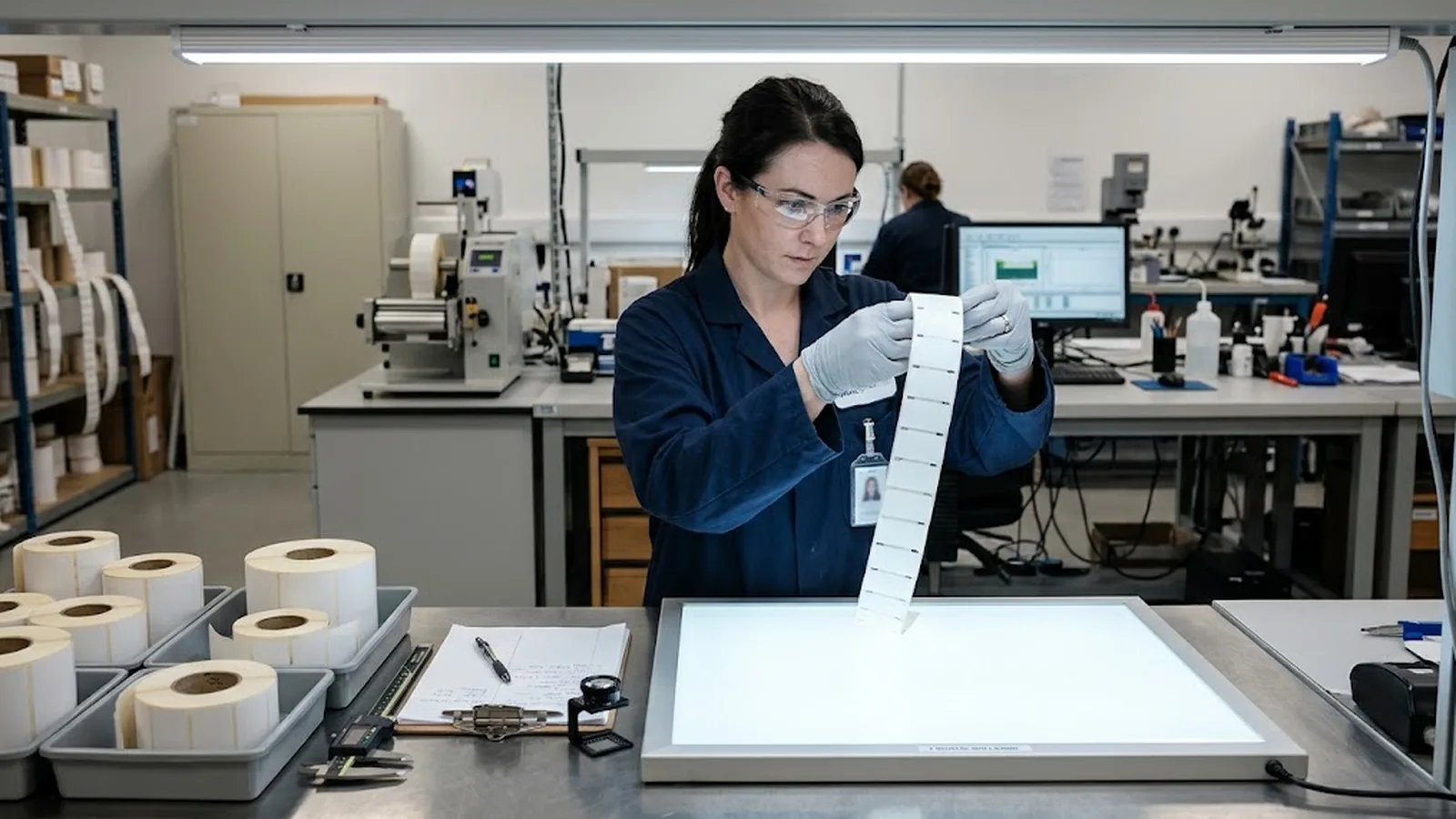
Blank label quality is almost entirely checkable at goods-in, which is why a one-case-per-pallet routine is the buying discipline that matters. The checks: measure label dimensions and corner radius against the die spec; strip a strip of matrix and watch it release cleanly; pull the liner to confirm it does not tear at the die-cut line; feed a handful of labels through the destination printer at production speed and check registration, darkness and sensor response; and date-code the batch into the retained-sample log.
Programme buying then mirrors the receipt-roll structure: a fixed specification sheet per label SKU, a rolling forecast that lets the mill schedule die changes and coating campaigns, and agreed packing — rolls individually sealed, moisture-barrier cases, pallets protected for the destination climate. Labels sit in storage longer than receipt rolls, so the storage condition (cool, dark, original wrap until use) belongs on the case label as well as in the contract.
Close the loop commercially: track feeding complaints and adhesion returns per batch against the retained samples, requalify after any construction change, and keep die artwork and construction drawings under version control so the label that ships in year three is the label the customer qualified in year one.
Frequently asked questions
What is the difference between blank and pre-printed thermal labels?
Blank labels carry no printed content — all text and barcode data is printed at the point of use, so one stock serves unlimited variable data. Pre-printed labels carry fixed content (logos, colour zones, fixed compliance text) applied by the manufacturer before converting. Blank stock is the flexible default; pre-print adds brand presentation or fixed markings where the application needs them.
Which face structure should I choose for blank shipping labels?
Standard direct thermal face for labels consumed within weeks in dry handling — the usual parcel shipping case. Choose top-coated stock where labels face condensation, friction, repeated scanning or months of dwell: chilled distribution, warehouse location labels, return labels that travel on the parcel for long periods.
What adhesive class works for cold-chain blank labels?
A cold-temperature adhesive grade, specified with its minimum application temperature (often around 0°C or below) and a service range covering the frozen chain. Standard permanent adhesives applied in chilled docks below their minimum bond poorly and lift in service — the application temperature matters as much as the service range.
What MOQ applies to custom die-cut blank label orders?
A new die-cut shape carries die tooling and a make-ready run, so custom shapes start at pallet volume per SKU. Standard die shapes in common widths can be ordered at case volume, and mixed-SKU pallets of standard shapes typically reach container economics like any other thermal paper programme.