
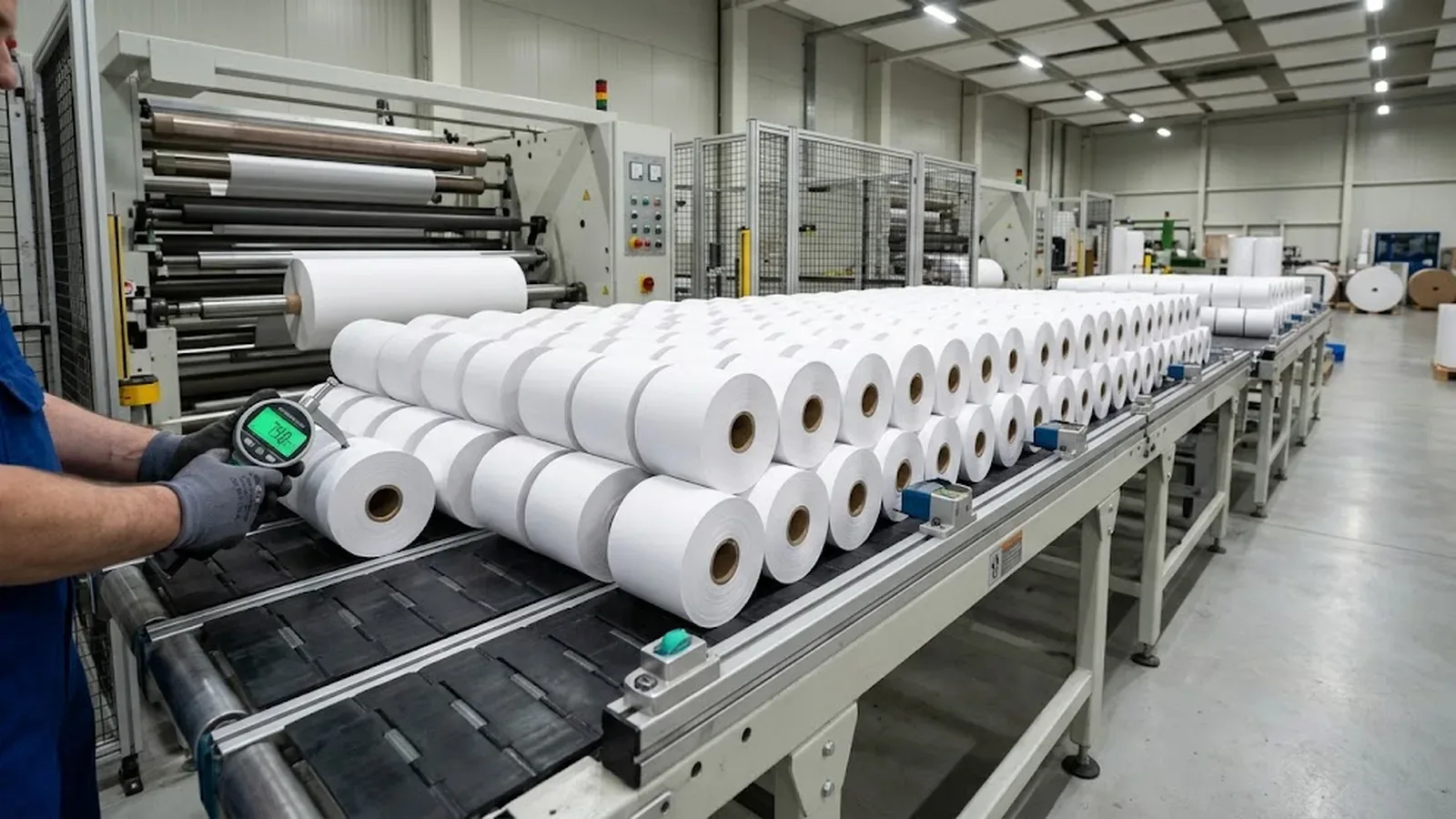
An 80x76 thermal paper roll is a receipt roll wound 80 mm wide with a 76 mm outside diameter — the same paper width as the common 80x80 roll, on a slightly shorter roll. It exists because several markets, notably in Latin America, standardised on the shorter diameter, and because a shorter roll costs less per roll while fitting the same 80 mm-wide holders and terminals. The trade is capacity: at the same core and grade, a 76 mm roll carries roughly a tenth less paper than an 80 mm one, so metres per roll — not roll count alone — should drive the price comparison. Specify width, core, diameter tolerance and developer class on one line, and settle the 76-versus-80 decision on samples in your own devices.
Receipt roll naming compresses two dimensions into four digits, and 80x76 is the case buyers ask about most after the universal 80x80. The first number is the paper width — 80 mm, the global standard for full-size receipt formats. The second is the outside diameter of the wound roll — 76 mm, roughly 5% shorter than the 80 mm of a full-diameter roll. Everything else about the two sizes is identical: same paper grades, same 12.7 mm core in most markets, same feed behavior at the device.
Our POS and receipt paper rolls programme publishes the test data behind each grade, so specifications can be verified against the mill's own measurements rather than a catalogue claim — the width, core and diameter data that make a regional size like 80x76 quotable on the same terms as the standard 80x80.
This guide covers the size from the buyer's side: what the 80x76 roll size actually specifies, why it exists and where it is preferred, how it fits 80 mm-class holders and terminals relative to 80x80, the metres-per-roll and price-per-roll arithmetic that should govern the comparison, the tolerance and packing details that matter in export orders, and the sample test that settles the diameter question before a programme is standardised.
- 80x76 means 80 mm paper width x 76 mm outside diameter — the width of a standard 80 mm roll on a slightly shorter roll, not a narrower paper size.
- The size exists for regional and commercial reasons: several markets, notably in Latin America, standardised on the shorter diameter, and the shorter roll lowers cost per roll.
- An 80x76 roll fits the same 80 mm-class holders and terminals as 80x80 — diameter only changes clearance and roll-change frequency, not feed alignment.
- Compare on metres per roll and cost per metre, never on price per roll alone: the shorter roll is cheaper per roll and more expensive per metre by the same geometry.
- Specify width, core, outside diameter and tolerance on one specification line so the 76 mm diameter is contractual, not incidental.
What 80x76 actually specifies: width x outside diameter
Roll naming in this category is always width first, outside diameter second. So an 80x76 thermal paper roll is a roll of 80 mm-wide paper wound until the roll measures 76 mm across — the same width that 80x80, 80x65 and every other 80 mm variant shares, on a shorter wound body. The core is the third, unstated dimension: 12.7 mm (half-inch) is the norm for receipt rolls in most markets, though some regional programmes run a 13 mm core, and the difference matters for spindle fit.
Width governs what the roll can print — column layout, print-zone coverage, and which devices it physically feeds into. Diameter governs how much paper is on the roll and how long it lasts before the end-of-roll mark arrives. Because 80x76 keeps the width and trims only the diameter, it is a capacity decision, not a compatibility decision: the paper that comes off the roll is indistinguishable from an 80 mm roll of the same grade.
The distinction matters when quotes arrive. Two suppliers quoting '80 mm rolls' may be quoting different diameters — one at 80 mm outside diameter, one at 76 — and a per-roll price comparison between them is meaningless until the diameters are normalised.
Why 80x76 exists: the regional and commercial logic
The shorter diameter did not appear by accident. In several markets — most notably across Latin America — the installed base of receipt holders and the distribution trade standardised on the 76 mm roll decades ago, and the size has persisted through every device generation since. Local wholesalers stock it as the default full-width roll, and buyers in those markets order it not as a substitute for 80x80 but as the local definition of a full roll.
The commercial logic supports the regional one. Winding a roll to 76 mm instead of 80 mm puts less paper on each roll, which lowers the price per roll — a number that reads well on an invoice and suits markets where cash-flow-sensitive small retailers buy receipt paper in small, frequent quantities. The shorter roll also weighs less per carton, which softens inland distribution costs in markets where paper travels long distances by road from the port.
The buyer's caution is equally simple: the shorter roll must be cheaper per roll, because it is.
| Property | 80x80 roll | 80x76 roll |
|---|---|---|
| Paper width | 80 mm | 80 mm |
| Outside diameter | 80 mm | 76 mm |
| Metres per roll (55-60 gsm class, illustrative) | ≈ 60 m | ≈ 54 m (≈10% less) |
| Fit in 80 mm-class holder | Full clearance | Fits with extra radial clearance |
| Roll-change frequency | Baseline | ≈11% more often |
| Price per roll | Higher | Lower — check per-metre parity |
Holder and terminal fit: 76 mm inside an 80 mm programme
Compatibility runs one way, and buyers should be clear about which way. A 76 mm roll drops into any holder or paper path dimensioned for 80 mm-diameter rolls with room to spare — the paper width, which is what actually feeds through the mechanism, is unchanged. Roll-change frequency rises by roughly the diameter ratio, and the end-of-roll mark arrives sooner, but feed alignment, print-zone coverage and paper-path geometry are untouched.
The reverse does not hold. A terminal or holder dimensioned tightly around a 76 mm roll — as some compact regional fixtures are — may reject an 80 mm roll on diameter clearance even though the paper width is identical. This is why a fit check belongs in the specification review: measure the paper compartment's maximum diameter and minimum width, not just its nominal size, before assuming the two diameters are interchangeable across a mixed device estate.
For estate-wide programmes the practical rule is: fix the paper width to 80 mm, then let each market or property take its local diameter. Because the printed output is identical, downstream systems — archive scans, dispute handling, consumable counts — see one paper programme even where two diameters circulate.
Metres per roll and price-per-roll arithmetic
Roll capacity scales with the difference of squares: usable paper area per turn is proportional to (outside diameter squared minus core diameter squared). Run the numbers for a 12.7 mm core and the 76 mm roll holds (76² − 12.7²) / (80² − 12.7²) — roughly 90% of the paper an 80x80 roll carries. In metres, on mid-weight receipt stock, that is the difference between roughly 60 and 54 metres per roll — an illustrative figure that shifts with grade and caliper but whose ratio does not.
Procurement teams standardising on one supplier can review our custom thermal paper programme alongside the comparisons in this guide, where metres per roll are documented per grade and diameter rather than left to be inferred from a per-roll price.
The arithmetic converts directly into purchasing discipline. Compare quotes on cost per metre of paper — or cost per thousand receipts, once metres per receipt is known — and the shorter roll's lower invoice price stops distorting the comparison. Per-roll pricing is not wrong, but it is only meaningful between rolls of identical diameter; across 76 and 80 it systematically flatters the shorter roll.
Sourcing notes: tolerance, core and packing for export orders
The diameter is a tolerance, not a label. Wind diameter drifts with tension and grade, so the specification line should read: width 80 mm ±0.5, outside diameter 76 mm (+2 / −0), core 12.7 mm, end-of-roll mark 2-3 turns before core. The upper tolerance matters more than the lower for holder fit — a roll wound to 79 mm still fits an 80 mm compartment, but a roll wound consistently over 78 mm when 76 was ordered is a packing-fraction failure that quietly erodes the metres-per-roll arithmetic.
Packing deserves the same explicitness at export scale. Carton counts per size, roll wrap, pallet height and moisture-barrier treatment should all be on the quote, because the shorter roll changes the carton geometry: more rolls per carton at 76 mm than at 80, and a different pallet pattern than the one your 80x80 programme uses.
Grade variables ride on top of the geometry and belong in the same line: basis weight, coating class (standard or top-coated) and developer system — BPA-free or phenol-free — with per-batch certificates. A diameter switch is the wrong moment to introduce a grade switch; change one variable per order and keep the comparison clean.
Comparing samples and standardising the size
The sample comparison for 80x76 is short because the size question is geometric. Run an 80x76 sample and your incumbent roll through the same device class: check feed reliability, fit clearance in the holder, and roll-change frequency across a normal trading day. Then price the programme on metres and freight: rolls per carton, cartons per pallet, pallets per container at each diameter — the shorter roll changes the packing maths in ways that partially offset its lower per-metre efficiency.
For production volumes, the same construction logic applies to our thermal paper jumbo rolls, quoted per jumbo roll, slit reel or finished format — converting the 76 mm diameter from a regional accommodation into a documented, repeatable specification. Where container planning is the next step, our export shipping guide covers pallet standards, moisture-barrier packing and the document set for ocean freight.
Standardise the outcome, not just the roll. Once the sample run confirms fit and the freight arithmetic closes, write the winning geometry — width, diameter, core, tolerance, end-of-roll mark — into the programme specification so every market orders the same physical product and every reorder is a comparison against a fixed baseline. That is what turns a size code into a supply programme.
Frequently asked questions
What does 80x76 mean on a thermal paper roll?
It is a receipt roll specification: 80 mm paper width and 76 mm outside roll diameter. The width matches the standard 80 mm receipt format; only the wound diameter is shorter than the common 80x80 roll, which reduces the paper capacity per roll.
Will an 80x76 roll work in a device that takes 80x80 rolls?
Yes in the common case — the paper width is identical, so it feeds through any holder or paper path dimensioned for 80 mm-wide rolls, with extra radial clearance. The reverse is not always true: fixtures sized tightly around a 76 mm roll may reject the fuller 80 mm diameter.
Why do some markets prefer 80x76 over 80x80?
Regional standardisation and price optics. Several markets — notably in Latin America — built their distribution around the 76 mm diameter, and the shorter roll carries less paper, so it invoices at a lower price per roll, which suits small frequent purchases. The per-metre cost is what should govern the comparison.
How many metres are on an 80x76 thermal roll?
Roughly 90% of what the same grade carries at 80 mm diameter: on mid-weight receipt stock that is on the order of 54 metres versus about 60 for 80x80, with a 12.7 mm core — illustrative figures whose ratio follows the geometry (OD² − core²) and shifts slightly with grade caliper.
What should I specify when ordering 80x76 rolls?
Width 80 mm ±0.5, outside diameter 76 mm (+2/−0), core size, end-of-roll mark position, basis weight, coating class and developer system on one specification line — plus carton counts and pallet pattern, since the shorter roll changes the packing geometry your 80x80 programme may have assumed.