
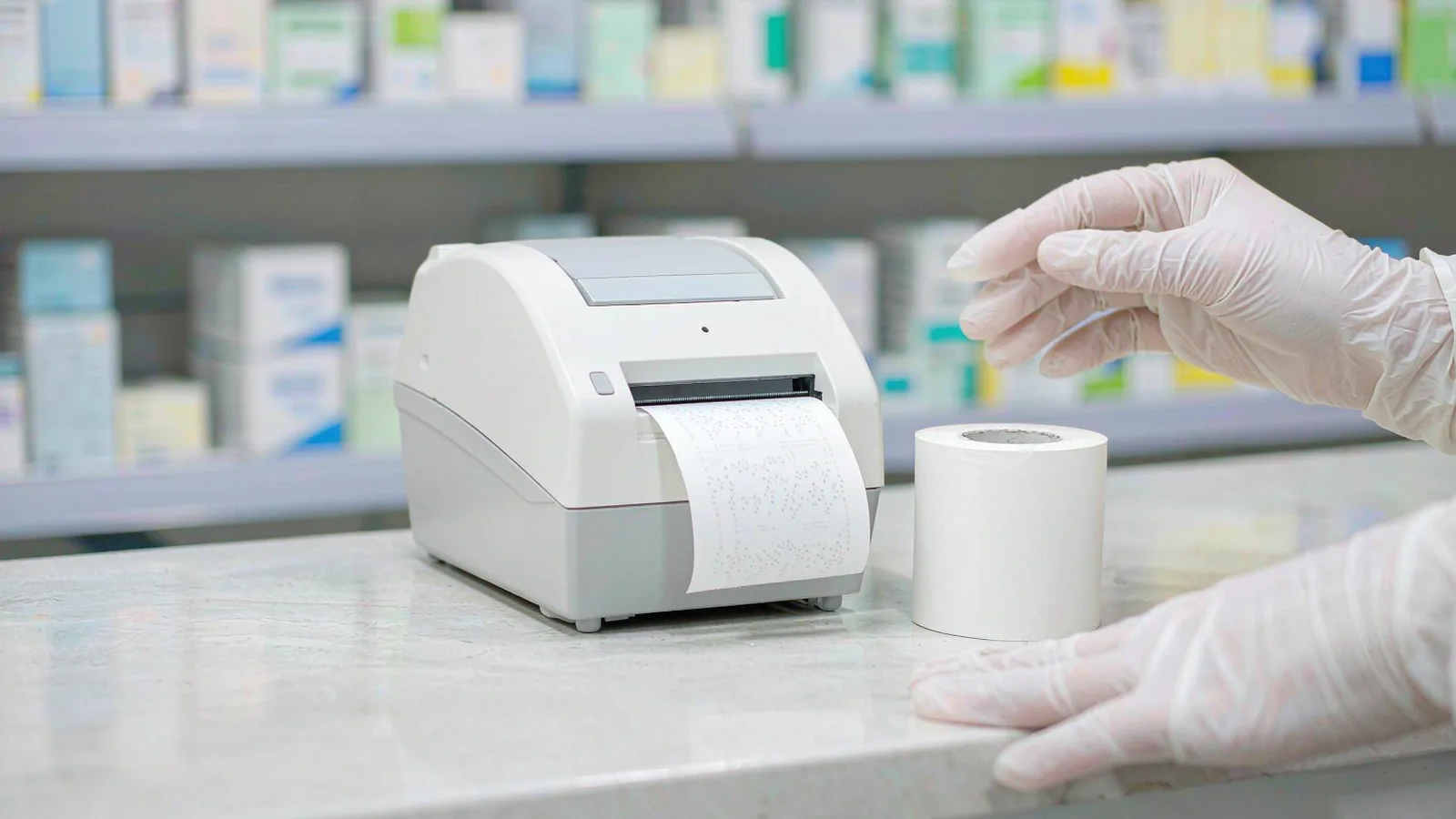
Medical receipt paper is direct thermal roll stock used across healthcare printing: pharmacy dispensing slips, laboratory result slips, hospital registration and payment receipts, queue tickets and specimen labels. The specification differs from ordinary retail receipt stock in three ways — developer compliance matters more because slips are handled by patients and staff all day (BPA-free or phenol-free chemistry is now the tender default), lightweight 48–55 gsm grades dominate high-volume dispensing counters, and image retention must cover record-keeping periods measured in years for anything filed with a patient record. Buyers who pin chemistry class, width, gsm and retention on one specification sheet pass hospital procurement audits without requalification cycles.
Every healthcare encounter produces printed paper: the pharmacy dispensing slip, the laboratory result handed over the counter, the hospital registration receipt, the payment slip at discharge, the queue ticket at the outpatient hall. Healthcare institutions print more receipts per day than most retail chains, and nearly all of it runs on direct thermal rolls.
Healthcare printing also raises the stakes on two fronts. First, compliance: thermal receipts are handled constantly — by pharmacists, nurses, patients, filing clerks — so the developer chemistry inside the paper is scrutinised in tenders and audits to a degree retail buyers rarely see. Second, retention: a dispensing slip or lab report is often the physical copy of a record, and its image must survive filing cabinets and handling for as long as the institution keeps the record.
This guide works the healthcare receipt decision properly: the printing applications and their duty cycles, the compliance frame around developer chemistry, the width and gsm choices per counter, the image-retention requirements for filed documents, and the specification frame for multi-site healthcare procurement.
Healthcare buyers comparing roll specifications can review our POS and receipt paper rolls, where width, basis weight, coating construction and developer class are documented per grade before an order is placed.
- Pharmacy and lab counters are high-volume printing: 48–55 gsm lightweight grades cut roll cost and change frequency without sacrificing legibility.
- BPA-free or phenol-free chemistry is the healthcare tender default — receipts are handled all day by staff and patients, and audits check the developer class.
- Image retention for filed slips and reports must match the institution's record-keeping period; top-coated stock buys years of extra file life.
- Standard widths cover most healthcare counters: 80 mm class for registration and payment, 57 mm class for compact pharmacy and lab printers.
- Specify chemistry class, width, gsm and retention together — one sheet, confirmed in writing, is what passes procurement audits.
Where healthcare prints: applications and duty cycles
Pharmacy dispensing counters are the volume engine: a slip per prescription, printed continuously through the day on compact 57 mm-class printers. Duty is moderate — the slip is handed to the patient and often kept for insurance or reimbursement — so a 48–55 gsm uncoated or lightly specified grade covers the mechanical requirement, but the chemistry question (below) still applies because the slip is handled by hand for years of shifts.
Laboratory and diagnostic printing splits in two: result slips handed to patients, which behave like retail receipts with short handling lives, and specimen and tube labels, which are labels rather than receipts and lean on the label-stock side of the family. Hospital registration, billing and discharge counters print on 80 mm-class printers with longer slips — itemised charges, insurance references, appointment data — and these are the slips most likely to be filed with the patient record.
Queue tickets, visitor passes and wayfinding slips round out the family: short-dwell, high-volume, printed on kiosk-class hardware. They are the least demanding duty in the stack, but they share the same compliance scrutiny, because in a healthcare tender every roll in the building tends to be qualified together.
| Application | Typical width | Dwell / retention | Grade | Chemistry class |
|---|---|---|---|---|
| Pharmacy dispensing slip | 57 mm class | Months–years (insurance) | 48–55 gsm | BPA-free / phenol-free |
| Laboratory result slip | 57–80 mm | Months (filed: years) | 50–58 gsm | BPA-free / phenol-free |
| Registration / billing receipt | 80 mm class | Years (patient record) | 55–65 gsm, top-coated for filing | BPA-free / phenol-free |
| Specimen / tube labels | Label stock | Process-bound | Label facestock | BPA-free / phenol-free |
| Queue tickets / visitor slips | 57–80 mm | Days | 48–55 gsm | BPA-free / phenol-free |
Widths and grades reflect common healthcare deployments; printer fleets and record-retention policies vary by institution and are matched per tender.
The compliance frame: developer chemistry in healthcare tenders
Direct thermal paper develops its image with a chemical developer system, and for two decades the industry default was BPA. Healthcare buyers led the migration away from it: receipts handled continuously by staff and patients made exposure scrutiny unavoidable, and institutional tenders now routinely specify BPA-free or fully phenol-free chemistry as a qualification condition, with documentation required per shipment rather than per catalogue claim.
The practical hierarchy is simple to state. BPA-free stock eliminates bisphenol A but may carry alternative phenolic developers such as BPS — acceptable in many markets but increasingly questioned in audits. Phenol-free stock eliminates the phenol class entirely and is the specification that healthcare procurement teams hold on file. Each shipment should carry a COA and SDS identifying the developer system, so the paper trail matches the tender commitment without a requalification exercise.
For buyers consolidating healthcare paper stock on one supplier, our custom thermal paper programme covers chemistry class, width, core and packaging in a single specification sheet, so the tender commitment and the shipped goods reconcile line by line.
Where developer compliance is part of the specification, our BPA-free vs phenol-free guide documents the chemistry, the regulations and the paperwork behind each class.
- BPA-free: eliminates bisphenol A; alternative phenolic developers possible — check which.
- Phenol-free: eliminates the phenol class; the healthcare tender default.
- COA and SDS per shipment identifying the developer system — the audit paper trail.
- Qualify every roll type in the building together; tenders treat paper as one programme.
Widths, gsm and printer fit at the counter
Width follows the printer fleet, not the preference. Compact pharmacy and laboratory printers run the 57 mm class (57 x 40, 57 x 50), where roll capacity is small and change frequency matters — which is why lightweight grades dominate here: at 48 gsm, the same roll shell carries noticeably more metres than a 60 gsm equivalent, and a busy dispensing counter measures that in fewer interruptions per shift.
Registration, billing and discharge counters run the 80 mm class (80 x 80 being the global workhorse), printing longer itemised slips. Grade choice trades slip stiffness against metres per roll: 55–58 gsm is the common middle, while 65 gsm-class stock serves counters where slips are filed and handled repeatedly — the extra basis weight resists filing wear and keeps long slips flat in the tray.
Core size and roll diameter belong on the specification too: printer spindles and roll compartments fix the maximum outer diameter, and a roll that fits the shelf but not the printer is a procurement error repeated weekly. Confirming width, core, OD and gsm as one line — as the printer fleet defines them — prevents the mismatch before the first delivery.
For high-volume dispensing counters watching cost per slip, our 48 gsm lightweight thermal paper documents basis weight, yield and packing per grade, so the counter economics can be verified rather than estimated.
- 57 mm class: pharmacy and lab compact printers — 48–55 gsm for yield per roll.
- 80 mm class: registration and billing — 55–65 gsm by filing duty.
- Confirm width, core, OD and gsm as one line matched to the printer fleet.
- Filed slips justify heavier grades; handed-over slips justify lightweight yields.
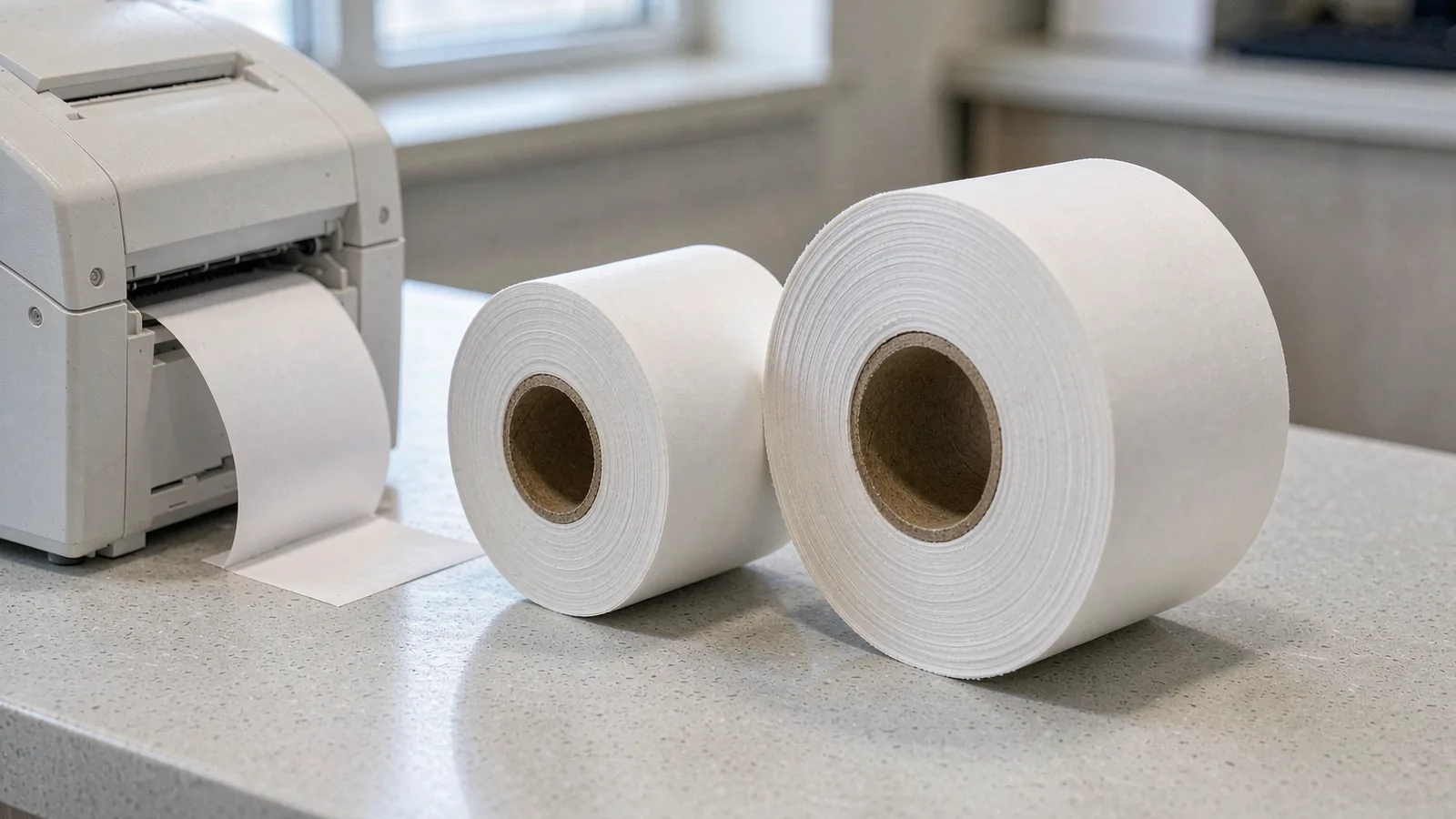
Image retention and the specification sheet
Retention is the healthcare-specific requirement. A retail receipt can fade after its useful life; a dispensing slip or laboratory report filed with a patient record cannot. Direct thermal images hold well in cool, dark filing conditions, but filing cabinets live next to radiators, windows and photocopiers — heat, light and plasticiser contact each shorten image life. Top-coated stock resists the handling and contact portion of that damage and is the default wherever slips are filed for years rather than handed over and discarded.
The specification sheet for a healthcare programme is one page per roll family: width, core, outer diameter, gsm and coating class, developer system (BPA-free or phenol-free, named), image-retention expectation matched to the institution's record-keeping period, and packaging. Institutions printing patient-facing slips increasingly also ask about recyclability and responsible fibre sourcing — questions the mill answers with documentation, not adjectives.
Finally, plan the delivery cadence. Healthcare printing is volume-stable and therefore highly forecastable: counters consume at a known slips-per-day rate, and quarterly delivery against a standing specification beats emergency purchases on price, freshness and administrative load. Buyers who separate the flows — high-turnover counter stock versus long-retention filing stock — typically hold both from the same chemistry class so audit documentation stays uniform.
- Filed slips and reports: top-coated stock, retention matched to record-keeping period.
- Handed-over slips: lightweight uncoated grades optimise cost per slip.
- One specification page: width, core, OD, gsm, coating, developer system, packaging.
- Quarterly delivery against a standing spec beats emergency purchase on price and freshness.
In a healthcare programme the developer class and the retention expectation are the two lines auditors actually read — everything else is standard receipt-roll practice.
Frequently asked questions
What is medical receipt paper?
Direct thermal roll stock used in healthcare printing: pharmacy dispensing slips, laboratory result slips, hospital registration and payment receipts, queue tickets and visitor passes. It is specified like receipt paper — width, core, gsm, coating — with two healthcare additions: developer chemistry compliance (BPA-free or phenol-free) and image retention matched to record-keeping periods.
Do healthcare receipts need BPA-free or phenol-free paper?
BPA-free is the entry requirement in most institutional tenders; phenol-free is increasingly the specified class because it eliminates the whole phenol developer family, including alternatives such as BPS that audits are beginning to question. Each shipment should carry a COA and SDS naming the developer system.
What width and gsm suit a pharmacy counter?
Compact pharmacy printers run the 57 mm class, and 48–55 gsm grades dominate because the same roll shell carries more metres — fewer roll changes on a busy counter. Registration and billing counters run the 80 mm class with 55–65 gsm grades, heavier where slips are filed with patient records.
How long do printed thermal slips last in filing?
Direct thermal images hold for years in cool, dark, dry filing conditions, and top-coated constructions extend that substantially by resisting handling and contact wear. Heat, sunlight and plasticiser contact shorten image life, so filing location matters as much as the paper specification.
Can receipt rolls and specimen labels be sourced together?
Yes, and most healthcare programmes do: rolls and die-cut label stock from the same chemistry class share audit documentation, image behaviour and delivery cadence. Specifying both on one sheet with the developer system named keeps the tender commitment and the delivered goods reconciled.