
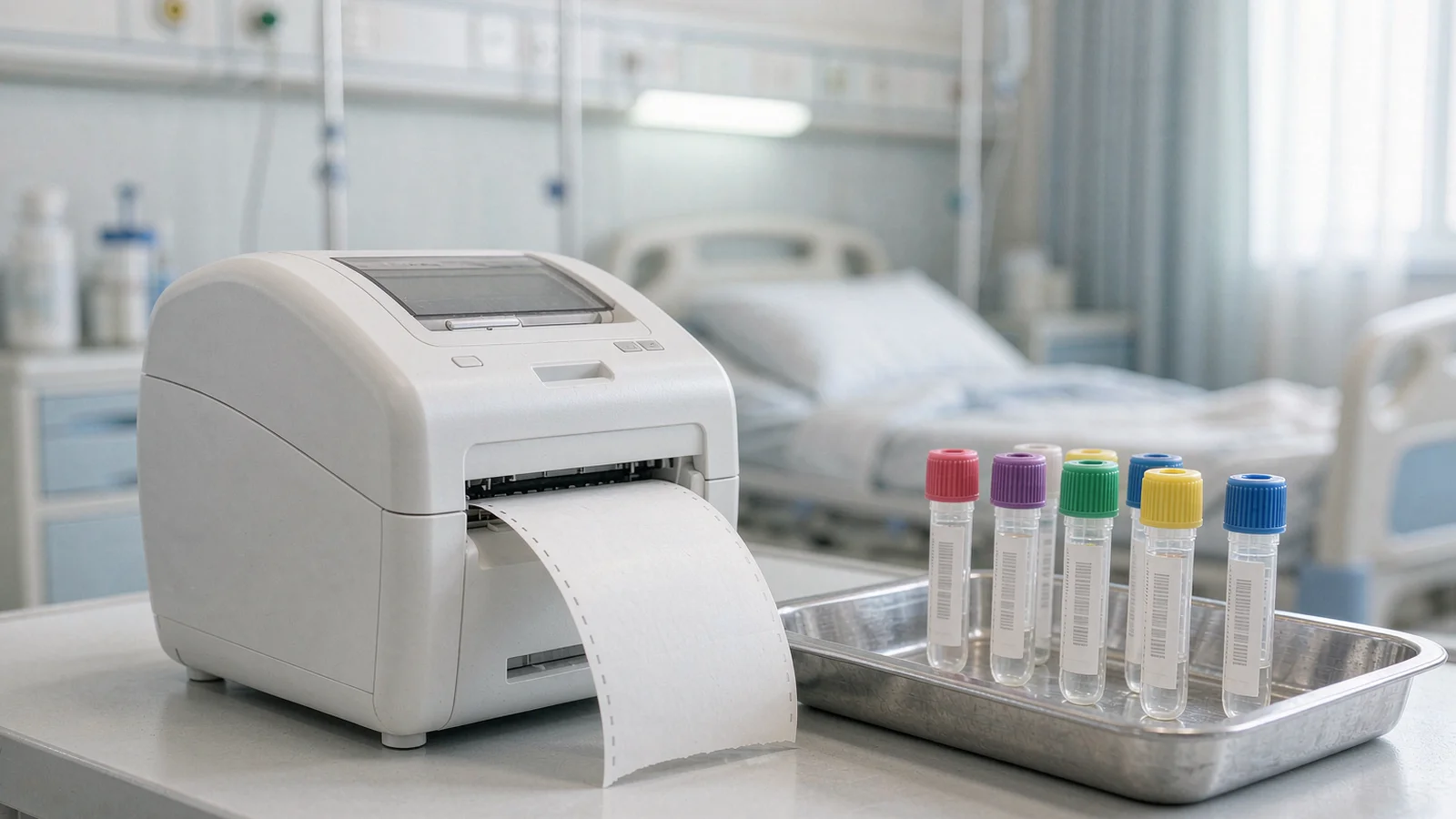
Patient ID thermal labels are specified on five lines: facestock construction (top-coated direct thermal for scan life, uncoated where cost rules), adhesive matched to the substrate it must survive on (wristband film, specimen tube plastic, paper chart), basis weight between 48 and 65 gsm for the label face, die size matched to the printer fleet (25 × 25 mm and 50 × 25 mm are the workhorse formats), and the developer chemistry class with documentation to match. Direct thermal wins this application because the volume is enormous, the life required is short to medium — hours for a wristband event, days for a specimen chain, weeks for a chart — and a two-media printer fleet with no ribbon inventory is operationally simpler on a ward than thermal transfer ever is.
Hospitals move on identification. Every admission generates a wristband, every wristband generates specimen tubes, and every tube, bag, chart and pharmacy order carries a label that must scan on the first pass at 3 a.m. The volumes are extraordinary — a mid-size hospital can consume several million labels a year — and that volume is exactly why the patient ID thermal labels conversation is a buying-guide conversation, not a product-brochure one: at this scale, an adhesive that lifts or a facestock that fades is a workflow incident, not a stationery complaint.
Direct thermal is the dominant construction for this duty, and the reasons are operational rather than chemical. The print life a patient ID label needs — hours to weeks, indoors, at ward temperatures — sits comfortably inside what a direct thermal coating delivers. There is no ribbon to stock, thread or run out of on a night shift, and the same compact printer handles wristbands, tubes and chart labels by changing the roll. The trade-off is that the specification has to be right up front, because direct thermal offers no second chance: the coating that develops the image is also the surface the image lives on.
Our custom thermal paper programme publishes the test data behind each grade, so specifications can be verified against the mill's own measurements rather than a catalogue claim.
This guide walks the specification end to end: where direct thermal fits and where it does not, the five-line specification — facestock, adhesive, gsm, die geometry, developer class — how to write a print-life demand that a mill can actually test against, and the goods-in and compliance checks that keep a healthcare label programme auditable.
- Direct thermal dominates patient ID labels because the required life is hours-to-weeks and the ribbon-free workflow is simpler on a ward.
- Specify five lines: facestock (top-coated or not), adhesive matched to substrate, 48–65 gsm face weight, die size matched to the printer fleet, developer class with documentation.
- Print life should be demanded as a test condition — scan-grade at X days at Y °C and Z % RH — not as a vague 'long-lasting'.
- Adhesive failure, not fading, is the most common field failure; match the adhesive to wristband film, tube plastic or chart paper explicitly.
- Top-coated constructions cost more per thousand but buy scan-grade image life and resistance to lotion, alcohol and plasticiser contact.
Where direct thermal fits in patient identification
A patient identification programme uses thermal printing in three distinct places, and each places a different demand on the label. Wristband systems are usually printed on specialist synthetic wristband stock, but the workflow around them — chart flags, allergy alerts, specimen collection, pharmacy bag labels — runs overwhelmingly on paper-faced direct thermal labels. Specimen labelling is the highest-stakes duty: a barcoded tube must survive refrigeration, centrifuge handling and hours-to-days of chain of custody, and a mis-scan there costs far more than the label ever did. Chart and administration labels are the volume base: short life, high count, cost-sensitive.
The common thread is indoor duty with a bounded life. Direct thermal image stability is a function of coating chemistry, storage temperature and contact with plasticisers, solvents and heat — and all three are predictable in a ward environment. What direct thermal does not survive well is sustained UV, repeated alcohol swabbing of the printed surface, or years of archival storage, which is why long-life duties such as permanent laboratory archives migrate to thermal transfer while the front-line workflow stays direct thermal.
The economics close the argument. A two-media fleet — one receipt/paper roll printer per ward plus a label printer — with no ribbon inventory, no transfer-ribbon waste stream and no operator training split is measurably cheaper to run than a mixed transfer estate, provided the label stock is specified to hold its image for the life the workflow actually needs. That specification is where buying decisions are won or lost.
The five-line specification: facestock, adhesive, gsm, die, developer class
Facestock first. An uncoated direct thermal label is the economy option and is correct for short-life, dry, high-volume duties such as chart flags and administration labels. A top-coated construction adds a protective layer over the developer chemistry: it holds scan-grade contrast longer, resists moisture and light abrasion, and tolerates incidental contact with alcohol wipes and hand lotion far better. For specimen and pharmacy labels that ride through refrigerators and gloved handling, top-coated is the default; for flags and file labels it is a cost decision.
Adhesive second — and in field failure statistics, first. The adhesive must be matched to the substrate it will actually live on: general-purpose permanent acrylic for paper charts and cartons, a higher-tack construction for low-surface-energy plastics such as specimen tubes and IV bags, and skin-tolerant constructions only where the label itself contacts skin (which is wristband territory, a different stock). A label that scans perfectly but lifts off a cold polypropylene tube in a refrigerator is a failed specification no matter how good the coating is.
Basis weight third: 48 to 65 gsm covers the practical range, with 48 gsm stock maximising labels per roll and 55–65 gsm giving the face more body for larger die sizes and harder handling. Die geometry fourth: the die size must match the printer fleet's media range and the workflow's scan distance — 25 × 25 mm and 50 × 25 mm are the workhorse specimen and chart formats, and roll outside diameter and core size must match the desktop printers actually deployed. Developer class fifth: the chemical class of the thermal coating (phenol-free where policy requires it) determines what compliance paperwork the programme can demand.
Buyers comparing these specifications can review our top-coated thermal label stock, where basis weight, coating construction and packing are documented per grade before an order is placed.
| Duty | Facestock | Typical gsm | Typical die / format | Required life |
|---|---|---|---|---|
| Chart & admin flags | Uncoated direct thermal | 48–55 gsm | 50 × 25 mm, 76 mm core | Days to weeks |
| Specimen tube labels | Top-coated direct thermal | 55–65 gsm | 25 × 25 mm, 76 mm core | Days, cold-chain tolerant |
| Pharmacy bag labels | Top-coated or uncoated | 55 gsm | 50 × 30 mm, 76 mm core | Hours to days |
| IV / infusion line labels | Top-coated direct thermal | 55–65 gsm | Narrow wrap formats | Days, moisture tolerant |
| Archive / long-life records | Thermal transfer (not direct) | Label face per system | Per printer fleet | Years |
Writing a print-life demand the mill can test
The most common specification failure in healthcare label buying is a life requirement nobody can test. 'Long-lasting image' is not a specification; 'scan-grade at 12 months at 23 °C and 50 % RH, dark storage, on the supplier's declared construction' is. Reputable thermal paper mills test image stability under standard conditions and can state expected first-scan readability for their grade at defined temperature and humidity; the buyer's job is to translate the workflow's real duty — a tube that lives four days in a 4 °C refrigerator, a chart label that lives a month in a filing room — into those test terms and put the numbers in the purchase order.
Equally testable are the environmental demands. Refrigeration tolerance is a condensation-and-adhesive question as much as an imaging one: ask whether the declared construction survives condensation cycles without adhesive bleed. Abrasion resistance matters where tubes rub in racks; a top-coated face or a laminate over-label solves it, but the choice should be made in the specification, not discovered in the field. And where the label may contact alcohol wipes, state it — the mill can declare wipe tolerance for the top-coated construction, which an uncoated face cannot honestly carry.
Procurement teams standardising on one supplier can review our 48 gsm lightweight thermal paper alongside the comparisons in this guide, then match the grade to each duty in the programme rather than buying one stock for all of them.
Goods-in checks and the compliance paperwork
At goods-in, a healthcare label consignment is audited like any other engineered consumable, in about ten minutes. Check die-cut quality on a sample — no liner cuts, no face-stock nicks, liners that release cleanly in the printer. Wind a sample roll on the deployed printer and scan a test barcode with the fleet's actual scanners, not a reference reader. Weigh or count a sample roll against the declared labels per roll, and check the liner and face for curl that will jam a desktop printer mid-shift. A consignment that passes these checks will run; one that fails any of them should be quarantined before wards see it.
The paper trail is what makes a healthcare programme auditable. Demand a COA per batch, an SDS for the coating chemistry with the developer class stated, and written confirmation of the chemical construction behind any 'phenol-free' or BPA-related claim — healthcare procurement in most jurisdictions now asks, and the answer must be a document, not a sentence in an email. Where the programme feeds into regulated workflows, align the paperwork with the hospital's own quality system at the RFQ stage, not after the first audit finding.
Where developer compliance is part of the specification, our BPA-free vs phenol-free guide documents the chemistry, the regulations and the paperwork behind each class.
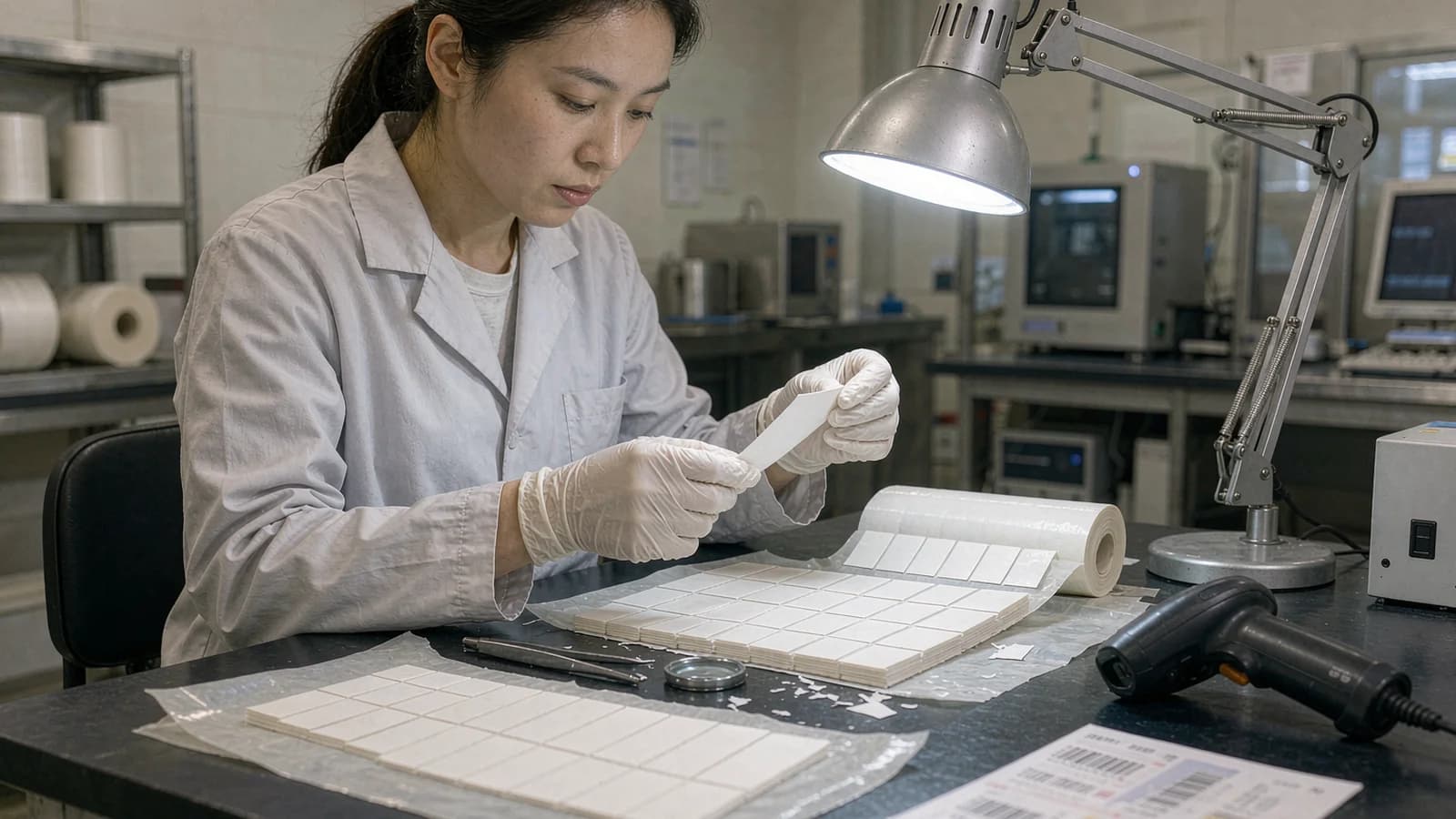
Test the barcode with the hospital's own scanners — a reference reader will pass labels the deployed fleet will not.
Frequently asked questions
Are direct thermal labels suitable for patient identification?
Yes, for the front-line workflow. The life patient ID labels need — hours to weeks indoors — is well within direct thermal capability, and the ribbon-free workflow is operationally simpler on a ward. Long-life archival duties are the exception: those migrate to thermal transfer. Specify the coating class and test life explicitly, and direct thermal carries the programme.
What gsm thermal paper is used for patient ID labels?
The practical range is 48–65 gsm. Lightweight 48 gsm facestock maximises labels per roll and suits high-volume chart and administration labels; 55–65 gsm gives more body for specimen and pharmacy labels and larger die formats. Basis weight is a handling and yield decision, not an image-quality one.
Why do patient ID labels need a top coating?
A top-coated direct thermal face holds scan-grade contrast longer and resists moisture, light abrasion and incidental contact with alcohol and lotion. For specimen and pharmacy labels that pass through refrigerators and gloved handling, top-coated is the default; for short-life chart flags, uncoated stock is a legitimate cost saving.
What is the most common failure mode for thermal patient ID labels?
Adhesive failure, not image fade. Labels specified with a general-purpose adhesive lift from cold, low-surface-energy plastics such as specimen tubes and IV bags. Match the adhesive to the actual substrate — tube plastic, wristband film, chart paper — and demand condensation-cycle tolerance where labels enter refrigeration.
What documentation should a healthcare thermal label supplier provide?
A batch COA, an SDS stating the developer chemistry class, written confirmation of any phenol-free or BPA-related claim, and declared print-life test conditions (temperature, humidity, storage) behind the grade. The claims must arrive as documents so the hospital's quality system can file them.