
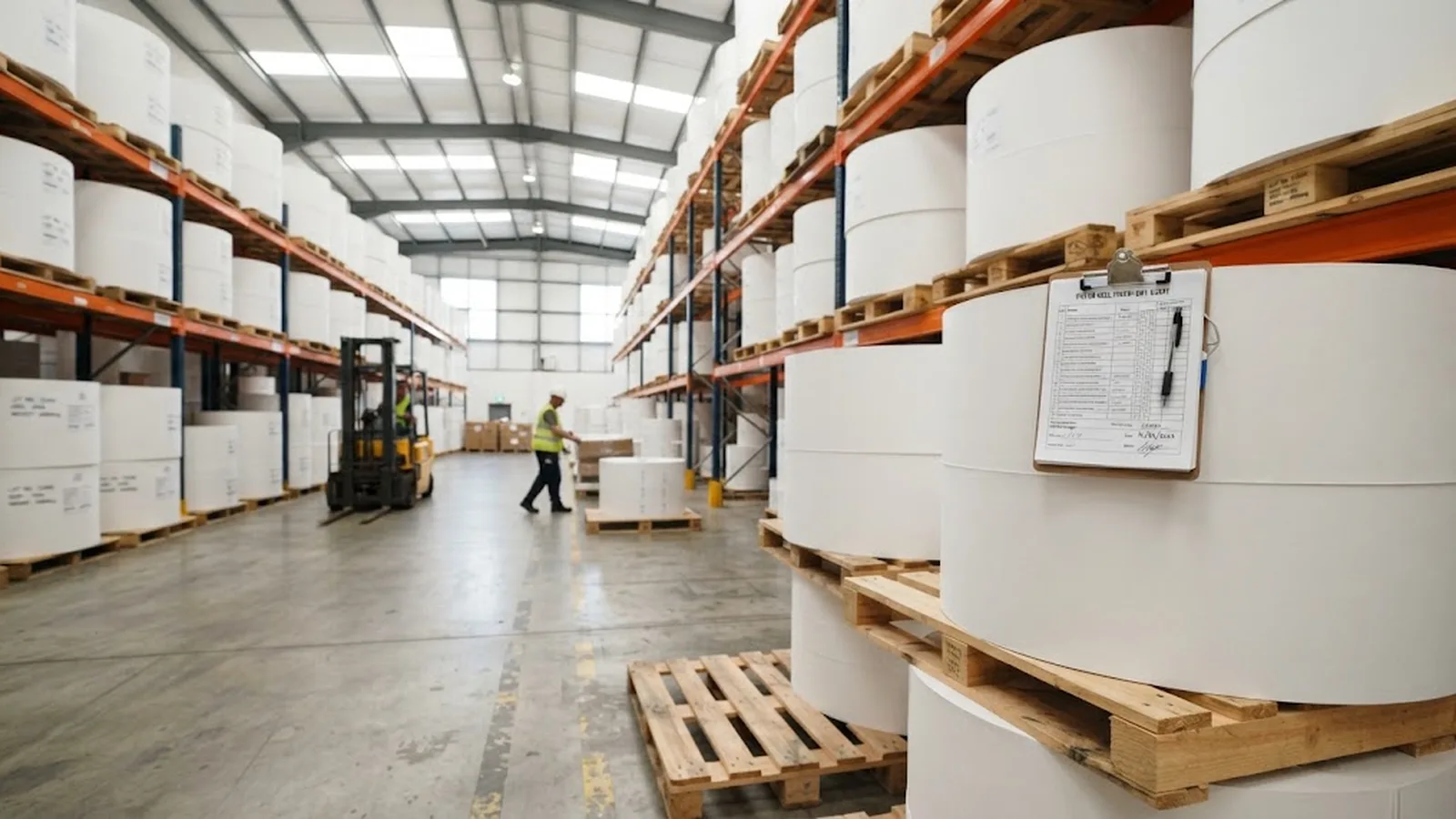
FSC certified thermal paper is direct thermal paper whose fibre input — the base paper, not the thermal coating — comes from forests managed to Forest Stewardship Council standards, delivered through a certified chain of custody that follows the material from forest to mill to converter to exporter. The claim is audited at every transaction point: a buyer can only sell the roll on with an FSC claim if every stage above it held a valid FSC CoC certificate. For buyers the practical test is three documents: the supplier's FSC certificate number verifiable in the public FSC database, the FSC claim and category (FSC 100%, FSC Mix or FSC Recycled) stated on the invoice for the specific shipment, and the trademark licence code that authorises the supplier to use the FSC logo. Sustainability claims that stop at a marketing sentence — without certificate number, claim category and licence code — are not verifiable and should be treated as unproven.
Sustainability requests used to arrive at the end of a thermal paper negotiation, as a nice-to-have line after price and lead time. That has changed. Retail groups, pharmacy chains and public-sector tenders across Europe, the UK and parts of North America now write responsible-sourcing requirements into paper specifications, and the shorthand they reach for is FSC — the Forest Stewardship Council label the average shopper actually recognises.
Thermal paper complicates the picture. A receipt or label roll is a converted, coated product: base paper made from wood fibre, then coated with chemistry that contains no fibre at all. Where does the FSC claim attach, and what should a buyer in Hamburg or Manchester demand from a mill or converter in Asia to know the claim is real? These are answerable questions — but only if the buyer knows which documents carry the evidence.
Buyers comparing certified and conventional grades can review our custom thermal paper programme, where basis weight, coating construction, developer class and certification status are documented per grade before an order is placed.
This guide explains how chain-of-custody certification maps onto thermal paper specifically, what the three FSC claim categories mean for a receipt roll, and the paperwork and verification steps a procurement team can run in an afternoon — plus where certification changes the product and where it changes only the paperwork.
- FSC certification attaches to the fibre in the base paper and travels through chain-of-custody certificates held by every company that takes ownership of the material — mill, converter and exporter.
- The three claim categories are FSC 100%, FSC Mix and FSC Recycled; most commercial thermal grades are FSC Mix, and the category must appear on the shipment invoice, not just the brochure.
- Verification is document-driven: certificate number in the public FSC database, FSC claim on the invoice, and the supplier's FSC trademark licence code (for logo use) — three checks, no lab required.
- Certification changes the fibre story, not the thermal chemistry; image performance is set by the coating, so certified and conventional grades of the same construction print identically.
- Expect a price increment driven by certified pulp availability and audit overhead, typically modest for mainstream grades and larger for FSC Recycled or 100% claims where fibre supply is thinner.
Chain of custody: how the claim travels through a thermal paper supply chain
FSC operates two certificate types. Forest Management certificates cover the forest itself; Chain of Custody (CoC) certificates cover every company that processes, manufactures or trades the material downstream. For thermal paper the relevant chain is: certified forest or controlled fibre, pulp mill, paper mill producing the base paper, thermal coating plant, slitting and converting operation, exporter, importer, and the retail or distribution customer who may resell the rolls with their own FSC claim. Each link in that chain must hold a valid CoC certificate before it can pass the claim on.
The system's strength is transaction-level traceability. A certified mill cannot ship FSC-claimed jumbo rolls to an uncertified converter and still call the converted output FSC; the claim dies at the first uncertified hand. This is why buyers should ask not only whether the manufacturer is certified but whether the specific converting and export entities in their supply route appear on the certificate — a group may hold certification at the mill while its outsourced slitting partner does not, and the claim cannot survive that detour.
The practical consequence for a buyer sourcing from Asia: request the CoC certificate of every entity that will physically handle the goods, and check each certificate number against the public FSC database for validity and scope. Scope matters — a certificate covering printing paper in general may not include the product-group codes for thermal base paper, and an expired or suspended certificate voids every downstream claim.
FSC 100%, FSC Mix and FSC Recycled — what each means on a receipt roll
The claim category tells you the composition of the certified fibre input. FSC 100% means all fibre in the product comes from FSC-certified forests. FSC Mix means a blend of certified fibre, recycled fibre and FSC 'controlled' wood — fibre verified as low-risk from non-certified forests. FSC Recycled means the fibre input is entirely reclaimed material. Under the credit method most paper mills use, a mill can mix inputs across production and assign the FSC claim to a defined share of output, which is why FSC Mix dominates the commercial market: it matches the realistic fibre pool for large coated grades.
For thermal paper specifically, remember what is and is not covered. The claim covers the fibre — the base paper. The thermal coating, the developer chemistry and the packaging inks are not fibre and sit outside the FSC system; they are governed by the compliance conversation buyers run separately. A roll can therefore be FSC certified and still be BPA-containing or BPA-free — the two claims are orthogonal, and mature suppliers specify both explicitly rather than letting one imply the other.
Category choice is a procurement decision, not a technical one. FSC Mix delivers the recognised label at mainstream cost and is what most retail receipt and label programmes specify. FSC Recycled thermal base paper exists but the fibre pool is thinner and the price increment wider — realistic for brand-led programmes, harder to justify on high-volume till rolls. FSC 100% is rare in thermal grades for the same supply-reason. Buyers should state the category in the specification so quotations are comparable.
| Claim | Fibre input | Availability on thermal grades | Typical buyer |
|---|---|---|---|
| FSC Mix | Certified + recycled + controlled wood blend | Widely available; mainstream choice | Retail chains, pharmacy, hospitality groups |
| FSC Recycled | 100% reclaimed fibre | Limited; narrower weight range | Brand-led and NGO-visible programmes |
| FSC 100% | All fibre from FSC-certified forests | Rare in thermal base paper | Public tenders with premium spec |
The document set: what should accompany a certified shipment
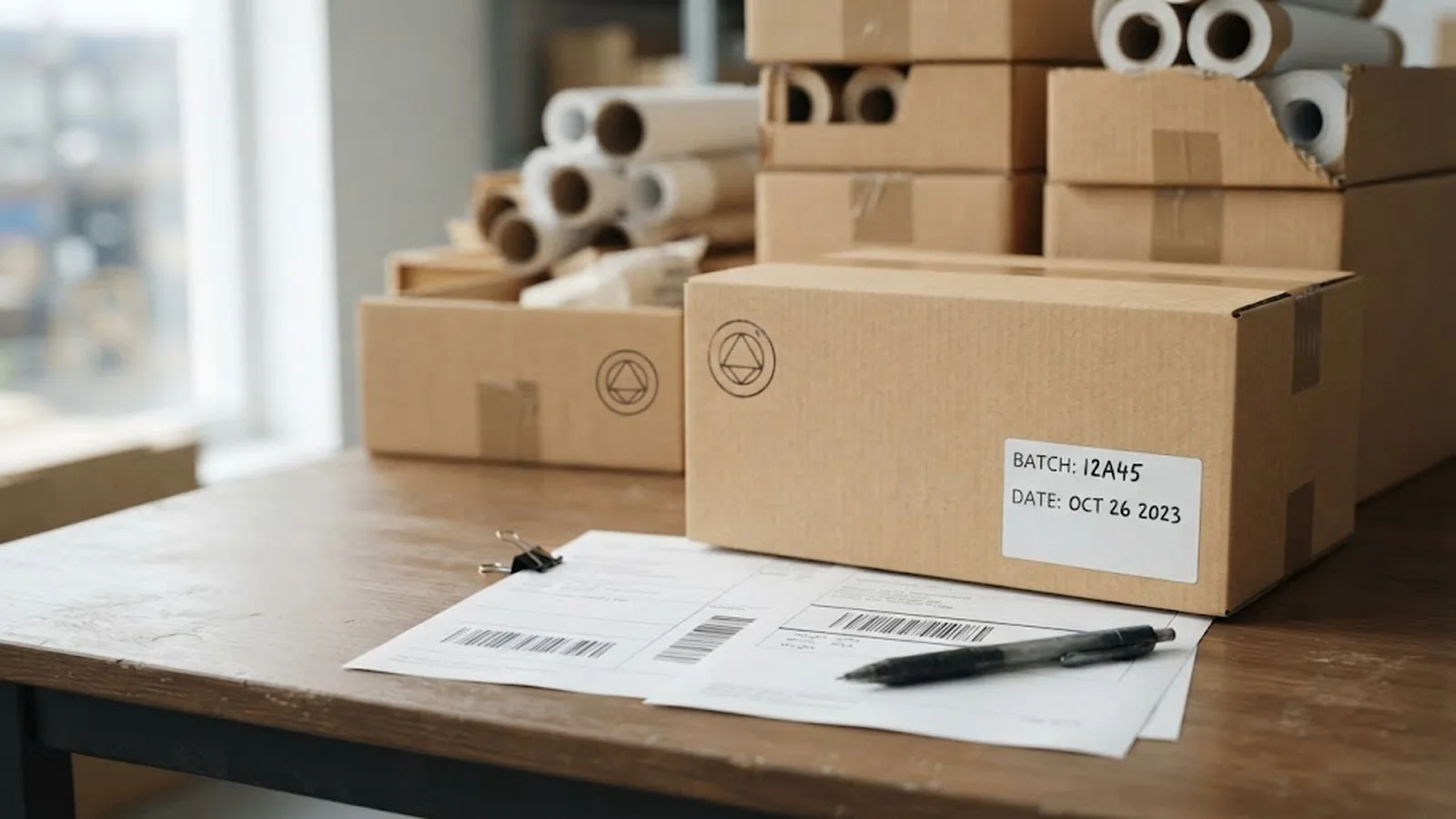
Verification requires exactly three anchors. First, the supplier's FSC CoC certificate number — checked in the public FSC database for validity, scope and the certificate holder's legal name matching the invoice issuer. Second, the FSC claim stated on the commercial invoice for the shipment itself, in the format 'FSC Mix 70%' or the category agreed, because the invoice is the transaction document the FSC system audits against. Third, the supplier's FSC trademark licence code, which authorises use of the FSC logo on the datasheet, the carton mark or the buyer's own downstream communication — a logo without a licence code is a compliance breach the buyer inherits.
Per-batch evidence completes the pack. A capable manufacturer ties the claim to production records: the certified base-paper lot used, the coating batch, and the quality documentation for the grade — the same COA discipline buyers already expect for developer chemistry. Where the buyer's tender requires it, the mill's annual FSC audit summary or a product-group scope statement can be shared under NDA. None of this is exotic; a supplier who resists providing certificate numbers or invoice-level claims is telling the buyer the claim was never theirs to make.
Buyers should also plan the downstream half of the chain. An importer who resells the rolls as FSC needs their own CoC certificate, or must buy through a certified importer with the claim passed on the invoice; a retail chain printing the FSC mark on shelf-ready packaging needs the trademark licence extended to that use. Done once at onboarding, the certification conversation prevents the most common failure: a genuine certified shipment whose claim lapsed at an uncertified middle link.
What certification does and does not change — and how to brief the specification
Certification changes the fibre story and the paperwork, not the print. Image density, sensitivity and scan reliability are functions of the coating system, so a 55 gsm certified base paper with the same thermal construction prints identically to its conventional twin — buyers switching for sourcing reasons do not need to re-run printer validation, only to confirm the base paper weight and finish match the existing grade. Certification is therefore one of the lowest-risk specification changes in the category.
The cost conversation should be run openly: certified fibre carries an increment over conventional pulp, plus audit and documentation overhead through the chain. On mainstream receipt grades the increment is modest; on recycled-claim grades it widens with fibre availability. Buyers comparing quotations should normalise for category — an FSC Mix quote against an FSC Recycled quote is not a price comparison — and should treat a quote with no category, no certificate number and no licence code as unpriced against the requirement at all. Where image-life demands are part of the same brief, the construction choices behind them are documented in our top-coated grade family, from lightweight till-roll stock such as 48 gsm lightweight thermal paper to the heavier 75 gsm heavyweight thermal paper used where stiffness and record retention matter.
A specification line that works in any tender: 'Base paper FSC certified, claim category FSC Mix; supplier CoC certificate number stated on quotation and invoice; trademark licence code supplied for logo use; per-shipment invoice carries the FSC claim.' Pair it with the chemistry line — developer system named, bisphenol status declared with test evidence — and the sourcing and compliance halves of the sustainability requirement are both closed, with no separate requalification needed for the print side.
Where developer compliance is part of the specification, our BPA-free vs phenol-free guide documents the chemistry, the regulations and the paperwork behind each class — the natural companion to the fibre-side story told here.
Tender shorthand: 'FSC Mix base paper; CoC certificate number and trademark licence code stated; FSC claim printed on every shipment invoice; developer system declared separately with bisphenol test evidence.'
Frequently asked questions
What does FSC certified mean on thermal paper?
It means the fibre in the base paper comes from forests managed to Forest Stewardship Council standards, and that every company handling the material — mill, converter, exporter — holds a valid FSC chain-of-custody certificate. The claim attaches to the fibre, not the thermal coating, and must appear on the shipment invoice to stay valid.
Is FSC certified thermal paper more expensive?
Certified fibre carries a modest increment on mainstream grades, plus documentation overhead through the chain. FSC Mix is the closest to conventional pricing; FSC Recycled and FSC 100% claims carry wider increments because the fibre pools are thinner. Quotes should be compared within the same claim category.
How do I verify a supplier's FSC claim?
Three checks: confirm the CoC certificate number in the public FSC database (validity, scope and legal name), require the FSC claim on the shipment invoice itself, and obtain the trademark licence code if the logo will be used. A claim supported only by brochure wording should be treated as unverified.
Does FSC certification affect print quality or image life?
No. Image performance is set by the thermal coating system, so a certified base paper with the same construction prints identically to its conventional twin. Buyers switching for sourcing reasons confirm weight and finish match, and normally skip printer revalidation.
Can a roll be both FSC certified and BPA-free?
Yes, and the two claims are independent: FSC covers the fibre, while the developer system (BPA-free, BPS-free or phenol-free) is a coating-chemistry claim backed by test reports. Mature suppliers specify both explicitly on the datasheet and the invoice.