
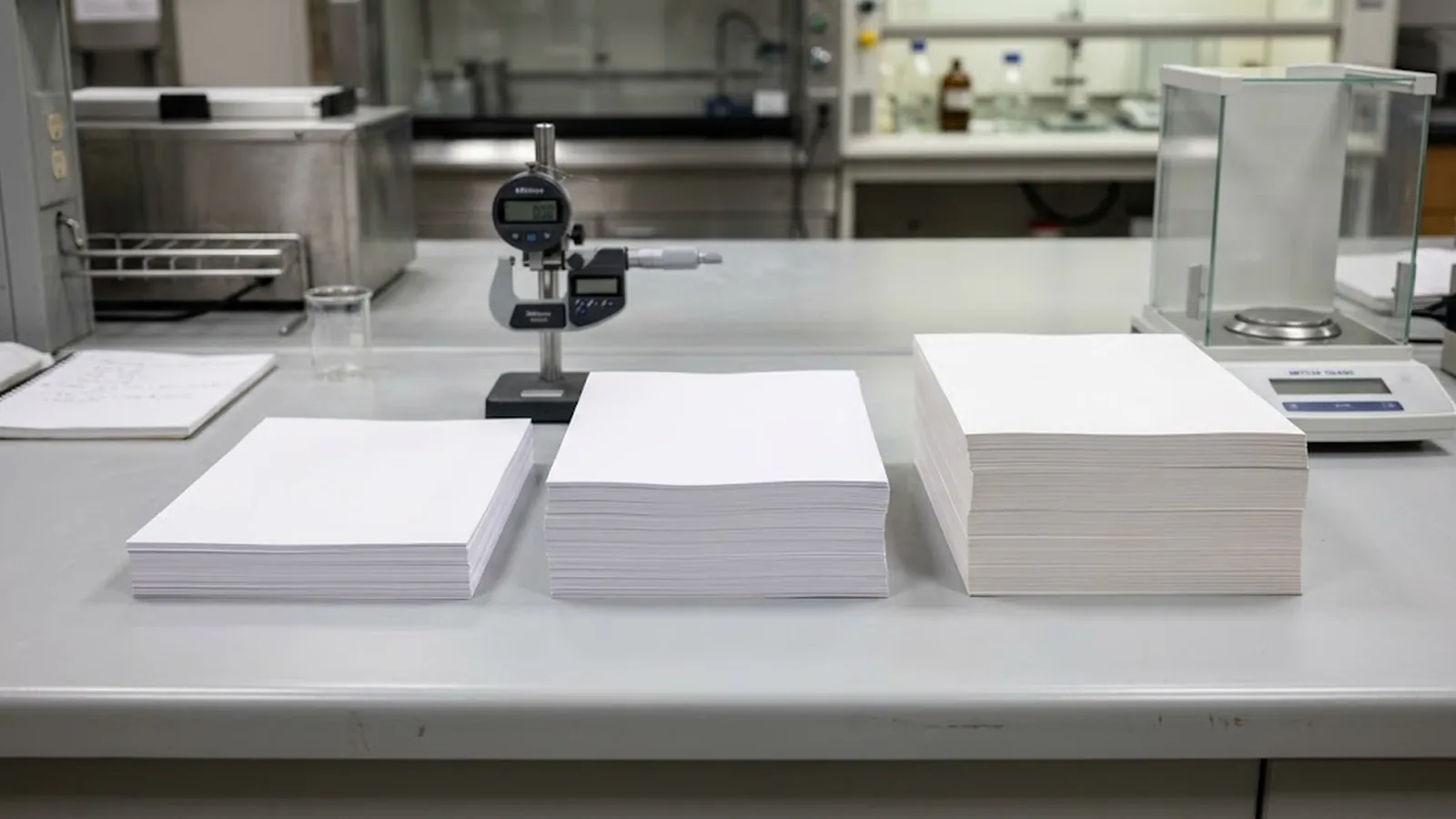
GSM (grams per square metre) is the basis weight of the thermal paper. Lower grades such as 48 gsm give more metres per roll and suit high-volume POS receipts, while higher grades such as 65 and 75 gsm offer greater caliper, stiffness and durability for ATM records, tickets and handling-intensive workflows. The right choice balances roll length, printer path, print durability and cost per usable metre.
Buyers often compare thermal paper by price per roll and discover later that the cheaper roll runs out sooner, curls at the cutter or produces lighter print on a busy printer. Most of those surprises trace back to one number: basis weight, written as gsm.
This guide explains what gsm means for direct thermal paper, how it relates to caliper and roll length, and how each common grade behaves in real print environments. It is intended for procurement teams, distributors and converters selecting a grade for a repeat program rather than a single purchase.
The grades discussed here — 48, 55, 65 and 75 gsm — are the ones most frequently requested from our coating and converting lines, and each can be reviewed against a printer model and an approved sample.
- GSM is weight per square metre, not thickness; caliper in microns is the thickness measurement.
- Lower GSM means more metres per roll diameter and a lower cost per metre, with less stiffness.
- Higher GSM improves handling, tear resistance and perceived quality, but shortens roll length.
- Coating quality, smoothness and image density matter as much as basis weight for print results.
- Specify GSM together with width, diameter, core and length so quotes are truly comparable.
What gsm actually measures
GSM stands for grams per square metre. It describes how much a square metre of the sheet weighs, including the base paper and the thermal coating. It is a weight measurement, not a thickness measurement, although the two are closely related for a given paper construction.
Thickness is expressed as caliper in microns (μm). Two papers can share the same gsm and have slightly different caliper if the base paper is bulkier or the coating weight differs. That difference matters when a printer compartment is tight, because a bulkier sheet of the same weight may produce a larger outside diameter at the same length.
For most purchasing decisions, gsm is the practical specification because suppliers quote grades by weight. Where a machine has a strict media path or thickness sensor, add a caliper limit to the specification as well.

Grade-by-grade comparison
The table below summarises how the common grades behave. Treat it as a starting framework: the final grade should be confirmed on the actual printer and against the handling the printed document will experience.
| Grade | Approx. caliper | Character | Best suited to |
|---|---|---|---|
| 48 gsm | ~54 μm | Lightweight, maximum metres per roll diameter | High-volume POS receipts, mobile printing, lightweight labels |
| 55 gsm | ~60–65 μm | Balanced length and handling | Retail receipts, payment terminals, general-purpose rolls |
| 60–65 gsm | ~70–85 μm | Stiffer sheet, more substantial feel | Restaurant and hospitality receipts, weighing and shelf labels |
| 75 gsm | ~104 μm | Heavyweight, durable and stable in unattended machines | ATM receipts, banking records, transport and parking tickets |
Caliper figures are typical planning values for direct thermal constructions and should be confirmed against the grade specification for your program.
How gsm changes roll length and cost per metre
At a fixed outside diameter, a lighter paper gives more metres of usable media. This is the single most important economic effect of basis weight, and it is the reason a lower price per roll does not automatically mean a lower cost of ownership.
Consider two rolls of the same 80 mm width and 80 mm diameter. The 48 gsm roll will hold noticeably more metres than a 75 gsm roll, so it needs fewer changes per shift. If your printed document has a short life — a receipt handed to a customer — that extra length is usually the better trade.
The opposite applies when the document must survive handling, filing or a long ticket life. Paying for a heavier sheet is reasonable when the alternative is reprints, unreadable records or a customer complaint.
- Compare cost per metre, not cost per roll, when the diameter is fixed.
- Factor in roll change frequency and labour, not only material price.
- Match grade to document life: short-life receipts favour lighter grades; durable records favour heavier grades.
Print performance: what gsm does and does not control
Basis weight influences print results, but it is not the main driver of image quality. Image density, background whiteness and sensitivity come from the thermal coating, the smoothness of the base paper and the printer's energy settings.
A heavier sheet can help in two indirect ways: it tends to feed more predictably through a long or vertical media path, and it resists curling near a heat source such as a cutter or a hot print head. Neither effect compensates for a coating that is poorly matched to the printer.
When print is faint or uneven, check printer head energy and head condition first, then review the grade. If the issue persists across several printers, the coating specification is the more likely cause.
Selecting a grade by application
The following patterns cover most of the programs we support. They are guidelines built around workflow rather than rules, and each can be adjusted after a print trial.
- Supermarket and high-volume retail receipts: 48–55 gsm for maximum metres per change and lower cost per metre.
- Restaurant and hospitality receipts: 55–65 gsm where a stiffer sheet handles better at the table and in kitchen printers.
- Payment terminals and mobile POS: 48–55 gsm, prioritising compact roll diameter and long run time in a small device.
- ATM and banking records: 65–75 gsm for stable feeding in unattended machines and a durable record the customer keeps.
- Parking, transport and event tickets: 65–75 gsm or higher where stiffness, tear behaviour and ticket feel matter.
- Direct thermal labels: grade selected by facestock construction and printer, typically in the 55–75 gsm range for logistics and retail labels.
Storage, image life and handling
Direct thermal images are formed by a heat-activated coating, so printed documents remain sensitive to heat, light, friction and certain plastics and solvents. Basis weight does not change that chemistry, but a heavier sheet generally tolerates handling better and lies flatter in storage.
Store rolls in their original packaging away from direct sunlight and heat sources, and avoid prolonged contact with plasticisers in PVC sleeves or adhesive tapes. Where a document must remain readable for years, consider a thermal transfer construction or a protective topcoat instead of increasing gsm alone.
How to specify a grade in an enquiry
A complete grade request lets a factory quote accurately the first time and reduces the number of sample rounds.
- Target gsm and acceptable tolerance, plus caliper limit if the media path is tight.
- Width, outside diameter, core ID and required length per roll.
- Printer model and print speed, plus whether the document is receipts, tickets, labels or records.
- Expected document life and storage conditions.
- Quantity, packing and any private-label or pre-printing requirement.
Frequently asked questions
What is the difference between gsm and caliper?
GSM is the weight of one square metre of paper in grams. Caliper is the thickness, measured in microns. They are related, but two papers with the same gsm can have different caliper depending on the base paper and coating weight.
Is a higher gsm always better?
No. A higher gsm gives a stiffer, more durable sheet but reduces the metres you get at a fixed roll diameter, so you change rolls more often. Choose the lightest grade that still meets the handling and durability your workflow requires.
Which gsm should I use for POS receipts?
48–55 gsm covers most high-volume retail receipt programs. Move to 55–65 gsm if the receipt is handled more, printed in a kitchen environment or needs to feel more substantial to the customer.
Why is 75 gsm recommended for ATM and ticket paper?
Unattended machines place more emphasis on predictable feeding and on a document that survives handling. A heavier sheet is stiffer, feeds more consistently and feels more durable, which suits ATM receipts, banking records and tickets.
Does gsm affect print darkness?
Indirectly. Print darkness is primarily a function of the thermal coating, paper smoothness and printer energy settings. Basis weight influences feeding stability and heat behaviour rather than the image development itself.
Can you supply grades between the standard 48 and 75 gsm?
Yes. Intermediate grades such as 55, 60 or 65 gsm are commonly produced, and a specific basis weight can be reviewed against volume, coating requirements and the intended printer.