

Queue ticket thermal paper is the direct thermal roll stock consumed by queue-management dispensers — the 'take a number' printers in banks, government service halls, clinics, telecom stores and post offices. The stock looks trivial but carries an unforgiving duty: the printer sits unattended in a public hall, prints one short ticket at a time for years, and every misfeed or faint number is witnessed by a queue of customers. That pushes buyers toward a narrow specification, not a cheap one: width and core matched exactly to the dispenser model, sensitivity high enough for a short, low-energy print head, stiffness heavy enough for the ticket to present itself, and a declared developer system — increasingly BPA-free — because the public handles the output bare-handed. Facilities teams should buy ticket stock with the same documentation discipline as receipt paper: dimensions with tolerances, sensitivity class, developer declaration and per-batch consistency, verified with a trial roll in the actual dispenser.
The queue ticket is the smallest product in the thermal paper catalogue — a strip of paper, a three-digit number, a life of minutes between the dispenser and the trash. But the printer that produces it has one of the hardest jobs in the paper's end-market: it stands in a public hall, unattended, printing hundreds of short tickets a day for years, and every jam, curl or faint number happens in front of exactly the customers the machine exists to reassure.
That is why queue ticket thermal paper rewards precision over price. Ticket stock that is a fraction off in width fights the dispenser's feed rollers; stock that is too light curls into the output slot; stock that is marginally insensitive prints a number the third row of the waiting area cannot read. Each failure is small, public and cumulative — and each one traces back to a line on the specification that a facilities buyer can control.
Buyers comparing these specifications can review our custom thermal paper programme, where width, core, roll diameter and developer class are documented in a single specification sheet before an order is placed.
This guide covers how queue dispensers actually consume ticket stock, the dimensions and sensitivity choices that keep printer uptime high, the compliance dimension of tickets the public handles bare-handed, and the specification checklist facilities managers and ticket-system integrators should hold suppliers to.
- Queue printers fail in public: every misfeed or faint number is witnessed by the waiting queue, so ticket stock is an uptime product, not a stationery line.
- Match width, core and outside diameter to the dispenser model exactly — queue mechanisms have almost no tolerance for geometry drift.
- Sensitivity and stiffness must balance: high sensitivity for short, low-energy print heads; enough basis weight for the ticket to present flat in the output slot.
- Tickets are handled bare-handed by the public, so a declared developer system — BPA-free where required — is a compliance line, not a marketing line.
- Buy with documentation: dimensions with tolerances, sensitivity class, developer declaration and per-batch consistency, verified by a trial roll in the actual dispenser.
How queue dispensers consume ticket stock
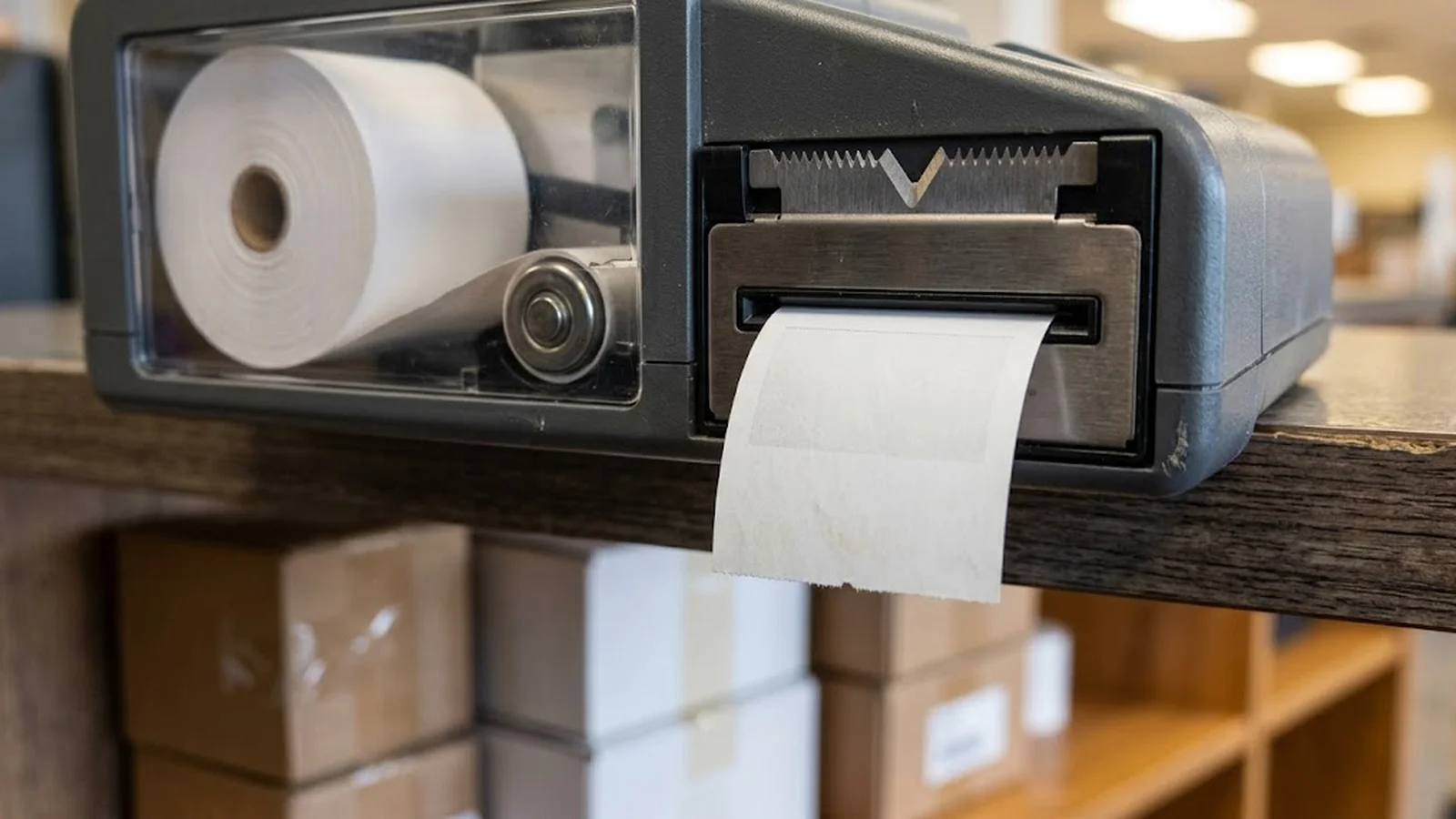
A queue-management dispenser prints one short ticket per customer — a number, a timestamp, sometimes a service category or QR code — then advances and guillotines the stock against a fixed blade. The mechanism is simple, which is exactly why it is demanding: there is no operator to nudge a misfed roll, no second chance at a faint number, and the paper path is short, with tight bends that expose any curl or stiffness error in the stock. Ticket widths commonly sit in the 54mm to 58mm band with 30-40mm outside diameters on small cores, and each dispenser family expects its geometry held tightly across every roll in the carton.
Consumption is the quiet planning problem. A busy service hall issuing four hundred tickets a day consumes a roll in days, and a dispenser that runs empty mid-morning creates the one queue the system was installed to abolish. Facilities teams that log tickets-per-day per hall, standardise roll geometry across their dispenser fleet, and hold buffer stock per site treat ticket paper as an operating supply — because to the customer waiting in the hall, that is exactly what it is.
Ticket content is also growing. Modern queue systems print QR codes for virtual queuing, multilingual prompts and service-point directions, all of which demand steadier print density than a bare number did. Density stability comes from the paper's sensitivity uniformity across the roll and across batches — the property that decides whether code 147 scans from a pocket or a photograph.
Where a programme needs several formats from one supplier, our 75 gsm heavyweight thermal paper publishes the test data behind each grade, so stiffness and sensitivity can be verified against the mill's own measurements rather than a catalogue claim.
Public handling: the compliance dimension
Queue tickets are the one thermal-printed item the general public handles without choosing to. Every visitor to the hall takes one bare-handed, holds it, and pockets or discards it — which puts the ticket's developer chemistry under the same scrutiny regulators and retail chains apply to receipts. EU REACH restrictions on Bisphenol A, retailer bans that extend to BPS, and institutional procurement policies that specify phenol-free systems all reach into the ticket roll, because a service hall's ticket stock is part of its public-facing compliance posture.
For facilities managers, the practical requirement is declaration: the supplier should state the developer system — BPA-free, BPS-free or phenol-free — in writing, backed by test documentation per batch, so the institution can answer the question 'what is printed on this?' without a laboratory. Public-sector tenders increasingly carry that line explicitly, and suppliers who document it win the framework; suppliers who market it win nothing.
Storage is the quieter compliance-adjacent issue. Tickets may be retained by the institution for service-audit purposes — a disputed queue order, a service-level claim — so the stock's image life under office storage matters as much as its first-pass darkness. Ticket stock specified with a stated image-retention class turns 'the number faded' from a dispute into a non-event.
Where developer compliance is part of the specification, our BPA-free vs phenol-free guide documents the chemistry, the regulations and the paperwork behind each class.
Ticket-roll spec shorthand for tenders: 'Direct thermal ticket roll, [width] mm x [OD] mm on [core] mm core; sensitivity class for [dispenser model]; stiffness per sample ticket; developer system declared (BPA-free / phenol-free) with per-batch test documentation; image-retention class stated.'
Buying ticket stock: the specification checklist
The checklist for queue ticket stock is short and unforgiving. Width, outside diameter and core with tolerances matched to the dispenser model; sensitivity class proven on the actual mechanism, not a generic rating; basis weight chosen so the ticket presents flat rather than curling into the slot; developer system declared with per-batch documentation; and packing that keeps humidity away from stock stored in service corridors and storerooms rather than climate-controlled warehouses.
Trial protocol matters more here than in most paper categories because the installed base of dispenser hardware is old, varied and unforgiving. A carton of trial rolls run across every dispenser model in the fleet — feed, print, cut, repeat — surfaces geometry drift, curl and sensitivity mismatches before a container order, at the cost of a morning. Integrators who install queue systems as a business make that trial a standing part of their acceptance routine.
Finally, consolidate the supply. A facilities programme running banks, clinics and service halls across a region buys ticket rolls, receipt rolls and label stock from overlapping fleets; consolidating those lines with one manufacturer aligns tolerances, documentation and delivery rhythm across the whole estate, and turns a dozen small stationery orders into one managed programme with one accountability chain.
Frequently asked questions
What paper do queue ticket dispensers use?
Direct thermal ticket rolls, typically 54-58mm wide with 30-40mm outside diameters on small cores, matched to the dispenser model. Queue mechanisms have little tolerance for geometry drift, so width, diameter and core tolerances matter as much as the paper grade itself.
Why do queue tickets sometimes print faintly?
Faint numbers usually trace to low-sensitivity stock on a short, low-energy print head, or to sensitivity variation across the roll. Matching the stock's sensitivity class to the dispenser model — verified by a trial roll — restores consistent first-pass density.
Do queue tickets need BPA-free paper?
Increasingly yes, especially in public-sector and EU-facing institutions: tickets are handled bare-handed by the public, so REACH restrictions on BPA and institutional procurement policies extend to ticket stock. Buy with the developer system declared in writing and backed by per-batch test documentation.
How long do printed queue tickets last?
With standard thermal stock, a stored ticket stays readable for years under office conditions, but heat, humidity and plastic contact shorten image life. Where institutions retain tickets for service audits, specify a stated image-retention class so retention is a property of the paper, not an accident.
How should facilities teams buy ticket rolls?
Log tickets-per-day per hall, standardise roll geometry across the dispenser fleet, hold buffer stock per site, and buy against a written specification — dimensions with tolerances, sensitivity class, stiffness, declared developer system and batch documentation — verified by a trial carton in the actual machines.