
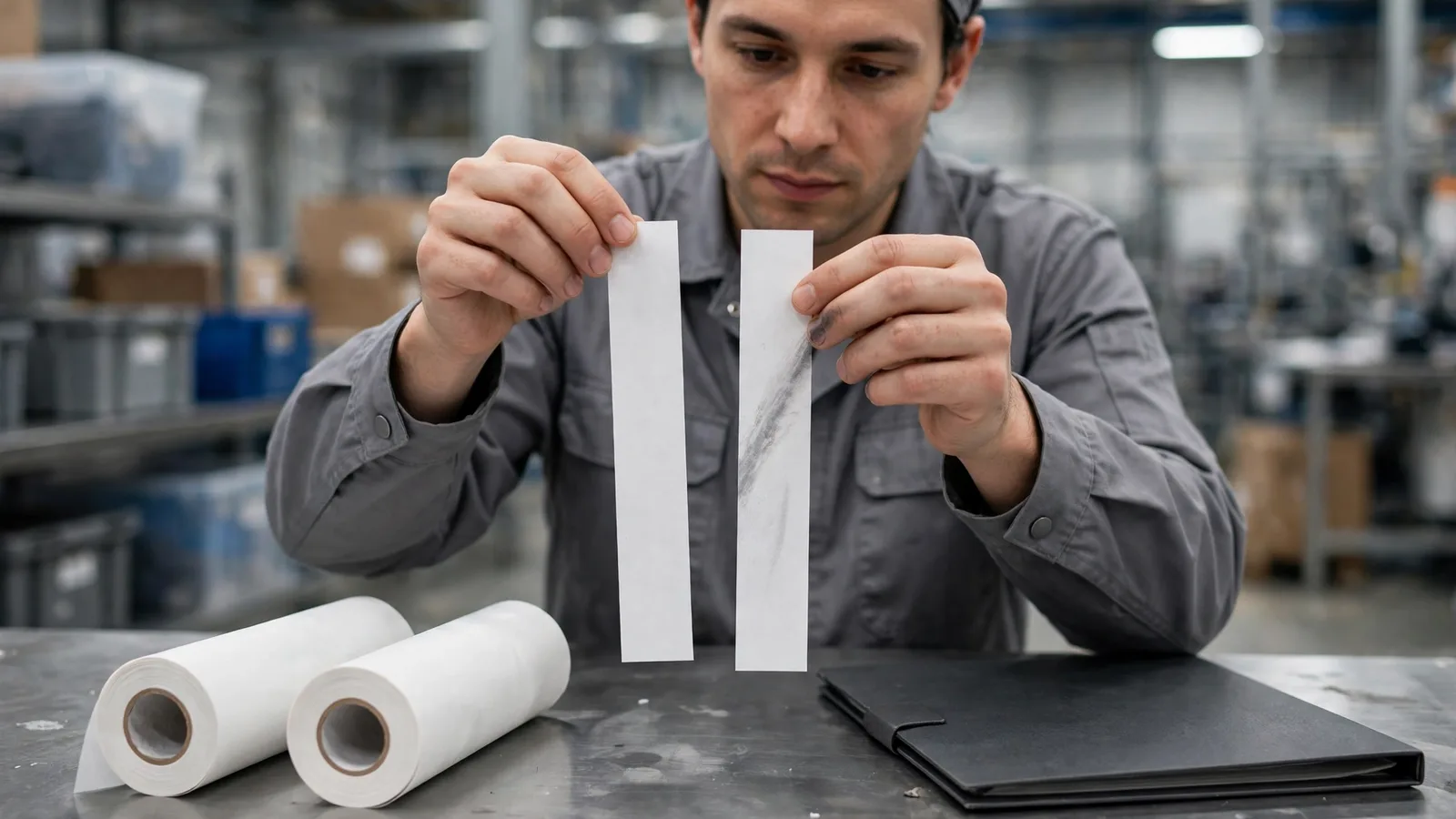
Thermal paper carries a heat-sensitive coating, so the fastest identification checks are friction and heat: rubbing a fingernail, pen cap or coin firmly across the surface leaves a dark grey mark on genuine stock, and a warm object darkens it within seconds. Plain and bond paper show nothing under either test; carbonless stock reacts only to pressure applied between two plies, not to heat alone. The coated side is usually the smoother, slightly glossy face, and it is the only side that develops an image. For shipments, identification should be confirmed against the supplier's COA and SDS rather than chemical testing in the warehouse.
Warehouses rarely hold one kind of paper. A distributor's shelf carries receipt rolls, label stock, plain bond pads and carbonless books, often in the same white-on-white finish, and a mislabelled carton can sit unnoticed until an end customer reports blank pages. Identification is also a procurement skill: when a sample arrives from a prospective mill, the first quality gate is confirming that what is in the box behaves like thermal stock at all, before any print trial is scheduled.
The good news is that thermal paper identifies itself readily, because its defining feature — a chemical coating that darkens under heat — is easy to provoke without equipment. Friction generates enough localized heat to mark the surface, which is why a fingernail or pen cap dragged across genuine stock leaves a grey streak. No other common printing media behaves this way, and that asymmetry makes a five-minute check decisive.
Reference-grade stock makes the comparison meaningful, so keep a known sample beside the unknown one; our 75 gsm heavyweight thermal paper is documented per grade and serves many buyers as exactly that bench reference when a shipment's identity is in doubt.
This guide walks through the checks in the order a buyer would run them: the friction and heat tests, finding the coating side, separating thermal from plain and carbonless stock, and finally verifying that an incoming shipment matches its paperwork.
- Thermal paper darkens under friction and heat because its coating contains the developing chemistry; this is the fastest and most reliable identification check available without equipment.
- Plain bond paper fails both tests; carbonless stock marks only under pressure between plies and shows no reaction to heat alone, which separates the two most common lookalikes.
- The coated side is typically the smoother, slightly glossy face, and it is the only side that develops an image — knowing it matters for loading, winding direction and QC.
- Identification by touch and heat is for screening only; a shipment's developer class and grade should be confirmed against its COA and SDS documentation.
- Archive a signed reference roll from every approved supplier so future shipments can be compared side by side rather than judged from memory.
Why identification checks matter in a paper programme
Mixed media look alike because the base paper is similar: white, smooth, wound on similar cores. What differs is a microns-thin coating on one face, invisible until it reacts. Distribution centres that combine receipt rolls and label stock from several suppliers, or that inherit stock from an acquired competitor, accumulate exactly the kind of ambiguous inventory where a blank-print complaint traces back to a carton that was never thermal at all.
Identification also protects the purchasing side of a programme. A sample submission is a claim about a construction — basis weight, sensitivity class, coating system — and the buyer's first task is confirming the claim is about thermal stock at all before evaluating whether it is good thermal stock. The checks below screen for identity; the mill's documents and a machine trial then evaluate quality.
Procurement teams standardising on one supplier can review our POS and receipt paper rolls alongside the comparisons in this guide, where each roll format is documented per width, core and grade so identification results can be tied back to a written specification.
The friction and heat tests
The friction test needs nothing but the paper itself. Press a fingernail, a pen cap or the edge of a coin against the coated face and draw a firm, quick line. Genuine thermal stock darkens along the stroke — light grey on insensitive grades, near-black on high-sensitivity constructions — within a second. Run the same stroke on plain bond paper and nothing happens; the difference is the entire diagnosis. Use an expendable edge of the roll or an outer winding layer, since the mark is permanent.
The heat test confirms what friction suggests. Rest the paper's coated face briefly against a warm object — the outside of a mug of hot water, a recently switched-off enclosure, a body warmed coin held between fingers — and the surface greys evenly where it touched. Direct flame is too aggressive: it browns ordinary paper as well, which destroys the discriminating power of the test. Warm, not burning, is the rule that makes the result readable.
Interpret both tests with the grade in mind. Insensitive or long-life constructions are formulated to resist accidental darkening, so their friction marks are fainter; a weak streak is not evidence of fakery, only of a lower-sensitivity class. If the result matters contractually, the check escalates to the documents described in the final section, not to a harder scratch.
Finding the coating side
Only one face of the web carries the heat-sensitive layer, and confirming which is a two-minute exercise with real operational value. The coated face usually reads as the smoother and slightly glossier side, catching light with a subtle sheen against the more fibrous matte back. Where the visual difference is subtle, the friction test settles it: the side that darkens under a nail stroke is the image side.
Coating side governs handling decisions up and down the chain. Winding direction determines whether the image face is inside or outside the wound roll, which decides how the roll loads into its holder; print heads contact the coated face, so a wind-direction error produces blank output from perfectly good stock; and in storage, the coated face is the face that must stay protected from plastic contact, moisture and abrasion. A buyer who can name the coating side can audit all three.
Construction adds a second layer to the question. On stock with a protective overcoat, the sealed top surface is even smoother and more resistant to a wet fingertip drag than non-top-coated stock, where the sensitive layer sits closer to the surface and marks more readily. Where that structural difference drives image life and cost, our top-coated vs non top-coated guide compares the two constructions on retention, cost and machine behaviour.
Thermal stock versus plain, bond and carbonless paper
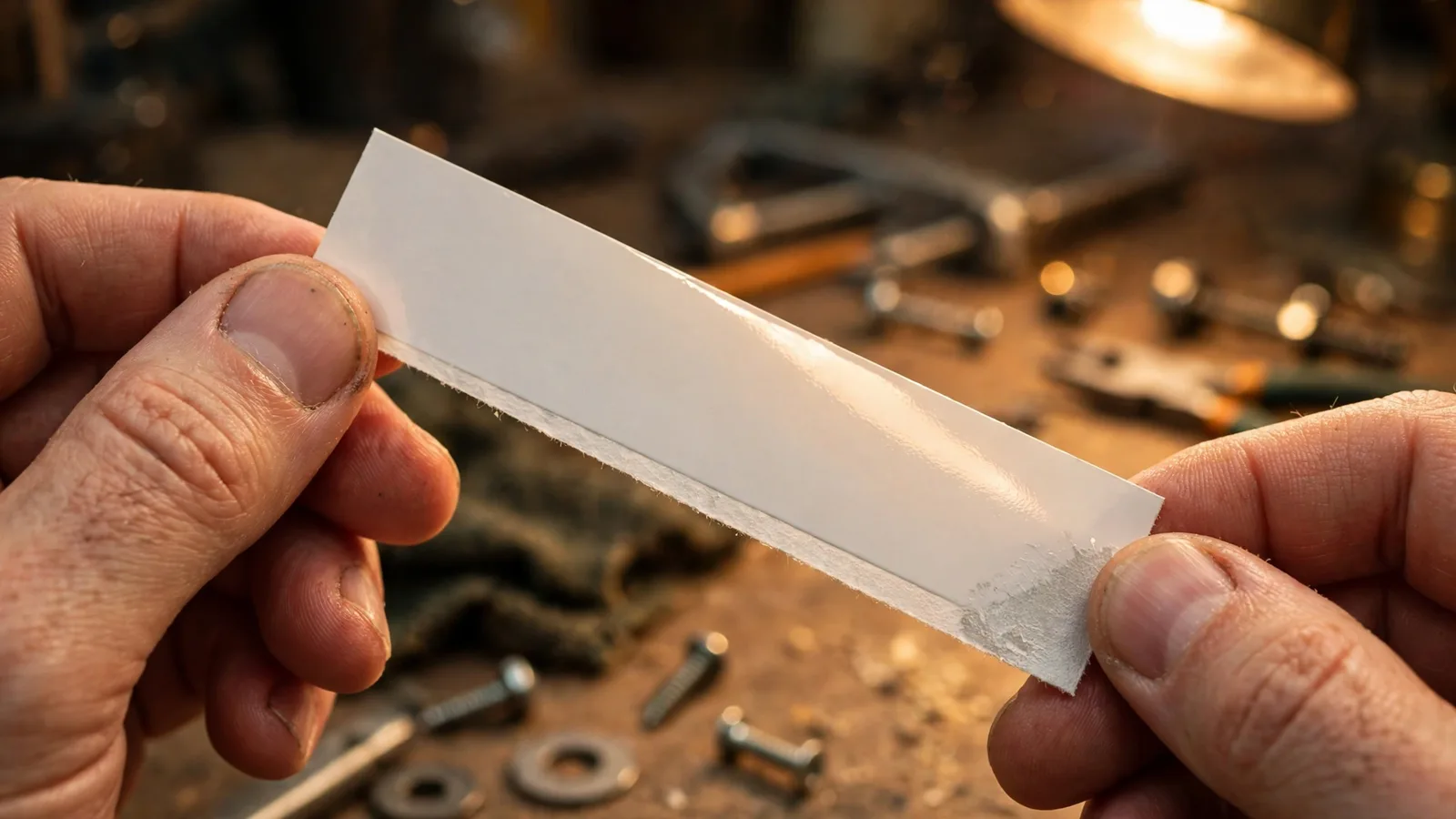
Three lookalikes account for nearly every misidentification. Plain bond and woodfree stock — the paper of notebooks and pads — fails both the friction and heat tests completely; nothing darkens, nothing transfers. If a 'thermal' roll shows no reaction at all, it is almost certainly ordinary paper wound onto a thermal-looking core, and the conversation with the supplier should be a short one.
Carbonless (NCR) stock is subtler, because it does react to pressure. The distinction is mechanism and geometry: carbonless sheets carry encapsulated dye that ruptures under pressure and develops against the adjacent ply, so a hard stroke made with the sheet flat on a desk marks little, while the same stroke made with two plies stacked marks both faces. Thermal stock needs no partner sheet and reacts to heat alone — one surface, one stroke, one mark. Testing a suspected carbonless roll against a known thermal sample side by side makes the difference obvious in seconds.
Pre-printed and coated-one-side decorative stocks occasionally confuse buyers because a printed logo survives handling that would smudge toner. Printed ink, however, sits on the surface as colour, not as a heat-developed layer; it does not redden under warmth and it does not scratch grey. Ink that arrives already on the sheet is print, not coating, and the friction test reads it as silence.
Verifying a shipment against the specification
Screening tests establish identity; documents establish conformance. Every carton of a properly documented programme travels with a certificate of analysis tying the batch to measured basis weight, sensitivity and caliper, and an SDS declaring the developer system. Reading those two documents against the purchase order — grade, developer class, construction — is the warehouse-side verification, and it takes less time than a second friction test.
The developer class deserves particular attention because it cannot be seen, scratched or heated into view. Whether a construction uses a BPA-free developer system or a phenol-free one is a chemistry declaration, not a surface property, so the buyer's evidence is the SDS and, where required, third-party test reports. Store the paperwork with a signed reference roll from the same batch: together they form the standard every future shipment is judged against.
Where a programme needs several formats from one supplier, our custom thermal paper programme covers width, core, roll diameter and developer class in a single specification sheet — the document that makes each incoming carton self-identifying, leaving the scratch test for the cartons nobody documented.
Verification shorthand: friction and heat screen for identity; the coating side answers a handling question; the COA, SDS and archived reference roll answer the conformance question.
Frequently asked questions
Does the scratch test damage the roll?
The mark is permanent, so run it on the outer winding layers or an expendable end of the roll, never on the printable face you intend to use. One stroke removes a few centimetres of usable paper at most, which is negligible against the value of knowing what the roll is.
Can humidity or sunlight trigger the mark without friction?
Slow ambient heat and strong sunlight can grey thermal surfaces over time, but neither produces the instant, localized response of a fingernail stroke. A surface that darkens only gradually in storage is still thermal stock; the friction test simply accelerates what heat does.
How do I know which side to load in the device?
Load the coated face toward the print head. The coated side is the smoother, slightly glossy face, and the friction test confirms it — the side that darkens under a nail stroke is the image side. Most rolls wind so the coated face is on the outside; a roll that prints blank while feeding normally has been wound or loaded the other way.
Is a faint scratch mark a sign of poor quality?
Not by itself. Lower-sensitivity and long-life grades are formulated to resist accidental darkening, so their friction marks are naturally lighter than high-sensitivity constructions. Sensitivity is a specification choice, documented per grade; the scratch test identifies the media rather than grading it.
Can I verify whether a roll is BPA-free by testing it?
No — the developer system is chemistry, not surface behaviour, and no warehouse test distinguishes developer classes. The evidence is the shipment's SDS and certificate of analysis, and where the market requires it, third-party test reports from the mill.