
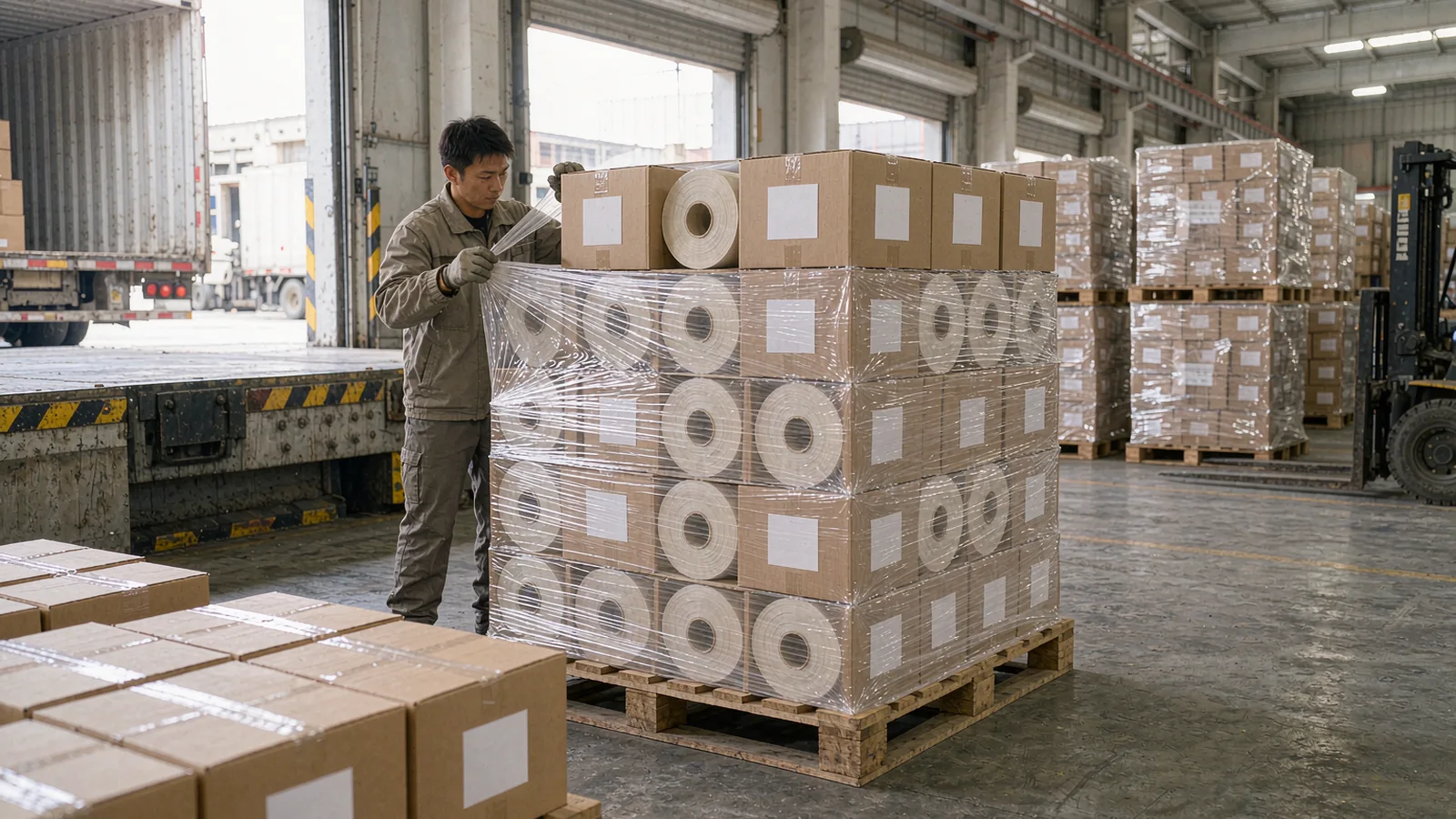
A thermal paper distributor private label programme is a factory-direct arrangement in which a mill produces receipt rolls, label stock or jumbo rolls to the distributor's specification and ships them under the distributor's own brand — from the printed core plug and box label to the full retail pack. The programme is built on four decisions: product scope (which formats the house brand covers), specification control (width, gsm, core, developer class fixed on one sheet per SKU), branding depth (shrink wrap, printed box, leaflet, core printing, each with its own MOQ), and the quality-compliance pack (COA, SDS, developer-class declaration) that lets the distributor defend the brand in its own market. Margin upside of 15–30 points over reselling a factory brand is common, but it is earned by specification discipline, not by the sticker.
Distributors in the thermal paper trade face a persistent margin problem: reselling a manufacturer's brand puts every competitor on the same price list, and the product is — rightly or wrongly — perceived as a commodity. Private label breaks that loop. A house brand of receipt rolls, built on a factory's coating and converting capacity, gives the distributor a product nobody else quotes, a margin the market does not arbitrage away, and a brand asset that compounds with every counter it reaches.
Private label in this trade is also more accessible than most distributors assume. Modern coating plants already produce across developer classes, gsm grades and the full width family; putting a distributor's brand on that output is a packaging, documentation and logistics exercise — provided the specification work is done seriously at the start.
This guide works the private label decision the way a distributor would: the programme scope and MOQ structure, how specification control protects the brand, what branding depth costs at each level, the quality and compliance pack a house brand needs, and the logistics frame for shipping a branded paper programme internationally.
Distributors scoping a house brand programme can review our custom thermal paper programme, where widths, cores, grades and developer classes are quoted as one specification per SKU before an order is placed.
- Private label turns a price-list product into a brand asset — margin upside of 15–30 points is typical over reselling a factory brand.
- Scope the programme to formats the distributor actually moves: 57 mm and 80 mm receipt rolls plus one or two label formats cover most house brands.
- Specification control is brand protection: one sheet per SKU fixing width, gsm, core, developer class and winding keeps every shipment identical.
- Branding depth is tiered — printed box labels cost little; shrink wrap, leaflets and core printing each carry their own MOQ.
- COA, SDS and developer-class declaration per shipment are what let a distributor defend the house brand in audits without a requalification cycle.
Programme scope: what a house brand actually covers
The strongest distributor private label programmes start narrow and deep rather than wide and shallow. A typical scope is the 57 mm and 80 mm receipt roll family — 57 x 40, 57 x 50, 80 x 80, 80 x 60 — in one or two gsm grades, plus one label format if the distributor serves logistics or retail customers. Every additional SKU multiplies MOQ commitments, packaging artwork and inventory risk, and a house brand with thirty half-moving SKUs is weaker than one with six that never stock out.
MOQ structures follow the branding tier. Stock paper with generic packaging carries the lowest commitment; adding the distributor's printed box typically sets the MOQ per SKU per design cycle; shrink wrap, leaflets, core printing and retail multipacks each add their own run lengths. The honest planning exercise is backwards from the distributor's sales forecast: the brand tier must clear its MOQ inside a reasonable stock-turn, or the margin advantage is quietly consumed by capital tied up in printed cartons.
Grade selection within the scope follows the same logic: one lightweight grade (48–55 gsm) for high-volume counters, one mid or heavyweight grade (65–75 gsm) for premium positioning or filing-heavy customers, and one developer-class commitment — BPA-free or phenol-free — that applies across the whole brand so the compliance story is uniform.
| Branding tier | Elements | Typical MOQ behaviour | Lead time impact |
|---|---|---|---|
| Generic / neutral | Stock box, neutral marking | Lowest — runs with standard production | None |
| Printed box | Distributor artwork on carton | Per SKU per design cycle | Print plate + days |
| Full retail pack | Shrink wrap, leaflet, barcode | Higher run per SKU | 2–3 weeks first run |
| Core & wrap printing | Printed core plug, branded wrap | Run-length dependent | Quoted per element |
Tiers combine: most mature house brands run printed boxes at minimum, with full retail packs on the SKUs that reach end-user shelves.
Specification control: the brand protection layer
A house brand makes one promise — this product is the same every time — and specification control is how the factory honours it. One sheet per SKU fixes width, core, outer diameter, basis weight, coating class, developer system, winding hardness and joint policy. Every shipment is checked against that sheet, and any change (a gsm drift, a different developer, a softer winding) is a change the distributor approves in writing before it ships. Distributors who skip this step discover brand drift the way retailers do: a counter complaint about roll length or print darkness that traces to an unrecorded specification change.
The developer-class line deserves special attention in a private label programme, because it is the line a distributor's own customers increasingly audit. Fixing the brand on BPA-free or phenol-free chemistry — and keeping the COA and SDS with each shipment identifying that system — turns compliance from a recurring question into a filed answer. It also protects the brand across borders: developer rules in destination markets tighten rather than loosen, and a brand already running phenol-free chemistry inherits those markets without requalification.
Quality verification sits on top of the sheet: incoming tests on image density, curl and winding per lot, with the mill's own measurement data published per grade so the distributor's QC can compare shipment to specification rather than to memory. Where image life is part of the brand promise — premium grades positioned on retention — our top-coated vs non top-coated guide compares the two constructions on retention, cost and machine behaviour.
- One specification sheet per SKU: width, core, OD, gsm, coating, developer, winding, joints.
- Changes ship only after written distributor approval — no silent substitutions.
- One developer-class commitment across the brand keeps compliance uniform.
- Per-lot COA and SDS let the distributor answer audits from file, not from memory.
Margin maths and the MOQ reality
The private label margin case rests on three numbers: the factory-direct price versus the branded-resale price, the brand premium the distributor's market will carry, and the working capital the branding tier ties up. Factory-direct pricing on receipt rolls typically lands 10–20 percent under branded resale; a house brand in most markets carries a further premium over generic imports once counter availability and trust are established; the binding constraint is usually the third number — printed packaging is inventory, and slow-moving branded stock is the most expensive paper in the warehouse.
The programme therefore rewards sequenced commitment: start at the printed-box tier on the two or three highest-velocity SKUs, prove stock-turn, then add retail packs and further SKUs as the brand earns shelf presence. Distributors who reverse the sequence — full retail programme first — often end up discounting their own brand to clear it, which damages the asset the programme was built to create.
Where the counter formats in the house brand overlap the distributor's existing resale lines, plan the migration openly: house brand at a deliberate margin advantage over the branded equivalent, with the branded line retained for customers who specify it. A private label programme that cannibalises a distributor's branded line at equal margin has gained nothing; one that shifts volume to the house brand at 15–30 extra points has rebuilt the category economics.
For the high-volume end of a house brand, our POS and receipt paper rolls document the finished-format family — the 57 mm and 80 mm SKUs a distributor programme most commonly starts from.
- Factory-direct typically 10–20% under branded resale; house brand adds a market premium.
- Printed packaging is inventory — the binding constraint, not the paper price.
- Sequence: printed boxes on high-velocity SKUs first; retail packs after stock-turn is proven.
- Plan house-brand-versus-branded migration deliberately; margin advantage decides it.
Logistics, export documentation and programme governance
A private label programme is an export logistics programme with a brand attached. Ocean freight planning dominates: receipt rolls are light but bulky, palletisation standards, container fill and moisture-barrier packing decide landed condition, and a branded programme adds one requirement — packaging artwork and labelling must be correct at the moment the container is stuffed, because there is no overprint fix at destination. Artwork versioning (a numbered, dated artwork register shared between distributor and factory) prevents the classic private label failure of a container arriving with last year's barcode.
The document set travels with the goods: commercial invoice, packing list, bill of lading, certificates of origin as the destination market requires, and the quality-compliance pack — COA and SDS per shipment with the developer system named. Distributors running house brands into regulated retail channels add the destination-market labelling review to the artwork cycle, so the printed box complies where it lands, not where it was printed.
Governance closes the loop: an annual specification review, per-lot quality data flowing back from the distributor's QC, and a written change-control agreement covering artwork, specification and developer class. Distributors who formalise this early run programmes that survive staff changes on both sides; those who run it on goodwill re-negotiate it during their first quality dispute.
Where container planning is the next step, our export shipping guide covers pallet standards, moisture-barrier packing and the document set for ocean freight.
Procurement teams building the heavyweight end of a house brand can review our 75 gsm heavyweight thermal paper, where premium-positioning grades are documented alongside the counter-roll family.
- Container fill and moisture-barrier packing decide landed condition — plan both per SKU mix.
- Artwork register: numbered, dated, shared — correct at the moment of stuffing, no destination fixes.
- Document set: invoice, packing list, B/L, certificates of origin, COA and SDS per shipment.
- Governance: annual spec review, per-lot QC feedback, written change control on art and chemistry.

A private label programme is judged at the container door: artwork current, specification matched, documents complete — everything before that point is preparation.
Frequently asked questions
What is a thermal paper distributor private label programme?
A factory-direct arrangement in which a mill produces receipt rolls, label stock or jumbo rolls to the distributor's specification and ships them under the distributor's own brand — printed cartons, retail packs and core printing included — with specification, quality and compliance documentation structured so the distributor can defend the brand in its own market.
What MOQ should a distributor expect for private label rolls?
It scales with branding depth. Neutral-packaged stock paper carries the lowest commitment; printed cartons set an MOQ per SKU per design cycle; full retail packs with shrink wrap, leaflets and barcodes carry higher run lengths. The workable structure is printed boxes on the two or three highest-velocity SKUs first, with retail packs added once stock-turn is proven.
How much margin does private label add over reselling a factory brand?
Factory-direct pricing typically runs 10–20 percent under branded resale, and an established house brand usually carries a further market premium over generic imports. Realised upside of 15–30 margin points is common — provided printed-packaging inventory turns fast enough that the working capital does not consume the gain.
Which chemistry class should a house brand commit to?
One class across the whole brand, and increasingly phenol-free: BPA-free stock may still carry alternative phenolic developers such as BPS, which destination-market audits are beginning to question. A phenol-free commitment with COA and SDS per shipment turns compliance into a filed answer rather than a recurring qualification.
How is quality consistency controlled across shipments?
Through specification control and lot data: one specification sheet per SKU fixing width, gsm, core, developer class and winding; per-lot COA with the mill's image-density and winding measurements; and a written change-control agreement so no specification or artwork change ships without the distributor's written approval.