
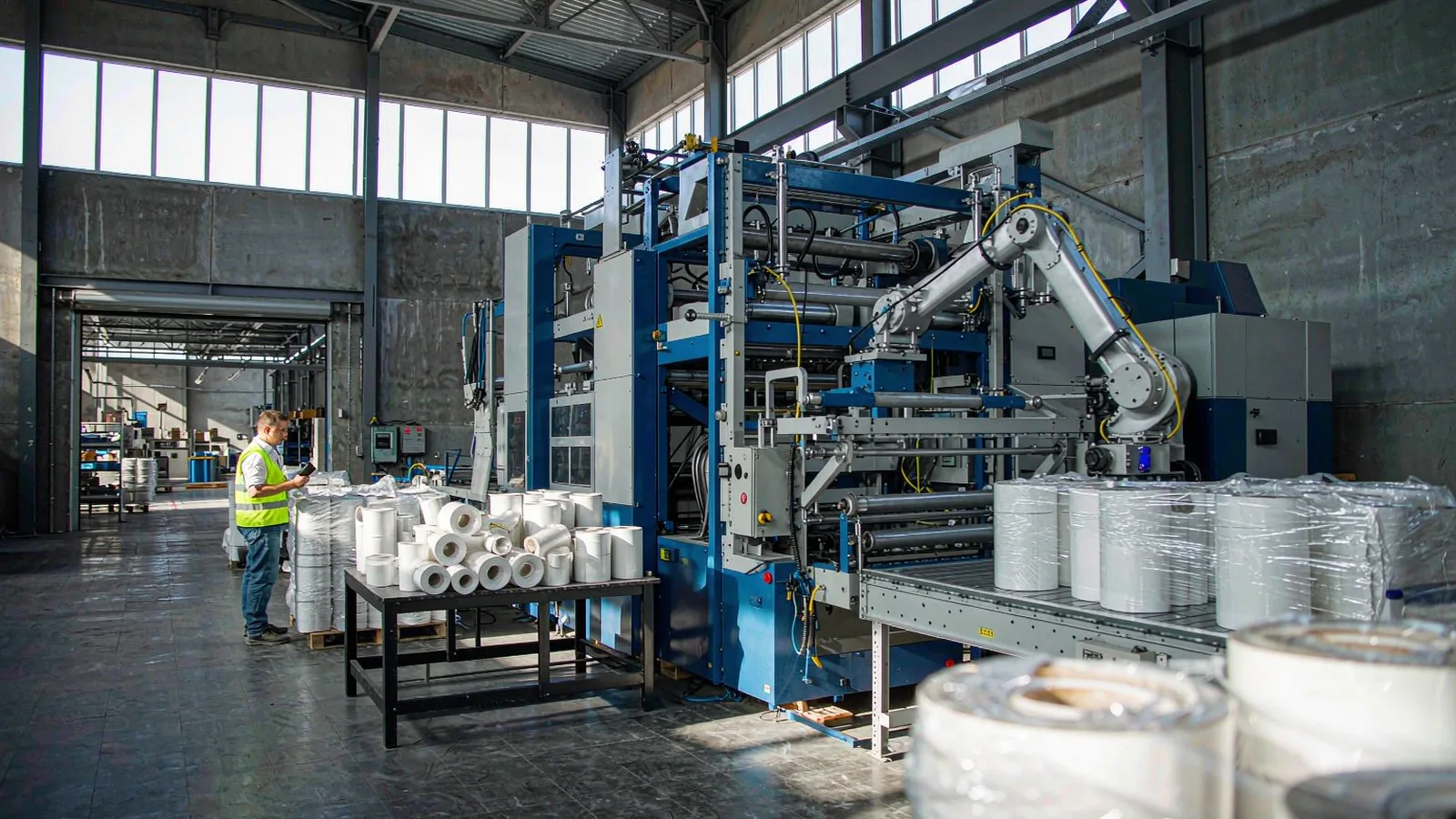
Industrial thermal labels are identification labels for manufacturing environments — work-in-progress tags, pallet and container labels, drum and equipment identification, and quality-status labels — most commonly produced in direct thermal stock where dwell runs from days to a few years. The specification decision is a stack of four: facestock grade (58–65 gsm for stiff, abrasion-resistant labels), construction (top-coated wherever scuffing, oil mist, moisture or long dwell appear), adhesive class (permanent for cardboard and rigid plastics, high-tack for low-surface-energy surfaces, freezer-grade for cold zones), and format (die-cut rolls, fanfold or converter parent stock). Plants that test the label on the actual surface at the actual temperature — and document all four choices on one sheet — avoid the quarterly relabelling cycles that eat programme budgets.
Manufacturing plants identify everything: containers moving between work centres, pallets staged at shipping doors, drums of raw material, test specimens, equipment panels and maintenance assets. The identification workload runs into the thousands of labels per shift, and nearly all of it is printed on demand — which is why direct thermal stock carries the majority of industrial identification programmes.
But a factory floor is a harder environment than a checkout counter. Labels rub against racking in transit, pick up oil mist near machining centres, sit in hot corners beside curing ovens, and are expected to scan months or years after printing. The label stock that works is a construction decision, not a commodity purchase: facestock grade, coating class, adhesive and format chosen against the real duty of each label family.
This guide works the industrial decision the way a plant engineer would: the label families and their duties, how abrasion, heat, chemicals and dwell drive the construction stack, the format and converting options, and the rollout checks that separate programmes that last from programmes that relabel.
Buyers comparing these specifications can review our top-coated thermal label stock, where facestock grades, adhesive classes and coating construction are documented per grade before an order is placed.
- Match the label family to its duty: WIP tags need mid-dwell abrasion resistance; pallet and drum labels need transit-grade adhesion; equipment ID needs years of dwell.
- Top-coated construction is the default on the factory floor — oil mist, scuffing and label-to-label contact in stacks degrade uncoated images quickly.
- Adhesive class decides more failures than facestock: high-tack for plastics and powder coatings, freezer-grade for chill zones, permanent for cardboard.
- Die-cut rolls serve mobile print stations; fanfold serves fixed high-volume stations; converter parent rolls serve plants that slit their own.
- Trial on the actual surface at the actual temperature — datasheet adhesion values do not transfer to oily steel or frozen shrink-wrap.
The industrial label family and its duties
Work-in-progress and traceability labels run the widest duty range: applied at goods-in or the first work centre, scanned at every operation, and expected to survive handling, wipes and partial occlusion for weeks to months. A 58–65 gsm direct thermal facestock with a permanent adhesive covers the standard case; the top-coated build earns its premium wherever the label passes through wash-down zones, picks up coolant spray, or is handled with gloves that scuff unprotected images.
Pallet, container and drum labels are the transit end of the family: applied under compression, stacked, and scanned through yards and lorries. Here adhesive performance matters as much as image life — drums of oil, shrink-wrapped pallets and powder-coated containers each defeat a general-purpose adhesive in a different way, and the 100 x 150 mm SSCC format has become the default for anything that leaves the plant.
Equipment, pipe and asset identification sits at the long-dwell end: labels expected to scan or read for years in fixed positions. Direct thermal serves the moderate end of this family — asset codes, calibration stickers and inspection labels on a one-to-three-year cycle — while the harshest cases (outdoor UV, solvent wipe-down) belong to other media. Knowing where direct thermal's envelope ends is part of specifying it well.
| Label family | Typical size | Dwell | Facestock | Adhesive class |
|---|---|---|---|---|
| Work-in-progress / traceability | 100 x 50 – 100 x 150 mm | Weeks–months | 58–65 gsm, top-coated | Permanent |
| Pallet / SSCC / shipping | 100 x 150 mm (4 x 6 in) | Days–weeks | 58–65 gsm, top-coated | Permanent / high-tack |
| Drum & container ID | 100 x 150 / custom wrap | Months–years | 65 gsm class, top-coated | High-tack |
| Equipment / asset / calibration | 50 x 25 – 100 x 50 mm | 1–3 years | 65 gsm class, top-coated | High-tack permanent |
| Quality / status flags | Custom die-cut | Days–weeks | 58 gsm direct thermal | Permanent / removable |
Sizes reflect common export-standards; plant-specific WMS and applicator requirements are die-cut to order from the same facestock families.
Environment factors: abrasion, heat, chemicals and dwell
Direct thermal image life is a chemistry-plus-construction outcome, and the factory floor attacks both layers. Uncoated facestock prints sharp and costs less, but its image sits exposed: abrasion from sliding containers, plasticiser contact from shrink-wrap, and label-to-label friction in stacks all lift it within weeks. A top-coated build adds a sacrificial protective layer that resists scuffing, splashes and contact, and is the reason top-coated stock is the industrial default rather than the upgrade.
Heat needs a second look in plants: direct thermal images are developed by heat, so storage near ovens, curing lines, heat-treatment cells or sunlit loading yards pre-develops the chemistry and darkens the label. Stock selection and storage position both matter — keep roll inventory and printed labels out of radiant-heat zones, and where ambient temperatures run high, choose a chemistry class rated for it and confirm image life at that temperature in writing.
Chemical exposure is a screening question more than a datasheet one: oil mist and occasional coolant splash sit inside a top-coated label's envelope; solvents, aggressive cleaners and prolonged immersion do not, and those applications need protected or alternative media. The honest specification states what the label will touch, how often and for how long — and the supplier confirms the construction against it.
Where the two builds are being compared for a specific programme, our top-coated vs non top-coated guide compares the constructions on retention, cost and machine behaviour.
- Uncoated stock: short-dwell, dry, gentle handling — status flags and short-cycle WIP only.
- Top-coated stock: abrasion, oil mist, moisture, stack contact — the industrial default.
- High ambient heat: keep stock and printed labels out of radiant zones; confirm chemistry rating.
- Solvent or immersion exposure: outside direct thermal's envelope — specify protected media instead.
Formats, adhesives and converting input
Format follows the print station. Mobile and multi-station fleets — forklift printers, maintenance carts, quality stations — run die-cut rolls, with core, outer diameter and registration (gap or black mark) matched to the print hardware. Fixed high-volume stations, such as a pallet labelling cell at the shipping door, often run fanfold stock: z-fold labels stack far more labels per carton and feed without roll changes at peak throughput.
Adhesive is chosen per surface, not per programme. Cardboard and rigid plastics bond well with general permanent adhesive applied above roughly 10 °C; shrink-wrap, polyethylene drums and powder-coated surfaces need high-tack formulations that wet out on low-surface-energy substrates; chill stores and winter docks need freezer-grade adhesive that applies cold and survives thaw cycles. Plants that standardise one adhesive across all surfaces are usually funding the two or three failure modes in that list.
Plants that convert their own labels buy parent stock instead: a jumbo roll slit to the label web, die-cut in-house, with the facestock grade and coating class specified by the buyer rather than the converting floor. The economics mirror receipt converting — yield per parent metre is a two-multiplier division — and holding one facestock family across the site keeps print darkness and image quality identical between in-house labels and bought-in finished stock.
For plants consolidating label and roll stock on one supplier, our thermal paper jumbo rolls document converter-grade parent widths and facestock grades alongside the finished-roll programme.
- Die-cut rolls: mobile fleets and multi-station plants; specify core, OD, registration.
- Fanfold: maximum labels per carton for fixed high-volume labelling cells.
- Converter parent stock: in-house slitting with buyer-specified facestock grade.
- Adhesive per surface: permanent, high-tack, freezer-grade — never one adhesive for all.
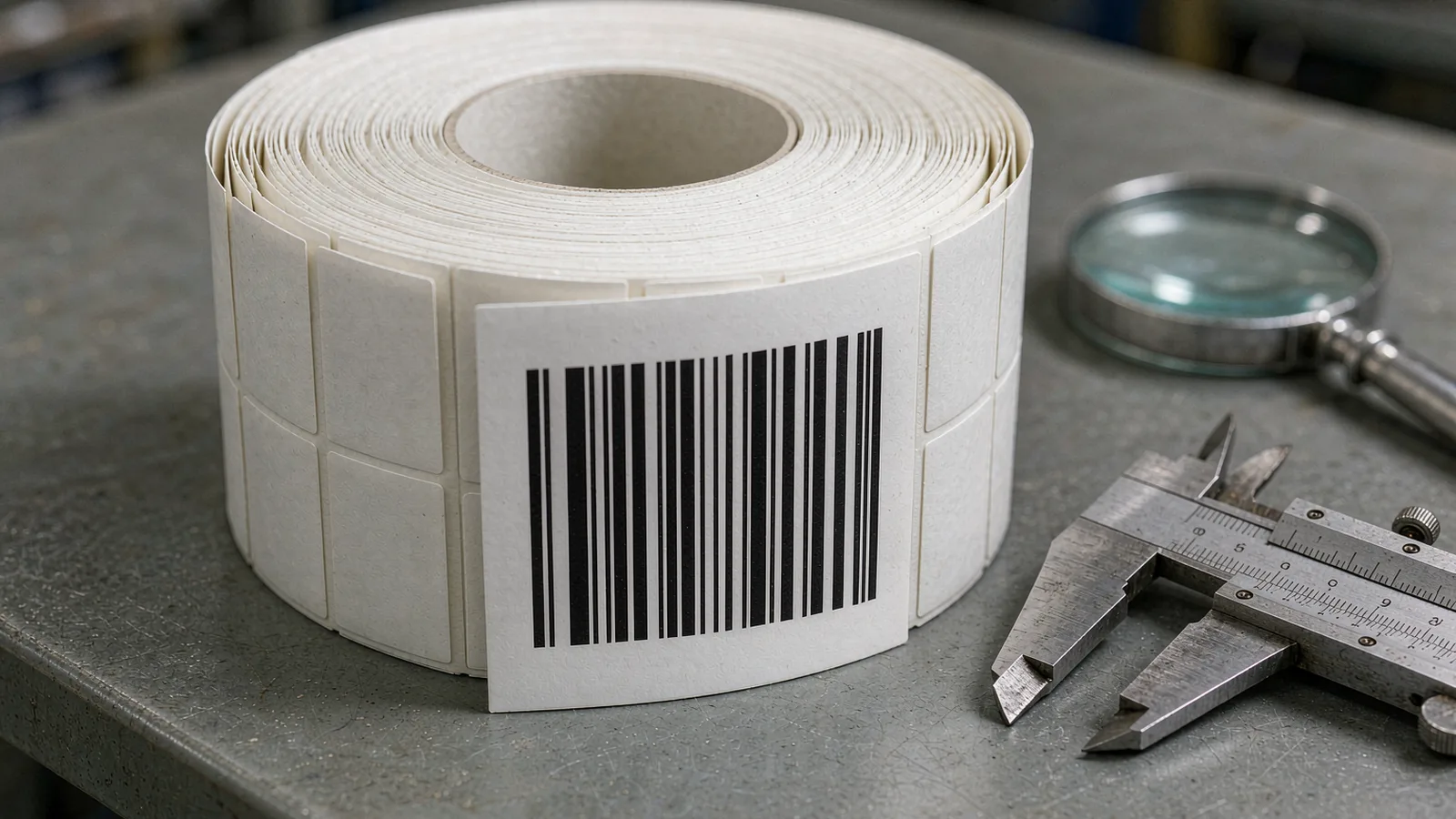
Rollout checks and the specification sheet
First, trial on the real surface at the real temperature. Adhesion measured on a laboratory plate says little about adhesion on an oily steel drum, a frozen shrink-wrapped pallet or a powder-coated enclosure. A twenty-label trial — applied in the actual zone by the actual crew, scanned after 24 hours, one month and one quarter — costs a day and prevents the relabelling programmes that cost a quarter.
Second, pin one specification page per label family: facestock gsm and coating class, adhesive class, liner, die-cut dimensions and tolerance, format (roll or fanfold), core and outer diameter, and the developer system of the thermal chemistry. Destination-market chemical rules on phenols in labels that travel with goods are now routine in customer audits, so compliance documentation ships with the goods as standard practice, not as a request honoured after the fact.
Third, plan replenishment by consumption pattern. WIP and status labels are consumed by production volume; asset and equipment labels by projects and audits — two flows with different stock depths and pack sizes. Plants that separate the flows hold a high-turnover stock for the line and a long-dwell stock for infrastructure, both from the same facestock family so image consistency holds across the site.
Procurement teams standardising several label formats on one supplier can review our custom thermal paper programme, where width, core, roll diameter and developer class are quoted together on a single specification sheet.
- Surface-and-temperature trial: 24 h, 1 month, 1 quarter scans before rollout.
- One specification page per family: facestock, adhesive, liner, die-cut, format, chemistry.
- Compliance paperwork with shipment for destination-market chemical rules.
- Separate replenishment flows: line-consumed labels versus project-driven infrastructure labels.
The specification sheet is only as good as its worst surface trial — everything else is secondary to how the label behaves on the actual drum, pallet or panel.
Frequently asked questions
What are industrial thermal labels?
Identification labels for manufacturing and industrial environments — work-in-progress tags, pallet and container labels, drum and equipment identification, quality-status flags — most commonly produced in direct thermal stock with a 58–65 gsm facestock, and in top-coated constructions wherever abrasion, moisture or long dwell are part of the duty.
Do industrial labels always need a top coat?
Not always, but it is the safe default. Uncoated stock suits short-dwell, dry, gently handled labels such as status flags and short-cycle WIP tags. Any label facing scuffing, oil mist, condensation, stack contact or months of dwell should be top-coated — the coating is a sacrificial layer that extends scan life substantially for a small cost increment.
Which adhesive should be used on drums and shrink-wrap?
High-tack formulations are specified for low-surface-energy surfaces such as polyethylene drums and shrink film, where general-purpose adhesive often peels at the corner after days. Cardboard and rigid plastics bond well with standard permanent adhesive applied above roughly 10 °C, and cold-zone applications need freezer-grade adhesive.
How long do direct thermal industrial labels last?
With a top-coated construction and sensible storage, printed images typically hold for one to three years indoors — enough for asset, calibration and equipment labels on that cycle. Heat, direct sunlight and solvent contact shorten image life, so storage position and chemistry class should be specified alongside the label construction.
Should a plant buy finished labels or convert its own?
High-volume standard formats are usually bought as finished die-cut rolls or fanfold; plants with unusual die-cuts, in-house slitting capacity or very high consumption often buy converter parent rolls and finish them on site. Holding one facestock family either way keeps print quality consistent across bought-in and converted labels.