
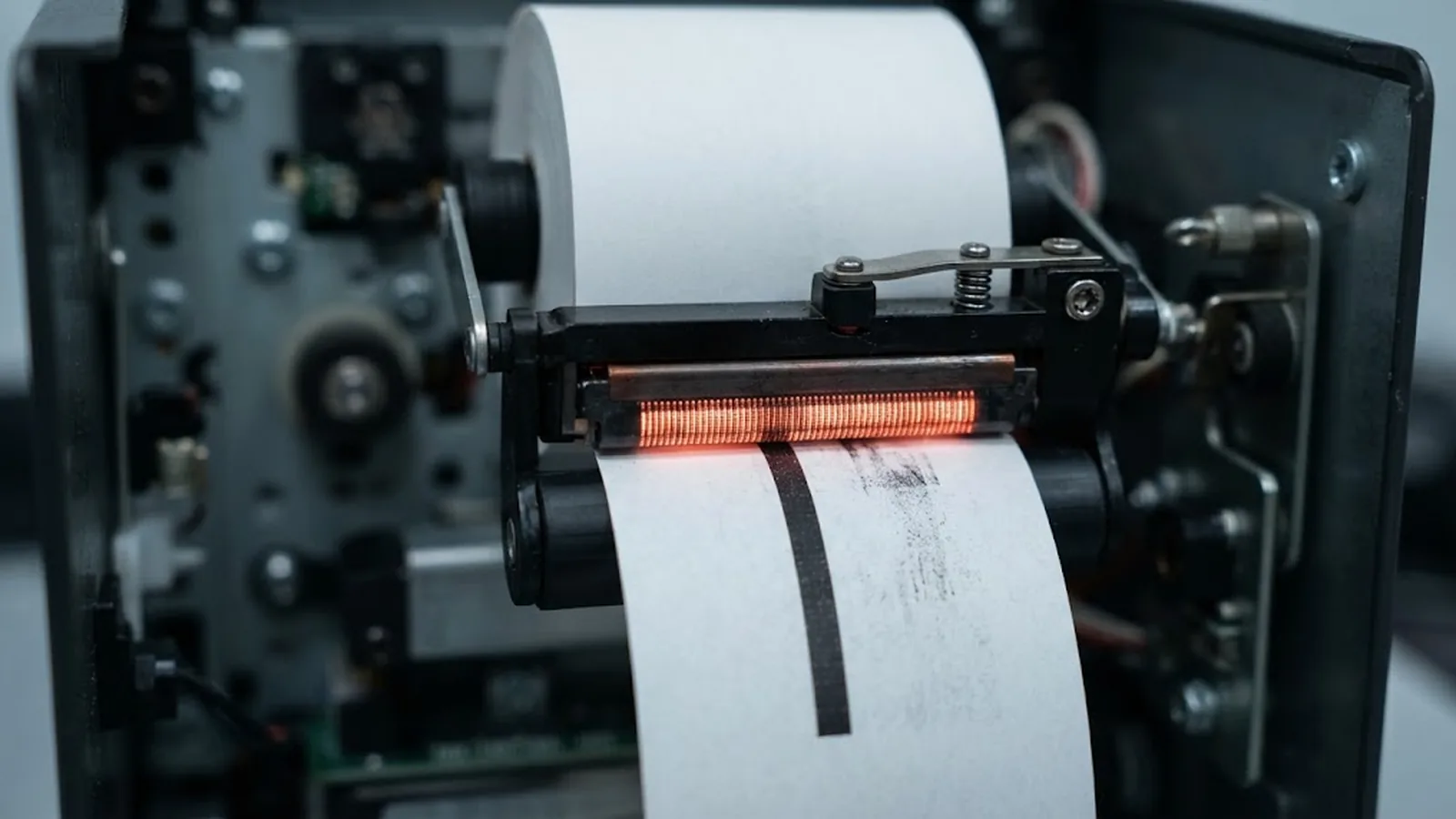
Thermal paper works because its top coating holds two ingredients that are normally inert: a colourless leuco dye and a phenolic developer. When a thermal print head presses heated elements against the paper, the coating at those spots melts and the dye and developer react, forming a dark image in milliseconds. The image is created by chemistry inside the paper itself — no ink, no ribbon, no toner. Everything else about thermal paper performance — darkness, resolution, fade resistance and shelf life — follows from how that coating is formulated and how precisely the print head's heat is applied.
A thermal receipt comes out of the machine already printed: black text, crisp edges, no ink cartridge anywhere in sight. That puzzle is solved entirely inside the paper. Direct thermal paper is an engineered chemical system that stays blank at room temperature and turns dark exactly where heat is applied — which is why it has become the default medium for receipts, tickets, labels and logistics documents worldwide.
The mechanism sounds like a lab trick, and it is one that has been refined over five decades. Getting it to work commercially at thousands of metres per minute, at a stable darkness level, without pre-triggering in storage or in a hot container — that is where coating formulation and converting quality earn their money. For a B2B buyer, understanding the mechanism is not trivia: it explains why grades differ in price, why some rolls scan poorly, and why storage and shipping conditions are written into specifications.
This guide walks through the imaging reaction layer by layer, explains how the print head and paper interact, and translates the chemistry into the practical specification points an export buyer should check when qualifying a thermal paper manufacturer.
- Thermal paper images through a melting-triggered reaction between a colourless leuco dye and a phenolic developer in the coating — no ink or ribbon involved.
- The coating is a multi-layer system: base paper, precoat, thermal layer, and often a topcoat; each layer's quality affects darkness, resolution and durability.
- Print darkness is controlled by the print head's energy profile — voltage, pulse duration and speed — matched to the paper's sensitivity class.
- The same chemistry that reacts to heat can react slowly to heat, humidity and contact chemicals, which is why storage conditions and shelf life are specified so tightly.
- When qualifying suppliers, buyers should ask for sensitivity class, image density at a stated print energy, and activation temperature — the numbers that describe how the paper will actually behave.
The core reaction: dye meets developer
The heart of direct thermal paper is the thermal layer, a thin coating containing three key ingredients. The first is a leuco dye — a colourless molecule that only shows colour in a specific chemical form. The second is a developer, typically a phenolic compound such as bisphenol A (in legacy grades), bisphenol S, or newer phenol-free alternatives. The third is a sensitizer that lowers the melting point of the mixture so the reaction can happen at print-head temperatures rather than requiring extreme heat.
At room temperature the dye and developer sit side by side but separated — dissolved in a solid matrix of waxes and binders that keeps them from touching. Nothing happens, and the paper stays white for years. When a heated element touches the coating, the local temperature rises past the mixture's melting point, typically somewhere between 60 °C and 120 °C depending on the grade. The matrix liquefies, dye and developer meet and react, and within a millisecond the leuco dye converts to its coloured form — black, in most receipt grades, though blue and other colours exist for speciality applications.
As the coating cools, the matrix re-solidifies and locks the coloured form in place. The image is not a pigment sitting on the surface; it is a chemical change distributed through the coating. That is why thermal images cannot be rubbed off like ink, but also why they can be affected by later chemical or heat exposure — the same molecular switch that turned dark can be pushed back or degraded.
The layer stack behind a white sheet
Commercial thermal paper is rarely a single coating. The base sheet is ordinary paper, but its smoothness and moisture content matter because the thermal layer above must be applied in a film only a few micrometres thick. Any fibre or defect in the base telegraphs through the coating and shows up as voids or specks in the printed image.
The precoat sits between base and thermal layer. It smooths the surface, controls how the thermal layer adheres, and insulates the sheet so print-head heat goes into imaging rather than escaping into the paper body. On many grades a topcoat is added over the thermal layer: a thin protective film that resists water, oils, plasticisers and abrasion. Top-coated grades are specified for labels that must survive handling, cold chains or long logistics cycles. Some constructions also add a backcoat on the reverse side to control moisture uptake and curl.
Each layer is applied at the mill's coating line and dried under controlled conditions, and the whole stack is calibrated together. This is why 'thermal paper' is not one product: the same mechanism powers a low-cost 48 gsm receipt grade, a high-sensitivity label stock, and a top-coated ticket paper rated for years of image life. The formulation choices — dye system, developer type, sensitizer loading, coating weight — are what separate the grades on a supplier's datasheet.
| Layer | Function | Buyer-relevant effect |
|---|---|---|
| Base paper | Mechanical carrier; gauge consistency | Roll caliper, stiffness, run-ability |
| Precoat | Smoothing, adhesion, heat insulation | Image sharpness, print-head efficiency |
| Thermal layer | Leuco dye + developer + sensitizer | Sensitivity, density, fade behaviour |
| Topcoat (optional) | Barrier against water, oil, abrasion | Image durability in handling and storage |
| Backcoat (optional) | Moisture and curl control | Flatness in dry or humid climates |
How the print head meets the paper
On the machine side, a thermal print head is a ceramic strip carrying hundreds of tiny resistive heating elements, typically spaced at 8 dots per millimetre. The controller addresses individual elements as the paper feeds past at print speed, applying short electrical pulses. Element temperature, pulse duration and feed speed together define the energy delivered to each dot — and because the paper's response is chemical, that energy budget must match the paper's sensitivity class.
High-sensitivity grades activate at lower energy, which suits fast machines and battery-powered mobile units. Standard grades need more energy but often hold image better in hot environments. If the match is wrong, the symptoms are familiar: faint or grey print when the grade is less sensitive than the machine assumes, and over-developed, muddy print or shortened head life when the energy is pushed too hard. This is why serious buyers specify sensitivity class and required optical density at a stated energy rather than ordering 'black thermal paper' generically.
Contact pressure and head cleanliness matter as much as the electronics. Uneven pressure shows up as light bands down the receipt; dust or coating residue on the head produces missing lines. A consistent, well-slit roll with the correct core and low curl feeds evenly, keeps pressure uniform, and quietly does more for print quality than any setting change.
What the chemistry means for buyers
Because imaging is a chemical state change, the paper's history before printing matters as much as its behaviour during printing. Stored too hot, the dye-developer mixture can develop background fog — a grey cast that kills contrast. Exposed to plasticisers, oils or certain solvents, an imaged area can lighten or lose sharpness. Humidity swings cause curl that misfeeds machines. None of these are defects in the mechanism; they are the mechanism operating as designed under the wrong conditions, which is why manufacturers publish shelf-life figures tied to storage temperature and humidity.
For procurement teams, the practical consequence is to buy against numbers, not adjectives. The specification fields that describe real performance: activation temperature or sensitivity class, image density (typically quoted as optical density at a defined print energy), dynamic sensitivity across the print speed range, and for durability-critical uses, image retention test results for the top-coated grade. A manufacturer with its own coating line can tune and certify these parameters; a trader buying finished jumbo rolls usually cannot.
Finally, the mechanism explains the compliance conversation. Because legacy formulations used phenolic developers, buyers in regulated markets increasingly require phenol-free or explicitly certified grades. The chemistry is the product — so when a supplier can explain what is in the coating and show test documentation, that is usually the signal that the rest of their quality system is equally real.
Ask any prospective supplier the same three questions: what is the sensitivity class, what density do you guarantee at what print energy, and what is the documented shelf life under stated storage conditions.
Frequently asked questions
Does thermal paper need ink or ribbon?
No. Direct thermal paper carries its own imaging chemistry in the coating. Heat from the print head triggers the colour-forming reaction, so there is no ink, ribbon or toner to replace — only the paper itself. This is a key difference from thermal transfer printing, which uses a separate ribbon.
Why is my thermal receipt printing faint or grey?
Faint print usually means an energy-to-paper mismatch — the grade is less sensitive than the machine expects — or degraded paper from heat, age or humidity exposure. Check the roll's storage history and expiry first, then confirm the grade's sensitivity class matches the machine specification. Dirty print heads and uneven pressure also cause light bands.
Is the image on thermal paper permanent?
Thermal images cannot be rubbed off because the colour is a chemical change inside the coating, but they can fade or lighten over time with heat, light and chemical exposure. Standard grades are intended for short-life documents like receipts; top-coated grades with tested image retention are specified for records, labels and documents that must stay readable for years.
What is the difference between standard and high-sensitivity thermal paper?
Sensitivity describes how much heat energy is needed to reach full colour development. High-sensitivity grades activate at lower energy, enabling faster print speeds, lower head wear and better performance in mobile or battery-powered units. Standard grades need more energy and are typically more economical for high-volume receipt printing.
What should I ask a thermal paper manufacturer before ordering?
Ask for the sensitivity class and activation temperature, the guaranteed image density at a stated print energy, the shelf life with its storage conditions, the developer system used (especially if you need phenol-free grades), and whether top coating is available for your application. A manufacturer with in-house coating can document all of these; ask for test reports rather than assurances.