
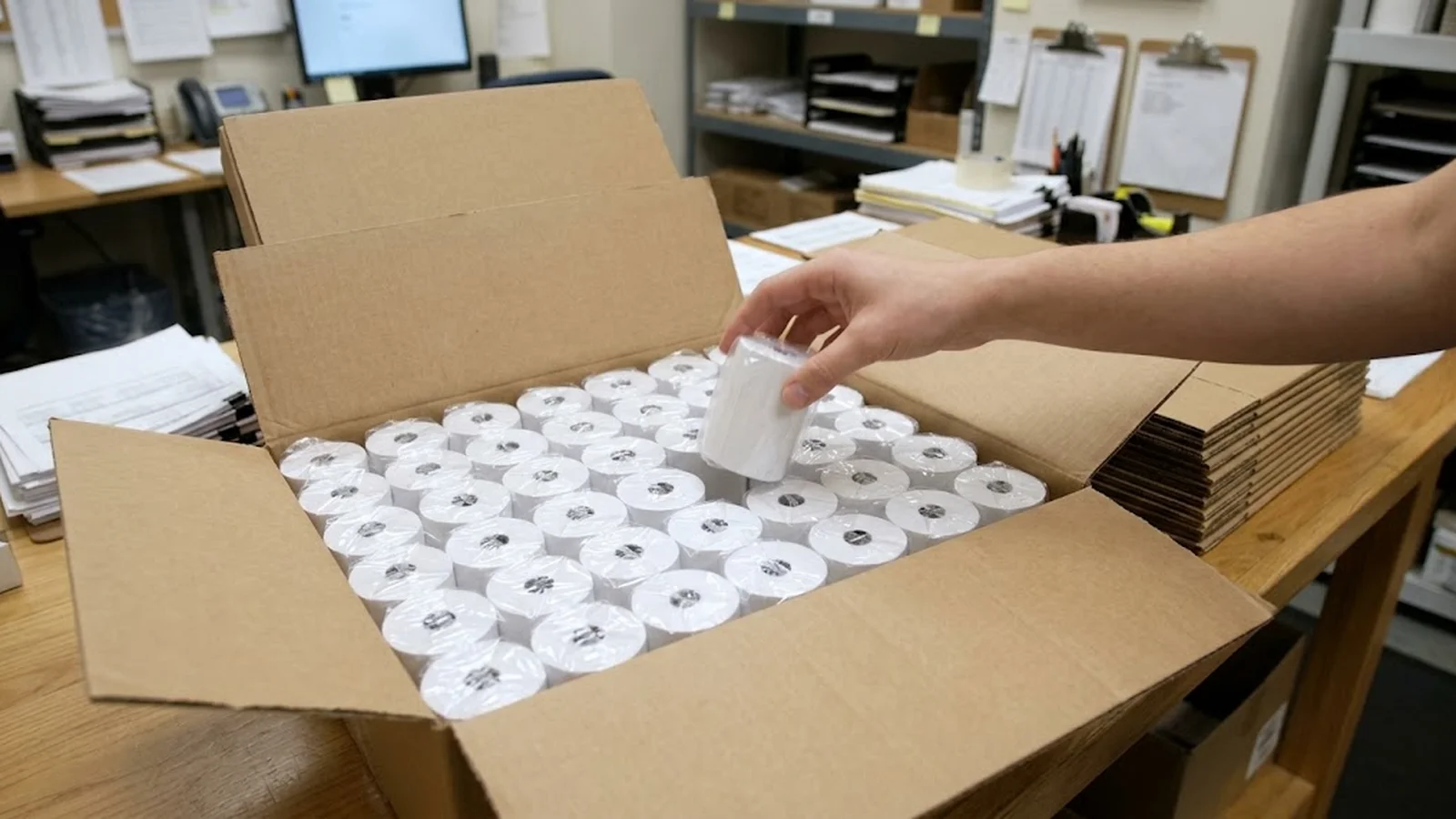
A 3 1/8 x 230 thermal paper roll is the standard North American counter-receipt roll: 3-1/8 inches (79.4 mm) wide and 230 feet (about 70 m) long. The label reads width by length — not width by diameter — so a 3 1/8 x 230 roll holds slightly more paper than a metric 80 x 80 roll (60–64 m) at a similar outer diameter near 66 mm. It fits any 80 mm-class receipt terminal, yields roughly 230–350 receipts depending on receipt design, and typically ships 50 rolls per carton. When buying, convert every quotation to metres per roll and confirm core size (12.7 mm standard), winding direction and BPA-free certification before comparing prices.
Walk into any North American retail back office and the consumables shelf says the same thing: 3 1/8 x 230. It is the default receipt roll of the United States and Canada — the size quoted by office-supply chains, cash-and-carry wholesalers and every offshore manufacturer's export price list. Yet the label itself causes steady confusion among buyers converting between imperial and metric conventions, and between length-coded and diameter-coded cartons.
The confusion is worth settling, because the 3 1/8 x 230 format sits at the centre of three overlapping descriptions: imperial length codes (3-1/8 x 230), metric diameter codes (80 x 80, 80 x 70), and equivalent-yield claims that do not always match. A buyer who can translate between them compares quotations on facts instead of labels — and usually finds several percent of cost hiding in the translation.
This guide decodes the 3 1/8 x 230 label number by number, converts it into metric equivalents, works through the yield maths per roll and per case, lists the terminals it fits, and finishes with the specification checklist that keeps replenishment orders arriving exactly as expected.
Buyers comparing these specifications can review our custom thermal paper programme, where basis weight, coating construction and packing are documented per grade before an order is placed.
- 3 1/8 x 230 reads width x length: 3-1/8 inches (79.4 mm) wide, 230 feet (≈ 70 m) of paper per roll.
- It is the North American twin of the metric 80 mm receipt class — nearest diameter-code equivalent ≈ 80 mm width at 66 mm OD.
- Yield: roughly 230–350 receipts per roll at typical retail receipt lengths of 200–300 mm.
- Standard packing is 50 rolls per carton (10 x 5), individually wrapped in moisture-barrier film on 12.7 mm (1/2 inch) cores.
- Compare offers in metres per roll and price per metre; confirm winding direction and grade (BPA-free or phenol-free) on the purchase order.
Reading the label: width by length, not width by diameter
The imperial receipt-roll convention writes width first and paper length second, with length in feet. So 3 1/8 x 230 means a roll 3-1/8 inches wide holding 230 feet of paper. Three and one-eighth inches converts to 79.4 mm — which is why the same physical roll in a metric market is labelled as an 80 mm-class receipt roll. The width tolerance runs +0/-0.5 mm, so 79.4–80 mm paper feeds identically in any 80 mm-class terminal.
The second number is where buyers trip. Metric-coded rolls (80 x 80, 80 x 70) state width x outer diameter, while imperial-coded rolls state width x length. A '230' is feet of paper, not millimetres of anything. Because paper length grows with the square of the diameter, a fixed length of 230 feet corresponds to an outer diameter of roughly 66 mm on a 12.7 mm core with typical 55 gsm paper — smaller than an 80 x 80 roll's 80 mm OD, yet holding more paper.
That asymmetry is the single most useful fact in cross-convention buying: 3 1/8 x 230 (≈ 70 m) holds more paper than 80 x 80 (≈ 60–64 m) even though its roll looks slimmer on the shelf. Comparing cartons by outer diameter alone — or by price per roll alone — systematically misprices one side of the comparison.
- 3 1/8 inch = 79.4 mm usable width (sold interchangeably with 80 mm-class rolls).
- 230 ft = 70.1 m of paper per roll.
- Equivalent OD on a 12.7 mm core at 55 gsm: ≈ 66 mm.
- Metric twins: 80 x 65 to 80 x 70 class; more paper than an 80 x 80 despite smaller OD.
| Label | Notation | Width | Paper length | Equivalent OD | Relative yield |
|---|---|---|---|---|---|
| 3-1/8 x 230 | width x length (ft) | 79.4 mm | ≈ 70 m | ≈ 66 mm | 1.00 (baseline) |
| 80 x 80 | width x diameter | 80 mm | ≈ 60–64 m | 80 mm | ≈ 0.86–0.91 |
| 80 x 70 | width x diameter | 80 mm | ≈ 45–48 m | 70 mm | ≈ 0.64–0.69 |
| 80 x 65 | width x diameter | 80 mm | ≈ 38–40 m | 65 mm | ≈ 0.54–0.57 |
| 3-1/8 x 273 | width x length (ft) | 79.4 mm | ≈ 83 m | ≈ 71 mm | ≈ 1.19 |
Yields assume 0.078 mm caliper (55–58 gsm grade including coating); heavier grades shorten length at the same OD.
How many receipts and how many rolls per case
Paper yield converts to receipt count through receipt length. A typical retail receipt prints 200–300 mm including logos, line items, totals and footer promotions; quick-service restaurant and cafe receipts cluster at the short end, grocery and big-box receipts at the long end. At 70 m per roll, that is roughly 230–350 receipts per roll — call it 280–300 for planning. A busy single-lane counter printing 150 receipts a day consumes a roll every second day; the 50-roll carton then covers one lane for about three months.
Case packing is equally standardised: 50 rolls per master carton, arranged 10 x 5, each roll individually sleeved in moisture-barrier film. Sleeve wrapping matters more than buyers assume — thermal coating absorbs moisture and image density degrades when rolls are shipped loose. Carton dimensions for 50 x 3-1/8 x 230 sit near 420 x 420 x 190 mm and about 13–15 kg gross, so a standard export pallet carries 48–60 cartons depending on stacking pattern and height limit.
For procurement maths, three numbers make any quotation comparable: metres per roll (70 for this format), rolls per carton (50 standard), and price per metre (price per roll divided by 70). Anything quoted without a verifiable length — or with an unusual core size inflating the OD claim — should be re-quoted against those three numbers.
Where a programme needs several formats from one supplier, our POS and receipt paper rolls covers width, core, roll diameter and developer class in a single specification sheet.
- Yield: ≈ 230–350 receipts per roll (200–300 mm receipt length).
- Planning figure: 280–300 receipts per roll for mixed retail.
- Case: 50 rolls (10 x 5), each sleeved; ≈ 420 x 420 x 190 mm, 13–15 kg gross.
- Pallet: 48–60 cartons depending on stack height and pattern.
Which terminals take 3 1/8 x 230
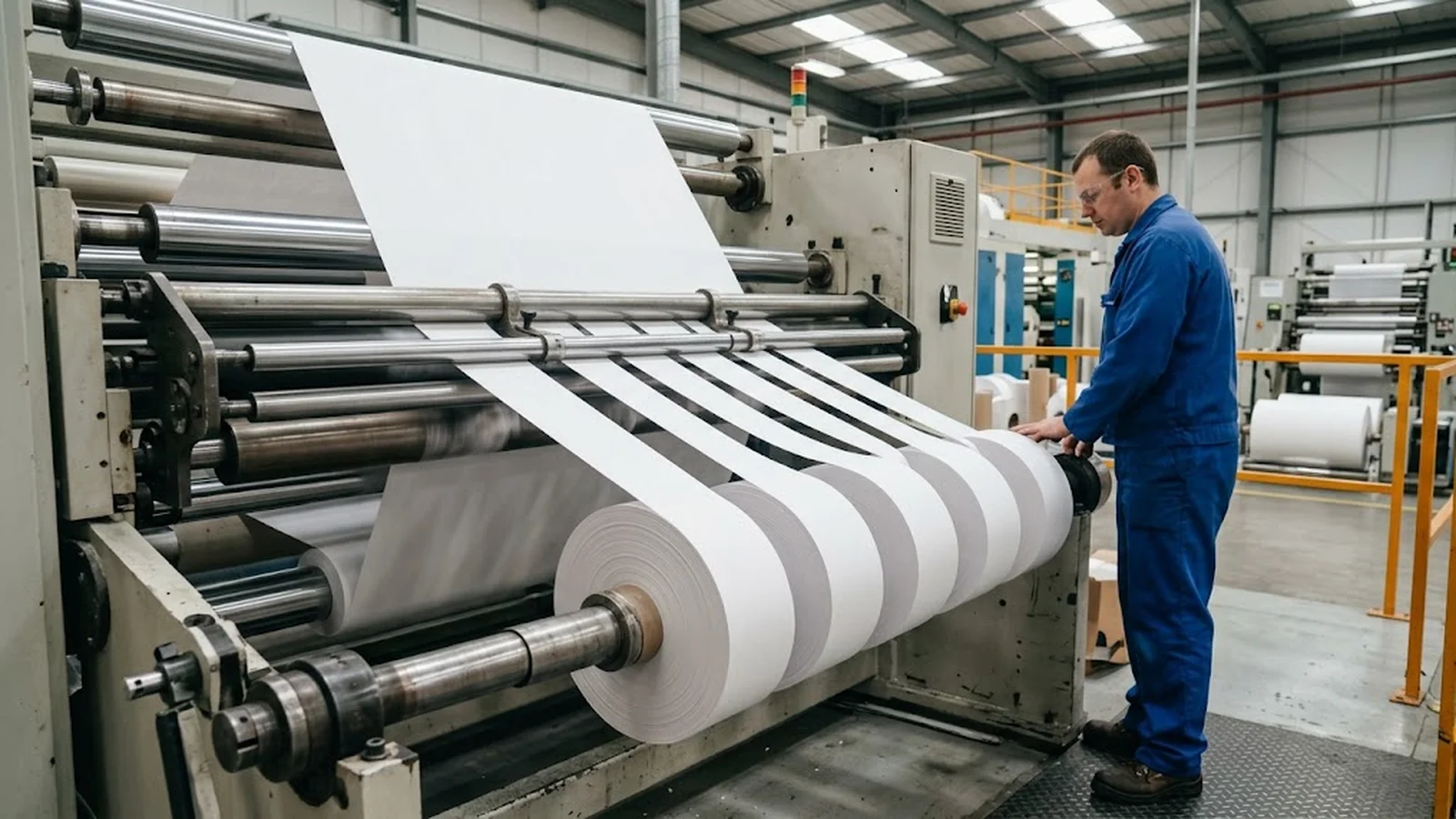
Any 80 mm-class receipt device accepts the format: Epson TM-T88 and TM-T20 series, Star TSP100 and TSP143, Bixolon SRP-330/350, and the generic 80 mm mechanisms used across North American ECR and hospitality terminals. The two things to verify are compartment clearance — the ≈ 66 mm outer diameter clears every standard 80 mm compartment with room to spare — and winding direction. North American market stock is overwhelmingly wound paper-out, but converters can slit paper-in for the minority of mechanisms that thread from inside; ordering against the device list avoids the one-in-fifty mismatch that generates returns.
The format is deliberately over-provisioned for card terminals: handheld and countertop card readers use the 2-1/4 inch (57 mm) class, not 3-1/8. When a fleet mixes counter printers with card readers, buyers typically hold two SKUs — 3 1/8 x 230 for counters and 2-1/4 x 50 or x 85 for handhelds — rather than forcing one width to serve both, because under-width paper slips and over-width paper jams.
One adjacent format causes recurring mis-orders: 3-1/8 x 273 (83 m), the longer sibling used where stores want fewer changeouts. It fits the same terminals if compartment height allows ≈ 71 mm OD; many standard compartments do not. Confirm the height limit before upsizing, and treat the two formats as separate SKUs despite the shared width.
| Device family | Width class | 3 1/8 x 230 fit | Watch item |
|---|---|---|---|
| Epson TM-T88 / TM-T20 | 80 mm | Yes | Paper-out winding default |
| Star TSP100 / TSP143 | 80 mm | Yes | Guillotine clearance at max OD |
| Bixolon SRP-330 / 350 | 80 mm | Yes | Core grip on 12.7 mm spindles |
| Generic 80 mm ECR | 80 mm | Yes | Check compartment height > 68 mm |
| Card terminals (2-1/4 class) | 57 mm | No | Use 2-1/4 x 50 / x 85 instead |
| 3-1/8 x 273 upsize | 80 mm | Only if OD 71 mm clears | Confirm height before switching |
Winding direction is the specification line most often missed on replenishment POs — state it once per device list and keep it on file.
Buying checks: what to confirm before the PO
First, grade. North American receipts are effectively expected to be BPA-free; most large retailers now specify phenol-free (BPS-free) as well. Ask for the developer system in writing and, for retail chains, the relevant compliance documentation with the shipment — it is standard export practice for manufacturers to supply test reports against the destination-market requirements.
Second, the physical specification. Confirm width 79.4–80 mm, length 230 ft (70 m) actual — not 'approximate' — core 12.7 mm, winding direction, and sleeve-wrapped packing. Reputable converters measure length at slitting and print it on the carton; a sample roll can be verified in minutes with a length counter or by weighing against a known-good roll of the same grade.
Third, the commercial frame. Compare offers per metre (price per roll ÷ 70 m), agree the case configuration (50 rolls, 10 x 5), and align carton marking with your barcode and labelling requirements before production. Buyers who anchor on these checks typically find that genuine 3 1/8 x 230 stock from a manufacturer with its own slitting line undercuts retail-channel pricing by a wide margin — precisely because the specification, once written down, removes the sampling rounds and mismatch returns that inflate landed cost.
Where container planning is the next step, our export shipping guide covers pallet standards, moisture-barrier packing and the document set for ocean freight.
- Grade: BPA-free baseline; phenol-free where retailer policy requires; request compliance docs with shipment.
- Spec lines: width, actual length, core, winding, sleeve packing — all on the PO.
- Verification: length counter or weigh-back against a known roll.
- Commercial: price per metre, 50-roll case, carton marking agreed pre-production.
A complete five-line specification (width, length, core, winding, grade) is the difference between a first-pass quotation and three weeks of samples.
Frequently asked questions
What does 3 1/8 x 230 mean on a receipt roll?
Width by length: the roll is 3-1/8 inches (79.4 mm) wide and holds 230 feet (about 70 m) of paper. It is not a diameter measurement — the outer diameter of a 3 1/8 x 230 roll is roughly 66 mm on a 12.7 mm core with typical 55 gsm paper.
Is 3 1/8 x 230 the same as 80 x 80?
Same width class (80 mm), different yield. A 3 1/8 x 230 roll holds about 70 m of paper; an 80 x 80 roll holds about 60–64 m despite its larger 80 mm outer diameter. In paper terms the imperial-coded roll is the bigger one — compare metres per roll, not carton appearance.
How many receipts does a 3 1/8 x 230 roll print?
Roughly 230–350 receipts, depending on receipt length. At a typical 200–300 mm per receipt and 70 m of paper, plan on about 280–300 receipts per roll for mixed retail use.
How many rolls come in a case of 3 1/8 x 230?
The standard export case is 50 rolls arranged 10 x 5, each roll individually sleeved in moisture-barrier film. A carton measures roughly 420 x 420 x 190 mm and weighs 13–15 kg gross, and a standard pallet carries 48–60 cartons.
Will 3 1/8 x 230 fit my terminal?
If the terminal is an 80 mm-class receipt device (Epson TM series, Star TSP series, Bixolon SRP series and generic 80 mm mechanisms), yes — the 66 mm outer diameter clears standard compartments. Card terminals need the 57 mm (2-1/4 inch) class instead. Always confirm winding direction and, if upsizing to 3-1/8 x 273, the compartment height limit.