
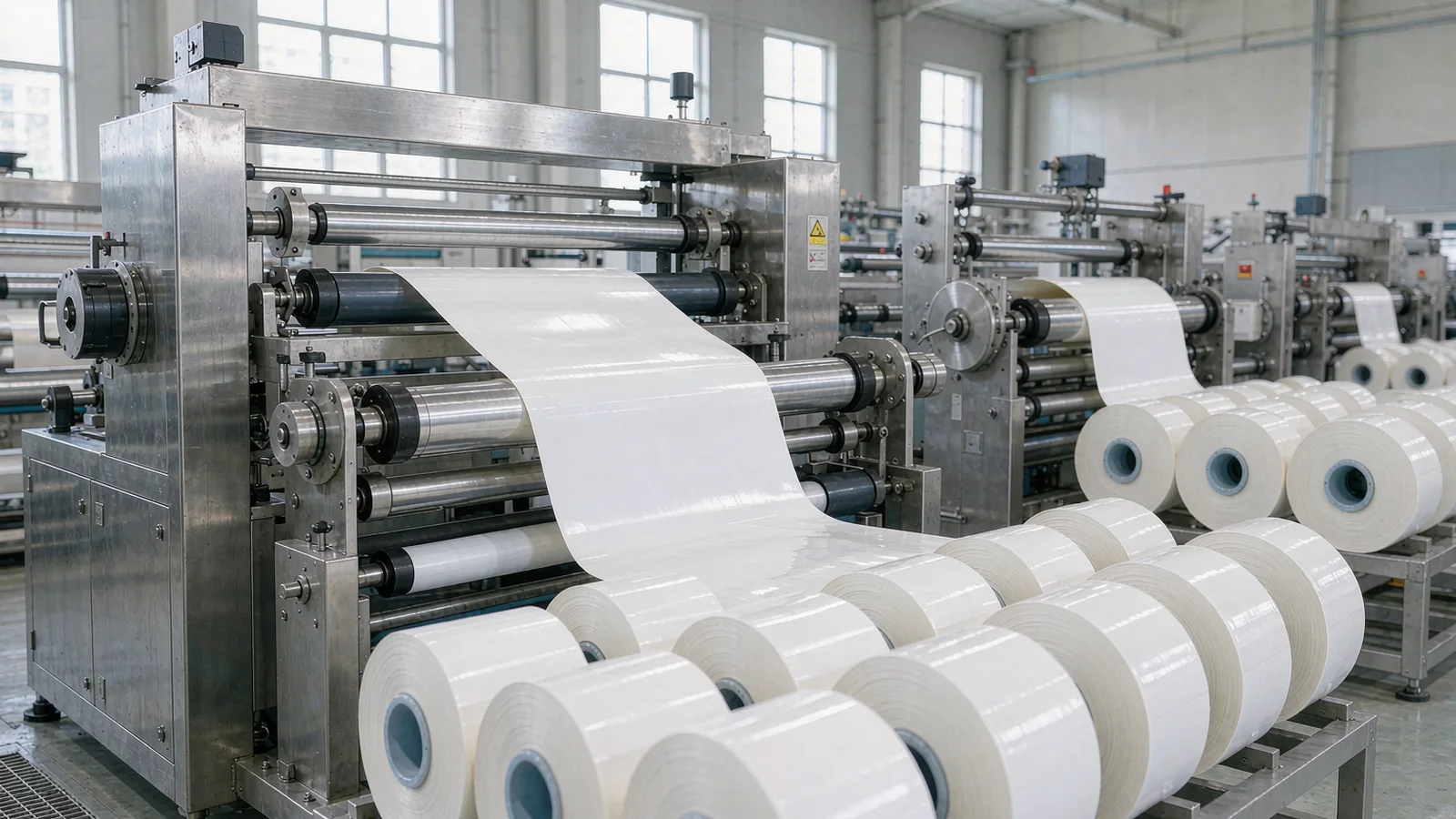
A 4 x 6 direct thermal label is the de facto parcel and freight label format: 4 inches (101.6 mm) wide by 6 inches (152.4 mm) long, functionally interchangeable with the 100 x 150 mm metric label used in the same market. The size won because it fits the 4-inch media class of direct thermal label mechanisms, carries routing barcodes, address blocks and 2D codes on a single label, and scans reliably at conveyor speeds. Stock is bought either as rolls — typically on 1 inch or 3 inch cores with 4 to 6 inch outer diameters — or as fanfold packs, and is specified on facestock (top-coated or uncoated), adhesive class and liner. Buyers should compare offers on labels per roll, actual construction lines and adhesive match, never on carton price alone.
Every parcel moving through a modern carrier network carries exactly one label, and almost everywhere in the world that label is 4 x 6. The format is so dominant that buyers, converters and warehouse planners treat it as furniture — until a replenishment order arrives with the wrong core, an adhesive that lifts off recycled corrugate, or rolls whose label count is half of what the carton promised. The format's very standardness hides how much specification work sits behind it.
It helps to think of 4 x 6 as a format class rather than a single SKU. Within the same four-by-six footprint sit roll and fanfeed variants, two core standards, a range of outer diameters that swing labels-per-roll by a factor of two, and a facestock-versus-adhesive decision matrix that changes with every destination climate and carton type. Two quotations for identical-looking 4 x 6 stock can differ by thirty percent in real delivered value.
This guide works through the format class in procurement order: why 4 x 6 became the standard and what its metric twin is, the roll and fanfold variants with their core and outer diameter options, facestock and adhesive selection for parcel environments, the hardware context that constrains the choice, and the specification discipline plus common mistakes that separate a clean programme from a returns-generating one. For production volumes, the same construction logic applies to our thermal paper jumbo rolls, quoted per jumbo roll, slit reel or finished format.
- 4 x 6 inches (101.6 x 152.4 mm) is the parcel and freight standard; 100 x 150 mm metric stock is functionally interchangeable within media tolerance.
- Buy as rolls on 1 inch or 3 inch cores with 4-6 inch outer diameters, or as fanfold packs; roll feeding dominates automated lines, fanfold suits batch benches.
- Facestock choice — top-coated versus uncoated — decides scan life through abrasion, moisture and sunlight on the parcel journey.
- Adhesive class matters more than paper weight: recycled corrugate, cold rooms and rough kraft each need a matched adhesive.
- Compare offers on labels per roll and written construction lines, never on carton price alone.
Why 4 x 6 became the parcel standard
The format was locked in by carrier operations. As carriers consolidated routing, service level and tracking onto a single barcode label, the label grew from a small address sticker into a full data sheet: routing barcode, postal barcode, address block, weight and service icons, and eventually a large 2D code holding the entire manifest. Four inches of width accommodates the 2D code and address side by side; six inches of length fits the full data stack plus quiet zones. Print width in the 4-inch class also matches the standard desktop and industrial label mechanisms that warehouses had already standardised on, so media was available everywhere before the format was formally 'chosen'.
The metric world runs in parallel. 100 x 150 mm labels occupy the same slot as 4 x 6 — the difference is 1.6 mm in width and 2.4 mm in length, well inside the media window of any 4-inch-class mechanism. Converters therefore treat 4 x 6 and 100 x 150 as one format class with two naming conventions, and buyers should too: what matters on the purchase order is the actual width in millimetres (100 or 101.6) and the tolerance, typically +0/-1 mm, not the inches on the box.
The deeper reason the format holds is scan economics. A single large label prints once, scans many times, and survives a journey of sorting machines, trailers and doorsteps. Everything about 4 x 6 stock procurement — facestock durability, adhesive bond, image density — exists to protect that one scan-able surface.
- 4 x 6 in = 101.6 x 152.4 mm; 100 x 150 mm is the metric twin inside the same media window.
- Width locked by 2D code plus address layout; length by the full routing data stack.
- One label per parcel: image durability and adhesive bond carry the whole journey.
- Standard width class means global media availability and interchangeable winding conventions.
Format variants: roll, core, outer diameter and fanfold
Rolls are the dominant supply form. Three variables define a 4 x 6 roll SKU: core size (25.4 mm / 1 inch standard, 76.2 mm / 3 inch for industrial unwind stands), outer diameter (typically 4 to 6 inches), and winding direction — labels-out is the near-universal convention for 4-inch-class media. Outer diameter is the yield variable: because paper winds in rings, going from a 4 inch to a 6 inch OD roughly doubles the labels on the same core. Converters quote labels per roll based on total liner-plus-face caliper, so the same OD converts to different counts at different facestock weights.
Fanfold is the batch alternative: labels stacked in a zig-zag accordion, packed flat in boxes, fed from an external tray rather than a spindle. It eliminates the unwind hardware, suits back-office batch printing, and can be cheaper per label at low volumes. What it gives up is automation — print-and-apply applicators and high-speed packaging lines feed from rolls, and trying to run fanfold through roll-fed hardware is a classic warehouse mismatch.
| Configuration | Core | Outer diameter | Approx. labels per roll | Typical use |
|---|---|---|---|---|
| Roll, 1 inch core, 4 inch OD | 25.4 mm | 102 mm | ≈ 450 | Compact desktop dispensers |
| Roll, 1 inch core, 5 inch OD | 25.4 mm | 127 mm | ≈ 650 | Mid-volume packing benches |
| Roll, 1 inch core, 6 inch OD | 25.4 mm | 152 mm | ≈ 900 | Automated applicators, fewer changeovers |
| Roll, 3 inch core, 6 inch OD | 76.2 mm | 152 mm | ≈ 700 | Industrial lines with 3 inch unwind |
| Fanfold pack | none | n/a | 500 per pack | Batch benches without roll hardware |
Labels-per-roll figures assume roughly 0.11-0.13 mm total caliper; verify counts against the converter's per-roll figure, which is measured at slitting, not estimated.
Facestock and adhesive selection for parcel environments
Facestock is the image-life decision. Uncoated direct thermal facestock prints densely and costs less, but its surface is exposed: abrasion from sorting belts, condensation at loading docks and sunlight in trailer yards all erode scan contrast. Top-coated facestock adds a protective overlayer that resists abrasion, moisture and UV, and it is the default wherever labels must stay scannable for the parcel's full journey — cross-border freight, outdoor handover points, long-haul ground networks. The trade is unit cost: top-coated stock typically prices 10-20 percent above uncoated, which is cheap insurance on labels carrying revenue.
Adhesive decides whether the label stays on the box. A general-purpose permanent acrylic bonds well to clean corrugate at room temperature, but three parcel environments break it: recycled corrugate with low surface energy and loose fibres, cold-chain and winter loading docks below 5 °C, and rough kraft or poly-bagged surfaces. Each needs a matched class — high-tack aggressive acrylics for recycled and rough substrates, low-temperature formulations rated for freezer and winter conditions. Specifying 'general purpose' as a catch-all is the most common silent failure in label programmes.
Liner and die-cut quality complete the construction. Paper liners in the 50-60 gsm range are standard; the die-cut gap must be consistent enough for the mechanism's gap sensor to register every label. Off-spec gap tolerance shows up as misfeeds and double-feeds that buyers misdiagnose as hardware faults.
- Top-coated facestock for scan life through abrasion, moisture and UV; uncoated for short, indoor journeys.
- High-tack adhesive for recycled corrugate and rough kraft; low-temperature class below 5 °C.
- Consistent die-cut gap (typically 3-4 mm) is what the gap sensor actually reads.
- Verify winding direction — labels-out — once per programme and keep it on file.

Hardware context: what runs 4 x 6 stock
4 x 6 media belongs to the 4-inch media class of direct thermal label mechanisms — desktop units in back offices and packing benches, industrial units on production lines, and print-and-apply applicators integrated into packaging machines. None of the buyer's decisions happen in a vacuum: the mechanism's media window defines what stock will actually run. The numbers to check are maximum outer diameter (desktop units commonly clear 5 inches, industrial units 6 to 8 inches), core spindle size (1 inch standard, 3 inch on industrial unwind), media width range (a 101.6 mm label with liner fits comfortably), and sensing method.
Sensing is the quiet constraint. Gap sensing between die-cut labels is the default; some continuous-liner or black-mark setups exist but are niche in this format class. Roll stock must be wound labels-out with the gap registered on the correct side for the mechanism's sensor position. Applicator-fed lines add a further demand — consistent roll geometry and a firm core, because a soft core or oval roll from poor winding shows up as feed skew at speed. Fanfold, conversely, needs an external stack feed path, which most desktop units lack.
The practical discipline is to write the mechanism list into the label programme: which units, which media window, which sensing. Media specs are stable hardware facts, and converters can match roll geometry to them precisely when they are stated — the mismatches that generate returns are almost always between an unstated hardware constraint and an assumed one.
- Check: max OD, core spindle, media width window, sensing method (gap standard).
- Winding labels-out with the gap on the sensor side; state it once per fleet.
- Applicators need consistent roll geometry and firm cores at speed.
- Fanfold needs external stack feed — not interchangeable with roll-fed lines.
Specification discipline and common procurement mistakes
Most 4 x 6 procurement failures trace to a handful of recurring mistakes. Buying on carton price is the first: labels per roll varies with caliper and OD, so two cartons of rolls can differ by twenty percent in delivered labels while looking identical. Not specifying adhesive is the second — the stock prints beautifully and fails on the box. Omitting the coating class is the third: uncoated stock supplied where the journey demanded top-coated is a scan-failure complaint weeks later that no one traces to the purchase order. Wrong core for the unwind stand, unwritten winding direction, and unverified die-cut gap round out the list.
The fix is a five-line specification written before quotation: label size and tolerance, facestock and coating class, adhesive class with the substrate named, liner and core plus outer diameter, and packing format. With that sheet, quotations become comparable line by line, and samples can be validated on the actual line rather than guessed in a lab. Where a programme needs several formats from one supplier, our top-coated thermal label stock covers width, core, roll diameter and developer class in a single specification sheet.
- Compare offers on labels per roll (verified), not rolls per carton.
- Name the substrate in the adhesive line: recycled corrugate, kraft, poly-bag, cold room.
- State coating class explicitly — uncoated or top-coated — with the journey in mind.
- Core, OD and winding on the PO; verify die-cut gap on a sample roll.
A five-line specification converts label buying from price-per-carton guessing into line-by-line comparison — it is the difference between first-pass supply and a season of returns.
Putting together the 4 x 6 buying specification
Assembled, a complete 4 x 6 programme sheet reads: 101.6 x 152.4 mm (or 100 x 150), die-cut on 50-60 gsm paper liner, top-coated direct thermal facestock, high-tack permanent adhesive rated for recycled corrugate, labels-out winding on 25.4 mm cores at 6 inch OD, verified labels per roll, carton-packed against moisture. Sample rolls validate density, gap sensing and adhesive bond on the real line before volume orders release. Every one of those lines is checkable, which is precisely the point — the format's standardness is only an advantage when the specification behind it is written down.
Parcel operations rarely stop at labels. Packing slips, lightweight documentation rolls and receipt stock for the same despatch benches usually come from the same budget line, and matching constructions across those formats from one qualified source simplifies both auditing and replenishment. Requests that combine several formats can be quoted together; see 48 gsm lightweight thermal paper for the construction options behind each one.
Where image life is the deciding factor, our top-coated vs non top-coated guide compares the two constructions on retention, cost and machine behaviour.
Frequently asked questions
What size is a 4 x 6 label in millimetres?
Exactly 101.6 x 152.4 mm. The 100 x 150 mm metric label is the functional equivalent — the difference is 1.6 mm in width and 2.4 mm in length, inside the media window of any 4-inch-class label mechanism, so converters supply both under the same format class.
How many 4 x 6 labels are on a roll?
It depends on outer diameter and total caliper. On a 1 inch core, a 4 inch OD roll holds roughly 450 labels, a 5 inch OD about 650 and a 6 inch OD about 900. Because counts vary with facestock weight and liner, buy on the converter's verified per-roll count rather than catalogue estimates.
Should I buy 4 x 6 labels as rolls or fanfold?
Rolls for anything automated or high-volume: applicators, packaging lines and continuous bench printing feed from spindles and need consistent roll geometry. Fanfold suits low-volume batch printing where the hardware feeds from an external tray — and it removes roll storage from the shelf. The two are not interchangeable on the same equipment.
What facestock should I choose for parcel labels?
Top-coated wherever labels must stay scannable through the whole journey — abrasion, dock moisture and trailer-yard sunlight all erode uncoated image density. Uncoated is defensible for short indoor journeys where unit cost dominates. The decision belongs on the specification sheet, not with the operator.
Why do my labels peel off recycled cartons?
Adhesive class mismatch, almost always. Recycled corrugate has lower surface energy and loose fibres, so general-purpose acrylic can lift at the edges in transit. Specify a high-tack aggressive acrylic rated for recycled substrates, and validate with a bond test on your actual boxes before the volume order.