
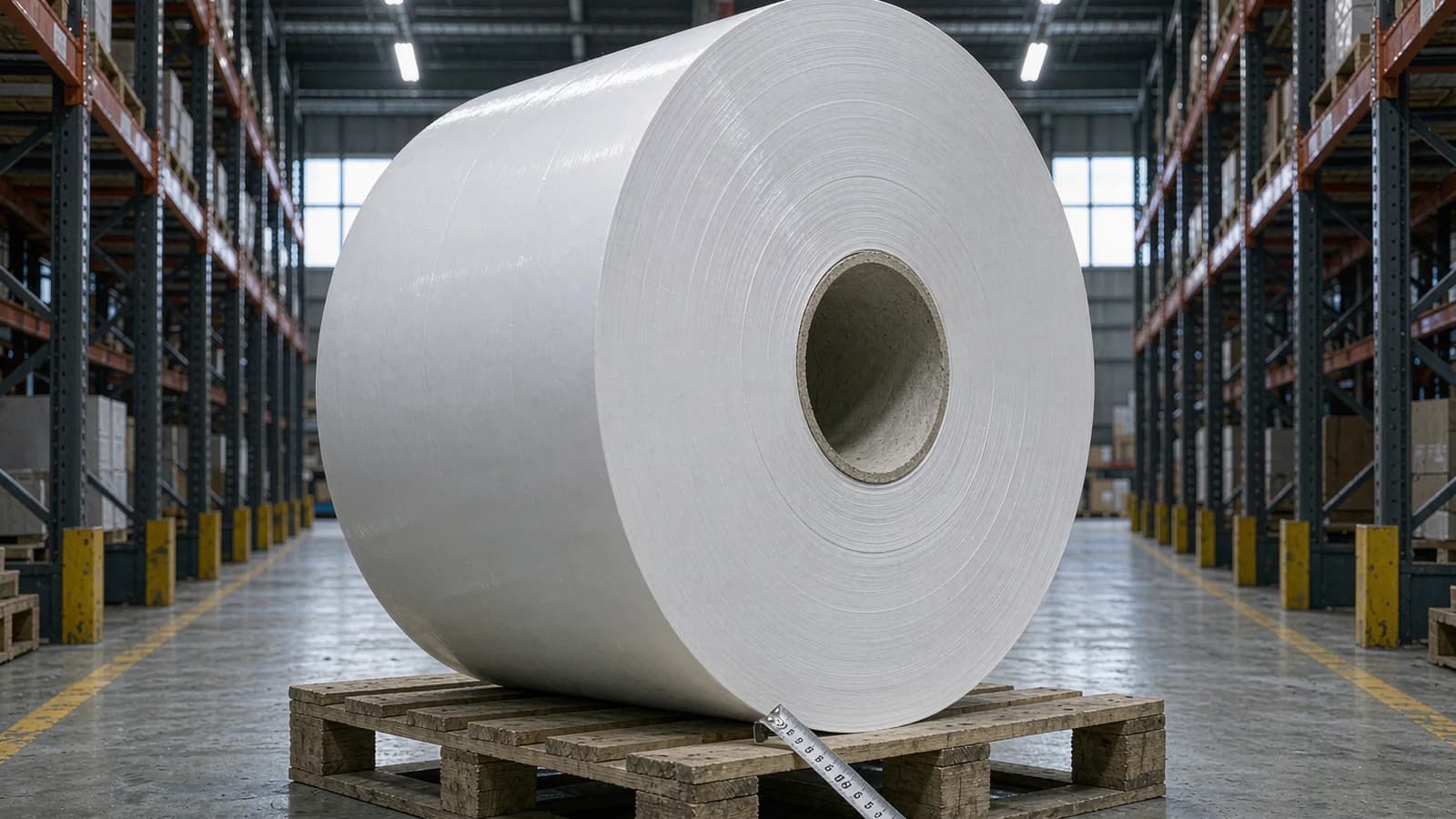
A thermal jumbo roll specified at 6000 m is a length commitment, and length is never free-floating: at a given gsm it fixes the roll's diameter, weight and pallet plan together. In 55 gsm paper, 6000 m on an 800 mm-wide web is roughly 264 kg of paper and unwinds to a diameter around 1,150 mm; in 48 gsm the same 6000 m comes in lighter and smaller. Converters favour the 6000 m parent because it balances two pressures — fewer changeovers per tonne than 4,000 m rolls, without exceeding the unwind stands and warehouse racking that 10,000–12,000 m parents demand. Ordering one is a five-line exercise: gsm with tolerance, width, core, OD or length, and joint policy — and verifying it takes one floor scale, because weight × 1,000 ÷ (width × gsm) returns the metres.
Jumbo roll conversations are usually about width — 405 to 875 mm families, slit plans, edge trim. But length is the other half of the parent-roll contract, and it is where converter economics are actually decided: metres per jumbo set how many finished rolls a container yields, how often the slitter stops for a changeover, and how much warehouse cube each tonne of paper occupies.
The 6000-metre parent sits at the reference point of that decision. Shorter jumbos — 4,000 to 5,000 m — suit houses with smaller unwind stands or many short runs, but they multiply changeovers and splice-risk exposure per tonne. Longer parents — 10,000 to 12,000 m — amortise changeovers almost entirely, but their diameter and weight push against unwind capacity, racking heights and manual handling limits. 6000 m is the compromise the industry keeps returning to: a full tonne-class parent that ordinary converting equipment still handles.
For production volumes, the same construction logic applies to our thermal paper jumbo rolls, quoted per jumbo roll, slit reel or finished format.
This guide works the length dimension properly: how metres, diameter, gsm and weight interlock, what 6000 m yields under real slit plans, why the same 6000 m order weighs differently in 48 and 65 gsm paper, and the goods-in audit that verifies declared length with a scale and a calculator.
- Length, diameter, gsm and weight form one interlocked system — a 6000 m order is meaningful only alongside its gsm and width.
- 6000 m is the industry's balance point: fewer changeovers than 4,000 m parents, without the unwind and racking demands of 12,000 m ones.
- At 800 mm width, 6000 m in 55 gsm is about 264 kg; the same length in 48 gsm is about 230 kg — length costs weight at the gsm exchange rate.
- Yield from a 6000 m parent is pure arithmetic: jumbo metres × webs in the slit plan ÷ metres per finished roll.
- Weight × 1,000 ÷ (width mm × gsm) = metres. One floor-scale reading audits the declared length of the whole roll.
The interlock: how 6000 m fixes diameter, weight and logistics
Metres on a jumbo are a winding-density function: length grows with the square of the outer diameter at fixed gsm, core size and wrap tightness. That is why a 6000 m order cannot be discussed without gsm and width. On an 800 mm web in 55 gsm paper, 6000 m typically winds to an outer diameter around 1,100–1,200 mm on a 76.2 mm core, and weighs in the region of 264 kg of paper plus core and packaging. In 48 gsm stock the same 6000 m is about 230 kg and slightly smaller in diameter; in 65 gsm it climbs past 310 kg and unwinds noticeably larger.
Those numbers are logistics decisions in disguise. A 264 kg roll needs mechanical handling or a very disciplined pallet plan; the diameter has to fit both the unwind stand's maximum and the warehouse racking it will sit on between slitting runs. Export buyers feel the container arithmetic too: pallet positions are finite, and a jumbo family chosen around 6000 m lengths packs a twenty-foot container more predictably than one mixing diameters. When a buyer specifies '6000 m, 55 gsm, 800 mm, 76.2 mm core, 1,250 mm OD maximum', the mill can commit to all of it — because the five numbers are consistent.
Why 6000 m rather than the extremes? Changeover economics scale with metres: a slitter line stopping every 4,000 m loses setup time and produces splice-exposure twice as often as one running 6000 m parents, for the same tonnage. Beyond about 8,000 m the gains flatten while the physical costs keep climbing — heavier rolls, higher unwind torque demands, and pallet plans that fight the racking. 6000 m is where the two curves cross for most mid-size converting houses, which is why it recurs across the industry as the reference parent length.
| Gsm | Paper weight at 6000 m | Typical unwound OD | Handling class |
|---|---|---|---|
| 48 gsm | ≈ 230 kg | ≈ 1,050–1,150 mm | Standard jumbo handling |
| 55 gsm | ≈ 264 kg | ≈ 1,100–1,200 mm | Standard jumbo handling |
| 65 gsm | ≈ 312 kg | ≈ 1,200–1,300 mm | Mechanical handling advised |
| 75 gsm | ≈ 360 kg | ≈ 1,250–1,350 mm | Mechanical handling, check unwind max |
Figures assume 76.2 mm core and typical winding density; individual mills' wind curves vary slightly — always confirm OD against your unwind stand's maximum.
Yield maths: what one 6000m jumbo produces
The yield chain has two multipliers and one division, and every converter runs it before quoting a job. First, the slit plan multiplies metres: an 800 mm web under a 10 × 80 mm plan turns every jumbo metre into ten finished metres, so a 6000 m parent carries 60,000 finished metres of 80 mm web. Second, the finished roll's own length divides that pool: 60,000 m ÷ 70 m per receipt roll is about 857 sets of ten, or roughly 8,500 finished 80 mm × 70 m receipt rolls from one parent — before wrap and start-up allowances.
The same arithmetic answers label questions. A 565 mm jumbo under a 5 × 108 mm plan converts 6000 m into 30,000 finished metres of label web; at 40 m per finished 108 mm roll that is 750 rolls per parent. And the inverse direction is the planner's tool: a customer demanding 20,000 finished receipt rolls a month needs 20,000 × 70 m ÷ 10 webs ≈ 140,000 jumbo metres, which is twenty-three 6000 m parents — a number that turns a vague volume conversation into a container plan.
Requests that combine several formats can be quoted together; see our POS and receipt paper rolls for the construction options behind each one, then compute each format's draw on the same parent length.
| Jumbo width | Slit plan | Finished web metres | Finished rolls (70 m receipts / 40 m labels) |
|---|---|---|---|
| 800 mm | 10 × 80 mm | 60,000 m | ≈ 8,500 receipt rolls (70 m) |
| 800 mm | 8 × 98 mm | 48,000 m | ≈ 6,850 receipt rolls (70 m) |
| 565 mm | 5 × 108 mm | 30,000 m | ≈ 750 label rolls (40 m) |
| 405 mm | 7 × 57 mm | 42,000 m | ≈ 6,000 compact receipt rolls (70 m) |
Ordering and auditing a 6000m parent
A 6000 m order is written as five lines plus one policy. GSM with tolerance — state the grade and the ±1 gsm band, because weight consistency between rolls is what keeps every parent's true length equal. Width — the jumbo web width from the slit plan. Core — 76.2 mm (3 inch) is standard, with wall strength rated for the roll mass. Length or OD — state 6000 m and a maximum OD together; the mill winds to length and confirms the diameter fits your unwind. Joint policy — splices acceptable or not, how flagged, minimum spacing; at 6000 m a single joint is a smaller fraction of the parent than at 4,000 m, but the flagging standard matters just as much.
Goods-in verification is the fastest audit in the warehouse: weigh the roll. Paper weight in kilograms × 1,000 ÷ (width in mm × gsm) gives metres directly — a 6000 m, 800 mm, 55 gsm parent should show about 264 kg of paper before core and wrap. A roll that weighs 240 kg is not a 6000 m roll; the shortfall is arithmetic, not negotiation. Add an OD check against the declared maximum, an edge inspection under light, and a short trial slit before the parent enters the schedule, and the audit is complete in minutes.
Where image life is the deciding factor in the grade you load onto that parent, our top-coated vs non top-coated guide compares the two constructions on retention, cost and machine behaviour.
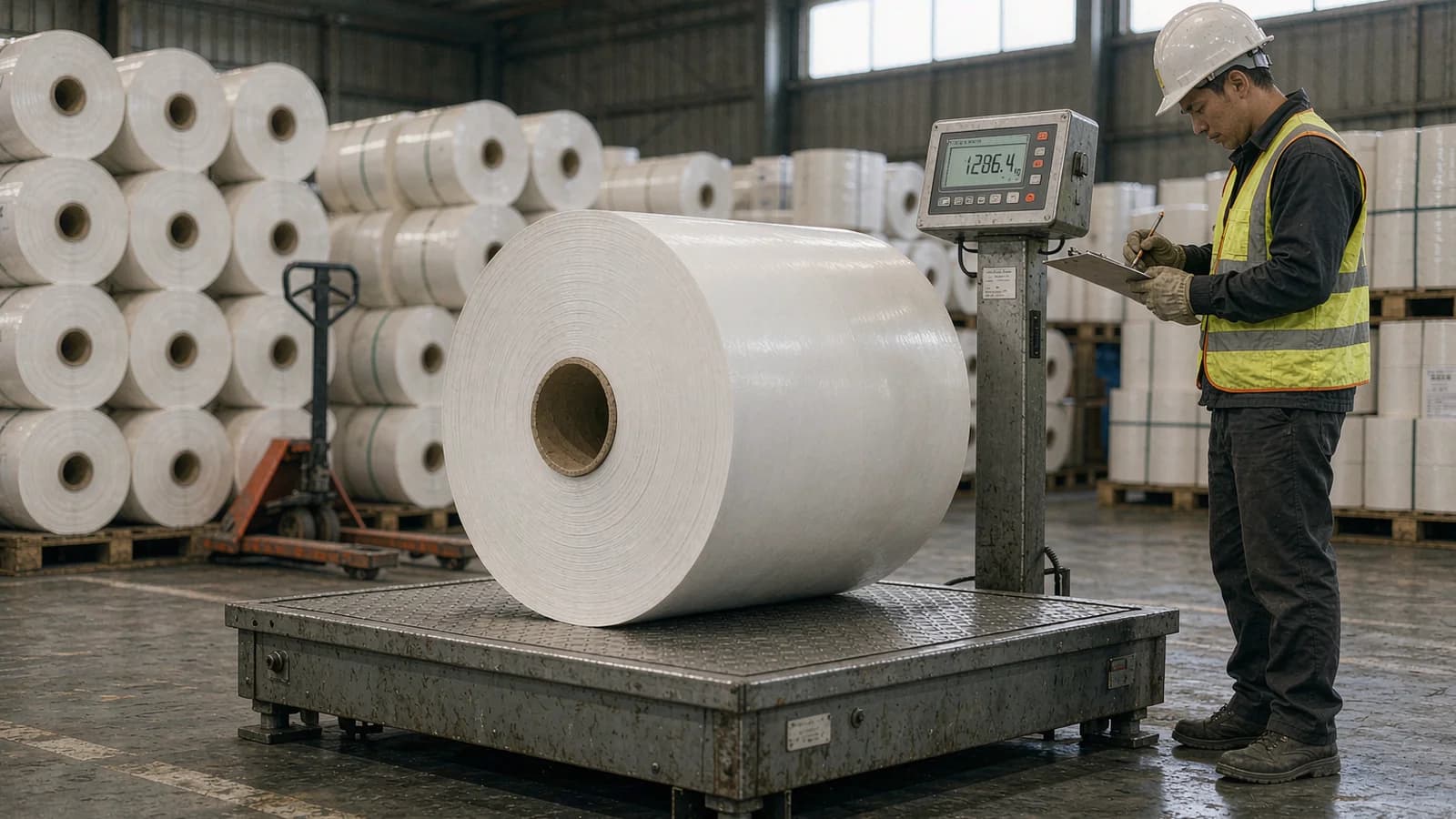
264 kg of paper at 800 mm × 55 gsm = 6,000 m. If the scale disagrees with the paperwork, the scale is right.
Frequently asked questions
How much does a 6000m thermal jumbo roll weigh?
It depends on gsm and width. On an 800 mm web: about 230 kg of paper at 48 gsm, 264 kg at 55 gsm, 312 kg at 65 gsm, and 360 kg at 75 gsm — before core and packaging. The formula is metres × width (m) × gsm ÷ 1,000 = kilograms.
How many finished receipt rolls come from one 6000m jumbo?
Multiply jumbo metres by the number of webs in the slit plan, then divide by metres per finished roll. A 6000 m, 800 mm parent under a 10 × 80 mm plan yields 60,000 finished metres — about 8,500 rolls of 70 m each. Scale linearly for other roll lengths and plans.
What outer diameter does a 6000m jumbo unwind to?
Roughly 1,050–1,300 mm depending on gsm and winding density: near 1,100 mm at 48 gsm and nearer 1,250–1,300 mm at 75 gsm on an 800 mm web. Always confirm the OD against your unwind stand's maximum and racking height when ordering, and state a maximum OD alongside the length.
Why order 6000m parents instead of 4,000m or 12,000m?
6000 m balances changeover economics against physical limits. Compared with 4,000 m parents it cuts changeovers and splice exposure per tonne by a third; compared with 10,000–12,000 m parents it stays within the unwind capacity, racking heights and manual-handling limits most mid-size converting houses operate with.
How do I verify a jumbo roll's declared length at goods-in?
Weigh it. Kilograms of paper × 1,000 ÷ (width in mm × gsm) = metres. A 6000 m, 800 mm, 55 gsm parent must show about 264 kg of paper. Subtract the core and wrap, compare, and any shortfall is visible on a floor scale in five minutes.