
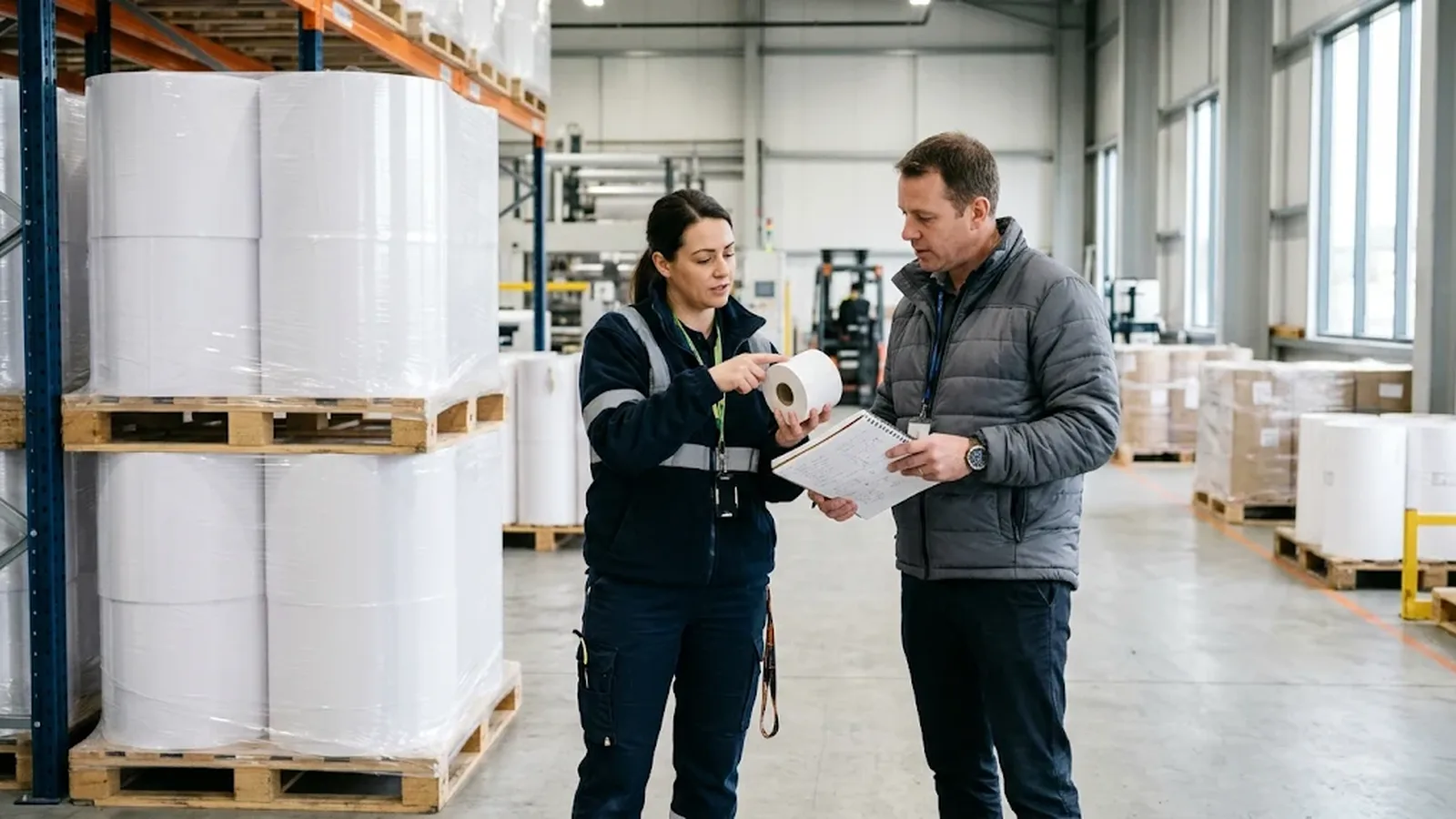
A direct thermal paper supplier is the party that stands behind the paper's specification — and that party sits at one of four tiers: a coating mill that coats and slits its own substrate, a converter that slits and packs bought jumbo stock, a distributor that resells finished goods, and a trader that arranges shipments without touching the product. The tier decides what the quotation can actually guarantee. A mill can document coating weight, developer chemistry and batch traceability from its own laboratory; downstream tiers can only forward what they receive. Choosing a supplier is therefore less about price per roll and more about matching the tier to the documentation, continuity and audit rights your programme requires — then verifying the claims with samples, capacity checks and paperwork that reconciles.
Every thermal receipt, label and ticket in circulation traces back to a direct thermal paper supplier — but 'supplier' is a word the industry applies to four very different parties. A coating mill, a converter, a distributor and a trader will all print the same catalogue on the same letterhead-quality PDF, quote the same nominal specifications, and behave completely differently the first time a batch disappoints.
The distinction matters because thermal paper is a manufactured product with a chemistry stack: base paper, precoat, thermal coating, and sometimes a top coat — each with tolerances, each with testable properties. Whoever controls that stack can document it; whoever resells it can only forward paperwork, and the seams show when a compliance audit, a scan-rate complaint or a shelf-life claim needs an answer the middleman cannot give from personal knowledge.
Requests that combine several formats can be quoted together; see thermal paper jumbo rolls for the parent-roll economics that separate the mill tier from everyone downstream, since jumbo capacity is the honest indicator of who actually controls production.
This guide maps the four tiers, lists what each can and cannot document, walks through a shortlist qualification protocol, and closes with the commercial architecture — dual sourcing, grade continuity, contracting and freight terms — that keeps a thermal programme stable across seasons and order cycles.
- Identify the tier before comparing prices: coater-mill, converter, distributor and trader carry radically different documentation and continuity capabilities behind the same catalogue.
- Weigh suppliers on what they can prove — coating weight, sensitivity class, developer chemistry, batch COA and SDS — not on the adjectives in their brochure.
- Qualify the shortlist with samples from nominated production runs, a capacity conversation reconciled to the coating schedule, and paperwork that names the manufacturing party.
- Insist on grade continuity: one written specification per SKU, change-control on any construction change, and density or sensitivity data batch to batch.
- Build commercial resilience with dual sourcing across tiers, price validity that reflects real coating economics, and freight terms planned for the product's light, volumetric profile.
The four tiers behind every quotation
The coater-mill is the tier that manufactures. It buys or makes base paper, runs the thermal coating line, controls coat weight and sensitivity in its own laboratory, and either slits jumbo rolls for converters or converts finished rolls and labels itself. Everything in the compliance chain — COA, SDS, batch traceability — originates here, and audit rights mean a factory visit rather than a forwarding email.
The converter buys jumbo parent rolls and creates finished formats: slitting to width, rewinding, printing, packing. A good converter adds real value in geometry discipline and packaging quality, and for many programmes is the right tier to buy from — but its authority over chemistry ends where the jumbo roll arrives. The distributor holds stock close to the buyer and adds availability and local service; the trader arranges transactions without handling product at all. Neither can originate a test result.
Procurement teams standardising on one supplier can review our POS and receipt paper rolls alongside the comparisons in this guide, but the review should start one question earlier: which tier is actually answering the email? The answer is discoverable — ask for the coating plant name, the coating line's capacity, and which party's laboratory ran the last batch test.
| Tier | Controls | Can document | Cannot document |
|---|---|---|---|
| Coater-mill | Coating chemistry, coat weight, batch production | COA, SDS, sensitivity data, audit visit | Local stock availability |
| Converter | Slitting, winding, printing, packing | Geometry tolerances, packing spec, artwork control | Origin chemistry beyond forwarded paperwork |
| Distributor | Local inventory, logistics, service | Availability, delivery consistency | Manufacturing claims of any depth |
| Trader | Transaction, price arbitrage | A quotation | Everything technical |
What each tier can actually document
Documentation is the dividing line between tiers, and it arrives in a fixed hierarchy. At the top sits the per-batch COA: basis weight, caliper, density or sensitivity measurement, and the developer system identified by name. Alongside it, the SDS discloses the sensitizer chemistry. Below these, batch traceability links a finished roll back to a coating date, and audit rights make the trail inspectable in person. Only the mill originates all four; converters can provide their own geometry and packing records and forward the rest.
Buyers should test the paperwork, not admire it. A COA without a measurement method is a claim; an SDS that does not identify the developer system is a placeholder; a specification sheet that cannot say who manufactured the product is a brochure. Direct thermal paper supply at programme scale runs on this chain — and the chain is only as strong as the party that signs it.
Where grade construction enters the shortlist conversation, our top-coated vs non top-coated guide compares the two constructions on retention, cost and machine behaviour, so the tier discussion is anchored to the product properties the programme actually depends on.
Qualifying the shortlist
Qualification starts with samples from nominated production runs — not from a showroom pack. Insist the sample batch carries a COA with the same fields the contract will require, then test on the buyer's own hardware: feed behaviour across a full roll, image density against the target, scan rates for label duty, and shelf-life expectations under the buyer's storage conditions. A sample that cannot be traced to a batch is a costume, not evidence.
Capacity is the second gate. A direct thermal roll supplier should reconcile lead times to a coating schedule — slots, tonnage, seasonality — and a buyer can verify plausibility by asking how many coating lines run, at what width, with what monthly output. Claims that cannot survive that arithmetic belong to the forwarding tiers. References close the gate: two customers at comparable volume, asked about the tenth order rather than the first.
Compliance completes the qualification: REACH-aligned developer documentation for regulated markets, FSC chain-of-custody where sourcing policy requires it, and food-contact declarations where labels touch produce or packaging. Each document should name the manufacturing party, because that party — not the letterhead on the quotation — is where the liability lives.

Commercial architecture: resilience across order cycles
Stable programmes are built, not hoped for. Dual sourcing across tiers — a mill for the core volume, a converter or distributor for surge and local availability — removes the single point of failure without fragmenting specifications, provided both parties quote against the same written SKU sheet. Grade continuity clauses should require notice and change-control before any construction change, because a silent coating substitution can shift density, shelf life or scanner behaviour across an entire estate.
Price structure reveals economics. Price validity that extends across quarters is only credible from a party that controls coating costs; spot prices that move weekly belong to the trading tier. Payment terms, currency and Incoterms allocate risk explicitly, and for import programmes the freight architecture deserves its own conversation: thermal paper is light and volumetric, container utilisation and moisture-barrier packing decide landed cost, and the packing specification is part of the product. Where container planning is the next step, our export shipping guide covers pallet standards, moisture-barrier packing and the document set for ocean freight.
For production volumes, the same tier logic applies to our 75 gsm heavyweight thermal paper, quoted per jumbo roll, slit reel or finished format, where heavier grades and their freight behaviour make the mill-versus-downstream comparison especially concrete.
Programme shorthand: identify the tier, demand COA + SDS per batch with methods named, qualify with batch-traceable samples and a capacity reconciliation, dual-source across tiers on one written specification, and put change-control, price validity and packing into the contract.
Frequently asked questions
What is the difference between a thermal paper manufacturer and a supplier?
A manufacturer (coater-mill) runs the thermal coating line and originates the chemistry documentation — COA, SDS, batch traceability. A supplier is anyone who sells the product: converters, distributors and traders all supply, but only the mill can personally stand behind the coating. Ask which party manufactured the product and which party tested the batch.
How do I verify a direct thermal paper supplier actually manufactures?
Three checks: ask for the coating plant's name and line capacity and reconcile claimed output against that arithmetic; request a COA from a nominated production batch and verify the measurement method; and exercise an audit visit. A manufacturer welcomes the visit — intermediaries reschedule it.
Is it better to buy from a mill or a converter?
It depends on what the programme needs. Mills give the strongest documentation and best economics at container scale; converters add value in local formats, printed rolls and smaller-lot flexibility, backed by the mill's paperwork. The failure mode is not the tier itself — it is buying from a tier that cannot document what your specification requires.
What documents should a direct thermal paper supplier provide per batch?
A COA stating basis weight, caliper, density or sensitivity with the test method, plus an SDS identifying the developer chemistry, plus traceability to a coating date. For regulated markets add REACH-aligned declarations, FSC chain-of-custody where sourcing policy requires it, and food-contact declarations where relevant.
Should I single-source or dual-source my thermal paper supply?
Dual-source at programme scale: a primary supplier for core volume and a secondary for surge and availability, both quoting against the same written SKU specification. Dual sourcing protects continuity without fragmenting quality, provided both parties operate under the same change-control and documentation requirements.