

An 800mm thermal paper jumbo roll exists because of clean slit arithmetic: 800 mm divides into ten 80 mm receipt webs, or eight 98 mm webs, with minimal edge trim — which is why it anchors the receipt-conversion width family alongside 790 and 795 mm. Yield follows a simple chain: jumbo length at the jumbo's gsm gives total square metres, the slit plan divides those into finished rolls, and metres per finished roll decide rolls per jumbo. Order an 800mm jumbo against six specification lines — gsm with tolerance, outer diameter, 76.2 mm core, winding direction, edge quality and joint policy — and verify the delivery by measuring OD, checking edge condition and confirming length against weight before releasing it to the slitter.
Converter language is full of jumbo widths — 405, 565, 636, 790, 795, 800, 844, 875 millimetres — and new buyers reasonably ask why the industry settled on this particular ladder. The answer is not tradition but arithmetic: every standard jumbo width is a clean multiple of the finished widths converters slit most often, chosen to maximise yield and minimise edge trim at the slitter.
The 800mm thermal paper jumbo roll is the clearest case. Eight hundred millimetres divides into ten 80 mm receipt webs exactly, or into eight 98 mm webs, or into practical mixed plans for houses converting both receipt and label stock. That divisibility — more than any property of the paper — is why 800 mm anchors receipt conversion worldwide, and why the neighbouring 790 and 795 mm trims exist for converters balancing different width mixes.
This guide explains where 800 mm sits in the jumbo width family, works through the yield maths from jumbo to finished rolls with real numbers, compares the family in one table, and closes with the specification and goods-in checklist that keeps an 800mm jumbo running cleanly at your slitter.
Where a programme needs several formats from one supplier, our thermal paper jumbo rolls covers width, core, roll diameter and developer class in a single specification sheet.
- 800 mm divides into ten 80 mm receipt webs with near-zero trim — the arithmetic, not the chemistry, is why the width dominates receipt conversion.
- 790/795/800 mm are siblings balancing different slit plans; 844 and 875 mm serve mixed receipt-plus-label houses.
- Yield maths is a three-step chain: jumbo length × width × gsm → square metres → slit plan → rolls per jumbo.
- Jumbo weight on arrival is a length audit: weight × 1,000 ÷ (width × gsm) = metres, checkable in the warehouse in minutes.
- Order against six lines — gsm tolerance, OD, core, winding, edge quality, joint policy — and the jumbo runs as predictably as its datasheet.
Why 800 millimetres: the slit arithmetic
A jumbo roll is a yield instrument. Its web width determines how many finished widths a converter can slit side by side, and the economics of the whole container ride on how cleanly the division lands. 800 mm is the industry's cleanest receipt answer: ten webs of exactly 80 mm with no trim deduction, eight webs of 98 mm, or seven 108 mm label liner widths with a small edge allowance. Compare that with a hypothetical 810 mm parent — still ten 80 mm webs, but with 10 mm of scrap edge on every metre of every jumbo in the container.
The 790 and 795 mm siblings exist for converters whose dominant product is not exactly 80 mm. European receipt fleets mixing 57 mm and 80 mm lines often prefer these trims because the edge allowance lands differently; a house running mostly 79 mm media gains yield at 790 that 800 mm cannot give. The lesson for buyers is that the best jumbo width is a function of your slit plan, not of the catalogue — but for pure 80 mm receipt conversion, 800 mm is the arithmetic optimum and the industry's default.
Width also drives logistics. A jumbo's weight scales with width at fixed diameter and gsm, and container loading rewards plans that match pallet positions to roll counts. An 800 mm jumbo at 1,000 mm OD in 55 gsm paper weighs in the region of 175 kg; larger 1,400 mm OD parents approach 350 kg and hold roughly twice the metres. Pallet and container plans are built around exactly these numbers, which is one more reason the width families are stable across the industry.
| Jumbo width | Typical slit plan | Primary conversion output |
|---|---|---|
| 405 mm | 7 × 57 mm | Compact receipt rolls |
| 565 mm | 5 × 108 mm liner / 6 × 90 mm | Label stock |
| 636 mm | 6 × 102 mm / 4 × 152 mm | Label stock, wide receipts |
| 790 mm | 10 × 79 mm or 8 × 98 mm | Receipt conversion, EU fleets |
| 795 mm | 9 × 88 mm / mixed 57+80 plans | Mixed receipt houses |
| 800 mm | 10 × 80 mm / 8 × 98 mm | Receipt conversion, global default |
| 844 mm | Mixed receipt + label plans | Flexible mixed houses |
| 875 mm | 8 × 108 mm / 6 × 145 mm | Wide label stock |
Yield maths: from one 800mm jumbo to finished rolls
The calculation chain has three steps, and every converter runs it before quoting a conversion job. Step one: metres of jumbo. Length scales with the square of the diameter at fixed gsm and winding density, so a 1,000 mm OD jumbo holds roughly twice the metres of a 700 mm one. Step two: square metres — jumbo length × 0.8 m of width — converted to weight through the gsm. Step three: the slit plan divides the jumbo into finished rolls; metres per finished roll then decide rolls per jumbo.
Worked example: an 800 mm × 1,000 mm OD jumbo in 55 gsm paper holds in the region of 4,000 m, which is 3,200 m² and roughly 176 kg of paper. At the slitter, a 10 × 80 mm plan feeds ten rewind shafts simultaneously, so one jumbo metre produces ten finished metres. An 80 mm × 70 m receipt roll (the 3-1/8 × 230 ft equivalent) therefore consumes 7 m of jumbo per set of ten rolls — the jumbo yields around 570 sets, or 5,700 finished rolls, before wrap and start-up allowances.
The inverse of this maths is also the fastest goods-in audit. Jumbo weight is printed or measurable on arrival, and weight × 1,000 ÷ (width in mm × gsm) gives metres per roll directly: a 176 kg, 800 mm, 55 gsm jumbo should declare about 4,000 m. If the weight implies substantially less length than the paperwork claims, the discrepancy is visible before a single metre reaches the slitter.
Buyers comparing these specifications can review our 48 gsm lightweight thermal paper, where basis weight, coating construction and packing are documented per grade before an order is placed.
| Quantity | Value | How derived |
|---|---|---|
| Jumbo OD / core | 1,000 mm / 76.2 mm | Order specification |
| Metres per jumbo | ≈ 4,000–7,000 m (OD dependent) | Length × diameter relationship |
| Square metres | length × 0.8 m | Width conversion |
| Finished sets (10 rolls) | ≈ 570 per 4,000 m | Slit plan ÷ metres per roll set |
| Finished receipt rolls | ≈ 5,700 × 70 m rolls | Sets × 10 shafts |
| Weight check | m × 0.8 × 55 g = kg | Goods-in length audit |
Ordering an 800mm jumbo: the specification and goods-in checklist
A jumbo order that slits cleanly is written down before it is made. Six lines cover it. GSM with tolerance — ±1 gsm is standard at manufacture, and weight consistency roll-to-roll matters more than the nominal number because it keeps finished roll lengths predictable. Outer diameter — state the maximum your unwind stands and pallet plan accept; diameter consistency across the container matters as much as the absolute figure. Core — 76.2 mm (3 inch) is the jumbo standard, with wall strength sufficient for the roll mass.
Then the three lines converters forget at their cost. Winding direction — paper-out or paper-in must match your slitter's unwind geometry, or every roll goes back to the floor for re-winding. Edge quality — clean slit jumbo edges without pressure develop or burrs, because edge defects propagate into every finished roll slit from them. Joint policy — whether splices are acceptable, how they are flagged, and the minimum distance between them; a single undetected joint can destroy a full shift's output if it passes unseen into the finished rolls.
At goods-in, the audit is fast: measure OD on a sample of rolls for consistency, weigh one roll against the declared length using the weight-to-metres relation, inspect edges under light, and slit a short trial before committing the container to the schedule. A jumbo that passes these four checks will run; one that fails any of them should be flagged before it consumes slitter time.
Where container planning is the next step, our export shipping guide covers pallet standards, moisture-barrier packing and the document set for ocean freight.
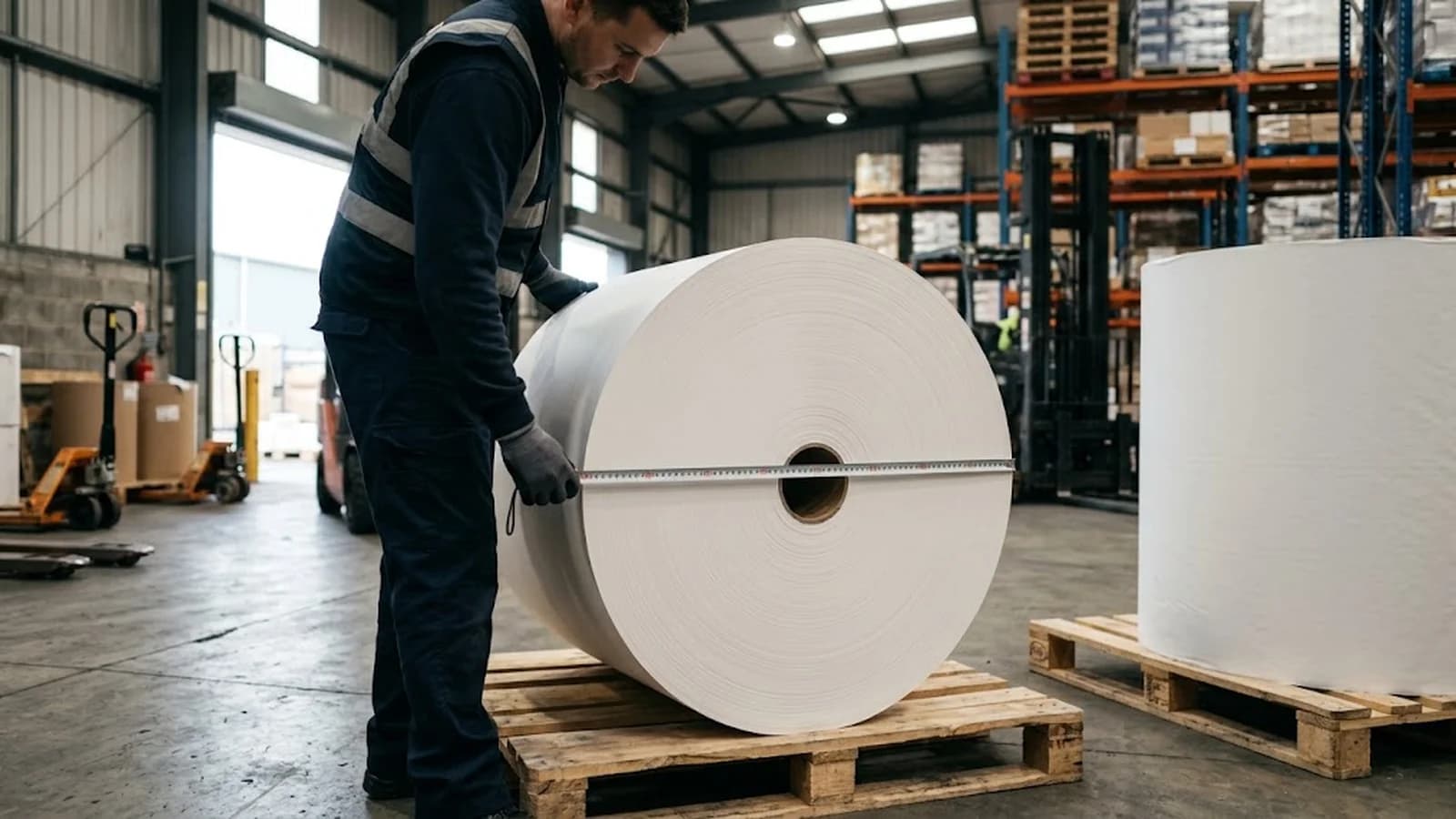
Weight × 1,000 ÷ (width mm × gsm) = metres. One warehouse scale check audits the whole container's declared length.
Frequently asked questions
Why is 800mm the standard jumbo width for receipt paper?
Because it divides into ten 80 mm receipt webs exactly, with no edge trim — the cleanest slit arithmetic in the receipt family. The width carries no special paper property; it is a converting optimum that every jumbo producer and most converters have tooled around, which is what keeps it standard.
How many finished receipt rolls come from one 800mm jumbo roll?
It depends on jumbo OD and finished roll length. As a worked example, a 4,000 m jumbo under a 10 × 80 mm plan yields about 570 sets of ten 70 m receipt rolls — roughly 5,700 finished rolls. Scale linearly with jumbo length: a 7,000 m parent yields about 10,000 rolls of the same size.
Should I choose 790, 795 or 800mm jumbo?
Match the trim to your slit plan. Pure 80 mm receipt conversion maximises yield at 800 mm. Fleets running 79 mm media or mixed 57/80 plans may gain yield from 790 or 795 mm because the edge allowance lands differently. Compute rolls per jumbo for your actual plan at each width — the best answer is arithmetic, not habit.
What should an 800mm thermal paper jumbo roll specification include?
Six lines: gsm with tolerance, outer diameter, core size and wall, winding direction, edge quality requirements, and the joint policy (acceptability, flagging, minimum spacing). Add grade and developer chemistry for the coating. Any competent mill quotes against that frame without further questions.
How do I verify the length of a jumbo roll at goods-in?
Weigh it. Weight in kilograms × 1,000 ÷ (width in mm × gsm) gives metres directly — a 176 kg, 800 mm, 55 gsm jumbo should be about 4,000 m. Compare against the declared length; a significant shortfall is visible in five minutes with a floor scale, before the roll ever reaches the slitter.