

A thermal paper roll size is defined by four numbers: paper width, roll outside diameter, core inside diameter and paper length. Most POS rolls are written as width × diameter in millimetres (for example 80 × 80 mm or 57 × 40 mm), while North American formats are often written in inches and feet (for example 3 1/8 in × 230 ft). Confirm all four values against the printer's compartment, not just the width, before ordering.
Few purchasing problems cost as much time as a roll that almost fits. A receipt roll can have the correct width and still jam because the outside diameter is 3 mm too large, or feed badly because the core is a fraction too narrow for the spindle. For distributors and multi-site operators, those small mismatches turn into returns, service calls and avoidable downtime at the counter.
This thermal paper size guide explains how roll dimensions are written in different markets, what each number actually controls, and how to convert a printer specification into a clear purchase request. It is written for buyers, importers and converters who need repeatable sizes rather than a one-off order.
Wintel coats and converts direct thermal paper in-house, so the dimensions discussed here are the ones we confirm against a machine compartment or an approved sample before production.
- Four numbers define a roll: width, outside diameter, core ID and paper length.
- Metric sizes (80 × 80 mm) and imperial sizes (3 1/8 in × 230 ft) describe the same roll in different units; convert before comparing.
- Roll diameter and length are linked by paper thickness — a heavier GSM gives fewer metres at the same diameter.
- Core ID is the most common cause of feeding problems when only width is checked.
- Send printer model, width, diameter, core and a photo of the label to avoid sample rounds.
The four numbers that define a thermal paper roll
Every finished thermal roll can be described completely with four measurements. Suppliers may not print all four on the carton, but a quotation should state them explicitly because they control fit, run time and price.
- Width — the dimension across the paper web, measured in millimetres or inches. This is what most buyers quote first.
- Outside diameter (OD) — the diameter of the wound roll. It determines whether the roll physically fits the printer compartment and how many metres of paper it holds.
- Core inside diameter (ID) — the hollow centre, commonly 12 mm or 17 mm for compact rolls, and 25 mm (1 in) or 40 mm for larger formats. Some machines use a spindle instead of a core.
- Length — the unrolled paper length in metres or feet. This drives cost per roll and changeover frequency more than any other value.
If a supplier only gives you width and diameter, ask for the core ID and length before comparing prices. Two rolls with identical 80 × 80 mm markings can differ by 20% in length.
Common POS and receipt roll sizes
The formats below cover the majority of retail, hospitality and payment-terminal enquiries we receive. They are starting points for specification, not limits — direct thermal paper can be slit and rewound to other dimensions when volume justifies a production run.
| Written size | Width | Typical diameter | Typical core | Common application |
|---|---|---|---|---|
| 80 × 80 mm | 80 mm | 80 mm | 12 / 17 mm | Supermarket and restaurant POS receipts |
| 80 × 70 mm | 80 mm | 70 mm | 12 / 17 mm | Compact POS terminals with limited compartment depth |
| 57 × 40 mm | 57 mm | 40 mm | 12 mm | Mobile POS, card terminals and portable printers |
| 57 × 50 mm | 57 mm | 50 mm | 12 mm | Longer-run mobile terminals and queue printers |
| 3 1/8 in × 230 ft | 80 mm | ~80 mm | 12 / 17 mm | North American POS receipts (imperial notation) |
| 2 1/4 in × 85 ft | 57 mm | ~40 mm | 12 mm | North American portable and terminal rolls |
Values are typical market formats. Always verify against the printer manual or an existing sample, because compartment limits vary by model.
Metric and imperial notation: reading 3 1/8 x 230 correctly
North American buyers frequently receive requests written as 3 1/8 × 230 or 2 1/4 × 85. In that notation the first number is the width in inches and the second is the paper length in feet. Converting to metric makes the requirement unambiguous for a factory.
3 1/8 in is approximately 79.4 mm, which is why it is treated as the imperial equivalent of an 80 mm roll. 2 1/4 in is approximately 57 mm. The length figure does not convert to a diameter directly — it depends on the basis weight and caliper of the paper, which is why two 3 1/8 × 230 rolls from different suppliers can have slightly different outside diameters.
When you send an enquiry, state both notations if you have them. It removes a conversion step and reduces the chance of an off-spec first production run.
Why roll diameter and length are not interchangeable
Roll length is a function of diameter, core diameter and paper thickness. A 48 gsm paper gives more metres at a given diameter than a 65 or 75 gsm paper of the same construction. This is the reason a 'cheaper per roll' quote can be more expensive per metre of usable paper.
For high-volume retail, the practical target is usually fewer roll changes per shift, which pushes towards lower GSM and larger diameter. For tickets, ATM receipts and documents that must survive handling, a higher GSM is often chosen even though it shortens the roll. Both decisions are easier to make when the supplier quotes length as well as diameter.
Core sizes, spindles and coreless rolls
Core ID is the value most often omitted from an enquiry and the one that most often causes a jam. A core that is too large will not seat on the spindle; a core that is slightly too small can spin or wobble, producing skewed feeding and inconsistent print position.
Common cores are 12 mm and 17 mm for compact receipt rolls, and 25 mm or 40 mm (1 in or ~1.6 in) for larger POS, kiosk and industrial rolls. Some kiosk and ATM machines use a spindle or a coreless roll, in which case the winding direction and the inner-end finish matter more than the core itself.
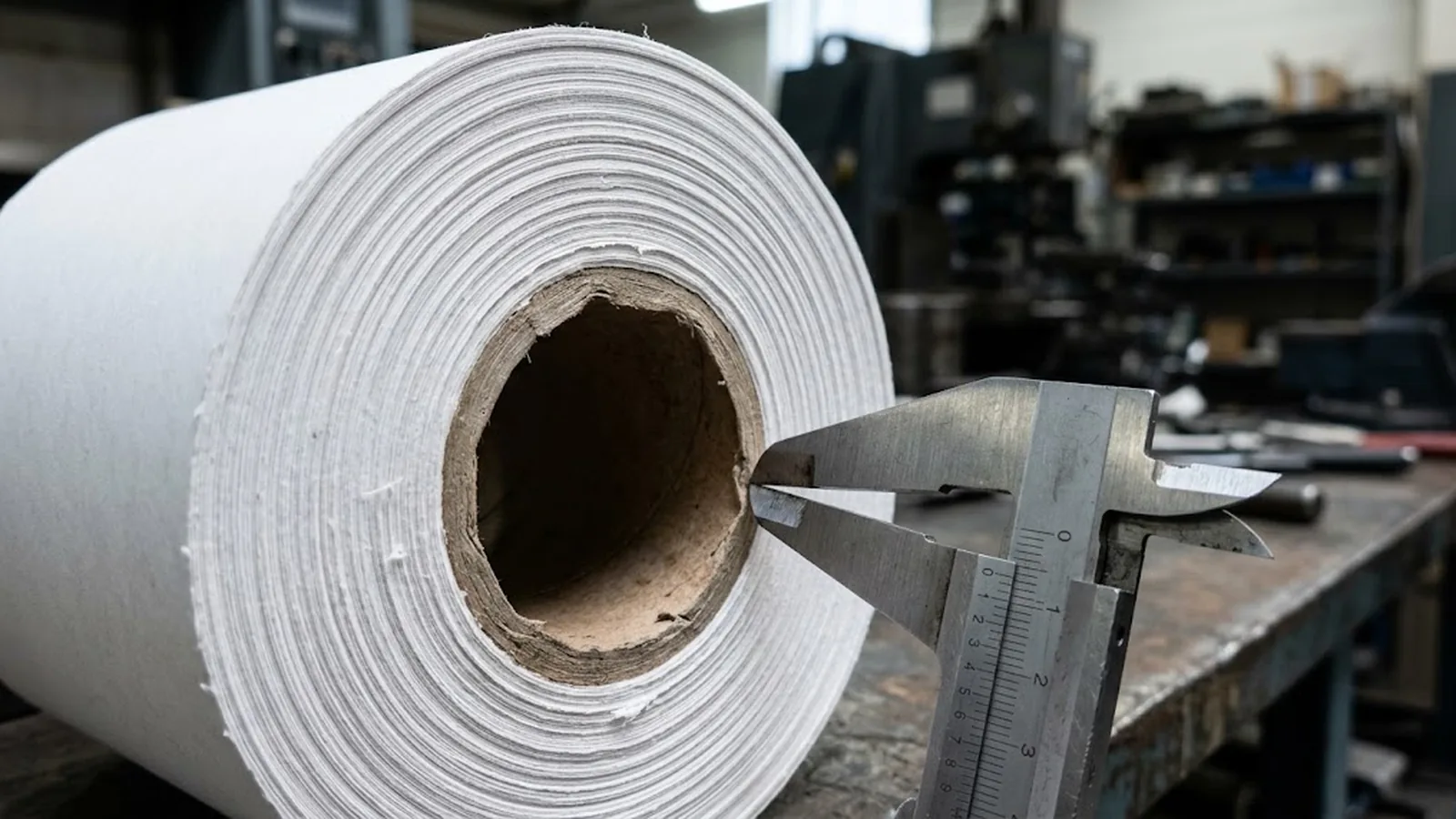
If you are replacing an existing roll, measure the core with a caliper rather than estimating. Plastic cores, paper cores and coreless formats are all available, and the choice affects both cost and disposal requirements in some markets.
Label sizes: why 4x6 and 100x150 are the same format
Direct thermal labels are specified differently from receipt rolls: label width, label height, gap or black-mark position, winding direction, roll OD and core. The most common shipping format is 4 × 6 in, which is the imperial way of writing 100 × 150 mm.
Because labels are die-cut, the converting details matter as much as the finished size. Gap width, corner radius, perforation and unwind direction all have to match the printer's sensor and media path. A sample run on the actual printer is the fastest way to confirm a new label construction.
How to write a size specification that avoids sample rounds
A complete first enquiry normally reduces the specification cycle to one round of confirmation. The following list is what our team asks for before quoting a custom or repeat format.
- Printer or machine model, plus a photo of the media compartment if available.
- Paper width, outside diameter and core inside diameter, measured on a current roll.
- Basis weight (GSM) or the current grade if known, plus required length per roll.
- Winding direction and any features such as black marks, perforation or pre-printing.
- Monthly or annual quantity, packing format and any private-label requirements.
- A physical sample or the carton label from the roll you currently use, when available.
Common size mistakes and how to avoid them
Most specification problems we see are not exotic — they are simple omissions that surface after the first delivery.
- Ordering by width only. Always confirm OD and core; width alone does not guarantee the roll fits.
- Assuming diameter equals capacity. Compare length in metres or feet, and remember GSM changes length at a fixed diameter.
- Mixing metric and imperial in one order. Convert and state both to avoid a 3 mm discrepancy on an 80 mm roll.
- Ignoring compartment tolerance. A roll that matches the manual can still bind if the printer has a worn or tight cover.
- Forgetting packing and core material. Plastic versus paper cores affect disposal rules and sometimes the machine's grip.
Frequently asked questions
What does 80x80 thermal paper roll mean?
It means the paper is 80 mm wide and the wound roll has an outside diameter of approximately 80 mm. The core is stated separately, usually 12 mm or 17 mm, and the length depends on the basis weight of the paper.
Is 57x40 the same as 2 1/4 x 85?
They refer to the same class of compact roll: about 57 mm (2 1/4 in) wide with a small diameter and a short length. The exact length and diameter still depend on the GSM, so confirm both values before treating two quotes as identical.
Can you produce a size that is not in your standard list?
Yes. Width, diameter, core, length and winding direction can be produced to specification when the volume justifies a run. Send the printer model and a sample or drawing so the format can be reviewed.
How much paper is on a 3 1/8 x 230 roll?
230 feet is roughly 70 metres. At 48 gsm this normally sits close to an 80 mm outside diameter, but the exact diameter changes with caliper, so the diameter should be confirmed against the printer compartment.
Do you supply 4x6 thermal shipping labels?
Direct thermal label formats including 4 × 6 in (100 × 150 mm) can be reviewed for logistics and e-commerce programs. Provide the printer model, label size, gap, core and roll OD so the construction can be confirmed.
What core size should I choose for POS rolls?
Use the core specified by the printer manufacturer. Where the machine accepts more than one, 12 mm and 17 mm are the common choices for 57 mm and 80 mm rolls; a caliper measurement on your current roll is the safest reference.