
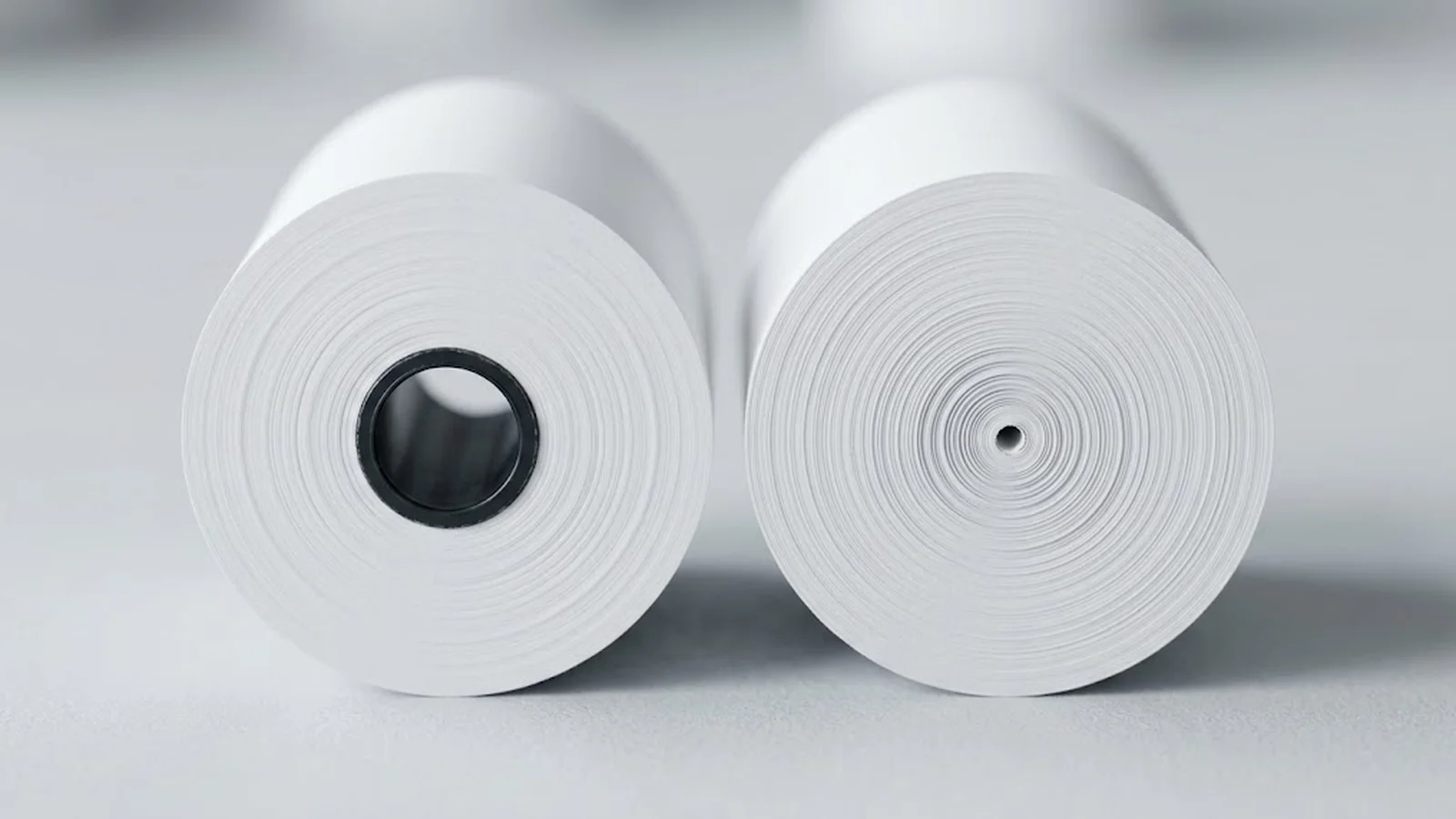
A coreless thermal paper roll is a receipt roll wound without the central plastic or cardboard core: the paper itself forms the innermost windings, and the printer feeds from the paper surface instead of gripping a core. Removing the core frees 10–20 percent more paper at the same outer diameter — an 80 x 80 coreless roll holds around 70 m versus 60–64 m cored — while eliminating core inventory, core disposal and the last-metre paper waste every cored roll leaves behind. Coreless rolls only work in paper-drive mechanisms, which most modern receipt terminals are; core-grip or spindle-drive machines cannot use them. Buyers should trial 50–100 rolls per device model, verify feed reliability at low paper (the failure mode unique to coreless), and confirm start-of-roll taper winding with the supplier.
Every conventional receipt roll carries a hidden cost wound into its centre: the core. A 12.7 mm plastic core occupies paper space on every roll, becomes waste the moment the roll is spent, and — multiplied across millions of receipts — turns into a quiet line item of lost paper, purchased plastic and disposal labour. Coreless thermal paper rolls remove it.
Coreless is not a niche experiment: it has been standard in Japanese retail for two decades and is steadily spreading through European and North American fleets as terminal generations turn over. Yet many buyers meet the format only as a quotation line they cannot evaluate — is it the same paper? will it jam? why is the metre price different?
This guide explains how coreless feeding actually works, quantifies the yield gain against cored equivalents, sets out which machines can and cannot run it, covers the converting details that separate good coreless stock from returns-generating stock, and finishes with a trial protocol for introducing coreless rolls to an existing fleet.
Buyers comparing these specifications can review our custom thermal paper programme, where basis weight, coating construction and packing are documented per grade before an order is placed.
- Coreless rolls remove the 12.7 mm core; the printer feeds from the paper itself, so the mechanism must be paper-drive (most modern receipt terminals are).
- Yield gain at the same outer diameter: roughly 10–20 percent more metres — 80 x 80 coreless ≈ 70 m vs 60–64 m cored.
- No cores to buy, store or discard, and no residual last-metre windings — the roll runs to its true end.
- The unique failure mode is feed slip when the roll is nearly empty; quality winding taper and terminal trial are the controls.
- Coreless suits high-volume fixed terminals best; mobile devices with core-grip spindles stay on cored stock.
How a coreless roll feeds without a core
In a conventional receipt mechanism, the platen drive pushes paper forward and either a spindle grips the core or friction holds the roll steady while the paper is drawn off the outside. Coreless operation relies on the second family: paper-drive mechanisms pull the web from the roll's outer surface, so the roll never needs anything solid in the middle. As the roll empties, the innermost windings — which in a cored roll would be wrapped around plastic — simply become the last printed metres of the receipt.
Two converting details make this work reliably. The first is the start-of-roll finish: coreless stock is wound onto a removable mandrel and finished so the inner end is flat, clean and slightly tapered, giving the mechanism a defined leading edge without a core lip. The second is wind tension control across the whole roll — too loose and the inner windings telescope or wrinkle as the roll depletes, too tight and the inner layers stick. A converter running coreless production tunes tension, taper and end-cut per grade, which is why coreless quality tracks the converter, not the paper chemistry.
The paper itself is unchanged. Coreless and cored rolls from the same mill share coating, sensitivity and caliper; the difference is purely geometric and mechanical. That matters for buyers because print quality, image retention and compliance documentation carry over unchanged from an approved cored grade to its coreless version.
- Feeding: paper-drive (outer-surface pull) — no core grip, no spindle contact.
- Start-of-roll: mandrel-wound, flat/tapered inner end replaces the core lip.
- Wind tension and taper are the core quality controls; chemistry is identical to cored stock.
- Machine requirement: paper-drive mechanism — the dividing line between coreless-capable and not.
The yield maths: coreless vs cored at the same diameter
Roll length follows the formula L = π x (OD² − core²) / (4 x caliper). Set the core diameter to zero and the same outer diameter yields visibly more paper. At an 80 mm OD with 0.078 mm caliper, a cored roll on a 12.7 mm core holds about 60–64 m; the same roll coreless holds about 70 m — a gain near 12 percent. At smaller diameters the relative gain is larger because the core occupies a bigger share of the cross-section: a 57 x 40 roll gains closer to 18–20 percent coreless, which is why the format originally spread through compact Japanese devices where every millimetre of compartment space counted.
The gain compounds at fleet scale. A retailer running 100,000 cored 80 x 80 rolls a year prints about 6.2 million metres; converting the same purchase to coreless at the same OD delivers roughly 7.0 million metres — the paper equivalent of 12,000 extra rolls bought with no extra shelf space, since outer diameter and case counts stay identical. Alternatively, buyers keep the same metres and accept a slightly smaller OD, freeing compartment clearance in tight devices.
Two secondary economics complete the picture. Storage and handling drop slightly — a case of coreless rolls weighs less and contains no rigid cores to crack in transit. And end-of-roll waste disappears: a cored roll stops feeding with a metre or more of paper still wound on the core, which operators either discard or chase; coreless rolls run to their true end. Neither effect shows on the invoice, but both show in the consumables budget.
Where a programme needs several formats from one supplier, our POS and receipt paper rolls covers width, core, roll diameter and developer class in a single specification sheet.
| Size (W x OD) | Cored length | Coreless length | Gain | Extra receipts per roll |
|---|---|---|---|---|
| 80 x 80 mm | ≈ 60–64 m | ≈ 70 m | ≈ +12% | ≈ +20–30 |
| 80 x 70 mm | ≈ 45–48 m | ≈ 51 m | ≈ +13% | ≈ +10–20 |
| 80 x 65 mm | ≈ 38–40 m | ≈ 44 m | ≈ +14% | ≈ +13–20 |
| 57 x 50 mm | ≈ 19–20 m | ≈ 23 m | ≈ +17% | ≈ +10–20 |
| 57 x 40 mm | ≈ 12–13 m | ≈ 15 m | ≈ +18–20% | ≈ +7–12 |
Receipt counts assume 200–300 mm per receipt; gains grow as OD shrinks because the core takes a larger share of the cross-section.
Machine compatibility: what can and cannot run coreless
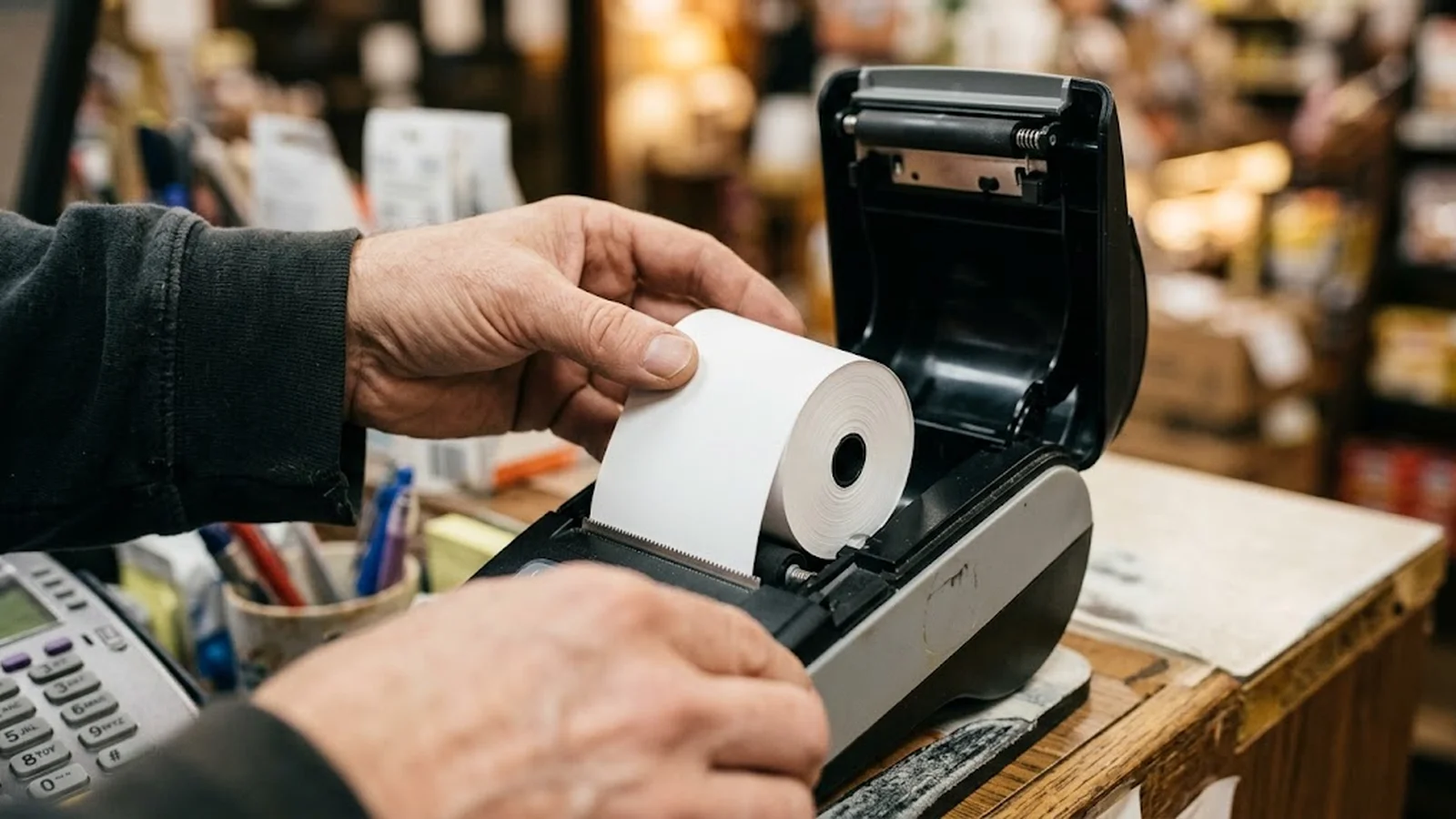
The dividing line is the feed architecture. Paper-drive mechanisms — the large majority of modern countertop receipt terminals and kiosk units, including the mainstream Epson, Star and Bixolon counter families — run coreless stock directly, usually with no setting change. Spindle-drive and core-grip mechanisms, common in some handheld card terminals, portable devices and certain older ECRs, cannot: they need the core to transmit drive, and a coreless roll spins uselessly on the spindle. Fleets should be sorted by model before switching, not after.
Even on paper-drive machines, two compatibility details deserve attention. Low-paper behaviour changes: sensors trigger at the same radius, but a nearly empty coreless roll is lighter and can shift in the compartment, so feed alignment at end-of-roll is the point to watch during trials. And roll-end taper quality decides whether the mechanism picks up the last windings cleanly or loses grip — the single most common cause of 'coreless jammed' complaints, and one that traces to converting, not to the concept.
Operational transition is otherwise minimal. Loading is the same or faster (no core to seat on a spindle), sensor positions are unchanged, and stock can be mixed per device model during a phased rollout. Most fleets trial coreless on their highest-volume fixed counters first, where the yield gain concentrates, and leave spindle-drive handhelds on cored stock permanently — a mixed specification that is normal and permanent in mature programs, not an interim compromise.
- Runs on: paper-drive counter terminals, kiosks, modern ECR families — typically no setting change.
- Does not run on: spindle-drive / core-grip handhelds and some legacy devices — keep cored stock for these.
- Watch point 1: feed alignment at low paper during trials.
- Watch point 2: roll-end taper quality — the top cause of coreless complaints, fixed at the converter.
Buying considerations and a trial protocol
Specify coreless with five lines: width, outer diameter, grade (gsm and developer system), winding direction, and coreless end-finish (flat/tapered inner end, wind tension standard). Price comparison needs one extra step versus cored buying: because coreless changes metres per roll, compare quotations per metre — not per roll — and note that a coreless roll at the same OD should quote slightly above a cored roll per roll but below it per metre. Suppliers without coreless converting experience often price the format as a speciality; manufacturers who run it as a standard line price it as what it is: the same paper, slit differently.
Trial protocol that catches real problems in one cycle: select one high-volume counter model, run 50–100 coreless rolls over two to four weeks, and track four measurements — receipts per roll (expect the yield gain in practice), feed faults per 10,000 receipts, end-of-roll behaviour, and operator loading comments. If receipts per roll and fault rates hold against the cored baseline, extend to the model family; if end-of-roll feeding misbehaves, resolve it with the converter's taper specification before scaling. One structured trial replaces the anecdotal back-and-forth that stalls most coreless conversions.
For procurement teams with sustainability reporting, coreless also removes the core waste stream: a 100,000-roll program eliminates roughly 100,000 plastic cores per year. Combined with the paper gain, coreless is one of the few consumable switches that improves cost, yield and waste metrics simultaneously — which is why the format keeps expanding across retail fleets worldwide.
Where container planning is the next step, our export shipping guide covers pallet standards, moisture-barrier packing and the document set for ocean freight.
- Spec lines: width, OD, grade, winding, coreless end-finish.
- Compare per metre; expect same-OD coreless to win on metres per dollar.
- Trial: 50–100 rolls on one model, track yield, faults, end-of-roll, operator feedback.
- Scale by model family; keep cored stock for spindle-drive devices.
- Sustainability: zero core waste alongside the 10–20 percent paper gain.
Golden rule: coreless is a converting capability before it is a product — buy from a converter that runs it as standard production, not as a favour.
Frequently asked questions
What is a coreless thermal paper roll?
A receipt roll wound without the central core tube. The paper forms the innermost windings and the printer feeds from the roll's outer surface (paper-drive), so no plastic or cardboard core is needed. At the same outer diameter it holds roughly 10–20 percent more paper than a cored roll.
How much more paper does a coreless roll hold?
An 80 x 80 coreless roll holds about 70 m versus 60–64 m cored (≈ +12%). The relative gain grows as rolls get smaller: a 57 x 40 coreless roll gains about 18–20 percent, because the core occupies a larger share of the cross-section at small diameters.
Will coreless rolls work in my receipt terminals?
If the mechanism is paper-drive — true of most modern countertop receipt terminals and kiosk units — yes, usually with no setting change. Devices that grip the core with a spindle to drive the paper cannot run coreless. Sort your fleet by model and keep cored stock for spindle-drive devices.
Why did my coreless roll jam near the end?
Almost always roll-end taper quality, not the concept. A poorly finished inner end or uneven wind tension makes the last windings feed unevenly. It is fixed at the converter: specify flat/tapered end finish and wind tension standards, and verify during a 50–100 roll trial before scaling.
Is coreless thermal paper more expensive?
Per roll at the same diameter, slightly — the converting is more involved. Per metre of paper, it is usually cheaper, because the same roll holds 10–20 percent more paper and no core is purchased. Compare quotations per metre to see the real economics.