
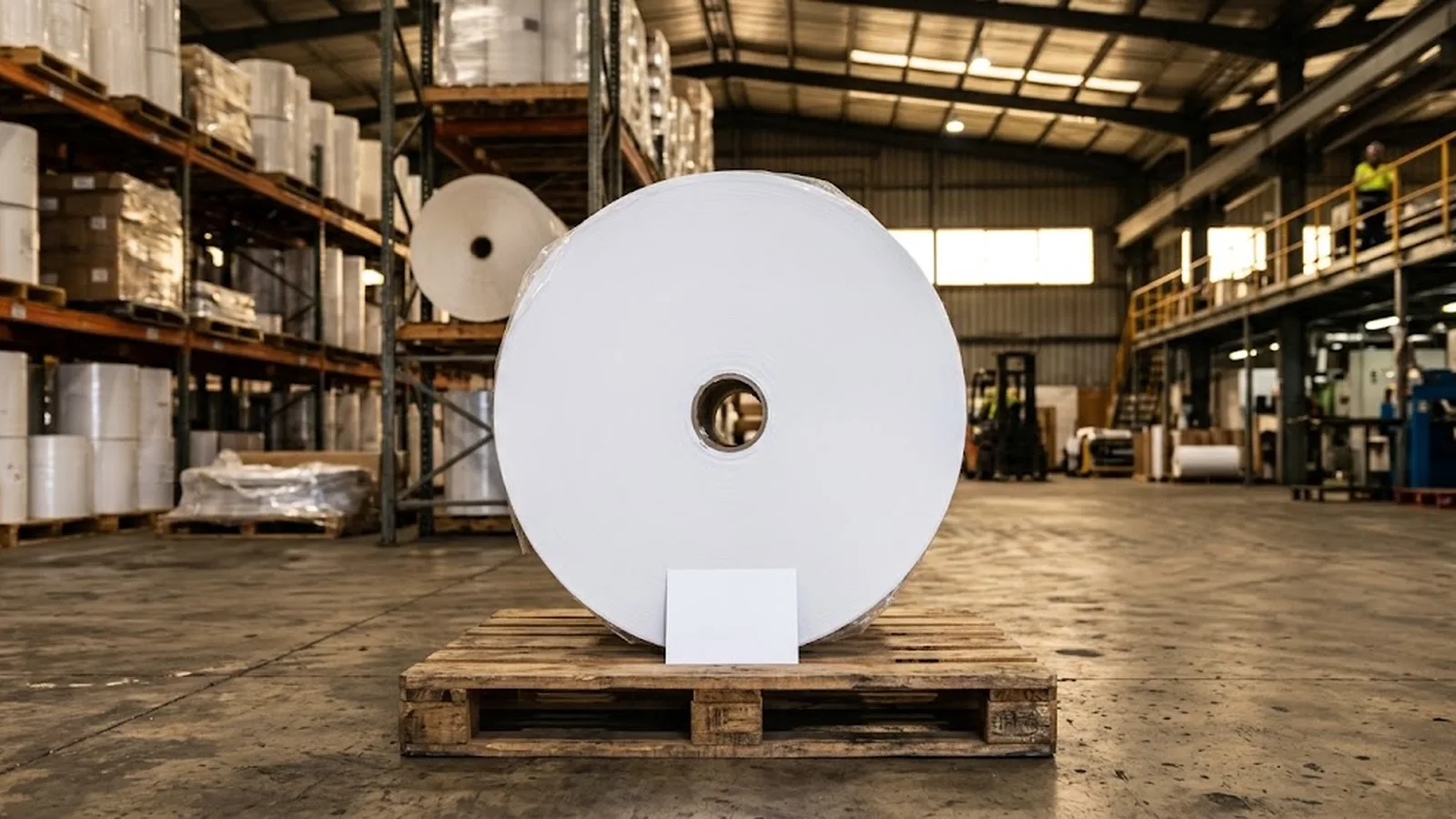
A 65 gsm thermal paper jumbo roll is a parent roll wound from mid-heavy thermal stock — one grammage step above the 55 gsm receipt standard and one below the 75 gsm ticket class. The extra 10 gsm per square metre buys a stiffer, more opaque, more abrasion-tolerant web that suits label facestock, durable receipts and event-style tickets, and it costs about 18 percent more weight per metre than 55 gsm: on an 800 mm web, 6,000 m of 65 gsm paper weighs roughly 312 kg and unwinds to a 1,200–1,300 mm diameter. Ordering one is a five-line exercise — gsm with tolerance, width, core, length or maximum OD, and joint policy — and the declared length audits with one floor-scale reading, because weight x 1,000 ÷ (width x gsm) returns the metres.
Grammage conversations in thermal paper usually orbit the two poles: 48–55 gsm receipt stock and 75 gsm heavyweight ticket stock. Between them sits 65 gsm — the grade converters reach for when a receipt needs to feel substantial, when a label facestock must survive warehouse handling, or when a ticket has to carry a second-side preprint without showing through. Specified in jumbo form, it is the input for a distinct family of finished goods rather than a heavier twin of ordinary receipt paper.
The grade matters commercially because every downstream number moves with it. Weight per metre, roll diameter at a fixed length, pallet positions per container, yield per tonne and even image-contrast behaviour at the print head all shift when the basis weight climbs from 55 to 65. Buyers who quote 65 gsm programmes with 55 gsm arithmetic systematically misprice freight and overstate yield.
For production volumes, the same construction logic applies to our thermal paper jumbo rolls, quoted per jumbo roll, slit reel or finished format.
This guide works the 65 gsm grade properly: where it sits in the grammage ladder, what it changes in weight, diameter and yield, which programmes it suits, how to order it in jumbo form, and the one-scale audit that keeps the declared length honest.
- 65 gsm is the mid-heavy tier: stiffer, more opaque and more abrasion-tolerant than 55 gsm, more economical and easier handling than 75 gsm.
- Weight scales linearly with gsm: 6,000 m on an 800 mm web is ≈ 312 kg at 65 gsm, versus ≈ 264 kg at 55 gsm and ≈ 230 kg at 48 gsm.
- Yield per tonne falls as gsm rises — one tonne of 65 gsm covers ≈ 15,385 m², about 26 percent less area than a tonne of 48 gsm.
- Suits label facestock, two-sided preprinted tickets and durable receipt programmes; overkill for plain counter receipts.
- Order on five lines — gsm ± 1, width, core, length/OD, joint policy — and audit length with weight x 1,000 ÷ (width x gsm).
Where 65 gsm sits in the grammage ladder
Thermal grades are best read as a stiffness-versus-handling trade. At 48–55 gsm the web is light, cheap per square metre and ideal for high-volume counter receipts; at 75 gsm it is card-like and serves tickets, boarding-pass stock and banking journals. 65 gsm is the midpoint: the base sheet and coating build add body that resists creasing in label liners and dispensers, raises opacity enough to hide second-side preprint, and improves surface durability against the scuffs of warehouse and transit handling.
The upgrade shows up physically in three places. Caliper rises to roughly 0.082–0.086 mm including coating, so a fixed diameter holds proportionally less length. Whiteness and stiffness improve curl behaviour in dry climates. And the coating layer on a 65 gsm facestock tolerates heavier die-cutting and dispensing forces than lighter stock, which is why label converters specify it for long label webs rather than short receipt rolls.
The inverse discipline matters just as much: do not pay for 65 gsm where 55 does the job. A plain counter receipt gains nothing from the extra grammage except freight; the grade earns its premium only where stiffness, opacity or durability is a functional requirement.
| Grade | Caliper (incl. coat) | Character | Typical destinations |
|---|---|---|---|
| 48 gsm | ≈ 0.068–0.072 mm | Lightweight, max yield per tonne | Mobile and compact receipt rolls |
| 55 gsm | ≈ 0.075–0.078 mm | Counter-receipt standard | POS receipts, everyday rolls |
| 65 gsm | ≈ 0.082–0.086 mm | Mid-heavy, stiff, opaque | Label facestock, durable receipts, tickets |
| 75 gsm | ≈ 0.092–0.096 mm | Heavyweight, card-like | Tickets, boarding passes, banking journals |
Caliper bands vary slightly by mill; confirm against the grade's own technical data sheet before tooling decisions.
What 65 gsm changes: weight, diameter and yield maths
Weight per metre scales directly with grammage. On an 800 mm web, one metre of 65 gsm paper weighs 0.8 x 65 = 52 g, so a 6,000 m parent carries about 312 kg of paper plus core and packaging — roughly 312 kg where the same parent in 55 gsm is about 264 kg and in 48 gsm about 230 kg. Diameter follows the same direction: at fixed length the 65 gsm roll unwinds larger (≈ 1,200–1,300 mm for the 6,000 m example), and at fixed diameter it holds proportionally less length. Both directions matter for unwind stands and racking.
Yield per tonne falls as the grade rises: one tonne of 65 gsm covers 1,000,000 ÷ 65 ≈ 15,385 m², against ≈ 18,180 m² at 55 gsm and ≈ 20,830 m² at 48 gsm. A converter budgeting by tonnage should therefore expect about 15 percent less finished area per tonne than the 55 gsm arithmetic suggests — and about 26 percent less than lightweight arithmetic. Quotations per tonne and quotations per square metre are not interchangeable across grades.
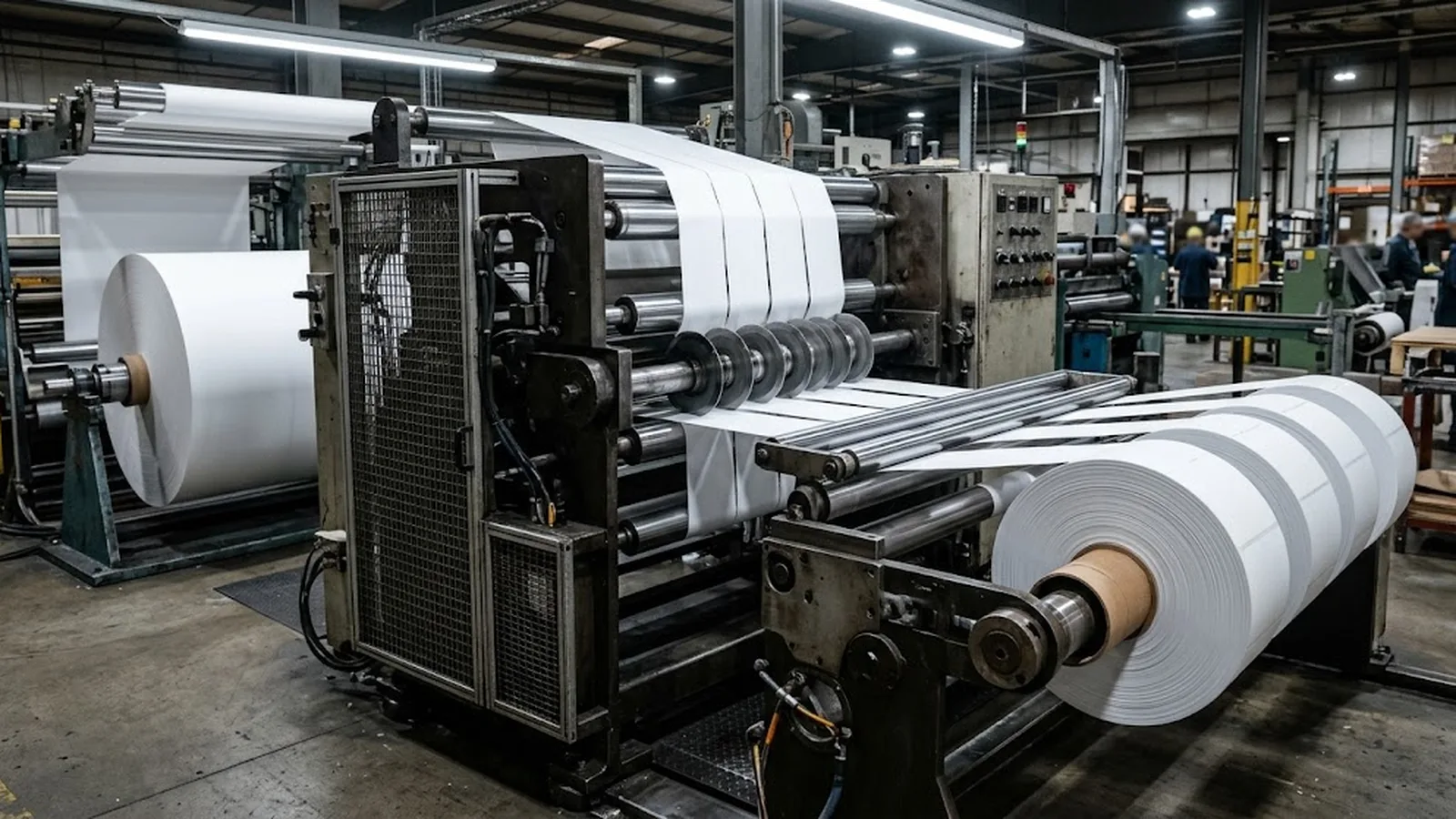
The slit-plan arithmetic works exactly as on any other parent: a 6,000 m parent under a 5 x 108 mm label plan yields 30,000 finished metres, or about 750 rolls at 40 m per label roll; under a 10 x 80 mm receipt plan it yields about 8,500 finished 70 m receipt rolls — but each of those rolls is measurably heavier and stiffer than its 55 gsm counterpart, which is precisely the point of the grade.
For lighter programmes that share the same parent-roll logistics, our 48 gsm lightweight thermal paper documents the lightweight construction, where maximum yield per tonne outranks stiffness.
| Gsm | Paper weight | Typical unwound OD | Area per tonne |
|---|---|---|---|
| 48 gsm | ≈ 230 kg | ≈ 1,050–1,150 mm | ≈ 20,830 m² |
| 55 gsm | ≈ 264 kg | ≈ 1,100–1,200 mm | ≈ 18,180 m² |
| 65 gsm | ≈ 312 kg | ≈ 1,200–1,300 mm | ≈ 15,385 m² |
| 75 gsm | ≈ 360 kg | ≈ 1,250–1,350 mm | ≈ 13,335 m² |
Figures assume typical winding density; individual mills' wind curves vary — confirm OD against your unwind stand's maximum.
Programmes that justify 65 gsm — and those that do not
Label facestock is the natural home of the grade. Direct thermal label webs in 65 gsm carry barcodes through warehouse handling without scuff-grey, feed reliably through dispensers because the stiffer web resists curl-back, and accept top-coat builds that extend scan life in cooler and transit environments. Shipping, shelf-edge and industrial identification programmes are the recurring buyers.
Durable receipt and ticket programmes are the second buyer group. Receipts that must survive in a customer's wallet for months — warranty slips, rental agreements, service records — keep legibility longer on a heavier sheet, and event or transport tickets carrying second-side preprint need the opacity of the 65 gsm build to stop show-through. Both programmes typically pair the grade with a top-coated construction for the retention promise.
The programmes that do not justify it are equally clear: high-volume counter receipts, mobile and compact roll formats, and any application where the sheet is discarded within days. There the extra 18 percent of weight per metre buys freight and nothing else — the grammage ladder exists so that spend lands where function requires it.
- Best fit: label facestock, durable receipts, preprinted tickets, wallet-kept slips.
- Pair with top-coated construction where scan life or retention is specified.
- Poor fit: plain counter receipts and short-life mobile formats.
- Expect ≈ 15 percent less finished area per tonne than 55 gsm arithmetic.
Ordering and auditing a 65 gsm parent
The order frame is five lines plus one policy, identical in structure to every jumbo specification but with grade-sensitive values. GSM with tolerance — 65 ± 1 gsm, because weight consistency between rolls is what keeps every parent's true length equal. Width — the jumbo web width from the slit plan. Core — 76.2 mm standard, wall strength rated for the heavier roll. Length or OD — state the target length and a maximum OD together, since the 65 gsm diameter penalty can push a familiar length past an unwind stand's limit. Joint policy — splices acceptable or not, how flagged, minimum spacing.
Verification takes one floor scale. Because paper weight is grammage x area, the declared length audits as weight x 1,000 ÷ (width mm x gsm) = metres: a 312 kg reading on an 800 mm, 65 gsm parent returns ≈ 6,000 m. Goods-in teams that weigh every parent catch short-wound rolls, grade substitutions and tolerance drift before the slitter ever threads them — and the same arithmetic converts a supplier's per-tonne quote into a per-metre price for direct comparison.
Heavier parents also change the export conversation. Fewer tonnes fit a container at 65 gsm than at lighter grades for the same pallet cube, moisture-barrier packing matters more on longer warehouse dwell, and the pallet plan must respect the higher roll weight. Where container planning is the next step, our export shipping guide covers pallet standards, moisture-barrier packing and the document set for ocean freight.
Procurement teams standardising one grade across several formats can review our custom thermal paper programme, where basis weight, coating construction and packing are documented per grade before an order is placed.
- Five lines: gsm ± 1, width, core, length/OD, joint policy.
- Audit: weight x 1,000 ÷ (width x gsm) = metres — one scale reading per parent.
- Check unwind max OD: 65 gsm winds larger at the same length than lighter grades.
- Export: fewer tonnes per container, moisture-barrier packing, heavier pallet plan.
A 65 gsm order quoted in tonnage and audited in metres is the pairing that keeps the grade's premium honest on both sides of the contract.
Frequently asked questions
What is a 65 gsm thermal paper jumbo roll used for?
It is the parent roll for mid-heavy applications: direct thermal label facestock, durable receipts that must survive wallet and handling wear, and tickets carrying second-side preprint that needs opacity. Plain high-volume counter receipts normally stay on 48–55 gsm stock.
How much does a 6,000 m jumbo roll of 65 gsm thermal paper weigh?
On an 800 mm web, about 312 kg of paper plus core and packaging — one metre weighs 0.8 x 65 = 52 g, so 6,000 m ≈ 312 kg. The same length in 55 gsm weighs about 264 kg and in 48 gsm about 230 kg.
How much less yield does 65 gsm give per tonne than lighter grades?
One tonne of 65 gsm covers about 15,385 m², versus roughly 18,180 m² at 55 gsm and 20,830 m² at 48 gsm — about 15 percent less area than 55 gsm arithmetic and 26 percent less than lightweight arithmetic.
How do I verify the length of a 65 gsm jumbo roll?
Weigh the roll on a floor scale and compute weight x 1,000 ÷ (width mm x gsm) = metres. A 312 kg reading on an 800 mm wide, 65 gsm parent returns about 6,000 m. Weighing every parent at goods-in catches short winding, grade substitution and tolerance drift.
Should receipt programmes upgrade from 55 to 65 gsm?
Only when the receipt must survive handling — wallet-kept warranty slips, rental and service records — or when the programme doubles as ticket stock. For discarded counter receipts the extra grammage buys freight cost with no functional return; the grade earns its premium on stiffness, opacity and durability.