
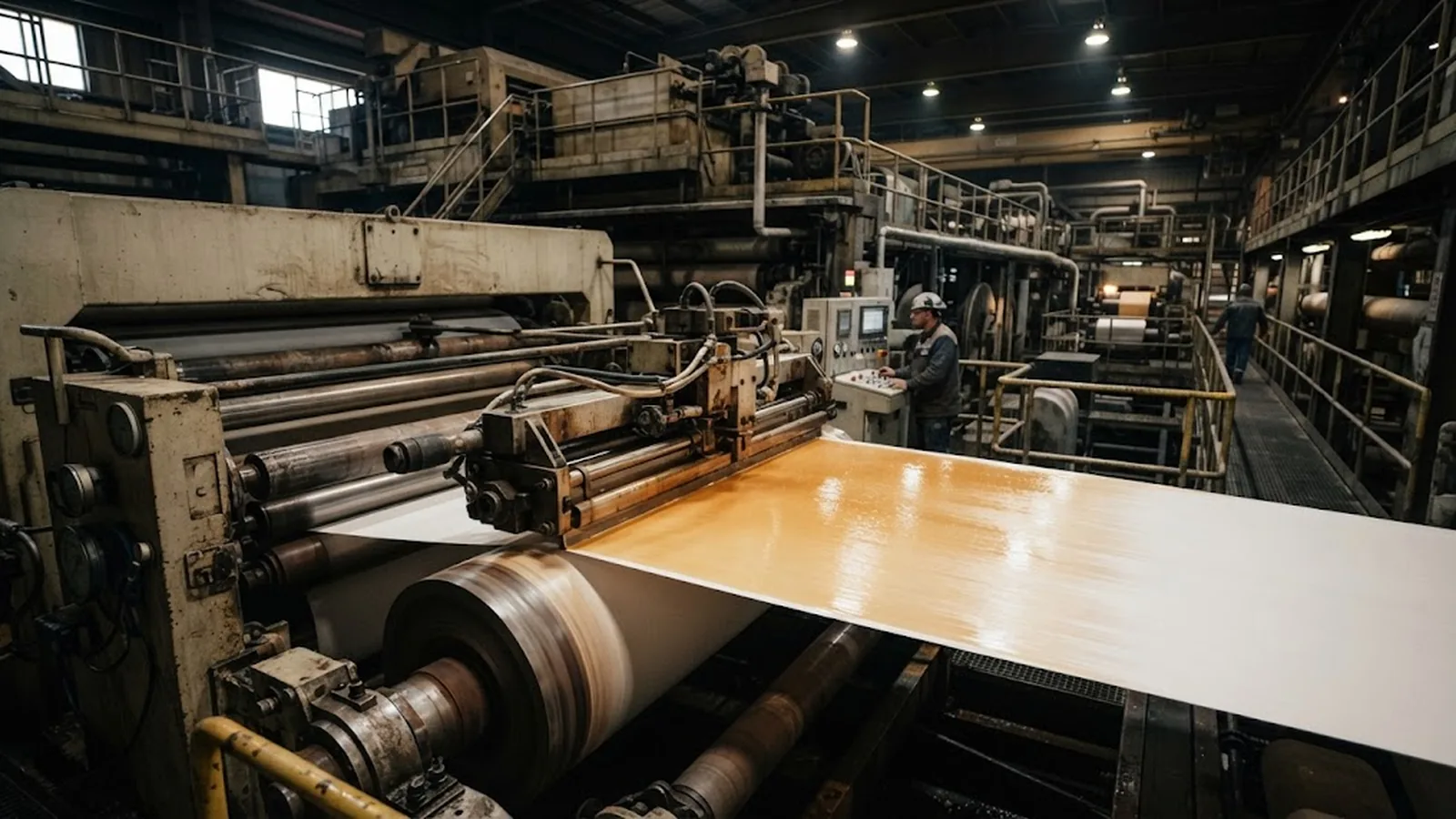
The coating system is where thermal paper earns its name. The sensitive layer carries four functional families of ingredients — leuco dye (the colour former), developer (the acidic partner that turns it black on heating), sensitiser (which lowers the activation temperature) and binder (which anchors the film to the paper). Above it, an optional topcoat adds water, oil, abrasion and plasticiser resistance; below it, an optional backcoat manages curl, friction and static. Coatings are applied as liquids in a metering process and dried to films measured in micrometres, with coat weights specified in grams per square metre and controlled to tight tolerances. Because a few grams per square metre of variation shifts sensitivity, print density and image life, buyers should treat coating data as the core of a thermal paper specification: coat weights, density test results and accelerated-ageing figures are the difference between comparable quotations and blind ones.
Two rolls of thermal paper can share a grammage, a width and a price, and still not be the same product — because the product is the coating. Everything a buyer ultimately experiences, from print darkness to shelf behaviour to how long a shipping label stays scannable, is decided in a few micrometres of chemistry applied onto the paper surface.
Yet coating is the least transparent part of most thermal paper quotations. 'Top-coated' appears as a checkbox, not a specification; nothing is said about what is in the sensitive layer, at what coat weight, applied on what kind of equipment. This guide opens that box: what each coating layer contains, what each ingredient does, how the coatings are applied and controlled in production, and which tests a buyer can legitimately demand.
The angle here is technical by design — this is the companion to the buying-side comparison of coated versus uncoated grades, and to the structural anatomy of the sheet. Here we stay inside the coating itself: formulation, application and quality control.
- The sensitive layer combines leuco dye, developer, sensitiser and binder — each ingredient family maps to a print property.
- Sensitiser package sets the energy a print head needs; mismatched sensitivity reads as grey print, not bad machines.
- Topcoat and backcoat are functional engineering layers: protection above, curl and friction control below.
- Coat weights are single-digit gsm figures controlled to tight tolerance — small deviations shift density and image life measurably.
- Buyers should demand coating QC evidence: print density, background ageing, and accelerated image-retention results.
Inside the sensitive layer: the chemistry
The thermal coating is a solid-state chemical system held in suspense. The colour former is a leuco dye — a molecule that is colourless in one chemical state and dark in another. It cannot develop on its own; it needs the developer, typically an acidic phenolic compound (or, in phenol-free formulations designed to address BPA/BPS concerns, alternative co-developer chemistries). At room temperature the two sit together without reacting, stabilised by the formulation.
Between them sits the sensitiser — a compound whose job is to lower the temperature at which dye and developer melt and react together. This is what tunes a grade to a print head class: a well-matched sensitiser package lets an efficient thermal head produce full black density at normal energy settings, while a mismatched one produces the familiar grey, under-developed print that end users wrongly blame on the machine.
Holding it all together is the binder — the polymer that anchors the pigment-and-chemistry film to the precoat beneath it, controls porosity so the chemistry does not migrate, and governs how the surface behaves under the mechanical rub of transport and feeding. Binder selection quietly sets much of a grade's rub resistance and ageing behaviour, which is why two grades with identical dye systems can still age differently.
- Leuco dye — the colour former; switches from colourless to black on reaction.
- Developer — the acidic partner (phenolic or phenol-free chemistry) that triggers the colour state.
- Sensitiser — lowers activation temperature; matches the coating to the print head's energy class.
- Binder — anchors the film, controls porosity and migration, sets rub and ageing behaviour.
Topcoat and backcoat: functional engineering
Over the sensitive layer, the topcoat is a micrometres-thin protective film. Functionally it is a barrier system: it slows water vapour ingress, resists oils and plasticisers that would otherwise migrate into the dye system and fade the image, shrugs off abrasion from rollers, transport and handling, and buffers incidental heat and light. It is the single biggest lever on image retention — top-coated grades with documented ageing data routinely deliver several times the usable image life of equivalent uncoated stock.
Beneath the sheet, the backcoat is the complementary control layer. A balanced backcoat counteracts the natural tendency of a one-side-coated sheet to curl toward the coated face as humidity changes; friction-modifying backcoats keep rolls feeding cleanly at speed; and in label converting, back coatings help manage static that would otherwise misfeed die-cut labels. Backcoat choice is climate- and process-driven — it earns its cost in tropical warehouses and high-speed converting lines more than in a temperate retail back office.
The engineering point for buyers: these layers are tunable, not binary. A supplier running its own coating line can weight the topcoat toward water resistance for a cold-chain label application or toward abrasion for a logistics sortation environment, and select backcoat chemistry for the destination climate. Resellers cannot offer that flexibility because they do not control the formulation.
How coatings are applied and controlled
Thermal coatings start as carefully dispersed liquid formulations — chemistry, pigments and binders in water — applied onto the moving web by a metering coating process that sets film thickness with high precision, then dried in ovens and calendered to final smoothness. Consistency comes from two disciplines: the dispersion quality of the formulation, and the coat-weight control of the application. A poorly dispersed batch prints unevenly; a drifting coat weight shifts sensitivity web-wide.
Coat weights are specified in grams per square metre, and the numbers are small — the sensitive layer is typically a single-digit gsm coating, with topcoat and backcoat each around 1–2 gsm. Against those magnitudes, control tolerance is everything: a deviation that sounds trivial on a spec sheet is a measurable shift in print density or background ageing. This is why serious manufacturers run continuous coat-weight measurement and statistical control on their coating lines rather than spot-checking finished rolls.
For a buyer auditing a supplier, the questions that matter: Is coating done in-house or purchased in? What coat weights are standard, and what tolerance is held? Is coat weight measured on-line or by laboratory sampling? The precision of the answers is a direct proxy for the precision of the product.
| Coating layer | Indicative coat weight | Control focus | Buyer-visible effect |
|---|---|---|---|
| Sensitive layer | single-digit gsm | Dispersion quality; coat weight tolerance | Print density, sensitivity, colour |
| Topcoat | ~1–2 gsm | Barrier uniformity; coat weight | Image life, water/oil/abrasion resistance |
| Backcoat (optional) | ~1–2 gsm | Balance against coated side; friction level | Curl, feeding reliability, static |
Coating quality: the tests buyers should demand
Because coating quality cannot be judged by looking at a roll, specification has to lean on measurement. The first family is print performance: optical density of the printed image against a reference print head (typically quoted as OD units, with good grades achieving high, uniform density), sensitivity expressed as the energy needed for full development, and print uniformity across the web width.
The second family is stability: background ageing — how much unprinted areas darken under elevated temperature and humidity — and image retention under accelerated ageing, which projects how long printed content stays readable. The third family is mechanical and environmental: rub resistance of the dried coating, water and oil resistance for top-coated grades, and curl behaviour through humidity cycling.
A manufacturer with its own coating and QC laboratory supplies these numbers routinely, per production lot, in report form. A trader supplies brochures. When a coating specification arrives with named test methods and lot-level results rather than adjectives, the price difference — if any — is the cheapest quality insurance in the paper trade.

Rule of thumb: any coating claim without a test method attached is a marketing statement, not a specification.
Frequently asked questions
What chemicals are in the thermal coating?
Four functional ingredient families: a leuco dye as the colour former, an acidic developer (phenolic or phenol-free chemistry) that turns the dye black on heating, a sensitiser that lowers the activation temperature, and binders plus fine pigments that anchor the film to the paper. Formulation quality and dispersion control decide how consistently the system performs.
What does the topcoat on thermal paper actually do?
It is a thin barrier film over the sensitive layer that resists water, oils, plasticisers and abrasion, and slows heat and light reaching the image. A good topcoat multiplies practical image life several times and is the specification behind durable logistics labels and records.
Why does coat weight matter so much?
Coatings are measured in single-digit grams per square metre, and print behaviour shifts measurably within that range. Too little sensitive-layer coating starves the image; drifting topcoat weight changes protection levels. Tight coat-weight tolerance is what makes one roll print like the next.
What is a backcoat for?
Balancing the sheet against curl (one-side coating naturally pulls the sheet as humidity changes), controlling friction for clean high-speed feeding, and managing static in label converting. It is worth specifying for humid climates, long warehouse storage and fast converting operations.
How can I compare coating quality between suppliers?
Demand numbers with methods: print density against a reference head, sensitivity for your machine class, background ageing and accelerated image-retention results, plus rub, water and oil resistance for coated grades. Lot-level test reports from an in-house lab are the strongest supplier signal.