
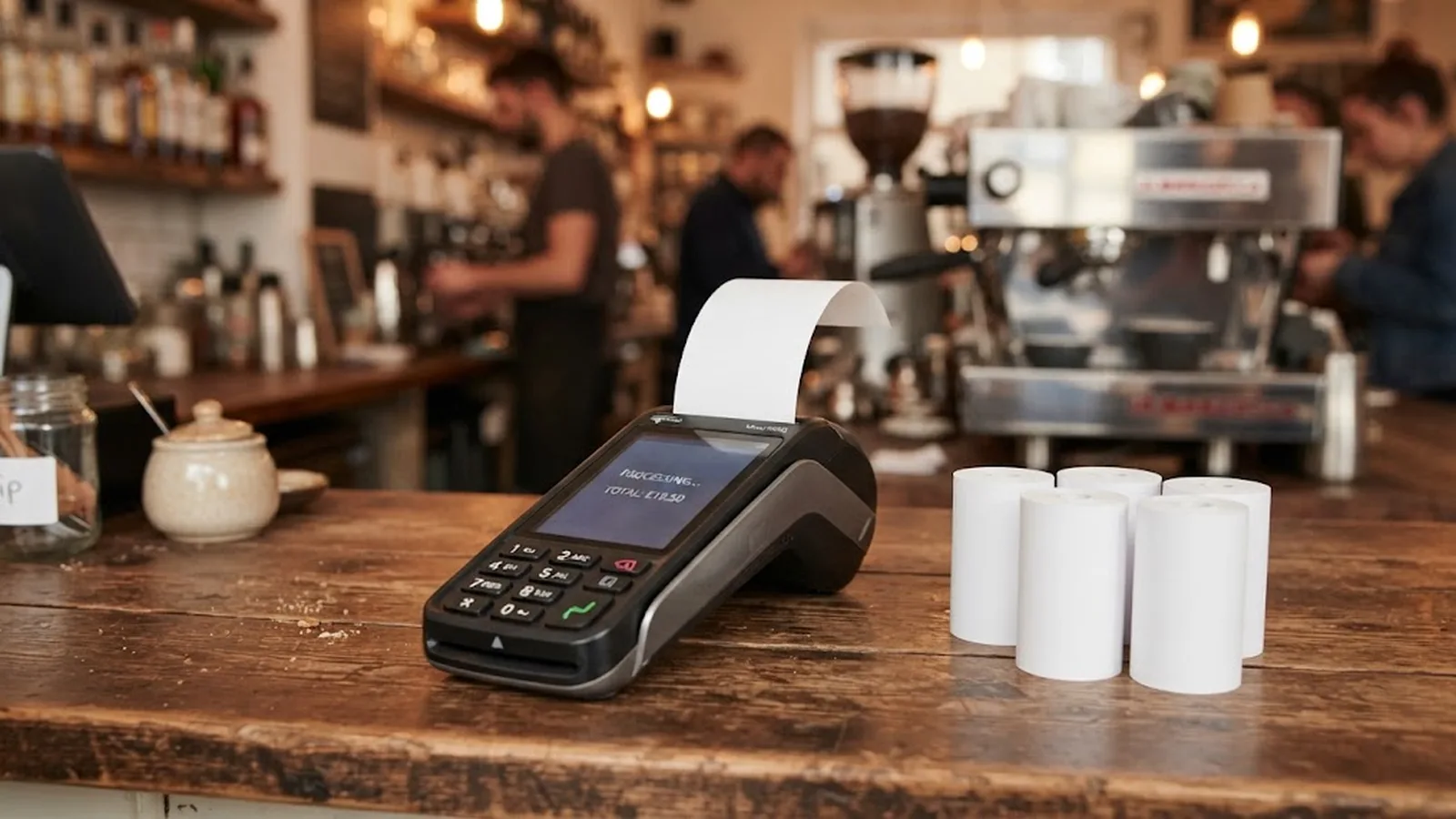
A payment terminal paper roll is the narrow direct-thermal roll — typically 2 1/4 inch (57 mm) wide, on a small core with a limited outside diameter — sized to the specific card machine family it feeds. The specification that matters is not width alone but the full geometry: width, core size, roll diameter and wind direction, because a terminal's tight paper path jams with oversized rolls and its sensor misses undersized ones. Countertop EFTPOS and EDC machines take taller rolls for fewer changes; mobile and handheld terminals take shorter, lighter rolls to keep the device pocketable. Stock should be 55 gsm class, top-coated where receipts face wallets and heat, and every programme should be matched terminal-family by terminal-family rather than bought as generic 'card rolls'.
Every completed sale ends with a slip of paper, which makes the payment terminal paper roll one of the highest-frequency consumables in commerce — changed more often than till rolls in most venues, stocked by acquirers and ISOs by the pallet, and judged by merchants on a single criterion: it must not jam mid-transaction. Yet the product looks deceptively simple, and much of what is sold against card machines is generic stock that fits the width but fails on geometry.
The terminal environment is tighter than any receipt printer's. Paper paths curve through compact mechanisms, the print head sits close to the housing, and the roll cavity leaves no room for a sloppy wind or an over-tall spool. Add the fleet reality — a bank or ISO deploying thousands of mixed countertop and mobile terminals, each family with its own cassette dimensions — and the paper roll becomes a fleet-management decision, not a stationery order.
Procurement teams standardising on one supplier can review our POS and receipt paper rolls alongside the comparisons in this guide, where roll geometry is documented per specification sheet before an order is placed.
This guide covers the formats that dominate card machines worldwide, why roll geometry rather than width is where fit fails, how gsm and coating choices show up in jam rates and scan life at the counter, and the stocking maths that keeps a mixed terminal fleet supplied without dead stock.
- Specify the full geometry — width, core, outside diameter and wind direction — per terminal family; width alone does not guarantee fit.
- 2 1/4 inch (57 mm) is the dominant card-terminal width; countertop EFTPOS/EDC machines take taller rolls, mobile terminals shorter and lighter ones.
- 55 gsm class stock balances roll capacity against feed reliability; heavyweight stock reduces changes per shift but costs cavity space in mobile devices.
- Top-coated construction earns its premium on terminal receipts because slips live in wallets and pockets — scan life is a customer-service issue, not just a chemistry issue.
- Acquirers and ISOs should stock by terminal-family mix and standardise cores and winding, or jam complaints will dominate the support queue.
The formats: what actually feeds a card machine
Two width families cover most of the world's card terminals. The 2 1/4 inch family — 57 mm nominal, with usable widths from about 50 to 55 mm depending on the mechanism — is the card-payment standard from countertop EFTPOS machines to handheld EDC terminals. A handful of countertop and unattended payment devices run the 80 mm (3 1/8 inch) class instead, usually where the terminal doubles as a full receipt printer at a service counter. Both are direct thermal: no ribbon, no ink, image developed by the head on contact.
Width is the visible number; geometry is the working one. Core size determines how much paper winds into a given cavity and how the roll sits on the spindle — a 12.7 mm core and a 10 mm core are not interchangeable in machines with fixed spindles. Outside diameter decides rolls per cassette and changes per shift; a terminal specified for a 40 mm OD will jam with a 50 mm spool long before the merchant sees the capacity benefit. Wind direction — paper out from the front or back of the roll — is fixed by the mechanism and silently flips a functional roll into a non-functional one.
Roll length is the arithmetic that follows. A typical 2 1/4 x 50' roll yields roughly 130–160 slips depending on receipt length; mobile-terminal rolls are shorter to keep device weight and cavity size down, trading changes per day against pocketability. Distributors serving mixed fleets should publish a fit chart per terminal family rather than a single 'card machine roll' SKU — the fastest way to cut both misorders and returns.
For production volumes, the same construction logic applies to our thermal paper jumbo rolls, quoted per jumbo roll, slit reel or finished format, so converters can feed several terminal formats from one certified coating source.
Gsm, coating and the jam-rate conversation
Basis weight in terminal rolls is a trade between capacity and feed behaviour. The 55 gsm class is the mainstream: light enough to keep roll counts high in a small cavity, stiff enough that the mechanism picks the leading edge reliably. Drop below the low 50s and thin stock can curl or slip at the feed; climb into the 60s and 70s and each roll carries fewer metres, forcing more frequent changes in exactly the high-traffic venues where changes are most unwelcome. The honest specification states the class and the tolerance, and validates on the terminal family in question — the same discipline any coating change demands.
Coating choice shows up at the customer's wallet. Terminal receipts travel in pockets, bags and car consoles, where friction, heat and hand-creams attack an uncoated image long before the merchant's reconciliation window closes. Top-coated construction holds scan-grade contrast through that life, which matters for chargeback evidence, expense documentation and any receipt the customer may need to read a month later. Uncoated stock remains a legitimate cost choice where slips are reprinted or photographed at the counter and the image's job ends the same day.
Sensitivity deserves a sentence in any fleet programme: terminals are battery-constrained, and mobile EDC devices manage head energy aggressively. A stock matched to the device's energy window prints full-density slips at speed and stretches battery life; an undersensitive stock forces higher energy and shows faint prints on cold mornings. This is why samples should be run on the actual terminal models in the fleet before volume is committed — a datasheet cannot simulate a Sydney winter on a delivery bike.
| Device class | Typical format | Stock class | Coating | Key constraint |
|---|---|---|---|---|
| Countertop EFTPOS / EDC | 2 1/4 in, taller OD (e.g. 57 x 40 mm class) | 55 gsm class | Top-coated preferred | Changes per shift; jam-free feed |
| Mobile / handheld terminals | 2 1/4 in, short OD, light roll | 55 gsm class | Top-coated | Device weight; battery head energy |
| Unattended / self-service pay | 2 1/4 in or 80 mm, high-capacity | 55–65 gsm | Top-coated | Unattended uptime; outdoor heat |
| Integrated counter devices | 80 mm (3 1/8 in) class | 55–65 gsm | Application-dependent | Shared with till-roll stock |
Stocking a mixed fleet: the acquirer and ISO maths
Fleet operators think in changes per venue per week. A café on one countertop terminal burns a roll every few days; a delivery fleet of handheld terminals burns one per shift per device. Mapping the installed base by terminal family and duty level turns the paper programme into a forecastable consumable schedule — and exposes the real cost driver, which is rarely the unit price of the roll and almost always the service friction of a failed or misfitted one.
Standardisation is where the leverage sits. Fixing core size, winding and tolerance across the stocked range lets one warehouse pick for every terminal family, cuts misfit returns to near zero, and makes per-venue auto-replenishment practical. Distributors who add fit charts and terminal-family SKUs to their listing see the effect immediately: fewer wrong orders, fewer support tickets, and merchants who reorder on schedule because the product simply works.
Compliance rides along in the same carton. Terminal slips are the receipts customers carry home, and retail groups increasingly write BPA-free requirements into their acquiring and merchant-services contracts; phenol-free developer systems are the specification that stays ahead of the restriction curve in every current market. Specifying the developer class alongside the geometry — one line on the purchase order — closes the question for the life of the programme.
Where a programme needs several formats from one supplier, our custom thermal paper programme covers width, core, roll diameter and developer class in a single specification sheet, so mixed fleets can be quoted and supplied under one agreement.
Where image life is the deciding factor, our top-coated vs non top-coated guide compares the two constructions on retention, cost and machine behaviour.
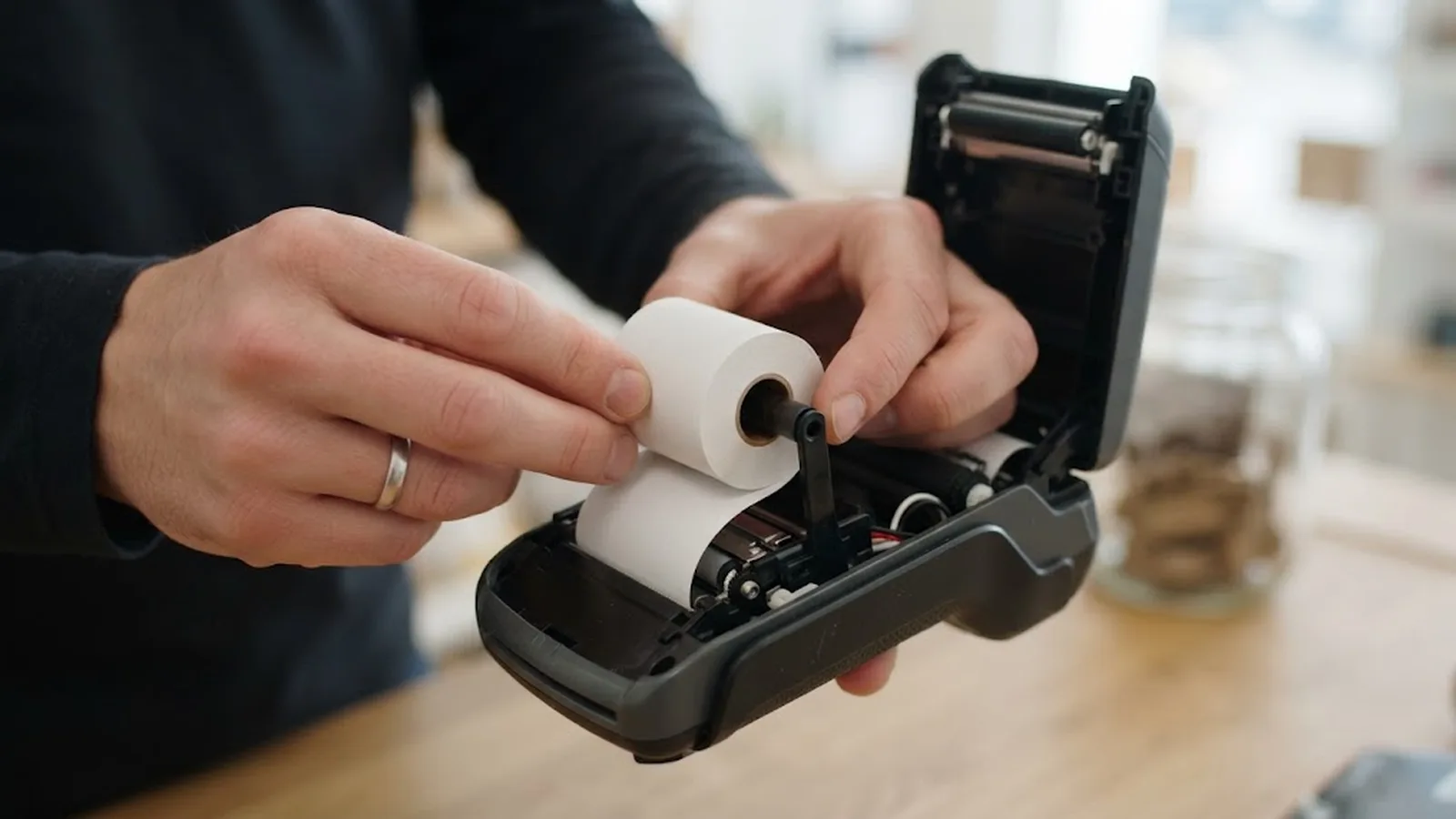
Order-line shorthand that prevents most fit complaints: '2 1/4 in x [OD] mm, core [size] mm, wind out front, 55 gsm class, top-coated, BPA-free developer — matched to [terminal family] per fit chart.'
Frequently asked questions
What size paper roll does a card payment terminal use?
Most card machines use the 2 1/4 inch (57 mm nominal) width family, with the core size and outside diameter varying by terminal model; some countertop and unattended devices take 80 mm (3 1/8 inch) rolls. Check the terminal family's fit chart rather than buying by width alone — OD, core and wind direction determine whether the roll actually feeds.
Why does my terminal jam with rolls that fit the width?
Fit is geometry, not just width. An oversized roll binds in the cavity, a wrong core size misaligns the spindle, a heavy stock resists the feed mechanism, and reversed winding feeds the back of the paper to the head. Match the full specification — width, core, OD, weight and wind — to the terminal model.
What gsm should payment terminal paper be?
The 55 gsm class is the mainstream choice, balancing roll capacity against reliable feeding in compact mechanisms. Heavier stock cuts changes per shift in countertop devices; mobile terminals usually stay light to preserve device weight and cavity space.
Do card terminal receipts need top-coated paper?
Top-coated stock is recommended wherever receipts live in wallets and pockets, because it holds the image through friction, heat and moisture. If slips are reconciled and photographed the same day, uncoated stock is a legitimate cost saving.
Can one supplier cover several terminal models?
Yes — a converter slitting from jumbo stock can produce each terminal family's geometry from the same coating source, provided each format's width, core, OD and wind are specified. This is how acquirers and ISOs standardise paper supply across mixed fleets.