
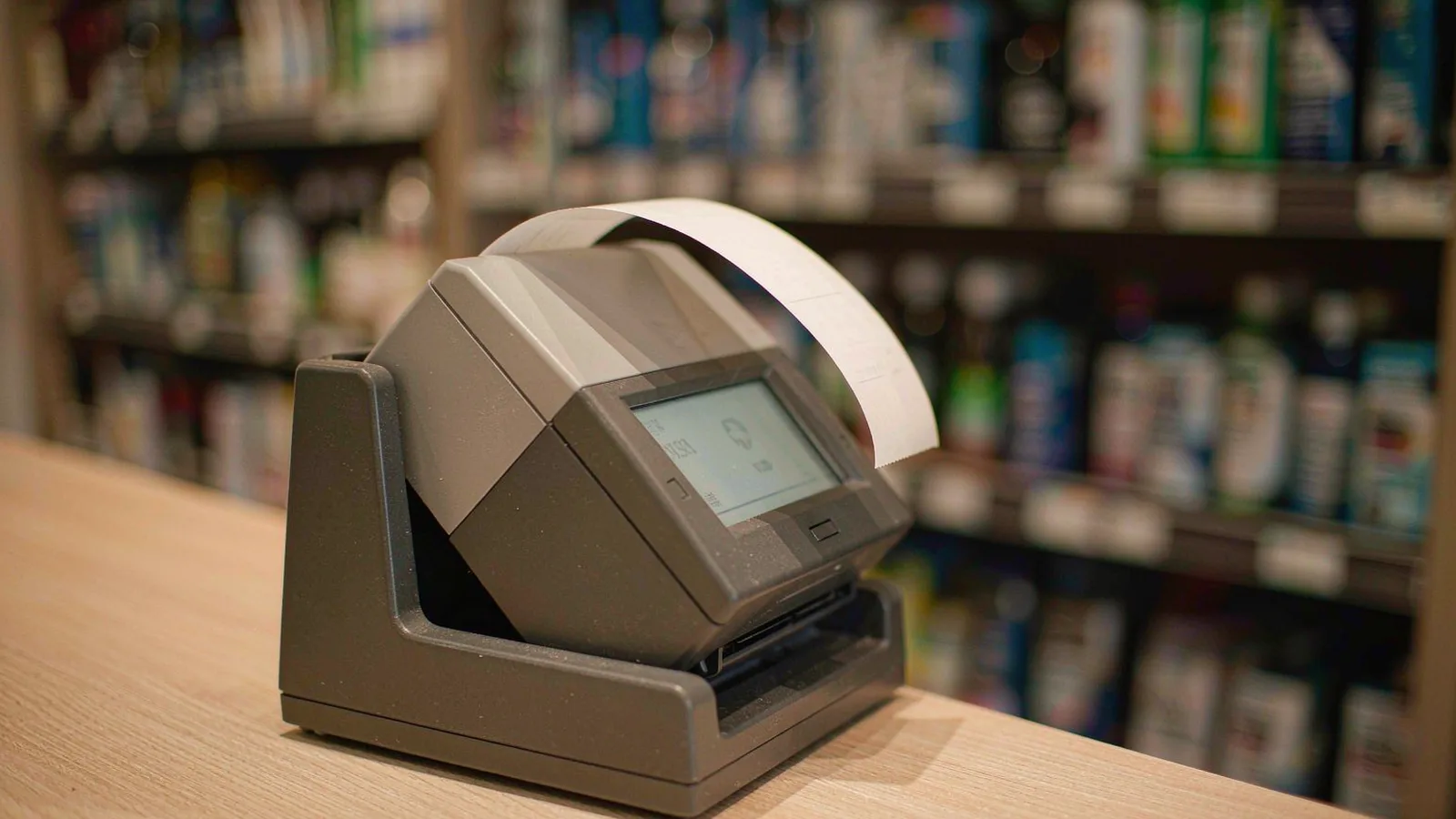
Card machine thermal paper is the compact receipt stock for payment terminals: mostly the 57 mm class (2 1/4 inch, 57.5 mm wide) in short lengths of roughly 18-45 m on 12.7 mm or smaller cores, alongside 80 mm rolls for countertop terminals in mixed fleets. The binding constraints are the terminal cavity — outer diameter and core must clear the bay or the lid will not close — and the end-of-roll warning mark printed near the core that tells staff to change the roll before transactions print blind. Because merchant receipts must stay legible for returns, reconciliation and tax inspection, developer system and image life belong in the specification alongside width and length, verified in writing rather than assumed.
A card terminal is the paper consumer nobody plans for. Retailers budget for counter receipt stock, then a fleet of handheld terminals appears — one per lane, per delivery driver, per market stall — each burning through a compact roll every few days and each failing in its own quiet way when the paper is wrong: lids that will not close, receipts that fade before reconciliation, transactions that print blank because nobody noticed the roll had run out.
Card-terminal paper is therefore its own vertical inside the receipt world. The rolls are shorter and narrower than countertop stock, the cavities are unforgiving on core and outer diameter, the winding conventions matter more because reloads happen hourly, and the image must survive longer than a customer's pocket — merchant copies feed returns, disputes and tax records. Specification discipline that works for counter rolls does not transfer automatically.
This guide covers the vertical end to end: why handheld terminals are a distinct paper category, the roll formats across a typical fleet, the cavity constraints including the end-of-roll warning mark, image stability expectations for merchant records, and the specification lines plus procurement mistakes that separate a clean terminal programme from a complaint-generating one. Where a programme needs several formats from one supplier, our POS and receipt paper rolls covers width, core, roll diameter and developer class in a single specification sheet.
- Handheld card terminals take the 57 mm (2 1/4 inch) class; countertop terminals take 80 mm rolls — mixed fleets need both SKUs.
- The cavity decides the roll: outer diameter and core must clear the bay, or the lid will not close and the paper will not feed.
- End-of-roll warning marks are printed at slitting; thin jumbos slit without them leave terminals printing blind.
- Merchant receipts need image life for returns, reconciliation and tax records — confirm developer class and retention in writing.
- Compare quotations on metres per roll and actual core size, not on rolls per carton.
Why card terminals are their own paper vertical
The defining difference is consumption pattern. A countertop receipt roll lasts a lane a week; a 57 mm handheld roll lasts a busy operator a day or two. Reloads happen mid-shift, often by staff with no training, so every design friction — a stiff roll, a lid that needs two hands, an oversize diameter that wedges in the bay — multiplies across a fleet. Paper that is merely adequate on a counter bench becomes a support-ticket generator in a pocket terminal.
The physical platform differs too. Handheld terminals run on battery, with compact print mechanisms, narrow platen rollers and tight thermal envelopes. Roll weight and diameter are engineered limits, not preferences: a few millimetres of over-diameter either jams the feed or prevents the lid from sealing, and a light-duty mechanism shows the paper's stiffness differently than a countertop unit does. Developers and coatings that behave perfectly on an 80 mm counter stock can feed or image differently in the small, fast-moving mechanism of a handheld — which is why terminal-grade stock is qualified per class, not borrowed from counter programmes.
Finally, the merchant copy has a duty the customer copy does not. Returns, chargeback disputes, end-of-day reconciliation and statutory record-keeping all read from receipts the merchant keeps — often filed in a drawer, a pocket or a warm till, exactly the conditions that degrade uncoated thermal images fastest.
- Reload frequency in handhelds is an order of magnitude higher than countertop lanes.
- Cavity limits on core and OD are hard constraints, not tolerances to stretch.
- Merchant copies carry returns, disputes and tax duties — image life is contractual, not cosmetic.
Roll formats across the terminal fleet
Two naming conventions describe the same handheld format: metric markets say 57 mm class (actual width 57.5 mm, tolerance +0/-0.5), imperial markets say 2 1/4 inch. Length codes then split by market habit — metric markets code width by diameter or length, imperial markets code width by feet of paper (2 1/4 x 50 ft ≈ 15 m, and so on). Under either convention, the physical envelope is the same small roll: 57.5 mm wide, roughly 18 to 45 metres of paper, on cores from 7 mm to 12.7 mm depending on the terminal family.
Mixed fleets are the norm rather than the exception: 57 mm rolls in handhelds and delivery terminals, 80 mm rolls (60 or 80 outer diameter) in countertop units at fixed lanes. The two share facestock grade and developer system but not geometry, so buyers hold them as separate SKUs with separate verification — the most common cross-order error is an 80 mm roll forced into a 57 mm bay because a purchasing template only had one line.
| Format | Width | Paper length | Core | Typical terminal class |
|---|---|---|---|---|
| 57 x 30 | 57.5 mm | ≈ 18 m | 10 mm | Compact handheld terminals |
| 57 x 38 / 2 1/4 x 50 ft | 57.5 mm | ≈ 25 m | 12.7 mm | Standard handheld card terminals |
| 57 x 50 | 57.5 mm | ≈ 38 m | 12.7 mm | Longer-run handhelds, delivery fleets |
| 57 x 60 | 57.5 mm | ≈ 45 m | 12.7 mm | Extended-capacity handhelds |
| 80 x 60 / 80 x 80 | 80 mm | ≈ 38-60 m | 12.7 mm | Countertop payment terminals |
Lengths are approximate and vary with caliper — verify metres per roll on the specification sheet rather than trusting diameter codes alone.
Cavity constraints: core, outer diameter and the end-of-roll warning mark
Every handheld terminal publishes a media envelope: roll diameter the bay will accept with the lid closed, core inner diameter the spindle grips, and maximum roll width. These are not negotiable from the paper side. A roll 2 mm over on diameter either binds the feed path or pops the lid; a core one size off spins on the spindle or seizes on it. Because handheld bays are the tightest cavities in receipt printing, the diameter check matters more here than anywhere else in the paper programme — verify it per terminal model, per SKU, at first article and at every source change.
The end-of-roll warning mark is the specification line most often missing from cheap terminal stock: a printed stripe running across the roll roughly one to two metres before the paper ends, giving staff a visual cue to reload before the mechanism prints on bare core. The mark is printed at slitting on the finished roll — it cannot be added afterwards, and rolls slit from thin or re-wound jumbos frequently ship without it. The symptom downstream is always the same: a queue of customers watching a terminal print blank strips, and staff who only discover the problem at the worst moment.
Our custom thermal paper programme publishes the test data behind each grade, so specifications can be verified against the mill's own measurements rather than a catalogue claim.
- Verify per model: max roll OD, core ID, max width — then freeze them on the PO.
- End-of-roll warning mark: printed stripe 1-2 m before core end; state it explicitly.
- Winding direction (paper-out standard) confirmed once per terminal family.
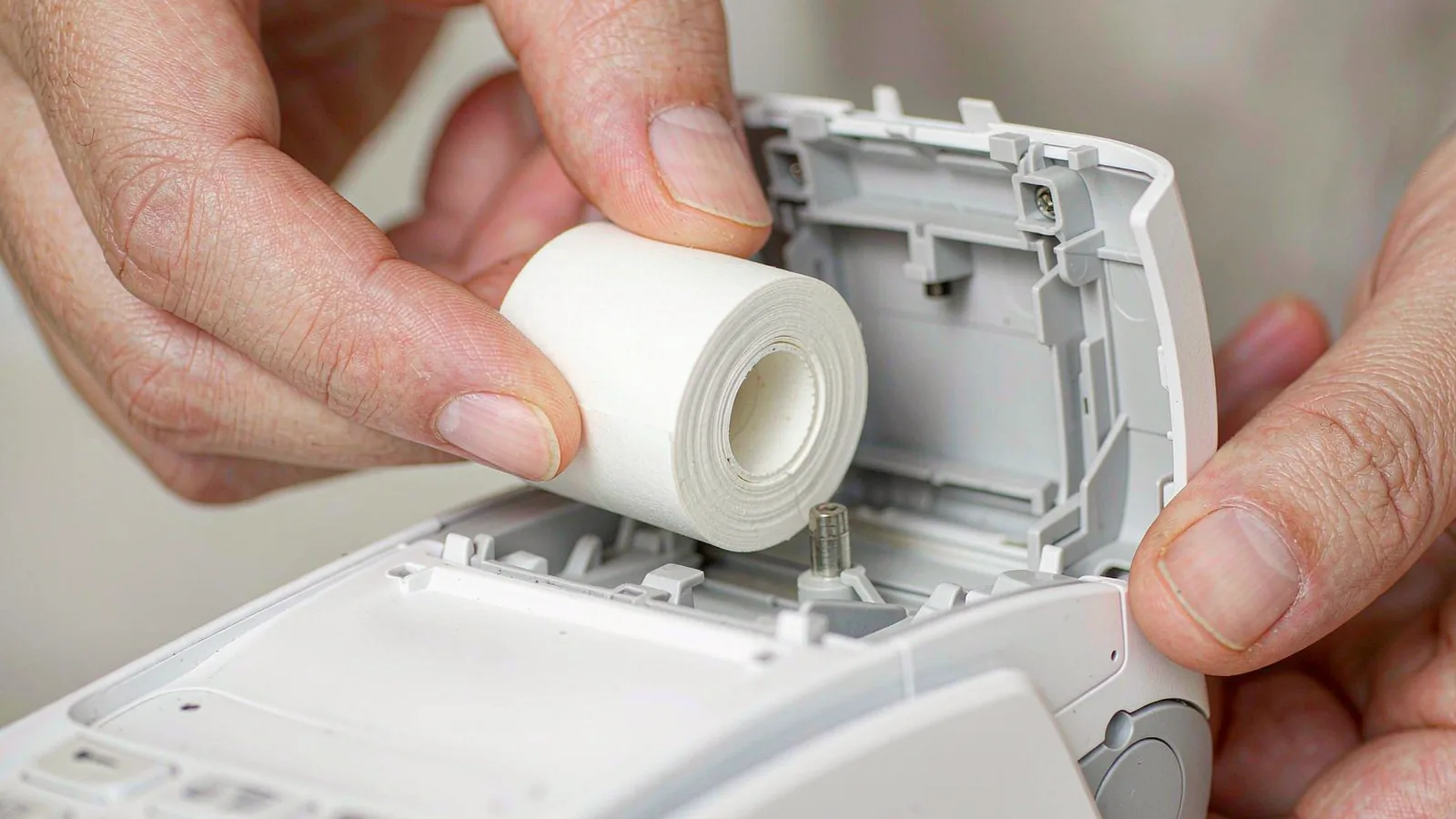
Image stability for merchant records
Merchant copies live in hostile conditions. They are filed in drawers, folded into till books, carried in apron pockets and stored near heat sources in back offices. Uncoated thermal images survive that treatment poorly — friction alone can ghost a receipt legible on the day it printed into a blur six months later. Where records must remain legible for two to seven years under local tax practice, the facestock decision belongs to the programme, not the operator: top-coated stock with a protective overlayer resists friction, moisture and mild chemical exposure, and it is the default for merchant-heavy fleets.
Developer system is the compliance half of the same decision. A BPA-free baseline is now table stakes in every regulated market; retail-chain policies increasingly require phenol-free (BPS-free) constructions as well. Both claims belong on the purchase order as written declarations — the developer class per grade, backed by the supplier's test reports against destination-market requirements — so the merchant can answer the 'what is on this receipt' question with a document instead of a shrug.
Retention expectations also shape grade choice: heavier, denser stocks image darker and resist handling wear better than thin economy grades, and the difference shows up years later in filed merchant copies. Buyers who test archived samples from real storage conditions — not just fresh-print lab tests — catch the difference at qualification stage instead of at audit stage.
- Top-coated facestock for merchant copies filed or carried long-term.
- BPA-free baseline; phenol-free where retail policy or market regulation requires.
- Declarations per grade in writing, backed by test reports per destination market.
- Validate retention with archived samples from real storage, not fresh prints alone.
Spec discipline and the mistakes that cost money
The recurring failures in terminal paper programmes are specific and avoidable. Thin or re-wound jumbos slit without end-of-roll warning marks — the single most common complaint from handheld fleets. Wrong core size ordered because two terminal families in the same fleet use different spindles. Unverified metres per roll, where diameter codes hide a 15 percent shortfall. Missing winding direction, causing rolls that thread backwards in half the fleet. And no image-life specification at all, surfacing years later as faded merchant records. Each is fixed by a written specification line, not by supplier goodwill.
Grade choice follows the same discipline. Heavier stock earns its cost where receipts are archived or handled repeatedly; lighter stock suits customer-copy-dominated fleets with high reload frequency. Where merchants prefer a heavier receipt stock for durability, compare grades on the same written basis as width and length. Procurement teams standardising on one supplier can review our 75 gsm heavyweight thermal paper alongside the comparisons in this guide.
Where image life is the deciding factor, our top-coated vs non top-coated guide compares the two constructions on retention, cost and machine behaviour.
- Warning marks, core, metres per roll, winding and developer class — all five on the PO.
- Match grade weight to retention duty: heavier stock for archived merchant copies.
- First-article check on the actual terminal model before fleet-wide release.
- Re-verify on every source change; terminal bays forgive nothing.
Terminal paper programmes are won on five written lines — warning mark, core, metres, winding, developer class — and lost on the one line nobody wrote down.
Frequently asked questions
What size paper does a card machine use?
Most handheld card terminals take the 57 mm class (57.5 mm actual width, called 2 1/4 inch in imperial markets) in lengths of roughly 18-45 m on 7-12.7 mm cores. Countertop payment terminals take 80 mm rolls instead. Always confirm the terminal's media envelope — max roll diameter, core and width — before ordering, since bays vary by model.
What is the end-of-roll mark on card terminal paper?
A printed stripe across the roll, roughly one to two metres before the paper ends, that warns staff to reload before the terminal prints on bare core. It must be printed at slitting during converting. Stock slit without the mark causes the classic complaint of terminals printing blank strips mid-transaction.
Why does card machine paper fade?
Heat, friction and chemical exposure degrade the thermal image. Merchant copies fade fastest because they are pocketed, folded and stored in warm back offices. Top-coated facestock with a protective overlayer, a documented developer system and sensible storage (cool, dry, away from solvents) extend legibility from months to years.
How many receipts does a terminal roll print?
Divide metres per roll by average receipt length. A 57 x 38 roll holding about 25 m prints roughly 150-250 receipts at typical 100-150 mm terminal receipt lengths. Buy on verified metres per roll — diameter codes alone can hide a 15 percent shortfall between suppliers.
Can I use 80 mm rolls in a handheld card terminal?
No. Handheld bays are built for the 57 mm class — an 80 mm roll will not fit the cavity or feed the narrow mechanism. Mixed fleets need both SKUs held separately, each verified against its own terminal family's media envelope.