

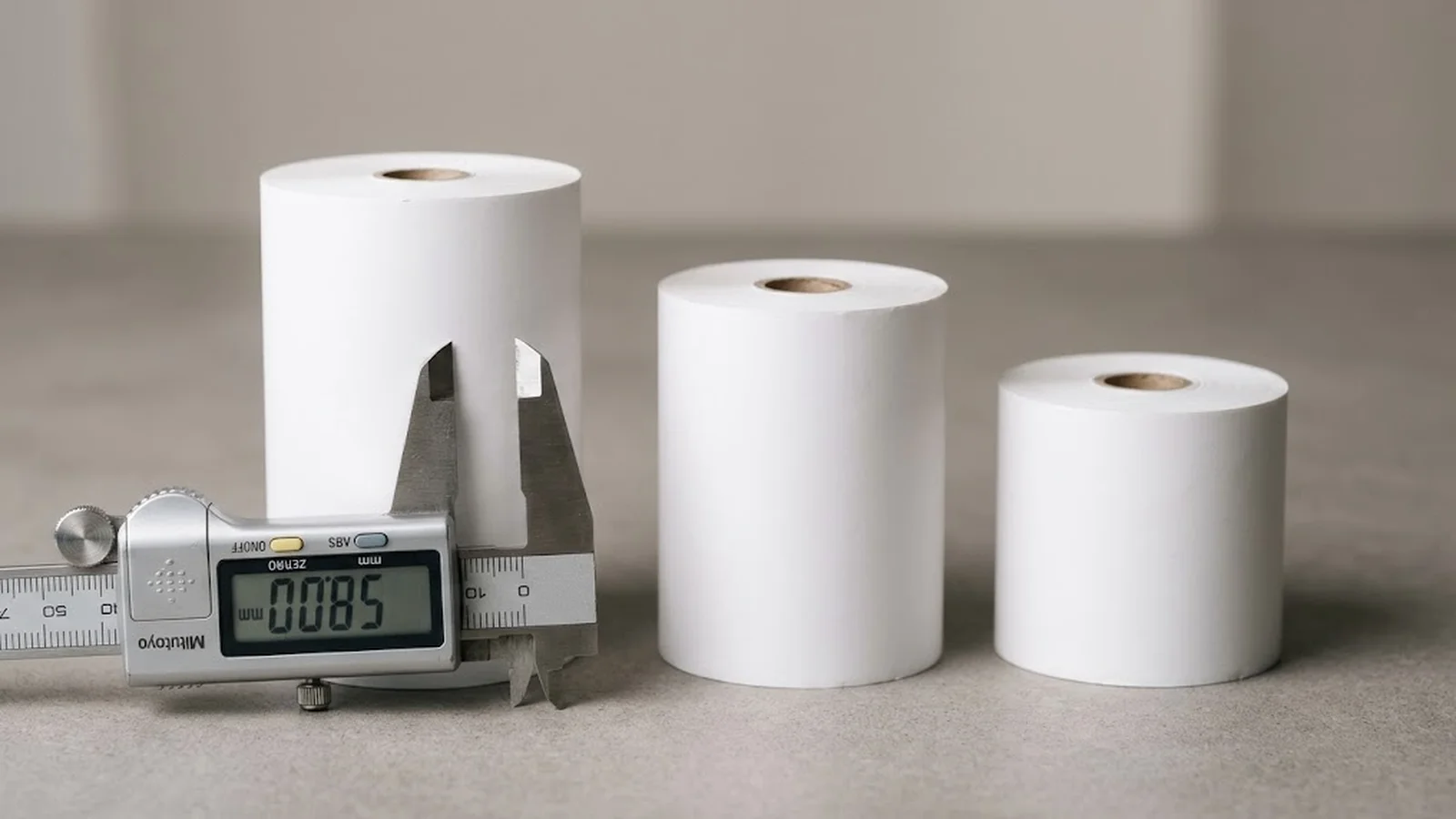
A 58mm thermal paper roll is a direct thermal receipt roll cut to 58mm width — one millimetre wider than the common 57mm class — and specified by fleets of card terminals and portable printers whose paper paths are dimensioned for that extra tolerance. Buying this format well comes down to three decisions layered on the width: roll diameter (30mm, 40mm or 50mm, set by the paper bay so metres per roll and change frequency balance out), core size (usually 12.7mm, sometimes 10mm on compact units), and grade class (typically 48-55 gsm, matched to the print head's energy window). Because the 58mm class sits on hardware with tight paper paths and no operator patience for misfeeds, dimensional consistency, curl control and a written developer class matter more than unit price. Specify the full geometry on one specification sheet, verify with trial rolls in the actual terminal model, and source the class from a manufacturer who publishes the measurements.
The 58mm width class occupies an awkward middle ground in receipt paper: close enough to the ubiquitous 57mm format to be ordered interchangeably by mistake, and different enough that the wrong rolls either jam, misalign the print, or slide sideways in a paper bay dimensioned for 58mm. Fleets of card terminals and portable printers — particularly certain Asian and Latin American EDC hardware — are built around this width, and distributors who treat '58mm' as a rounding error of '57mm' end up servicing avoidable complaints.
This guide sets out what the 58mm class actually is, how the diameter and core decisions interact with metres per roll, which grade classes suit terminal and portable duty, and what to verify before committing a fleet to a supplier.
Where a programme needs several formats from one supplier, our POS and receipt paper rolls cover width, core, roll diameter and developer class in a single specification sheet.
The aim is simple: that a 58mm roll ordered for one terminal model loads, feeds and prints identically across every device in the fleet — and keeps doing so across every reorder.
- 58mm is a genuine width class, not a 57mm rounding error: hardware dimensioned for 58mm will misfeed or misprint on 57mm stock, so the width must be stated explicitly on every purchase order.
- Roll diameter governs metres per roll and change frequency — buy the largest diameter the paper bay accepts rather than the cheapest short roll.
- Grade class sits at 48-55 gsm for most terminal and portable duty; sensitivity class must match the print head's energy window per device family.
- Dimensional consistency, curl control and stiffness decide feed reliability on tight paper paths — the metrics that matter at the point of sale.
- Specify width, diameter, core, grade and developer class on one sheet and verify with trial rolls in the actual hardware before a fleet-wide rollout.
What the 58mm width class actually is
Receipt roll classes are named by width — the fixed dimension along the print line — while the roll's height (its diameter) and its core bore vary independently. The 57mm class dominates compact receipt printing, but a meaningful share of card terminals and portable printers are dimensioned for 58mm stock: the extra millimetre gives the paper guide a defined fit, keeps the web centred under the print head, and prevents the lateral drift that produces faint or skewed print on a printer set up for the wider class.
The practical consequence is asymmetric. A printer built for 57mm will usually feed 58mm stock poorly or not at all; a printer built for 58mm may run 57mm stock but with alignment risk at the paper sensor and print edge. Neither direction is a safe substitution, which is why fleets that run mixed hardware keep a station map naming width per device rather than a single 'card machine roll' line on the purchase order.
For buyers the checklist is short but non-negotiable: confirm the width printed on the hardware specification or measured on the current roll, state it explicitly as 58mm on the RFQ, and reject any quotation that quietly substitutes the 57mm class. Roll tolerances — typically ±0.5mm on a slit web — are part of the specification, not an afterthought.
Roll diameter, core and metres per roll
Once the width is fixed, diameter is the decision that shapes daily operations. The taller the roll a paper bay accepts, the more metres wind onto it and the fewer change-overs an operator performs per shift — a real cost in taxi cabs, delivery rounds and queue-heavy counters where a paper change interrupts a sale. Shorter diameters exist for compact bays and for buyers optimising carton count per shipment, and both positions are legitimate; what matters is that the choice is deliberate.
Core size interacts with the arithmetic. The 12.7mm (half-inch) core is the default across the class; some compact terminals run a 10mm core to squeeze extra metres into the same bay, and a few legacy units still ask for other bores. Because the core consumes internal diameter that would otherwise carry paper, a small-bore roll of identical outer diameter yields more printable metres — worth checking when two quotations look comparable.
Requests that combine several formats can be quoted together; see our 48 gsm lightweight thermal paper for the lightweight grade class and the metres-per-carton arithmetic behind that decision.
| Format | Typical core | Indicative metres* | Duty notes |
|---|---|---|---|
| 58 x 30mm | 12.7mm | approx. 18-22 m | Compact bays; short receipts; frequent changes |
| 58 x 40mm | 12.7mm | approx. 33-38 m | Standard card-terminal duty; balanced change frequency |
| 58 x 50mm | 12.7mm | approx. 55-62 m | Largest common fit; fewest changes per shift |
| 58 x 40mm | 10mm | approx. 40-45 m | Small-bore variant; more metres in the same bay |
*Indicative ranges on a 50-55 gsm web; exact yield depends on grade caliper and winding tension and should be confirmed on the supplier's specification sheet.
Grade and sensitivity decisions for terminal duty
Card terminals and portable printers print short receipts at modest speed, which pulls the grade class toward the light end: 48-55 gsm covers most 58mm duty. Lighter webs yield more metres per roll and keep carton weights down for distributed fleets; heavier classes earn their place only where receipts are filed for reference, handled repeatedly, or expected to survive wallet and pocket abuse for months.
Sensitivity class is the other half of the grade decision. Each print head family applies a characteristic energy window, and stock matched to the wrong window prints faint at best and accelerates head wear at worst. Fleets running several terminal models should confirm the sensitivity class per device family — ideally by trial — rather than assuming one grade fits all hardware.
Developer class completes the spec. Terminals in customer-facing settings hand receipts to the public, so written BPA-free or phenol-free confirmation with per-batch documentation is increasingly part of the purchase order, both for regulatory markets and for brand-side ESG commitments.
Feed reliability: the metric that decides reorders
On a tight paper path, paper quality expresses itself as feed behaviour: does the roll start cleanly, track centred under the head, and tear off without curling back into the slot? Stock that is dimensionally loose, over-curled or wound unevenly produces the jams and misprints that turn a cheap roll into an expensive service call. Three properties deserve explicit attention: wound tension (which governs how the web releases), curl characteristics after printing (which govern tear-off behaviour), and edge quality of the slit web (which governs tracking).
Environmental duty adds a final filter. Portable terminals live in vehicles, delivery bags and jacket pockets, where heat, humidity and physical pressure attack both the roll and the printed image. Storage discipline — stock sealed in cartons until loaded, image side protected, no long dwell on hot dashboards — preserves the metres bought so carefully, and moisture-barrier packing deserves the same attention as the paper specification itself.
The verification step is unchanged across every format decision in this guide: trial rolls in the actual terminal models, in the hands of the actual operators, before a fleet-wide order. A day of field testing reveals more than any catalogue datasheet.
Sourcing 58mm stock and custom variants
Most 58mm programmes source from a manufacturer's standard width list, but the class sits close enough to the 57mm tooling that custom variants are practical: private-label logo printing on the back of the web, custom core bores for legacy hardware, tailored diameters for unusual bays, and packing formats matched to how a distributed fleet actually receives stock. These options cost little at manufacturing volumes and remove recurring friction at the point of use.
Image life and coating construction close the loop. Where receipts are retained — for warranty, expense or warranty dispute purposes — the choice between a top-coated and a non-top-coated construction decides how the print survives light, moisture and handling. For programmes where retention matters, our top-coated vs non top-coated guide compares the two constructions on retention, cost and machine behaviour so the grade decision rests on measurements rather than habit.
Buyers who fix the width, diameter, core, grade, sensitivity class and developer class on one specification sheet — and hold their supplier to per-batch documentation against it — turn a 58mm roll from a recurring irritant into a settled, auditable line item.
Frequently asked questions
Is 58mm thermal paper the same as 57mm?
No. The width is the fixed dimension along the print line, and one millimetre is enough to change how a roll sits in a paper guide and tracks under the print head. Hardware dimensioned for 58mm can misfeed or print skewed on 57mm stock, and the substitution risk runs in both directions. State the width explicitly on every order.
What diameter 58mm roll should I buy?
Buy the largest diameter your terminal's paper bay accepts. Diameter governs metres per roll and how often operators change paper; a 58x50mm roll holds roughly 55-62 metres on a 50-55 gsm web, versus under half that on a 58x30mm roll. Compact bays may force a shorter format — that is fine, as long as the choice is deliberate and the fleet standardises on it.
What gsm thermal paper suits 58mm card terminal rolls?
Most terminal and portable duty sits at 48-55 gsm: light enough for good metres per roll and easy feeding through tight paths, heavy enough for ordinary receipt handling. Move heavier — 55-65 gsm — only where receipts are filed or handled extensively, and match the sensitivity class to each print head family by trial.
Why does my 58mm terminal jam on cheap rolls?
Dimensionally loose stock, uneven winding, poor slit edge quality and excessive curl are the usual culprits — all properties of the roll's manufacture rather than its width. Tight paper paths punish every one of them. Feed reliability, not unit price, is the buying metric for terminal duty, which is why trial rolls in real hardware come before fleet-wide orders.
Can 58mm rolls be printed with our logo?
Yes. Back-web logo printing is a standard converting option at production volumes — typically one or two flexo colours on the reverse side, applied before slitting. Custom core bores, tailored diameters and branded carton packing are available on the same programme; confirm artwork requirements and minimum volumes with the manufacturer at specification stage.