
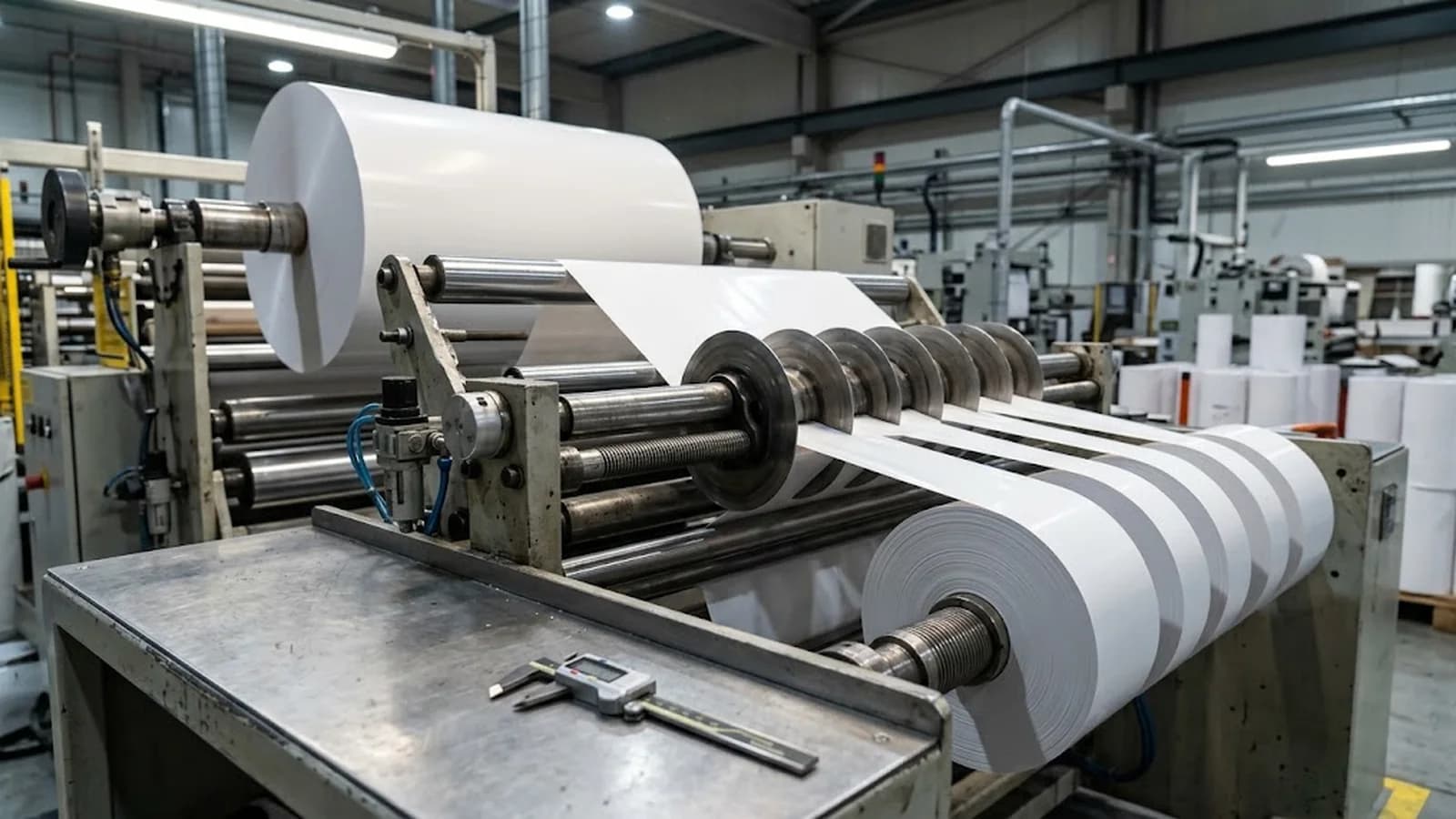
A thermal paper custom width is any roll width outside the industry's standard families, produced by trimming a wider sensitized jumbo on a slitter-rewinder set to your dimension. The paper itself is identical — the width is a converting parameter. Custom widths cost more for three mechanical reasons: the slitter setup and changeover time, the trim loss when your width does not divide the jumbo cleanly, and the shorter run length per setup. Specify a custom width with five fields — nominal width with tolerance, core size, outer diameter or length, gsm and grade, and wind direction — and expect MOQs sized to one economic run. If your device tolerates the nearest standard width, compare the total cost honestly; if it genuinely does not, a custom width is routine work for any competent converting plant.
Most thermal paper is bought in standard widths because most machines are designed around them: 57 and 80 mm receipt families, 405 and 800 mm jumbos, 4 x 6 label media. But real fleets are not always standard. Payment devices from a different market, kiosks engineered around a unique document, label applicators with an unusual web path, and converters serving niche verticals all meet the same question sooner or later: can the paper be made in our width?
The answer is yes — width is the easiest parameter to customise in thermal paper, easier than grade, easier than core, and far easier than packaging. Every coating line produces sensitized jumbo in wide webs, and every converting plant trims those webs to order daily. The real questions are not whether a custom width can be made but what it costs, what tolerance it will hold, and how to specify it so the first delivery is right.
This guide explains what happens at the factory when a custom width is ordered, why non-standard widths carry higher minimums and slightly higher prices, how width tolerance and edge quality are actually controlled, how to write a specification that avoids sample rounds, and how to decide between a custom width and the nearest standard one.
For production volumes, the same construction logic applies to our top-coated thermal label stock, quoted per jumbo roll, slit reel or finished format.
- Custom width is a converting parameter, not a different product — the coating, grade and chemistry are identical to standard stock.
- Three mechanics set the premium: slitter setup and changeover, trim loss when the width divides the jumbo poorly, and short run length per setup.
- Specify five fields minimum: width with tolerance, core, OD or length, gsm and grade, wind direction — plus edge-quality and joint policy for jumbo feeding.
- Width tolerance on well-run converting lines is typically +0.5/-0 mm; tighter tolerances are available but should be requested explicitly.
- Compare honestly against the nearest standard width including changeover and trim; choose custom only when the application genuinely requires it.
What 'custom width' means at the factory
Every thermal roll begins as sensitized jumbo — a wide web, commonly in the 405 to 875 mm range, coated on the mill's thermal line. Standard finished widths are nothing more than the slit plans that converters run most often: 405 mm divides into seven 57 mm receipt webs, 800 mm into ten 80 mm webs. A custom width is the same operation with a different number: the jumbo is loaded, the slitter knives are set to your dimension, and the web is slit and rewound to your core and outer diameter.
This is why the paper in a custom width roll is identical to catalog stock of the same grade. There is no special coating run for width alone — the width exists only from the slitter onward. The corollary matters commercially: minimum order quantities for custom widths are set by converting economics, not by the coating plant. The coater can produce your grade in bulk; the slitter must stop, change blades and restart for your dimension.
The one upstream interaction worth knowing: jumbo webs are trimmed to the widths demanded of them. A plant converting a steady program of an unusual width will either select the jumbo trim that divides into it cleanly or accept edge trim loss. Both appear in the quotation, the first as efficiency, the second as yield.
| Stage | Standard width | Custom width |
|---|---|---|
| Coating | Jumbo produced to standard trims | Unchanged — same jumbo, same grade |
| Slitting setup | Shared across many customers | Dedicated changeover: knives, cores, splice |
| Trim / yield | Minimal edge trim | Possible trim loss if width divides poorly |
| Run length | Long batched runs | One economic run per MOQ |
| Packing | Standard carton formats | Carton layout may need custom division |
Why non-standard widths cost more — the three mechanics
The first mechanic is setup. Changing a slitter to a new width consumes time and materiel: blades positioned and verified, cores loaded, splice tuned, and the first metres of web run to stability before product is counted. A setup amortized over a five-tonne run costs several percent per tonne; the same setup over fifty tonnes disappears into rounding. This arithmetic, not pricing strategy, is why custom width MOQs track roughly one economic run length.
The second is trim loss. If your width divides the jumbo trim cleanly — two 98 mm webs out of a 405 mm parent with modest edge allowance — yield is near-standard. If it does not, the unusable edge trim is real material that the quotation must carry. This is why two custom widths of identical size can quote differently: one divides a parent trim, the other fights it.
The third is run fragmentation. A plant running fifteen standard widths batches them efficiently across its order book; a sixteenth width interrupting that batching costs changeovers that must be recovered somewhere. None of this makes custom widths expensive in absolute terms — the premium over a comparable standard width is typically modest at meaningful volumes — but it explains the structure: higher minimums, a small per-unit premium, and longer first-delivery lead times than repeat orders of the same item.
Procurement teams standardising on one supplier can review our thermal paper jumbo rolls alongside the comparisons in this guide.
- MOQ for a custom width ≈ one economic run: setup time divided by run rate at your dimension.
- Ask whether your width divides a standard jumbo trim cleanly — the answer explains most price differences between similar widths.
- Annual programs convert custom widths into scheduled items: same line, reserved slots, standard-width economics at the margin.
- Cartons and pallet layouts for unusual widths are designed once and reused — first-order lead time includes this, reorders do not.
Specifying a custom width so the first delivery is right
A custom width specification is five lines. Width with tolerance: state the nominal and the acceptable band — well-run converting lines hold +0.5/-0 mm on receipt-type widths, and tighter bands are negotiable if your application genuinely needs them, at the cost of slower slitting and higher inspection rates. Core: inside diameter and type (12.7 mm for compact devices, 25.4 mm or 76.2 mm for industrial paths). Outer diameter or length: whichever your machine compartment or dispenser defines. Grade: gsm, coating construction and developer chemistry. Wind direction: paper-out or paper-in, which decides which face the print lands on in your machine.
For rolls feeding machinery rather than dispensers, add two lines. Edge quality: specify clean slit edges without pressure develop or dust, since a custom width run that has just been set up is exactly where edge defects concentrate. Joints and length policy: state whether splices are acceptable and how they are flagged. These lines cost nothing to write and prevent the two most common custom-width complaints at goods-in.
| Field | Typical entry | Why it matters |
|---|---|---|
| Width + tolerance | 98 mm +0.5/-0 mm | Fit in the media path; sensor registration |
| Core | 12.7 mm ID, standard wall | Spindle fit and roll stability |
| OD or length | 80 mm OD max / or stated length | Compartment limit and run time |
| Grade | 55 gsm, top-coated, BPA-free | Print quality and compliance |
| Wind direction | Paper-out (face out) | Correct print face in the machine |
| Edge quality | Clean slit, no pressure develop | Jam-free feeding at speed |
| Joint policy | No joints, or flagged per joint | Uninterrupted printing for dispensers |
Custom width or nearest standard: how to decide
Run the honest comparison. Take the nearest standard width and ask what it would actually cost your operation: if a 79 mm device path accepts an 80 mm roll, the standard wins immediately. If the standard is wider than the compartment allows, or the media path was engineered around an odd dimension, the custom width is not a preference but a requirement, and the premium is simply the cost of the machine you already own.
When the application genuinely needs the custom width, volume decides the economics. Below roughly one economic run per quarter, expect special-make treatment: higher MOQ, longer lead time, little price flexibility. Above it, ask the supplier to schedule the width as a recurring item — reserved converting slots turn a special into a product, and from the second or third order the differences from standard-width buying largely disappear.
Validate like any new item: sample from the actual converting run, not a hand-slit makeshift, and test fit, feed, print registration and jam behaviour on your machines. A width change never affects print chemistry, but it does affect how the roll sits, feeds and tracks — and those are machine behaviours, not datasheet ones.
Where image life is the deciding factor, our top-coated vs non top-coated guide compares the two constructions on retention, cost and machine behaviour.
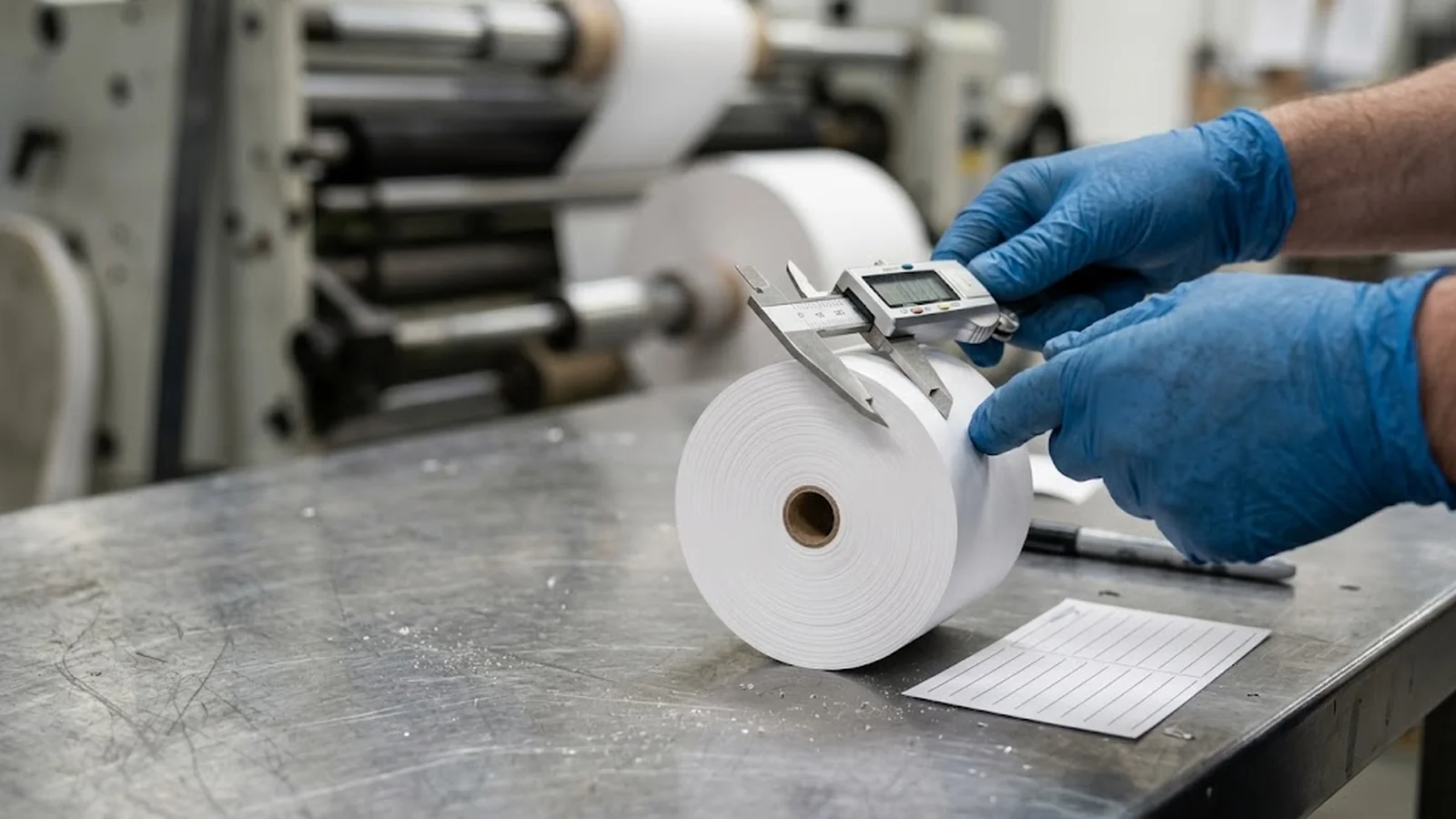
Width never changes the coating — but it changes how the roll feeds. Always validate on the machine, not the datasheet.
Frequently asked questions
What is the minimum order quantity for custom width thermal paper?
It tracks one economic converting run at your width — the quantity that amortizes the slitter setup, typically from a few hundred finished rolls for compact receipt sizes down to one or two pallets of larger formats. Annual programs scheduled as recurring items achieve the best minimums because the setup recurs predictably.
What width tolerance can a thermal paper converter hold?
Well-run converting lines hold +0.5/-0 mm on standard receipt widths as routine, verified by caliper checks per roll or per sampling plan. Tighter bands are possible at reduced slitting speeds and higher inspection rates — request them explicitly if your application needs them, and expect the tolerance to be stated on the specification, not assumed.
Is the paper quality the same in custom widths as standard rolls?
Yes. Width is created at the slitter; the coating, grade and chemistry come from the same jumbo as standard stock. The quality risks specific to custom widths are at the slit edge — pressure develop, dust or burrs from a freshly set-up line — which is why edge quality belongs in the specification and the goods-in check.
Why does one custom width quote higher than another of the same size class?
Usually trim arithmetic. A width that divides a standard jumbo trim cleanly converts at near-standard yield; a width that fights the parent trim carries edge trim loss into the price. Ask the supplier which parent trim your width comes from — the answer explains the difference immediately.
How long does the first delivery of a custom width take?
Longer than a repeat order: the specification review, any carton or core procurement, and a first converting run typically add one to two weeks over standard lead times. Reorders of the approved item run at normal schedules because the setup, tooling and packing design already exist.