
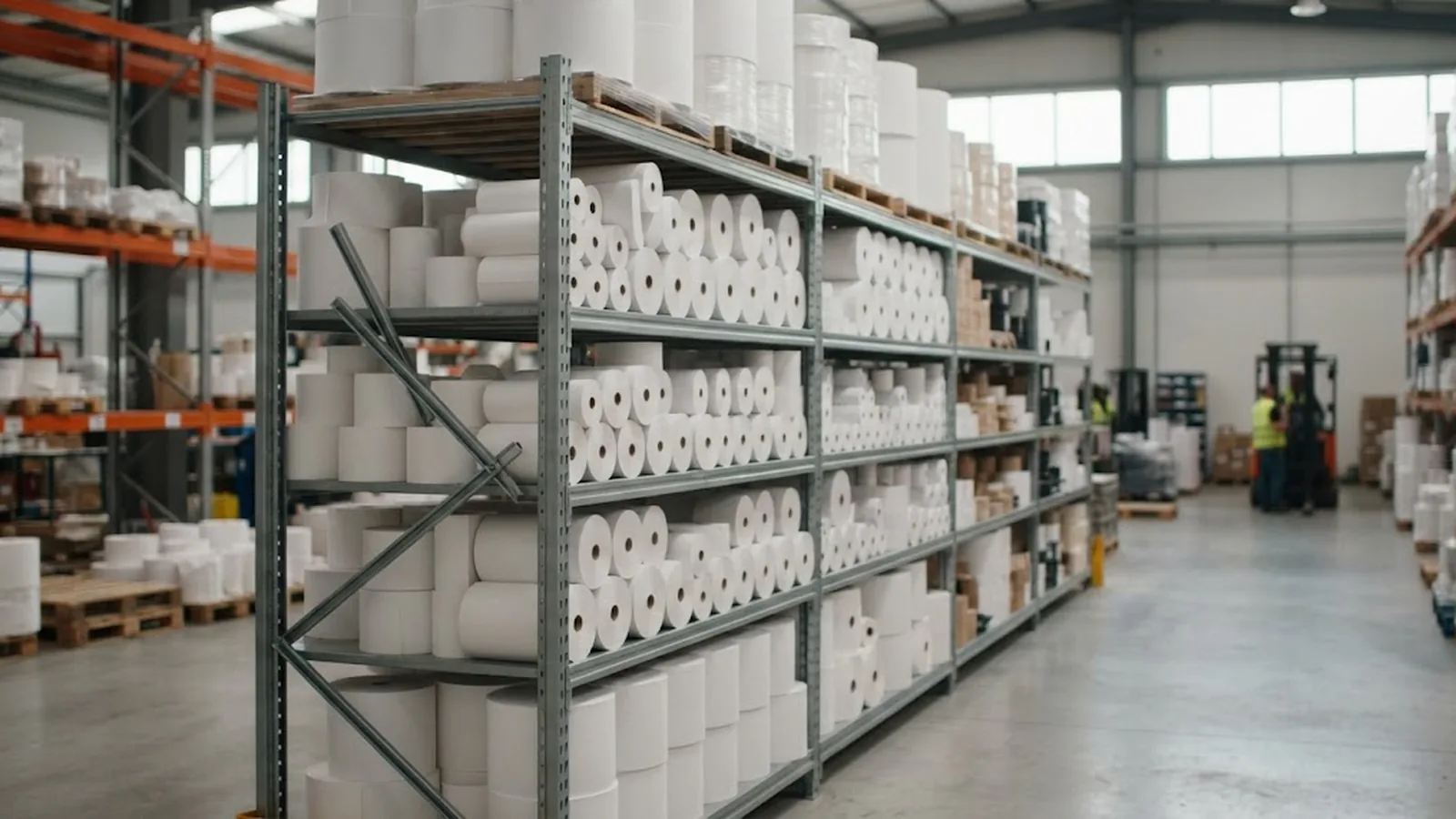
Thermal paper is paper coated with a heat-sensitive chemistry that produces an image directly where a heated print head touches it — no ink, toner or ribbon involved. The coating contains a leuco dye and a developer held apart in a solid state; heat from the print head melts them together and the contact point turns black (or occasionally blue). Compared with ordinary paper, it images itself, which is why it powers receipt rolls, payment slips, logistics labels, tickets and self-service kiosk output. Grades differ in weight (typically 48–75 gsm), coating quality, image life and whether a protective topcoat is applied. For B2B buyers the practical takeaway is simple: thermal paper is specified by weight, roll dimensions, image-life requirement and coating type — not by brand of machine.
Every trade buyer has handled thermal paper thousands of times — at the supermarket checkout, behind the airline gate, at the parcel locker — yet the product itself is often specified loosely, as if one white roll were interchangeable with another. It is not. The difference between a well-specified grade and a random one shows up months later, as faded images, curled rolls and complaints from end customers.
Thermal paper is best understood as a two-part product: an ordinary paper base, and a precision chemical coating that does the imaging. Everything that matters in procurement — print density, image life, sensitivity, shelf life — lives in that coating and in how well it is applied. That is also why the manufacturer you buy from matters more than the machine the paper runs on.
This guide answers the question plainly: what thermal paper is, how it differs from normal paper, what constructions and weights are common, where it is used, and what a buyer needs to know before comparing quotations.
- Thermal paper images itself under a heated print head — no ink, toner or ribbon — because its coating carries a colour-forming chemistry.
- The product is a system: base paper plus precoat, thermal layer and optional topcoat/backcoat; quality differences are mostly coating differences.
- Standard weights run 48–75 gsm — lighter for receipts, heavier for tickets, records and durable labels.
- Image life ranges from a few years on economy receipt grades to 7–10+ years on top-coated grades; match the grade to the document's required life.
- Before comparing quotes, specify weight, dimensions, core, image-life requirement and coating type — vague specs invite vague quality.
The plain definition
Thermal paper — sometimes called direct thermal paper or thermal printing paper — is a fine paper coated with a chemical layer that changes colour when heated. Inside the coating sit two key ingredients: a colourless leuco dye and a developer (an acidic phenol or, in newer formulations, an alternative co-developer). At room temperature they coexist without reacting. When the ceramic heating elements of a print head pulse against the paper, the coating at those contact points melts and reacts, and the dye develops into its visible coloured form — almost always black.
The critical word is direct. Unlike thermal transfer printing, nothing is melted off a ribbon onto the paper; the paper IS the ink. There is no ribbon stock to buy, no ribbon to thread, no ink to smudge wet. The print head writes the image into the surface itself, in a single pass, at speed. This simplicity is why thermal printing dominates receipt, ticket and label printing at the point of sale and in logistics — fewer consumables, fewer moving parts, less downtime.
One property follows from this chemistry and should be understood up front: the image cannot smear, because it is not deposited on the surface — it is a chemical change within it. But it is also a chemical state, not a physical one, so it can be degraded over time by heat, light, moisture and chemical contact. Image durability is a specification, not an accident.
- No ink, toner or ribbon — the heat-sensitive coating is the imaging system.
- Image forms exactly where the print head applies heat; resolution tracks the print head's dot density.
- The mark is smear-proof but not permanent — image life depends on coating quality and storage.
- Black is the standard image colour; specialist blue-image grades exist for lottery and gaming tickets.
How it differs from ordinary paper
Ordinary printing paper is engineered to accept ink; thermal paper is engineered to create its own. That difference drives every downstream property. The base stock for thermal grades is typically a smoother, finer paper than office bond, because the coating must be applied in a flawlessly even micrometres-thin layer — any surface defect telegraphs straight into the print as a white streak or weak spot.
Functionally, the comparison buyers care about is simple. Ordinary paper plus a printer means ribbons, toner or ink cartridges, and maintenance; thermal paper plus a direct thermal printer means one consumable and none of that overhead. Cost per print at low-to-mid volumes usually favours thermal for receipts, tickets and short-life labels. Ordinary paper wins when documents must survive decades, tolerate sunlight and chemicals, or carry full-colour graphics — thermal imaging is monochrome by nature.
There is also a handling difference worth knowing at counter level: thermal paper reacts to more than print heads. Hot storage, prolonged sunlight, plasticisers from PVC sleeves and some solvent-based adhesives can develop background colour or fade images. This is not a defect but a property of the chemistry — and it is precisely what top-coated grades are engineered against.
| Property | Thermal paper | Ordinary paper |
|---|---|---|
| Imaging method | Heat-sensitive coating reacts in place | Needs ink, toner or transfer ribbon |
| Consumables | Paper only | Paper + ink/toner/ribbon |
| Image colour | Monochrome (black standard, blue speciality) | Full colour possible |
| Smudge resistance | Smear-proof once imaged | Wet-ink smudging possible |
| Typical image life | 3–10+ years by grade and storage | Decades with pigment inks |
| Typical uses | Receipts, tickets, labels, kiosk output | Documents, brochures, packaging |
Constructions, weights and common types
Buyers meet thermal paper in three broad constructions. Uncoated (economy) grades carry just the base paper, precoat and thermal layer — the standard choice for short-life POS receipts. Top-coated grades add a protective barrier layer over the thermal coating that resists water, oil, abrasion and plasticiser attack, and materially extends image life — the choice for logistics labels, tickets and anything kept as a record. Back-coated grades add a functional layer to the reverse for specific conversion needs.
Weights cluster between 48 and 75 gsm. Lightweight 48–55 gsm grades are the receipt workhorses — more images per kilogram, matched to compact receipt rolls. Mid weights around 55–65 gsm balance hand feel and economy for retail and hospitality. Heavy 65–75 gsm grades stiffen tickets, boarding passes, parking documents and banking records, where the sheet must survive handling as well as imaging.
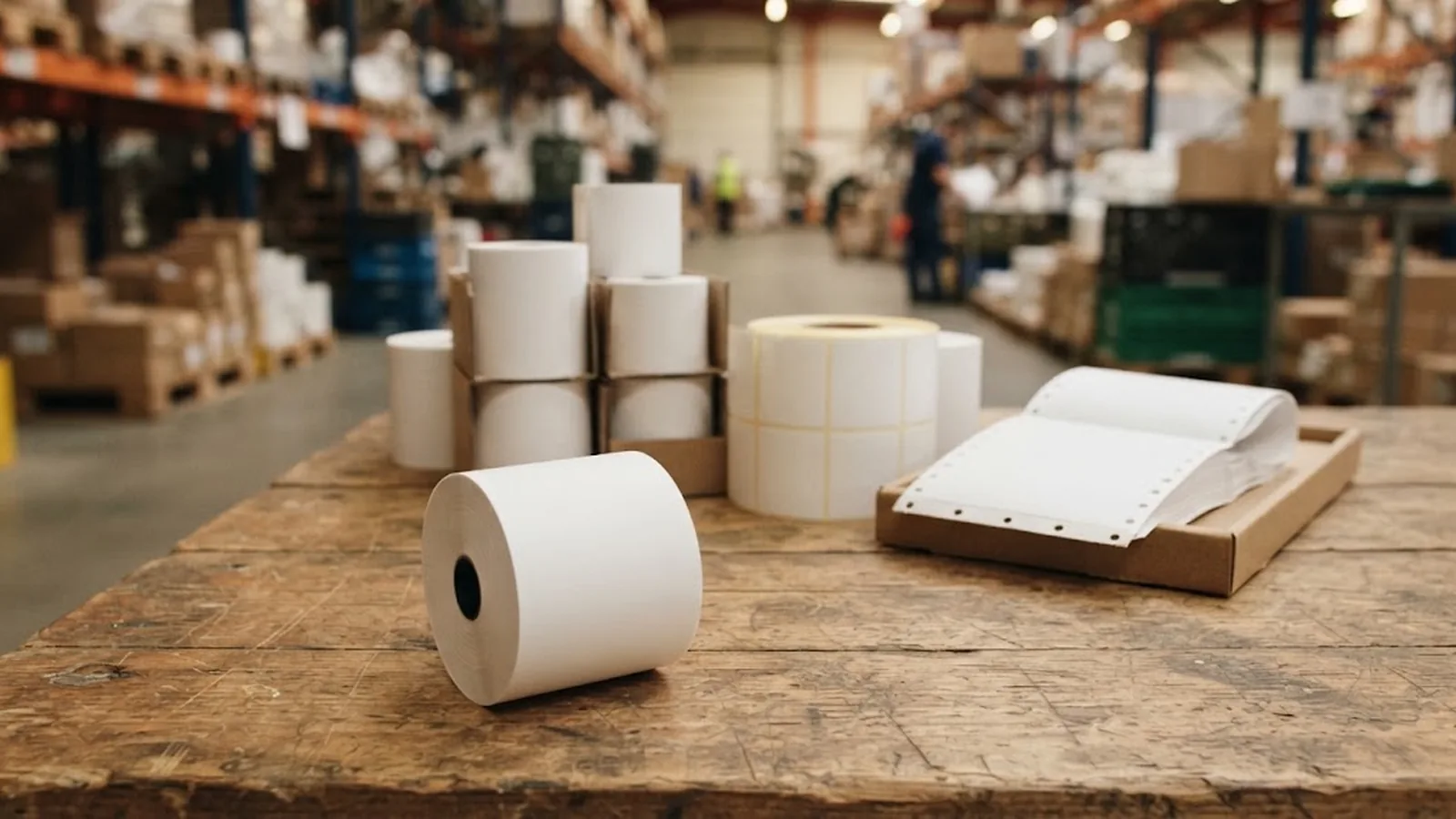
Buyers also encounter the same constructions in different supply formats: finished rolls slit to machine dimensions (57 mm, 80 mm receipt formats; label die sizes), or jumbo/parent rolls sold to converters who slit, sheet or die-cut downstream. Buying jumbo stock is the converter route to margin; buying finished rolls is the operator route to simplicity.
Where thermal paper is used
The application map is wider than most people assume, because anywhere a compact monochrome record is produced on demand, direct thermal is usually the answer. Retail and hospitality run on receipt rolls; payment terminals use smaller-format slips; logistics networks image millions of shipping labels daily, where barcode scannability and image life are the operative specs.
Public infrastructure leans on it heavily: parking, transport and queue tickets, ATM and kiosk receipts, medical monitoring and pharmacy labels, weighing-scale and price labels in food retail. Each vertical adds its own requirement — banking wants stiffness and archival behaviour, logistics wants scan life and cold-chain tolerance, healthcare wants clean, reliable feeds — which is why experienced buyers spec by application, not just by size.
For an exporter's customers — importers, distributors and converters — the practical use of this map is internal link and stock logic: one master grade in 55–65 gsm covers most receipt and general demand; a top-coated grade covers label and record demand; a heavy grade covers ticket and banking demand. Three well-chosen specifications cover the overwhelming majority of trade enquiries.
What buyers should specify
Because 'thermal paper' names a family rather than a product, quotations are only comparable when the specification is fixed. The minimum spec set for any RFQ: weight in gsm; roll or sheet dimensions and core size; image colour; coating type (uncoated, top-coated, back-coated); and the image-life requirement with the storage conditions assumed. Everything else — price validity, packing, lead time — hangs off that frame.
Then qualify the supplier, not just the sheet. A manufacturer with its own coating line can tune sensitivity, density and image life to the application and prove it with test reports — print density, background ageing, image retention under accelerated ageing. Resellers pass through whatever the mill ran that week. For a product whose entire value lives in an invisible coating layer, that difference in control is the difference between consistent supply and seasonal quality drift.
Finally, keep the paperwork standards realistic and evidence-based: food-contact or compliance claims, phenol-free chemistry declarations, and FSC chain-of-custody all belong in the specification where they are genuinely required — and none of them cost the buyer anything to ask for at the RFQ stage.
Rule of thumb: specify what the document must survive, not just what the machine must feed. Weight and dimensions get the roll into the printer; the coating spec determines whether anyone can still read it later.
Frequently asked questions
What exactly is thermal paper in simple terms?
Paper coated with a heat-sensitive chemistry that turns black where a heated print head touches it. The coating carries a colourless dye and a developer; heat triggers the reaction that forms the image. No ink, toner or ribbon is involved.
Is thermal paper the same as thermal transfer paper?
No. Direct thermal paper images itself — the coating reacts to heat. Thermal transfer uses a ribbon melted onto the surface of ordinary label stock. They are different consumables: never specify one when the machine requires the other.
What is thermal paper used for?
Receipts and payment slips, shipping and barcode labels, tickets for parking, transport and events, ATM and kiosk receipts, pharmacy and healthcare labels, and weighing-scale or price labels — anywhere a compact monochrome record is printed on demand.
What weights does thermal paper come in?
Typically 48–75 gsm. Light 48–55 gsm grades dominate receipt rolls, mid weights cover retail and hospitality, and heavy 65–75 gsm grades serve tickets, boarding passes and banking records where stiffness matters.
How long does printing on thermal paper last?
Depends on the grade and storage. Economy uncoated receipt grades are engineered for roughly 3–5 years of legibility in cool, dark conditions; top-coated grades with documented accelerated-ageing data reach 7–10 years or more. Heat, sunlight, moisture and plastic contact shorten any grade's life.