

Wholesale thermal paper rolls are bought most profitably as a programme, not as spot orders: fix a specification sheet per format, combine several roll sizes into mixed pallets to reach container MOQ, buy against a rolling forecast so the mill can level production, and protect margin by locking packing, tolerance and chemistry terms in the sheet rather than renegotiating every order.
Wholesale buying is where thermal paper margin is made or lost. The roll that looks cheapest per case on a spot quotation often carries hidden costs — short metres per roll, loose winding that breaks in transit, a chemistry change that forces a requalification mid-season — while the programme buyer who fixed those points in a specification sheet pays roughly the same price and keeps the complaints off the desk. The difference is not negotiating harder; it is structuring the purchase differently.
This guide covers the wholesale mechanics that distributor and chain buyers actually control: how manufacturer MOQ really works and how mixed pallets reach container economics, which specification points belong in the sheet before price is discussed, how to structure a rolling forecast that earns better pricing than spot volume, and the packing and private-label decisions that carry brand value at the case level.
For production volumes, the same construction logic applies to our thermal paper jumbo rolls, quoted per jumbo roll, slit reel or finished format — many wholesale programmes take a mix of finished rolls and converter stock in one container.
The sections follow the order a wholesale buyer would settle them: MOQ and container structure first, the specification sheet second, forecast-based pricing third, packing and private label fourth, and the programme review that keeps margin stable.
- Manufacturer MOQ is a container logic, not a case logic — combining several roll formats into mixed pallets reaches minimums faster and spreads freight across the whole basket.
- The specification sheet is the margin document: gsm tolerance, metres per roll, core size, sensitivity class and chemistry fixed in writing prevent the silent substitutions that erode repeat-purchase margin.
- A rolling 90-day forecast earns better pricing than spot volume because it lets the mill schedule coaters and slitters efficiently — the discount comes from production stability, not from haggling.
- Moisture-barrier packing and pallet standards are wholesale issues, not shipping afterthoughts: sea freight punishes a dry-only specification and claims eat the margin the price negotiation saved.
- Private-label case work turns a commodity repeat purchase into a brand asset — and it only works when printed-on-demand case stock is part of the agreed programme terms.
How wholesale MOQ actually works: containers, not cases
The first number a manufacturer quotes is almost never a case quantity — it is a production and freight logic. Coating lines run in campaigns measured in tonnes; slitters are changed over per specification; and ocean freight prices per container, not per pallet. A single-SKU order of twenty cases sits below every one of those thresholds, which is why it attracts either a premium or a refusal. Wholesale economics start when the order fills — or shares — a 20-foot container.
This is where mixed pallets change the game. A distributor rarely needs container volume of one SKU, but a basket of 57x40, 57x50, 80x80 and 80x70 rolls, label stock and a jumbo roll or two easily fills a container while each individual format stays at pallet volume. The manufacturer gains a production run it can schedule; the buyer gains container freight rates and a single document set. Buyers who quote the whole basket together consistently land better unit economics than those who quote SKU by SKU.
Where a programme needs several formats from one supplier, our POS and receipt paper rolls covers width, core, roll diameter and developer class in a single specification sheet — the basket structure that mixed-pallet wholesale buying is built on.
One caution on 'wholesale' pricing from trading companies: a trader reselling a mill's output adds a layer without adding production stability, so its floor is the mill's list price. Mill-direct wholesale pricing moves on forecast reliability and specification stability — the two things a trader cannot offer.
The specification sheet is the margin document
In wholesale thermal paper, the price negotiation is secondary to the specification negotiation, because the spec decides what the buyer actually receives per case. The points that belong in writing before price is discussed: basis weight with tolerance (a 55 gsm grade converting at 57 is a five-percent metre shortfall on every roll), metres per roll at a stated gsm, core inner diameter and wall thickness, outer diameter per format, winding quality, sensitivity class, and the developer chemistry class with SDS to match.
Each of those lines prevents a specific margin leak. Short metres show up as more frequent roll changes at customer sites — perceived as a quality problem with the buyer's brand, not the mill's. Chemistry drift forces requalification and, in regulated channels, paperwork. Loose winding telescopes in transit and blocks in warehouse storage in humid climates. None of these appear on the invoice; all of them appear in the margin.
Requests that combine several formats can be quoted together; see custom thermal paper programme for the construction options behind each one, including private-label constructions beyond the standard grade list.
Wholesale buyers should also fix the sampling protocol in the sheet: retained samples per batch, a goods-in inspection routine of one case per pallet, and an agreed remedy if a batch fails — credit, replacement or re-slitting. The protocol costs nothing until it is needed, and then it is the difference between a claim and an argument.
Forecast buying: why reliability prices better than volume
The counterintuitive result in mill-direct wholesale is that a steady 90-day rolling forecast often prices better than an unpredictable annual volume commitment. Coating campaigns and slitting schedules are planned around demand visibility: a buyer who confirms next quarter's volumes by format lets the mill sequence production, buy pulp and chemistry ahead, and fill the buyer's container into already-planned campaign slots. The discount comes from production stability, and it compounds — the predictable buyer is the one the mill protects when capacity tightens.
A workable programme structure has three tiers: a fixed specification sheet per format, a rolling forecast updated monthly for the next 90 days (firm for the first 30, indicative after), and agreed call-off lead times per destination. Buyers who can hold forecast accuracy within roughly ten percent consistently sit in the best price tier; buyers who cancel or swing volumes lose the tier regardless of total annual spend.
Programmes that convert their own slit rolls from jumbo stock often run the finished-format and parent-roll volumes through one forecast — that is where the scheduling benefit compounds furthest, and where the mill can protect capacity for both halves of the basket.
| Factor | Spot ordering | Programme buying |
|---|---|---|
| Price basis | Per-order quote, market-driven | Tiered sheet pricing, reviewed quarterly |
| MOQ position | Full container per SKU or premium | Mixed pallets share container volume |
| Lead time | Variable, queue-dependent | Agreed call-off lead times |
| Quality recourse | Negotiated per incident | Batch protocol in the sheet |
| Brand value | Generic cases | Private-label case work available |
Packing, pallets and private label at the case level
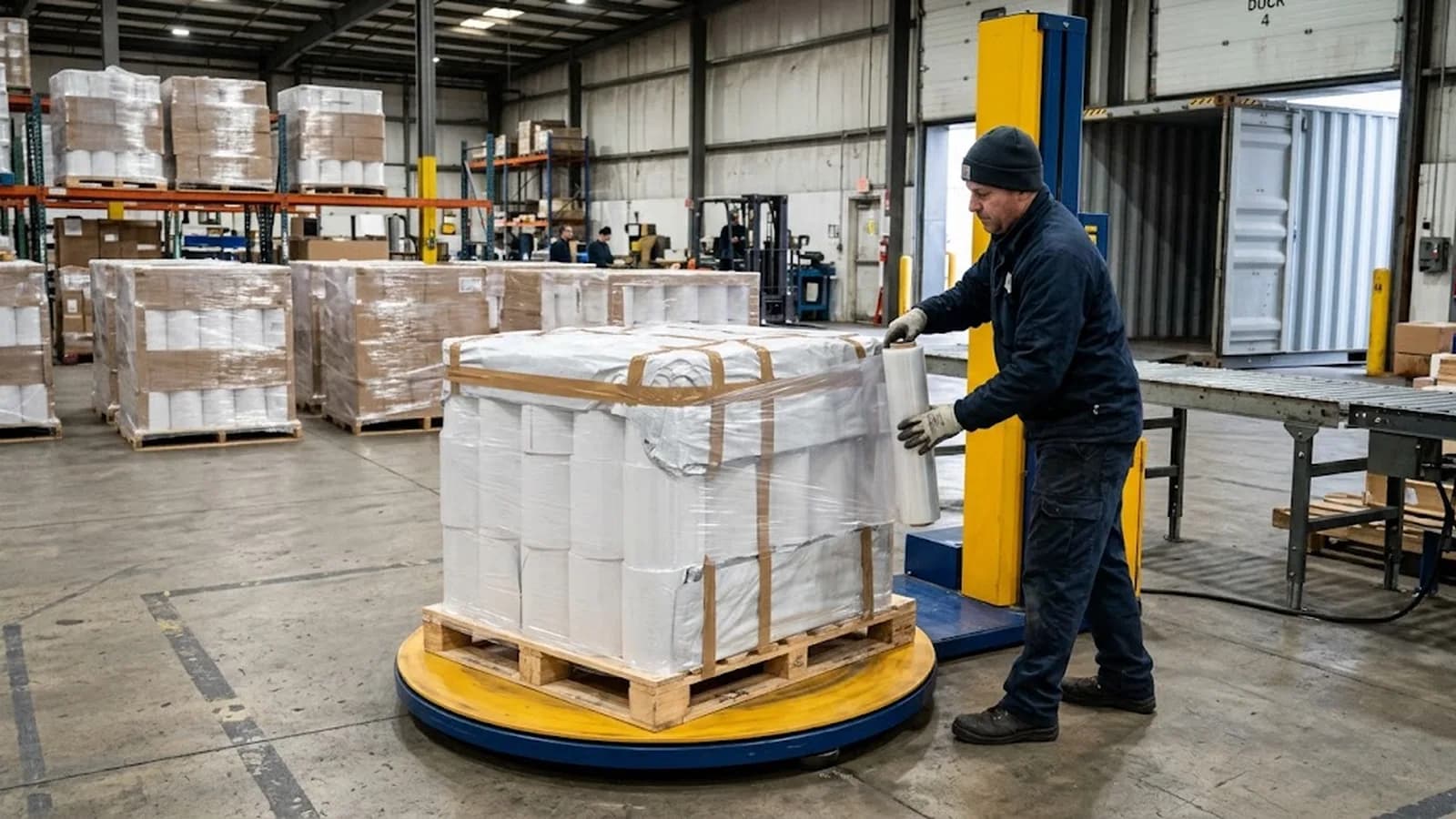
Wholesale margin survives the ocean or it doesn't. Thermal coating is hygroscopic, and a container crossing the equator cycles through humidity that a dry-only specification will not survive: blocked rolls, edge fade and claims that arrive two months after the price was agreed. The programme sheet should therefore fix moisture-barrier wrapping per case, case fill and weight, pallet pattern and corner protection, and container desiccant practice for tropical destinations.
Private label is the other case-level decision. For distributors, the shrink wrap and case print are the only brand surfaces the end customer sees — a generic mill case reads as a commodity, a branded case reads as the distributor's own product line. Programme terms should cover printed case stock (minimum reprint quantities, artwork ownership, change lead time) so reorders don't stall on a case-print cycle.
Where container planning is the next step, our export shipping guide covers pallet standards, moisture-barrier packing and the document set for ocean freight — the physical and paperwork side of the wholesale programme.
- Moisture-barrier wrap inside every case; PE or aluminium-barrier liner per destination climate.
- Pallet pattern agreed in the sheet — stable stacks, no overhang, corner boards on stacked layers.
- Case print spec: private-label artwork files held by the mill with agreed reprint MOQ and lead time.
- Container practice: desiccant for tropical routes, no direct contact between cases and container walls.
- Document set per shipment: COA, SDS, packing list keyed to pallet numbers for goods-in matching.
Running the programme review: keeping margin stable
A wholesale programme is a living agreement, and the buyers who keep margin stable run a short quarterly review against three data series: forecast accuracy (ordered vs forecast by format), complaint and claim rates per batch, and effective landed cost per roll (invoice price plus freight, duty, claims and requalification cost, divided by delivered metres). The last figure is the honest one — it is where short metres and transit damage stop hiding.
The review is also where format changes get decided. End-customer equipment drifts — terminals change, formats consolidate — and a programme that re-tenders the basket quarterly captures that drift as a better mix, while a buyer locked into a stale SKU list carries formats nobody orders. Keep the specification sheet stable, keep the SKU mix flexible.
Close the loop commercially: log batch performance against the retained samples, requalify after any gsm, core or chemistry change, and bring the landed-cost series to every price review. Mills keep the discipline that buyers measure — a wholesale buyer with a landed-cost series negotiates from data, not from the quote sheet.
Frequently asked questions
What is a realistic MOQ for wholesale thermal paper rolls from a manufacturer?
Mill-direct wholesale economics start at roughly pallet volume per specification and reach container economics when several formats are combined into mixed pallets. A basket of common receipt formats plus label stock typically fills a 20-foot container; single-SKU case orders below pallet volume attract premiums or are referred to a distributor.
How do wholesale buyers get better pricing than spot quotes?
Through production stability: a rolling 90-day forecast (firm 30 days, indicative after), a fixed specification sheet, and consistent order patterns let the mill schedule coating campaigns and slitting efficiently. Predictable buyers sit in better price tiers than larger but erratic spot buyers.
Can wholesale orders be packed under the distributor's own brand?
Yes — private-label case work is standard programme practice. The terms to agree are printed case stock minimums, artwork ownership and change lead time, so the branded packaging cycles alongside the roll replenishment rather than blocking it.
Which specification points protect wholesale margin the most?
Basis weight tolerance and metres per roll (they decide delivered metres per case), winding quality and moisture-barrier packing (they decide what survives transit), and fixed chemistry class with SDS (they prevent mid-programme requalification). All belong in the sheet before price is discussed.