

A medical thermal paper roll is a direct thermal grade specified for clinical printouts — ECG and CTG traces, patient monitoring charts, laboratory printouts and pharmacy receipts — where the buying points are image density at low printhead energy, trace and grid retention over the required record period, feed reliability in the device's roll channel, and a developer chemistry (BPA-free or phenol-free) documented with SDS for patient-adjacent environments. Dimensions, core size and gsm must match the device specification exactly; clinical printouts leave no margin for a substitute width.
Hospitals and clinics consume thermal paper in more formats than almost any other vertical: narrow rolls in patient monitors and infusion pumps, wide folded and roll stock for ECG and CTG tracings, laboratory printouts, and the receipt and pharmacy-counter rolls at the front desk. Each format has a different failure mode — a faint trace is a diagnostic problem, a misfeed at a monitor is a workflow problem, and a chemistry question from an infection-control committee is a procurement problem. Specifying medical thermal paper well means addressing all three before the first case ships.
This guide covers the paper classes behind the main clinical printout types, the specification lines that decide trace quality and record retention, how developer chemistry compliance works in patient-adjacent settings, and a qualification routine that tests the roll in the device — not just on a desk.
Procurement teams standardising on one supplier can review our 75 gsm heavyweight thermal paper alongside the comparisons in this guide — the heavyweight classes are the ones most clinical record formats settle on.
The sections follow the procurement path: paper classes by application first, the specification sheet second, chemistry compliance third, and the device-level qualification that closes the loop.
- Clinical printouts divide into trace formats (ECG, CTG, monitoring charts) and transaction formats (pharmacy, lab, reception) — they buy different paper classes.
- Trace quality is a sensitivity and calibration question: the paper must image at the device's printhead energy with the grid and timing marks printing sharply.
- Record retention is a paper property: ask for image-life data at the storage conditions the records will actually see, not a generic archival claim.
- BPA-free or phenol-free chemistry with SDS documentation is now the default ask for patient-adjacent environments.
- Dimensional fit is absolute in medical devices — width, core and outer diameter must match the device specification; near-misses cause misfeeds that no paper quality can compensate.
The paper classes behind clinical printouts
Trace formats lead with sensitivity and mark definition. ECG and CTG paper must image the trace line cleanly at the device's printhead energy while grid lines and timing marks print distinctly enough for measurement — a high-sensitivity class with a calibrated background is what diagnostic printouts are specified against. Monitoring and chart recorders run continuously, so feed reliability and low dust matter as much as density: a roll that sheds in the paper path stops a monitor, not just a print.
Transaction formats — pharmacy receipts, laboratory result printouts, reception and billing slips — buy the same classes as retail POS but under healthcare constraints: chemistry documentation for the environment and image life sufficient for the record period. Pharmacies in particular bridge both worlds; the front counter behaves like retail while the dispensary record may be retained for years, which is where heavyweight grades enter.
Where a programme needs several formats from one supplier, our POS and receipt paper rolls covers width, core, roll diameter and developer class in a single specification sheet — the transaction-format half of a hospital programme usually consolidates there first.
The specification sheet: dimensions, gsm, sensitivity and image life
Dimensional fit is the non-negotiable core of a medical paper enquiry. Clinical devices are engineered around a roll channel: width, core inner diameter, outer diameter and sometimes a spot mark or feed-hole pattern are device-defined, and a near-miss dimension causes misfeeds and drift that no coating quality can repair. The enquiry should state the device roll specification verbatim — width with tolerance, core size, maximum outer diameter, and any mark requirement — and expect the mill to confirm all four lines in writing.
Beyond fit, the lines that decide printout performance are sensitivity class (matched to the device's printhead energy), gsm and caliper (which set rolls per case and feed stiffness), and image life stated at storage conditions — temperature, humidity and light exposure — rather than as an unconditioned year count. Trace formats and long-retained records justify asking for the mill's retention test data: density after accelerated aging at defined temperature and humidity is the honest version of the claim.
Image retention separates medical from retail buying: a faded receipt is an annoyance, a faded trace in a patient record is a liability. Retention data should be requested per grade and per condition, and retained samples per batch make the claim auditable after the fact.
| Application | Paper emphasis | Critical spec lines |
|---|---|---|
| ECG / resting trace | High sensitivity, sharp grid | Width, fold or roll format, sensitivity class, retention data |
| CTG / fetal monitoring | High sensitivity, long-run feed | Width, core, outer diameter, low-dust winding, retention data |
| Patient monitoring charts | Feed reliability, density | Roll channel fit, gsm, image density, splice-free length |
| Pharmacy / lab / reception | Standard POS class plus retention | Width and core, gsm, chemistry class with SDS, image life |
Chemistry compliance in patient-adjacent environments
Healthcare procurement has led the shift away from BPA in thermal paper, and most hospital tenders now specify BPA-free or phenol-free classes outright. The buyer's job is documentation, not chemistry: the supplier should declare the developer system per grade, supply an SDS that names it, and support it with test reports when the tender requires them. European REACH requirements and retail-channel rules have converged enough that a grade documented for one market usually serves the other, but the paperwork must travel with the grade, not with a verbal assurance.
Patient contact with printed paper is incidental in most formats, but the environment argues for conservatism: printed output is handled by staff, stored in records rooms, and occasionally questioned by committees that ask for documents rather than explanations. A programme that standardises on phenol-free classes with SDS and declaration coverage answers those questions before they are asked — and answers them identically every quarter.
Where developer compliance is part of the specification, our BPA-free vs phenol-free guide documents the chemistry, the regulations and the paperwork behind each class — the reference most hospital procurement teams start from.
Qualifying the roll in the device, not on the desk
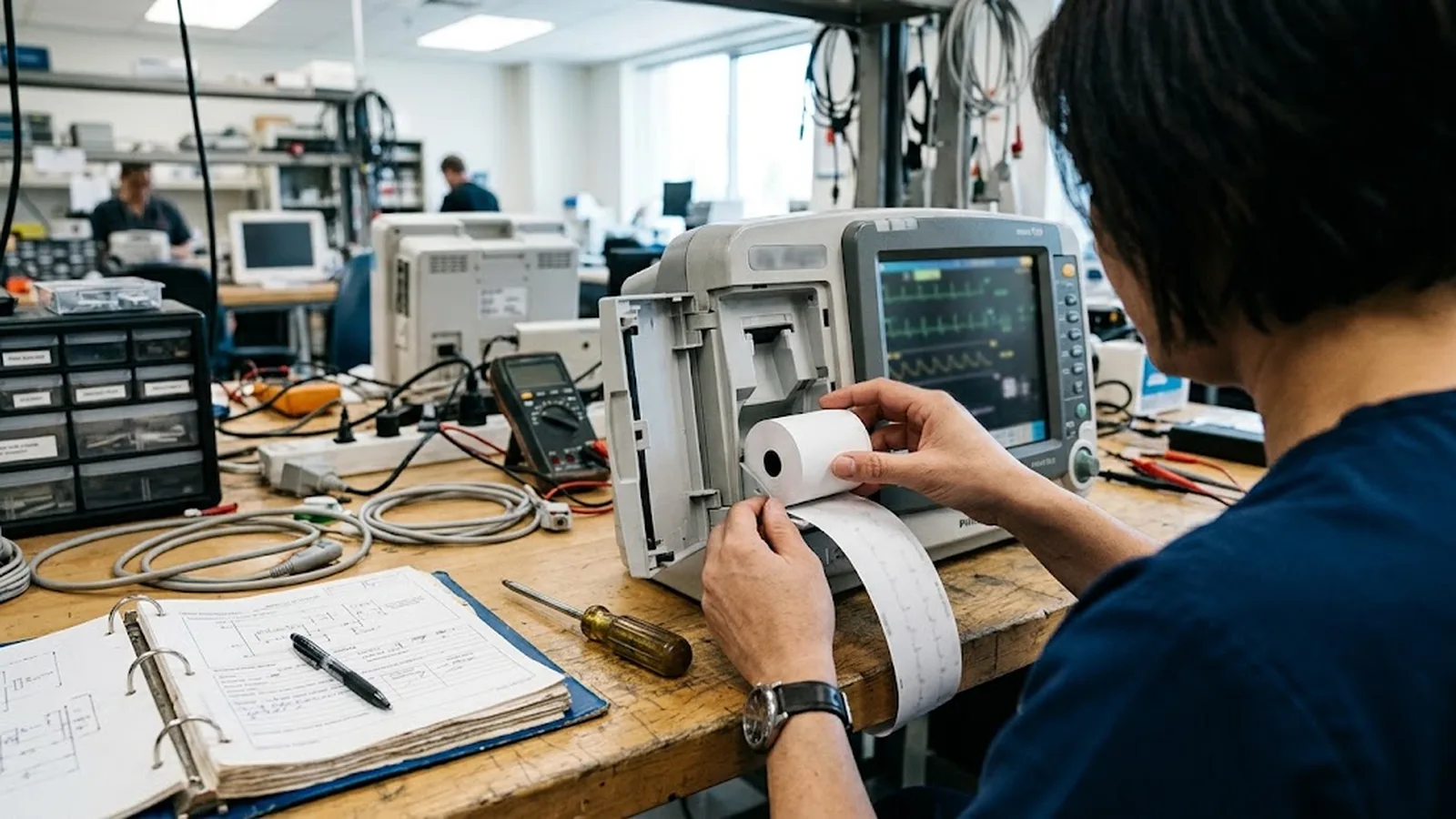
A medical paper qualification should end with the roll running in the device. The desk test — print a sample, look at the density — misses the failure modes that matter: feed friction in the roll channel, curl behaviour as the roll empties, dust accumulation over a shift of continuous tracing, and whether the trace calibration matches the device's expectation at its actual printhead energy. A practical routine runs a full roll through the highest-duty device in the department, checks first-print and last-print density against each other, and inspects the paper path for debris.
The batch protocol closes the loop: retained samples per production batch, a goods-in check of width, core and outer diameter against the sheet, and an agreed remedy if a batch fails — replacement or credit, stated in advance. Devices in clinical service are unforgiving of variation between batches; the protocol is what keeps a multi-year supply programme from drifting.
Where image life is the deciding factor, our top-coated vs non top-coated guide compares the two constructions on retention, cost and machine behaviour — the trade-off that decides which class a long-retention record format should specify.
Running the supply: consolidation and batch discipline
Hospital paper programmes consolidate well because most formats share one supplier conversation: trace formats, transaction rolls and labels can move under a single specification framework with per-format sheets, one chemistry standard and one batch protocol. Fragmented buying — a different source per department — is how chemistry documentation and retention data end up missing exactly when a tender or an audit needs them.
The maintenance routine is light but regular: requalify after any device fleet change (new monitors may want a different sensitivity class), review image-life data against the record retention policy annually, and keep the retained-sample archive keyed to batch numbers. Mills keep the discipline that buyers measure; a healthcare buyer with batch-level records is the customer a mill keeps stable through tight capacity.
Frequently asked questions
What paper is used for ECG and CTG printouts?
High-sensitivity direct thermal classes specified for the device's printhead energy, supplied in the exact width, core and format (roll or folded) the device defines, with grid and timing marks imaging sharply and retention data to support the record period. The dimensional specification is device-defined and must be matched exactly.
Is BPA-free thermal paper required for medical applications?
Most hospital tenders now specify BPA-free or phenol-free classes outright, and the practical requirement is documentation: a declared developer system per grade, an SDS that names it, and test reports where the tender asks. Standardising on phenol-free classes with full paperwork answers environment and audit questions consistently.
How long does thermal imaging last on medical printouts?
It depends on the grade and storage: density decays with heat, humidity and light exposure, which is why image life should be quoted as retention data at defined conditions rather than a single year figure. Long-retained record formats should demand the mill's accelerated-aging data and keep retained samples per batch for audit.
Can pharmacy and front-desk rolls be bought as standard POS stock?
Yes — the transaction formats use standard POS roll classes, sized to the device. The healthcare difference is the paperwork: chemistry declaration with SDS, and image life sufficient for the retention period the pharmacy's records policy requires. Consolidating these rolls under the hospital programme keeps documentation uniform.