
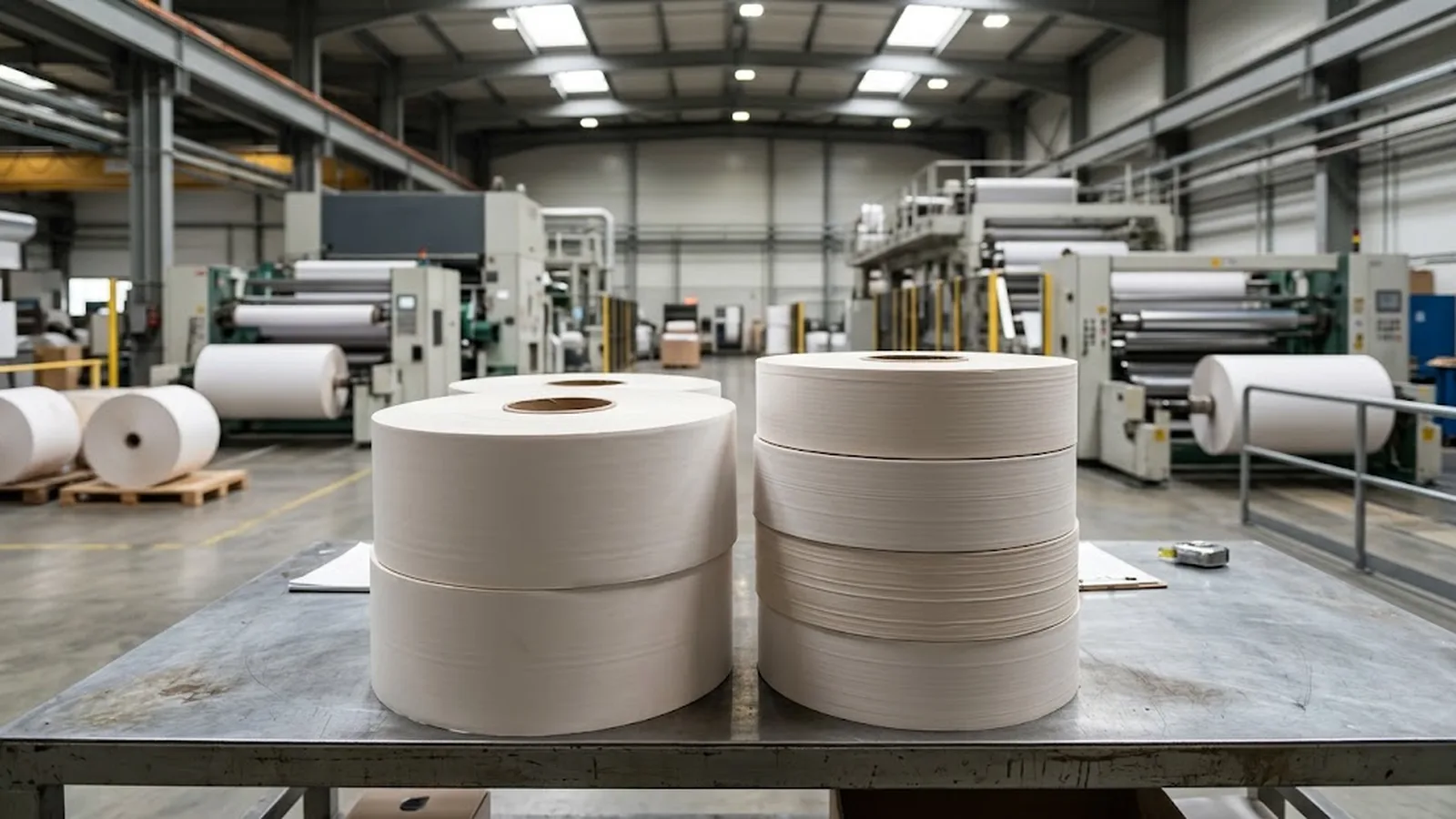
48 gsm and 55 gsm thermal paper differ mainly in thickness, stiffness and cost per usable metre — not in print chemistry. A 48 gsm sheet is roughly 13% lighter and thinner, so the same roll diameter yields more metres of printing and a lower price per metre, but the paper feels flimsier, jams more easily in marginal transports and suits short-life receipts. A 55 gsm sheet is stiffer, feeds more reliably across a wider range of printers, feels more substantial in the customer's hand and handles two-sided handling better, at a proportionally higher cost. Choose 48 gsm for high-volume, cost-driven receipt printing on well-maintained machines; choose 55 gsm when print reliability, brand feel or mixed-machine fleets matter more than the last few percent of consumable cost.
Among all the specification conversations we have with receipt-paper buyers, the most frequent single question is deceptively simple: should we run 48 gsm or 55 gsm? Both grades print with the same thermal chemistry, both come off the same jumbo rolls, and both are stocked by every serious manufacturer. The seven-gram difference sounds trivial — yet it moves roll length, cost per metre, machine behaviour and how the receipt feels in a customer's hand.
The confusion is understandable because suppliers describe the two grades in the vocabulary they prefer. One quotes metres per roll, another quotes price per roll, a third quotes stiffness values nobody asked for. What a buyer actually needs is the trade-off laid out dimension by dimension, with the application consequences made explicit.
This guide compares 48 gsm and 55 gsm thermal paper across the criteria that matter in real operations: caliper and feel, roll yield and cost, feeding and print reliability, and the application profiles where each grade is genuinely the better call. The aim is that after reading it, the choice can be written into a specification in one line — and defended internally.
- 48 gsm and 55 gsm share the same thermal coating chemistry; the difference is base-paper weight, which drives thickness, stiffness, roll length and price.
- A 48 gsm roll delivers roughly 13% more metres at the same diameter than a 55 gsm roll of equivalent width and core — the core economics of the comparison.
- 55 gsm feeds and prints more predictably across mixed or older printer fleets; 48 gsm assumes well-maintained transports and correct loading.
- Receipt feel is a brand signal: 55 gsm reads as 'substantial', 48 gsm reads as 'disposable' — choose deliberately, not by accident.
- The wrong way to decide is price per roll; the right way is cost per printed metre at equal quality and zero added jam rate.
What the gram weights actually describe
Gsm — grams per square metre — is the base paper's areal weight before and after coating. A 48 gsm thermal sheet and a 55 gsm thermal sheet carry chemically similar thermal layers; what changes is the base paper underneath, and with it the caliper (thickness), the stiffness, and the opacity of the finished sheet. In practice a 48 gsm grade measures roughly 55–60 microns thick and a 55 gsm grade roughly 62–68 microns, though exact figures vary by maker and coating structure.
That physical difference cascades into everything else. Thinner paper means more windings on the same roll core, so more metres per roll of a given diameter. Lighter base paper also means less fibre cost per square metre, which is why 48 gsm exists as a category at all: it is the value engineering of the receipt world. The trade-off is mechanical — a thinner sheet is less stiff, less tolerant of sloppy transport rollers, and more prone to curl through the print path in dry or humid extremes.
Neither grade is 'better'. They are two points on the same cost-versus-robustness curve, and the correct pick depends on which side of that curve your operation actually lives on.
| Property | 48 gsm | 55 gsm |
|---|---|---|
| Typical caliper | ≈55–60 µm | ≈62–68 µm |
| Stiffness / feel | Light, flexible, disposable feel | Noticeably stiffer, substantial feel |
| Metres per roll (same diameter) | Baseline + ~13% | Baseline |
| Cost per metre | Lower | Higher by roughly the weight delta |
| Feeding tolerance | Good on well-maintained machines | Wide tolerance across machine ages |
| Typical service life of print | Short-life receipts | Receipts and longer-life documents |
Roll length and cost per metre: where 48 gsm wins
The economics of the comparison live in roll yield. Because 48 gsm paper is thinner, more of it fits in the same roll diameter. As a working example, an 80 mm x 80 mm receipt roll on a 12.7 mm core holds around 80–85 metres of 55 gsm paper but roughly 95–100 metres of 48 gsm paper — about 13–15% more printing from the same physical roll that occupies the same shelf space and the same machine bay.
Multiply that across a high-volume operation — a supermarket chain printing hundreds of thousands of receipts a month — and the consumable saving of running 48 gsm becomes material. Buyers who negotiate strictly on price per roll often miss this, because a 48 gsm roll at the same quoted price is simply a bigger roll. The correct comparison metric is always cost per printed metre, or better, cost per thousand receipts at your actual print density.
There is a logistics dividend as well: more metres per roll means fewer roll changes per shift, less empty-core waste, and fewer cartons consumed per million receipts. For operations where till downtime is the real cost, fewer changes can be worth more than the paper saving itself.
- Compare quotes per metre, never per roll — roll lengths differ with grade and diameter.
- At equal roll diameter, expect roughly 13–15% more metres from 48 gsm than 55 gsm.
- Fewer roll changes per shift is a hidden operational saving of lighter grades.
- Confirm the actual metres-per-roll figure in writing — it varies with core size and wind tension.
Feeding, print reliability and the case for 55 gsm
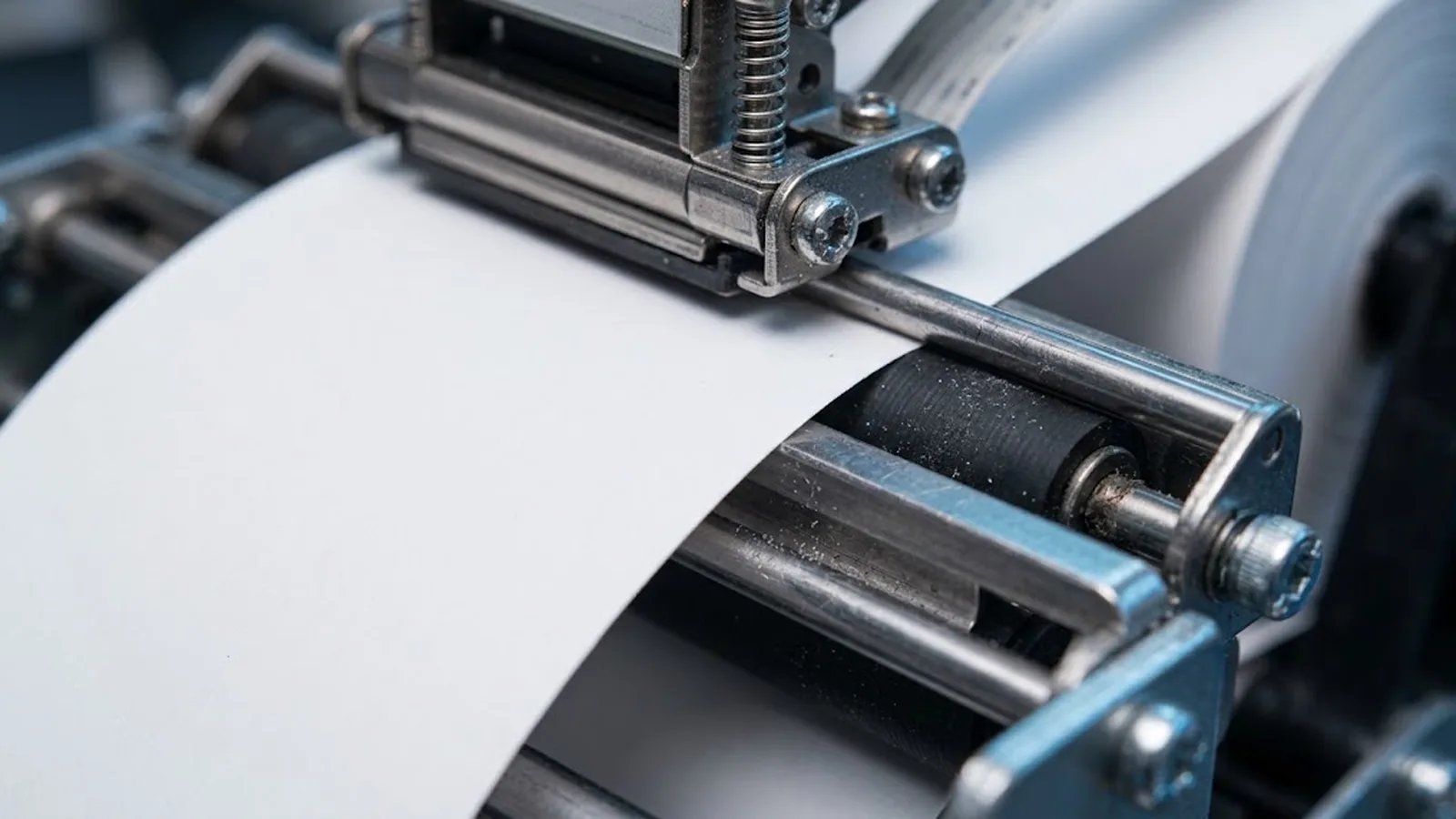
The counterweight to the yield advantage is mechanical robustness. A 55 gsm sheet is stiffer, which does three useful things in a printer: it resists buckling in the transport path, it presents a flatter surface to the print head for more uniform contact, and it tolerates the slightly worn rollers and marginal spring pressures found in older or heavily used machines. In a fleet of mixed hardware — some new, some five years into a depreciation schedule — 55 gsm simply misbehaves less.
Feel is the other half of the case. A receipt is the one physical artefact almost every customer takes home, and paper weight is read subconsciously as quality. Retailers with a premium positioning, pharmacies and clinics handing out records that must survive a handbag, and restaurants where receipts get stuffed into pockets all tend to specify 55 gsm precisely because the sheet survives handling and feels appropriate to the brand.
Print performance itself — image density, sensitivity, scan contrast — is not meaningfully different between the grades when both are made to spec. The coating chemistry is the same family. What differs is whether the sheet reaches the print head flat, centered and under correct pressure, which is a stiffness question. On a good machine both grades print identically; on a tired machine, only one of them reliably does.
Choosing by application: the practical decision
The decision compresses neatly into an application rule. Choose 48 gsm when volume is high, margins are thin, machines are modern and well-maintained, and the receipt is genuinely transient — queue tickets, parking stubs, high-turnover grocery and convenience receipts. Choose 55 gsm when receipts double as records, when the printer fleet is heterogeneous or ageing, when brand feel matters, or when the documents face handling, moisture or weeks of wallet life.
Many operations land on a split specification: 48 gsm in the high-volume back-of-house and till fleet, 55 gsm at service desks, pharmacies and anywhere the paper must survive longer than the shopping trip. This is a sensible outcome, not an indecisive one — the grades are tools, and matching the tool to the station is what specification is for.
One caution for buyers sourcing offshore: verify the gsm on receipt. Weight is the cheapest specification to quietly shave. A certificate of analysis or a simple cut-and-weigh check (a 100 x 100 mm sample on a 0.001 g balance) settles any doubt in a minute, and a supplier who resists that check has answered a different question about themselves.
One-line rule for your specification: high-volume transient receipts and modern machines → 48 gsm; records, mixed fleets and brand-facing prints → 55 gsm. Verify delivered gsm with a cut-and-weigh test.
Frequently asked questions
Is 48 gsm thermal paper thinner than 55 gsm?
Yes. The roughly 13% lower areal weight translates to a proportionally thinner sheet — typically about 55–60 microns versus 62–68 microns for 55 gsm, depending on the manufacturer's coating structure. The thinner sheet is also less stiff.
Does 48 gsm thermal paper print as clearly as 55 gsm?
On a well-maintained printer, yes — both grades use the same thermal chemistry and reach comparable image density. Differences appear on marginal machines, where the stiffer 55 gsm sheet maintains more uniform contact with the print head and feeds more reliably.
How many more metres does a 48 gsm roll give me?
At the same roll diameter, width and core, roughly 13–15% more metres than 55 gsm. For a standard 80 x 80 mm roll on a 12.7 mm core, that is about 95–100 metres versus 80–85 metres. Always confirm the exact figure with your supplier, since wind tension and core size shift it.
Which grade is better for a supermarket versus a pharmacy?
High-volume, transient receipt environments like supermarkets and convenience stores usually benefit from 48 gsm's lower cost per metre and fewer roll changes. Pharmacies, clinics and service desks handing out records that must survive handling are better served by 55 gsm's stiffness and durability.
Can I mix 48 gsm and 55 gsm in the same machines?
Yes — thermal printers handle both grades; only the media sensor and transport settings may need minor adjustment when switching. Many retailers run 48 gsm in high-volume tills and 55 gsm at desks where document life matters. Check your printer's media specification for minimum supported paper weight.