
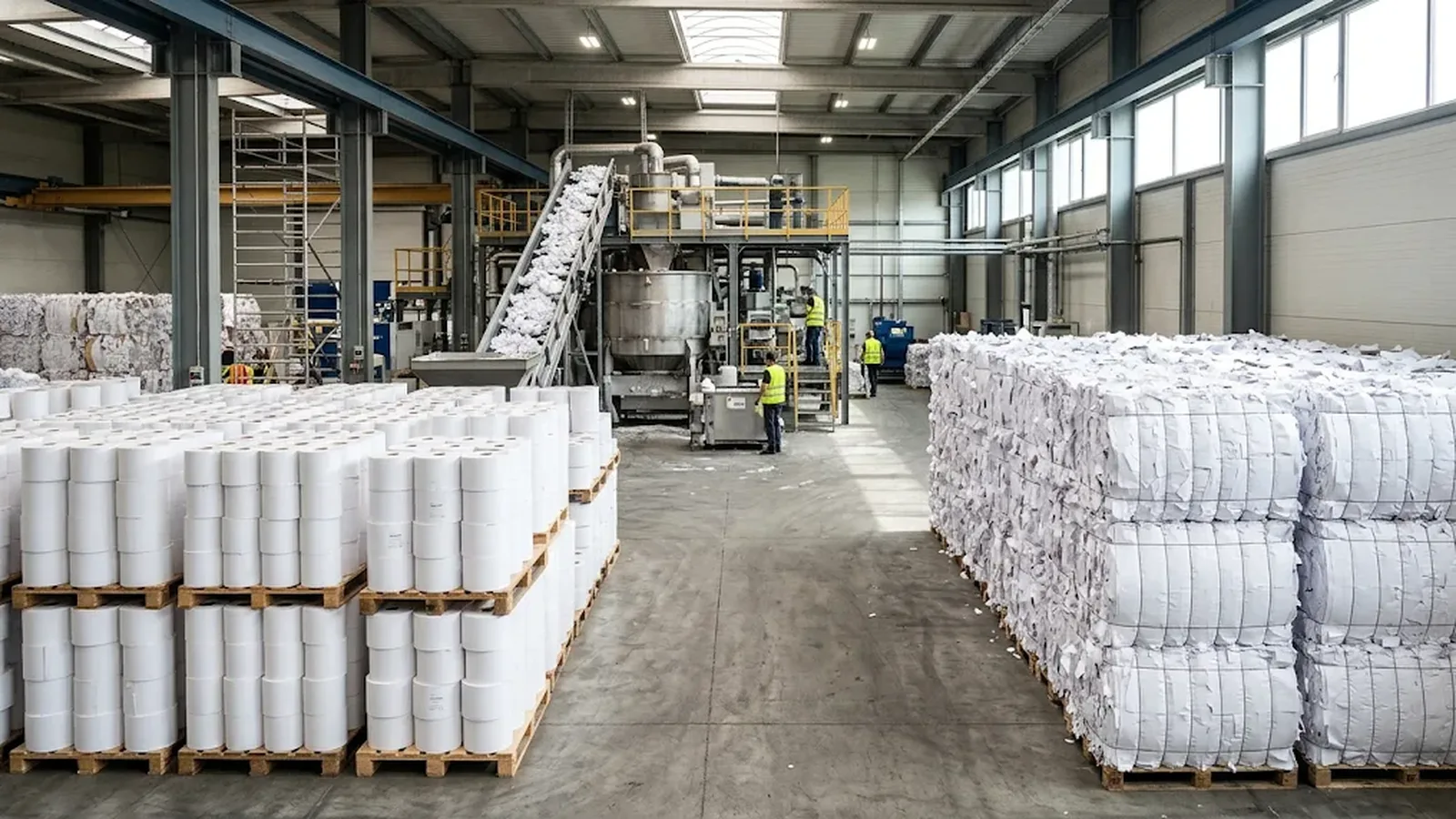
Recyclable thermal paper is defined by its developer chemistry, not by marketing labels. Grades using bisphenol A are effectively excluded from recycling streams — banned in the EU since 2020 and increasingly rejected elsewhere — while grades built on modern bisphenol-free, phenol-free developer systems are accepted by paper recyclers because they do not contaminate the recovered fibre. 'Recyclable' therefore has to be bought as a documented specification: the supplier declares the developer system in writing, supports it with mill statements or third-party test reports, and matches the grade to the waste-management requirements of the destination market. This guide walks buyers through the chemistry, the rules, the verification documents and the RFQ checklist that separates genuinely recyclable supply from a checkbox on a quotation.
Sustainability has arrived in the receipt roll and label aisle, but it arrived as adjectives: 'eco', 'green', 'environmentally friendly'. For a B2B buyer those words are unspecifiable — and unspecifiable claims cannot survive an audit, a retail-chain questionnaire or a waste-management contract. Recyclability is one property that actually can be specified, tested and documented.
This guide is the procurement-side companion to our explainer on whether thermal paper can be recycled. That article answers the question for a curious reader; this one shows a purchasing team how to buy the property: what the chemistry behind recyclability is, what regulators and retail chains now require, which documents to demand from a supplier, and how to write the requirement into an RFQ.
The commercial logic is straightforward. Where developer compliance is part of the deal — EU supply, grocery and pharmacy chains with sustainability questionnaires, municipalities with green procurement rules — the paper's chemistry is a gate, not a preference. Buying it properly costs nothing extra; buying it carelessly costs a rejected shipment or a failed supplier audit.
Procurement teams standardising on one supplier can review our POS and receipt paper rolls alongside the comparisons in this guide.
- Recyclability is decided by the developer chemistry: bisphenol-free, phenol-free systems are the grades paper recyclers accept.
- EU rules restricting bisphenol A in thermal paper and retail-chain policies have made the developer system a compliance gate, not a preference.
- 'Recyclable' must be documented: written developer declaration, mill statement or third-party test report, per shipment or per programme.
- Verify claims against named methods and certificates, and match the grade to the destination market's waste-management requirements.
- Write recyclability into the RFQ as a specification item with documents attached — the same way you specify GSM and width.
What actually makes thermal paper recyclable
Thermal paper is high-quality woodfree fibre — exactly the kind paper recyclers want — with one complication: the sensitive coating. In a recycling plant, thermal paper is repulped with other paper grades, and whatever chemistry sits in the coating enters the recovered fibre stream. If that chemistry contains bisphenols, it contaminates the fibre and the products made from it, which is why recyclers and paper mills increasingly reject thermal grades unless the developer system is known and clean.
That is the whole specification in one sentence: a recyclable thermal grade is one whose developer chemistry does not disqualify it from the recovered-fibre stream. Modern bisphenol-free, phenol-free developer systems were engineered precisely for this — they deliver the same colour-forming reaction without the bisphenol burden, and grades built on them are the ones waste-management operators and retail sustainability programmes accept.
The buyer takeaway: you are not really buying 'recyclable paper', you are buying a declared developer chemistry. Everything else in this guide — rules, documents, verification — exists to make that declaration trustworthy.
The regulatory and retail-chain backdrop
The regulatory anchor is the EU restriction on bisphenol A in thermal paper, in force since January 2020 under the REACH framework: thermal paper placed on the EU market may not contain BPA at or above defined limits. Enforcement is document-driven — importers and brands are expected to hold declarations and test evidence — and the effect has been to make BPA-based thermal grades unsellable in Europe rather than merely unfashionable.
Retail and food-service chains have pushed further than the law. Supplier sustainability questionnaires across European grocery, pharmacy and QSR chains now ask for the developer system by name, and several large programmes specify bisphenol-free or phenol-free grades outright, with documentation required at onboarding. Municipal and institutional green-procurement rules move the same direction.
Other markets are patchier, which is exactly why the specification matters: a grade acceptable for one destination may face questionnaire gates in another. Buyers serving multiple markets should qualify the chemistry once, at the strictest level required, rather than maintaining different compliance stories per customer.
Where developer compliance is part of the specification, our BPA-free vs phenol-free guide documents the chemistry, the regulations and the paperwork behind each class.
- EU: REACH-based restriction on BPA in thermal paper, in force since January 2020 — document-enforced.
- Retail chains: sustainability questionnaires increasingly demand named developer systems and evidence.
- Public procurement: municipal and institutional green rules favour phenol-free grades.
- Practical rule: qualify to the strictest market you serve, then reuse the documentation everywhere.
How recyclability claims are verified
A claim of recyclability is only as good as its paper trail, and the paper trail has a standard hierarchy. At the top sit test reports from recognised laboratories, stating the developer system and confirming the absence of restricted bisphenols against a named method and detection limit. In the middle sit mill statements — the manufacturer's formal declaration, on letterhead, tied to production lots. At the bottom sit catalogue claims and sales-deck badges, which are not evidence of anything.
Per-lot documentation is the professional standard for export supply: a certificate of analysis covering the specified properties, the developer declaration, and — where the programme requires it — a safety data sheet that names the chemistry. Sustainable forestry certification can sit alongside this where the fibre sourcing matters to the customer, but note that it certifies the fibre, not the coating chemistry; the two documents answer different questions and should not be confused.
Buyers should also verify rather than merely collect: check that the test report names a method and a limit of detection, that lot numbers on certificates match shipment documents, and that the declared chemistry is consistent across the datasheet, the SDS and the COA. Inconsistencies between those three documents are the classic red flag in this trade.
| Document | What it proves | Issued by | Ask for it |
|---|---|---|---|
| Laboratory test report | Absence of restricted bisphenols, named method and detection limit | Recognised third-party lab | Per programme or per lot |
| Mill developer declaration | The developer system used in production, on record | The manufacturer | Per programme |
| Certificate of analysis | Lot-level conformity of specified properties | Manufacturer QC | Every shipment |
| Safety data sheet | Chemistry named for handling and compliance | Manufacturer | Every shipment or revision |
Writing recyclability into the RFQ
The final step is contractual. Recyclability belongs in the RFQ as a specification line, not in the email thread: 'developer system: bisphenol-free, phenol-free chemistry; evidence: mill declaration plus third-party test report; documentation: COA and SDS per shipment declaring the developer class.' A requirement written this way is quotable, auditable and enforceable — a requirement written as 'eco-friendly please' is none of those things.
Two adjacent specification items belong in the same sentence. First, image-retention data, because some buyers worry that alternative developer systems trade life for compliance — well-formulated phenol-free grades do not, but the data should be requested rather than assumed. Second, packing and storage conditions, because sustainability of a paper product also means arriving usable: moisture-barrier packing and stated shelf life prevent the waste that no chemistry can offset.
Timing matters as much as wording. Compliance documentation should be requested at qualification, before the first purchase order, not after a chain questionnaire forces the issue — because changing developer chemistry mid-programme means re-approving print behaviour, updating artwork declarations and re-running customer onboarding. The cheapest moment to buy a compliant grade is the moment the programme is designed, and the second cheapest is today.
Requests that combine several formats can be quoted together; see 48 gsm lightweight thermal paper for the construction options behind each one.
Specification rule: name the chemistry, demand the documents, keep them per lot — anything less is a claim, not a spec.
Frequently asked questions
Is all thermal paper recyclable?
No. Grades using bisphenol A are effectively excluded — banned in the EU since 2020 and increasingly rejected by recyclers elsewhere — and some BPS-based grades face the same direction of travel. Grades on modern bisphenol-free, phenol-free developer systems are the ones accepted into recovered-fibre streams.
Does phenol-free paper cost more?
Alternative developer systems have historically carried a modest premium, but the gap has narrowed as volumes have grown, and for many programmes the compliance value — access to EU markets and to retail chains with chemistry gates — outweighs the difference. Price should be compared grade-for-grade with documentation included on both sides.
How do I verify a supplier's recyclability claim?
Demand a written developer declaration from the manufacturer, a third-party test report naming the method and detection limit for restricted bisphenols, and per-shipment COA and SDS documents that declare the same chemistry. Check that the datasheet, SDS and COA agree — inconsistencies are the classic red flag.
Is FSC certification the same as recyclability?
No — they answer different questions. Forestry certification covers where the fibre came from; recyclability depends on the coating chemistry. A programme that needs both should ask for both documents rather than assuming one implies the other.
Can printed thermal receipts be collected for recycling?
Commercial volumes can: businesses that collect clean, known-chemistry thermal waste can channel it to recyclers who accept it, which is exactly why the developer declaration matters. Mixed consumer streams are different — many municipal programmes still exclude receipts because the arriving chemistry is unknown.